

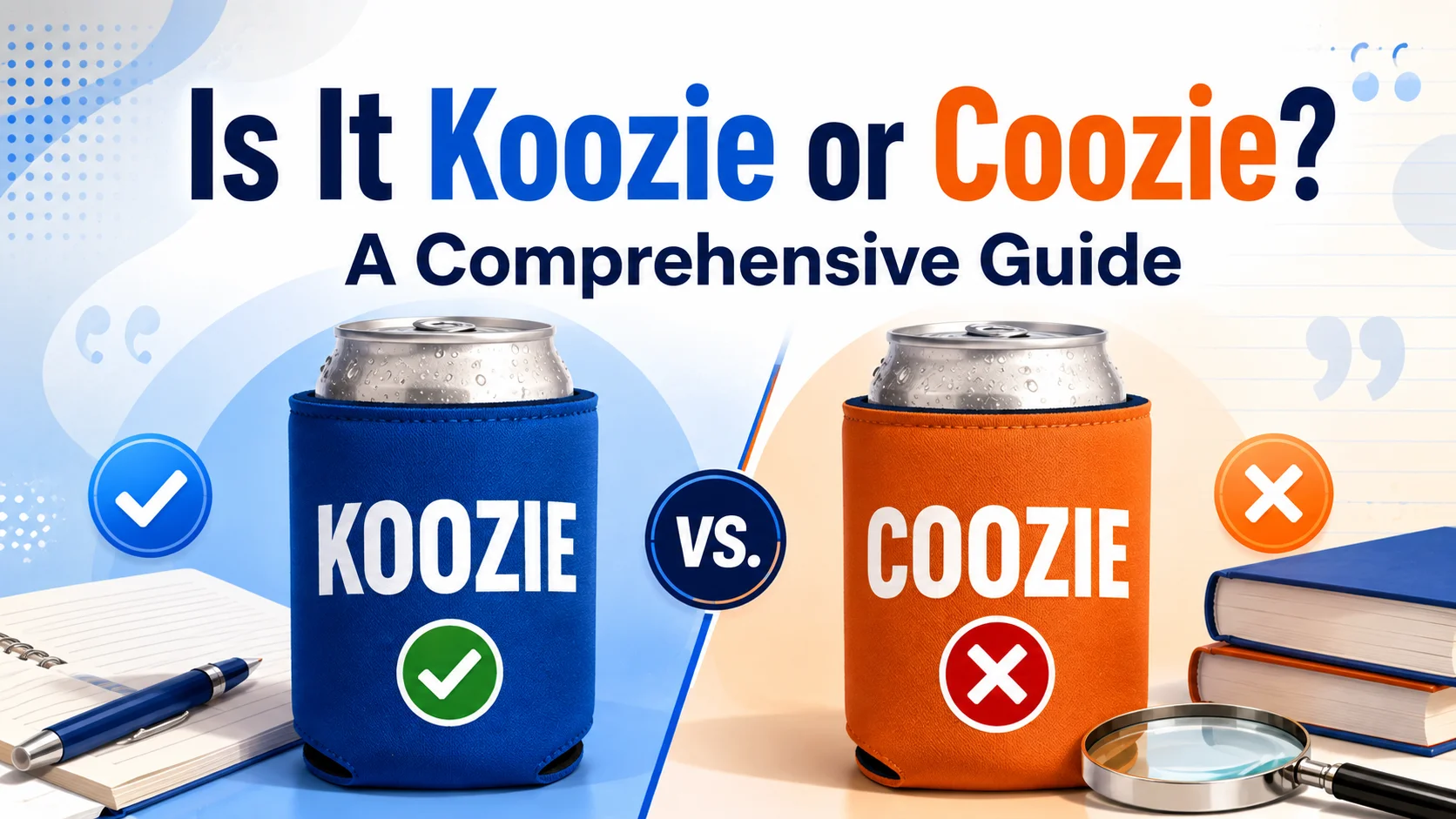
If you’ve ever searched for “koozie or coozie,” you’re probably wondering whether one spelling is correct and the other is a mistake. The short answer is that koozie is the most widely recognized spelling in American English, while coozie is a common variant used for the same general type of insulated drink holder. The confusion is understandable because the word is pronounced much like cozy, and people often spell unfamiliar words according to how they sound.
A koozie is typically a sleeve or holder designed to insulate a beverage container such as a can or bottle. It helps slow the warming of a cold drink and can also reduce condensation on the outside of the container. You’ll see them at barbecues, sporting events, parties, beaches, weddings, and promotional events. Depending on where you live, you may also hear terms such as can cooler, beer cozy, drink sleeve, beverage holder, or stubby holder.
There’s also an interesting reason the spelling deserves a closer look. KOOZIE began as a brand name, rather than simply being an ordinary English word invented to describe every insulated drink sleeve. The name became associated with insulated beverage holders and eventually entered everyday American vocabulary. Today, however, people commonly use koozie in casual speech to mean the product generally. So, if you’re choosing a spelling for ordinary American writing, koozie is the safest and most recognizable choice.
Koozie or Coozie? The Quick Answer
Koozie is the standard and most recognizable spelling when referring to the familiar insulated holder for a beverage can or bottle.
Coozie is a commonly encountered alternative spelling. In ordinary conversation, someone who writes coozie will generally be understood to mean the same kind of product.
The important distinction is this:
- Koozie — the established brand-derived spelling and the most familiar American form.
- Coozie — a variant spelling used informally for the same type of item.
- Cozy — a completely different standard English word meaning comfortable, warm, or snug.
- Can cooler — a clear generic description of an insulated holder for a can.
- Drink sleeve — a broader term that can refer to an insulating sleeve for various beverages.
- Stubby holder — a regional term, particularly associated with Australian English.
So if you’re writing a sentence such as “Put your soda in the ___,” koozie is the clearest choice for a typical U.S. audience.
Quick rule: If you mean the insulated holder for a cold drink, use koozie in ordinary American writing. If you want a neutral generic term, can cooler is even clearer.
Koozie vs. Coozie at a Glance
| Term | Meaning | Typical use | Important note |
| Koozie | Insulated beverage holder | Everyday American English | Brand-derived term |
| Coozie | Variant spelling for an insulated drink holder | Informal usage | Usually understood as the same product |
| Cozy | Comfortable, warm, or snug | General English | Not normally a drink holder |
| Beer cozy | Insulating holder for a beer container | Descriptive usage | Similar product category |
| Can cooler | Holder designed to insulate a beverage can | Retail/general writing | Clear generic description |
| Drink sleeve | Sleeve surrounding a beverage container | General/product usage | Broader than a traditional can koozie |
| Stubby holder | Insulated beverage holder | Australian English | Regional terminology |
The key point is that the first two terms generally refer to the same object. The difference is primarily one of spelling, naming history, and context rather than function.
What Is a Koozie?
A koozie is an insulated sleeve or holder that fits around a beverage container. Its purpose is to reduce heat transfer between the cold drink and the warmer environment around it.
A typical koozie might hold a:
- soda can
- beer can
- sparkling-water can
- energy-drink can
- bottle
- compatible cup or tumbler
Traditional designs are often cylindrical and flexible. Some are made specifically for standard cans, while others accommodate larger containers.
The word is particularly common in the United States, where koozie has become a familiar part of everyday vocabulary.
The Basic Purpose of a Koozie
A koozie doesn’t make a warm drink cold. Instead, it helps a cold drink remain cold for longer by providing insulation.
That distinction matters.
Imagine taking a cold can from the refrigerator and leaving it on a sunny patio. The surrounding air and sunlight gradually warm the can. A koozie places an insulating layer around it, reducing the rate at which heat reaches the container.
It also provides practical benefits beyond temperature control:
- It makes a cold can easier to grip.
- It reduces the amount of condensation reaching your hand.
- It can help protect surfaces from moisture.
- It provides a convenient surface for logos, names, artwork, and slogans.
What Is a Koozie Made From?
Modern drink holders come in several materials.
Foam is inexpensive, lightweight, and common in promotional products. It can be printed with logos and is easy to manufacture.
Neoprene is flexible and durable. It can conform more closely to different containers and is popular for reusable designs.
Other products use combinations of fabric, foam, synthetic insulation, rubber-like materials, or multilayer construction.
Material isn’t the only factor that determines performance. The fit, thickness, construction, container size, and surrounding temperature also matter.
What Is a Coozie?
Coozie is a common alternative spelling for the same general type of insulated beverage holder.
If someone says, “Grab me a coozie for this can,” they aren’t normally referring to a different invention or a special kind of drink sleeve. They’re using a spelling that represents the way the word sounds to them.
Is Coozie a Different Product?
Generally, no.
A koozie and a coozie can describe essentially the same product: an insulating sleeve or holder used around a beverage container.
The difference becomes more noticeable when you’re discussing the name itself, especially in commercial or formal contexts. KOOZIE has a documented trademark history, whereas coozie is commonly used as a variant spelling.
Why Do People Spell It “Coozie”?
The pronunciation naturally encourages this spelling.
When people hear koozie, they may associate it with the familiar word cozy. Because the first sound can be represented by either k or c in different English words, coozie feels intuitive to many writers.
This is a classic example of how pronunciation can influence informal spelling.
English contains plenty of words whose spellings can’t be reliably predicted from sound alone. An unfamiliar word is especially likely to develop competing spellings when people encounter it primarily through conversation.
Is Coozie an Incorrect Spelling?
Calling coozie simply “wrong” misses an important distinction.
If you’re trying to reproduce the established brand name, KOOZIE is the relevant spelling. If you’re writing informal English and using coozie to describe the generic object, readers will generally understand what you mean.
For polished writing, however, koozie is the safer and more recognizable choice in the United States.
Koozie vs. Coozie: Are They Actually Different?
In everyday use, the answer is usually no.
The two spellings generally point to the same concept. Someone asking for a coozie at a barbecue is almost certainly asking for an insulated drink holder, not a different product.
Same Function, Different Spelling
Consider these two sentences:
“Can you pass me a koozie?”
“Can you pass me a coozie?”
The practical meaning is essentially identical.
The spelling changes, but the object being requested doesn’t.
Why the Two Spellings Cause Confusion
Three factors explain most of the confusion:
- The word isn’t spelled exactly as it sounds.
- KOOZIE originated as a brand name.
- Everyday speakers often use brand-derived words generically.
That combination makes it difficult for people to know whether they’re dealing with a formal spelling rule, a brand name, or an ordinary noun.
Which Spelling Is More Widely Recognized?
For American readers, koozie is the strongest default.
That doesn’t mean every appearance of coozie is a typographical error. It means that if you have to choose one spelling for a general-audience article, product description, or everyday sentence, koozie is the more recognizable option.
Why Is It Called a Koozie?
The history of the word is more complicated than its casual appearance suggests.
KOOZIE became established as a product name for insulated beverage containers. Over time, the term became closely associated with the broader category of drink holders.
The exact story behind the name has been reported in several ways, and not every popular explanation is equally well documented. For that reason, it’s better to separate the established history of the product and trademark from colorful origin stories that may have been repeated over time.
The Story Behind the Name
The important point is that KOOZIE was not originally just a normal dictionary word.
It functioned as a commercial name associated with an insulated beverage product. As the product became more familiar, people began using the word conversationally for similar products made by other companies.
That transition isn’t unusual in English. Brand names can sometimes become widely used as informal terms for an entire category.
Koozie as a Brand Name vs. Generic Product Term
This distinction is useful when you’re writing professionally.
A brand name identifies a particular branded product or company offering. A generic term describes a type of object regardless of manufacturer.
In casual conversation, people often don’t make that distinction:
“Do you have a koozie?”
They usually mean any suitable insulated drink holder.
In a formal product description, however, you might choose:
“12-ounce insulated can cooler”
That wording describes the object without relying on a brand-associated term.
Is “Koozie” a Trademark?
KOOZIE has a documented trademark history, so writers and businesses should distinguish between the specific brand and the broader category of insulated drink holders.
This doesn’t mean ordinary speakers can’t use koozie casually. It simply explains why the word’s history is different from that of a normal English noun such as sleeve or holder.
If you’re writing commercial copy, product listings, or packaging, a generic phrase such as can cooler or insulated beverage holder may be preferable when you aren’t specifically referring to the brand.
Koozie, Coozie, Cozy, and Can Cooler: What’s the Difference?
These terms overlap in everyday conversation, but they aren’t interchangeable in every situation.
| Term | What it refers to | Example |
| Koozie | Insulated beverage holder | “Put the can in the koozie.” |
| Coozie | Variant spelling of the same concept | “I brought an extra coozie.” |
| Cozy | Comfortable, warm, or snug | “This blanket is cozy.” |
| Beer cozy | Insulating holder for a beer container | “He bought a beer cozy.” |
| Can cooler | Generic insulated can holder | “This can cooler fits 12-ounce cans.” |
| Drink sleeve | Sleeve around a beverage container | “The drink sleeve prevents condensation.” |
Koozie vs. Cozy
This is probably the most important distinction to remember.
Koozie is associated with an insulated beverage holder.
Cozy is an ordinary English word.
You can say:
- “The cabin feels cozy.”
- “She wore a cozy sweater.”
- “Put the soda in the koozie.”
You wouldn’t normally replace koozie with cozy in the third sentence.
The words may sound related, but their meanings are different.
Koozie vs. Can Cooler
These terms are much closer.
A can cooler is a generic descriptive phrase. It tells the reader exactly what the product does and what kind of container it is designed to hold.
Koozie is more conversational and familiar in the United States.
For a product catalog, can cooler can therefore be useful when you want to describe a category without relying on a brand-derived term.
How Is “Koozie” Pronounced?
The common pronunciation is approximately:
KOO-zee
Coozie is normally pronounced the same way.
That creates a classic spelling problem: different written forms can represent essentially the same pronunciation.
Does the Spelling Change the Pronunciation?
Usually, no.
In ordinary American English, koozie and coozie are generally pronounced alike.
The important difference is therefore orthographic rather than phonetic—the words look different on the page even though speakers generally pronounce them the same way.
How Did Koozies Become Popular?
The product’s popularity wasn’t based on insulation alone. Its usefulness and its enormous potential for customization worked together.
Commercial drink holders became particularly attractive as promotional products because they’re inexpensive, portable, and useful. Instead of producing an item that sits in a drawer, a company could put its logo on something people carried around during social events.
From Practical Insulation to Everyday Accessory
The appeal is simple.
A drink holder is:
- inexpensive
- lightweight
- reusable
- easy to carry
- useful at outdoor events
- relatively easy to customize
That’s a strong combination for a promotional item.
The Role of Advertising and Promotional Products
Koozies became common at:
- sporting events
- company picnics
- festivals
- weddings
- fundraisers
- trade shows
- bars and restaurants
- family reunions
- tailgating events
A company can print a logo on a koozie, while a wedding couple might add their names and wedding date.
The item therefore serves two purposes: practical beverage insulation and visual promotion.
Why Personalized Koozies Became So Common
Personalization is one of the reasons the product remains popular.
A personalized koozie can include:
- a person’s name
- a company logo
- an event date
- a sports team
- a slogan
- an illustration
- a wedding message
- a fundraiser’s branding
They’re especially useful as event favors because guests can use them immediately rather than simply taking home another decorative object.
What Types of Koozies Are Available?
Not every koozie has the same shape or construction.
Foam Koozies
Foam versions are among the simplest designs.
They are typically:
- lightweight
- inexpensive
- flexible
- easy to customize
- popular for large promotional orders
Their affordability makes them particularly common at parties and corporate events.
Neoprene Koozies
Neoprene versions tend to be more flexible and durable.
They often provide a snug fit around the container and can be folded or compressed for transportation.
They’re a popular choice when the holder is expected to be reused regularly.
Collapsible Koozies
Collapsible designs can fold flat when they’re not holding a drink.
This makes them convenient for:
- travel
- camping
- sporting events
- storage
- promotional giveaways
Bottle Koozies
Bottle koozies are designed around the shape and dimensions of bottles.
A can holder and a bottle holder aren’t always interchangeable because containers vary considerably in diameter and shape.
Can Koozies
Traditional can koozies are designed specifically for cans.
However, “standard size” isn’t universal for every beverage container, so checking the intended capacity is important when purchasing one.
Tumbler and Cup Insulators
Larger insulated sleeves are designed for reusable cups, tumblers, and other beverage containers.
These products may look similar to traditional koozies but are often better described as drink sleeves or insulated cup holders.
How Does a Koozie Keep a Drink Cold?
The basic principle is thermal insulation.
A cold beverage naturally gains heat from its warmer surroundings. A koozie creates an additional layer between the beverage container and that environment.
The Basic Science of Insulation
Heat naturally moves from warmer areas toward cooler areas.
If a cold can sits directly in warm air, heat reaches the can relatively easily. Surrounding it with an insulating material slows that transfer.
The result isn’t magic refrigeration.
The drink still warms eventually. The koozie simply slows the process.
Think of a koozie as a speed bump for heat, not a refrigerator.
That distinction explains why a koozie works best when the drink is already cold.
Why Condensation Matters
When a cold beverage container sits in warm, humid air, moisture can collect on its exterior.
That condensation can:
- make your hand wet
- leave water rings on furniture
- make the container slippery
A koozie creates a barrier between your hand or table and the cold, wet surface of the container.
What Affects Cooling Performance?
Several factors influence how well an insulated holder performs:
- Material: Some materials insulate better than others.
- Thickness: More insulation can reduce heat transfer.
- Fit: A close fit can reduce exposed gaps.
- Ambient temperature: A drink warms faster in a very hot environment.
- Sunlight: Direct sunlight adds additional heat.
- Humidity: Higher humidity can increase condensation.
- Starting temperature: A colder drink has more thermal headroom before it reaches an uncomfortable temperature.
- Container size: Larger containers and unusual shapes may require specialized sleeves.
Why Do People Use Koozies?
The obvious benefit is temperature management, but that’s only part of the story.
Keeping Drinks Cooler
A koozie helps slow the warming of a cold beverage.
This is especially useful when you’re outside and don’t have immediate access to a refrigerator or cooler.
Reducing Condensation
The sleeve helps keep moisture away from your hands and surfaces.
That can be especially helpful when you’re sitting at a wooden table, carrying a drink around an event, or spending time outdoors.
Improving Grip
Cold cans can become slippery when condensation forms.
A textured or fabric-covered koozie can provide a more comfortable grip.
Protecting Hands and Surfaces
The insulating layer reduces direct contact between the cold container and your hand.
It can also reduce the amount of moisture that reaches furniture and other surfaces.
Personalization and Branding
This is one of the biggest advantages beyond basic insulation.
A koozie is essentially a small reusable advertising surface.
For businesses, that means logos and contact information can travel with customers. For individuals, it can become a keepsake from an event.
Where Are Koozies Commonly Used?
Koozies are particularly popular in casual and outdoor settings.
Common examples include:
- backyard barbecues
- beach trips
- camping
- tailgating
- sporting events
- pool parties
- weddings
- birthday parties
- festivals
- family reunions
- corporate events
- fundraisers
Why Koozies Work Well as Event Favors
Event organizers often want favors that are inexpensive but genuinely useful.
A koozie checks several boxes:
- It can be customized.
- It is easy to distribute.
- It is small and lightweight.
- Guests can use it during the event.
- It doesn’t require complicated instructions.
- It can continue to be used afterward.
That practical value is one reason personalized drink holders have remained popular.
Common Mistakes and Misconceptions About Koozie and Coozie
Mistake 1: Assuming Coozie Is a Completely Different Product
Usually, it isn’t.
Coozie generally refers to the same kind of insulated beverage holder as koozie.
The difference is mainly the spelling.
Mistake 2: Assuming Cozy and Koozie Mean the Same Thing
They don’t.
Cozy is a standard English word associated with comfort, warmth, and snugness.
Koozie refers to an insulated beverage holder.
Compare:
“The blanket is cozy.”
with:
“The can is inside the koozie.”
The first describes comfort. The second describes a drink accessory.
Mistake 3: Believing a Koozie Makes a Drink Colder
A koozie doesn’t actively cool a drink.
It slows warming.
If you put a warm soda into an ordinary koozie, don’t expect the sleeve to chill it. The best results come when the drink is already cold.
Mistake 4: Assuming Every Drink Holder Is Technically a Koozie
In casual speech, people often call different insulated holders koozies.
But products vary significantly.
A small can sleeve, an insulated tumbler sleeve, and a large bottle holder may serve similar purposes without being identical products.
For precise writing, use the most descriptive term available.
Mistake 5: Treating the Trademark Issue as a Simple Spelling Rule
The fact that KOOZIE has trademark history doesn’t automatically make every casual use of koozie a spelling error or a legal problem.
Trademark law and ordinary language use are different questions.
If you’re creating a commercial copy, however, it’s sensible to distinguish a specific brand from a generic product category.
Which Spelling Should You Use in Your Writing?
Use “Koozie” for Familiar American Usage
If you’re writing an ordinary sentence for a U.S. audience, koozie is the safest choice.
For example:
“I bought a new koozie for the beach.”
That spelling will be immediately recognizable to most American readers familiar with the product.
Use “Coozie” When Reflecting Informal or Variant Usage
If you’re quoting someone, reproducing user-generated language, or discussing spelling variations, coozie can be appropriate.
For example:
“Some people spell the word coozie instead.”
That’s different from using it as your primary spelling throughout formal content.
Use “Can Cooler” or “Insulated Beverage Holder” for Formal Product Language
If precision matters, generic terms can be useful.
For example:
“This insulated can cooler fits standard beverage cans.”
This wording describes the product directly without relying on a brand-associated term.
For technical, retail, or catalog writing, can cooler may therefore be the clearest option.
Koozie vs. Coozie in American English and Other English-Speaking Regions
Vocabulary isn’t identical across English-speaking countries.
United States
Koozie is widely recognizable in American English.
It’s commonly used in informal conversations, product searches, event planning, and promotional merchandise.
Australia and the “Stubby Holder”
Australian English has its own familiar term: stubby holder.
A stubby traditionally refers to a small bottle of beer, and a stubby holder is an insulated holder designed for such a beverage.
The term can be used more broadly today for similar insulated drink holders.
Other Regional Terms
Depending on the country or audience, you may encounter:
- can cooler
- beer cozy
- drink sleeve
- beverage holder
- insulated sleeve
- stubby holder
- bottle cooler
This is a useful reminder that there isn’t one universal English name for the product.
Koozie vs. Coozie: A Practical Usage Guide
| If you mean… | Best term |
| Common U.S. insulated can holder | Koozie |
| Alternative informal spelling | Coozie |
| Generic product description | Can cooler |
| Insulated covering for a beverage | Drink sleeve |
| Something comfortable or warm | Cozy |
| Australian regional term | Stubby holder |
| Specific brand | KOOZIE |
A Simple Decision Rule
When you’re unsure, ask what you’re actually trying to communicate.
Writing casually for an American audience?
Use koozie.
Talking about the spelling variation itself?
Use coozie when discussing the alternative form.
Writing a generic product description?
Use can cooler or insulated beverage holder.
Talking about comfort or warmth?
Use cozy.
Writing for an international audience?
Consider using a descriptive term such as insulated drink holder so readers from different regions understand immediately.
Koozie or Coozie in Everyday Sentences
Examples With “Koozie”
- “Put your soda in a koozie before you head outside.”
- “We ordered personalized koozies for the wedding.”
- “The company handed out logo koozies at the event.”
- “I always keep a spare koozie in the cooler.”
- “This koozie fits a standard can.”
Examples With “Coozie”
- “I forgot my coozie at home.”
- “Everyone brought a different coozie to the barbecue.”
- “She bought a new coozie for her camping trip.”
These examples demonstrate that coozie is understandable in informal writing even though koozie is the stronger default spelling.
Examples With “Cozy”
- “The living room feels cozy in winter.”
- “We stayed in a cozy cabin.”
- “She bought a cozy blanket for the sofa.”
Notice that none of these sentences refers to a drink holder.
Examples With “Can Cooler”
- “This can cooler fits standard soda cans.”
- “The store sells reusable can coolers.”
- “I need an insulated can cooler for the picnic.”
This terminology is especially useful when you want to avoid ambiguity.
Is a Koozie Only for Beer?
No.
Although beer has historically been strongly associated with the product, a koozie isn’t limited to beer.
It can be used for many compatible beverages, including:
- soda
- sparkling water
- energy drinks
- canned tea
- sports drinks
- bottled beverages
- other canned drinks
That’s one reason cooler can sometimes be more precise than beer cozy.
If you’re describing a product intended for many beverages, calling it a beer holder unnecessarily narrows its purpose.
Koozie vs. Coozie: What Should You Call It?
For most readers, the answer is straightforward.
Koozie is the best default spelling when you mean the familiar insulated beverage holder in American English.
Coozie is a recognizable alternative spelling and usually refers to the same type of product.
Cozy is different. It describes something comfortable, warm, or snug.
Can cooler is a useful generic alternative when you’re describing the product rather than relying on the familiar brand-derived term.
Stubby holder is a regional alternative, particularly associated with Australian English.
The most important thing is not to overcomplicate the spelling question. If you’re writing for a U.S. audience and want the form readers are most likely to recognize, choose “koozie.” If you’re writing product copy and want maximum clarity, “insulated can cooler” is even more descriptive.
Conclusion
If you’re deciding between koozie and coozie, go with koozie when you want the most recognizable spelling for American readers. Coozie is a familiar variant and generally communicates the same meaning, but it isn’t the form most writers should choose by default. It’s also important not to confuse koozie with cozy, which is a completely different English word describing comfort or warmth. Can cooler and insulated beverage holder are excellent generic alternatives when precision matters. One final actionable tip: choose your wording based on your audience and purpose rather than pronunciation alone. A common mistake to avoid is assuming a koozie actually chills a drink; it simply slows warming. When in doubt, remember: koozie holds the cold, cozy describes the comfort.
Frequently Asked Questions
Q1. Is it spelled “koozie” or “coozie”?
Koozie is the most recognizable spelling in American English for an insulated beverage holder. Coozie is a common variant spelling that generally refers to the same product. For polished general-audience writing, koozie is the safer choice.
Q2. Is “koozie” a real word?
Yes. Koozie is an established term associated with insulated beverage holders and has a documented history as a brand name. It is now widely used in everyday American speech to refer to this type of drink sleeve, although generic terms such as can cooler are also common.
Q3. Is “coozie” a misspelling of “koozie”?
Not necessarily. Coozie is a commonly used variant spelling, although koozie is the more recognizable form. If you’re writing formal content, using koozie avoids unnecessary uncertainty. If you’re specifically discussing spelling variations, coozie is perfectly relevant.
Q4. Is a koozie the same as a can cooler?
Generally, yes. Both can refer to an insulated holder designed to slow the warming of a beverage can. The main distinction is terminology: koozie is a familiar brand-derived everyday term, while can cooler is a more neutral and descriptive generic phrase.
Q5. Is a koozie the same thing as a beer cozy?
They can describe essentially the same type of product, but the terms have different levels of specificity. Beer cozy emphasizes the beverage, while koozie is commonly used for cans or bottles containing many different drinks, including soda, sparkling water, and beer.