

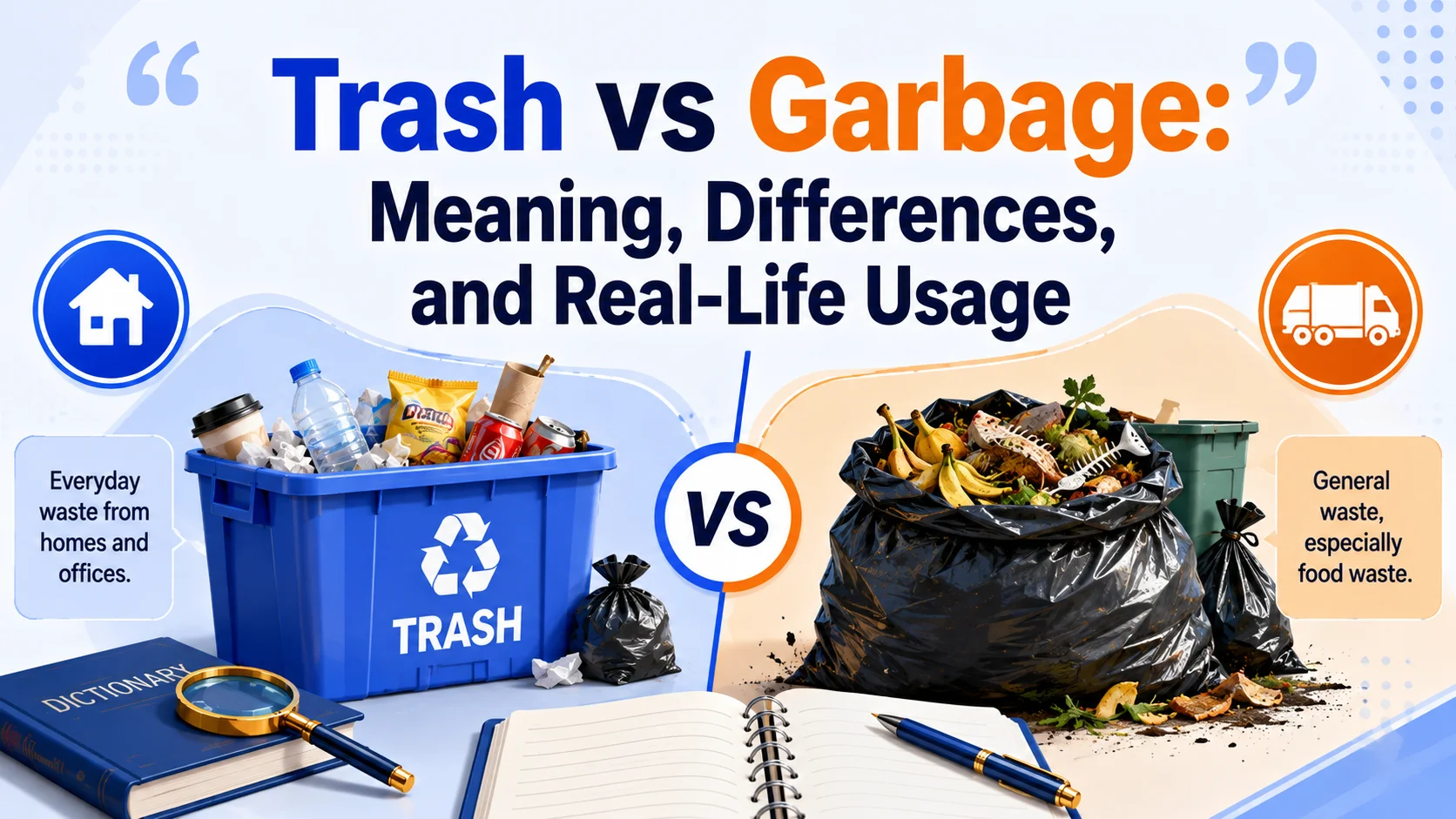
Trash vs garbage is one of those English word comparisons that looks simple until you notice how differently people use the terms. In everyday American English, trash and garbage often refer to the same basic thing: unwanted material that you throw away. Yet they aren’t always interchangeable in every context. Garbage disposal, trash talk, garbage truck, and trash can are familiar expressions, and replacing one word with the other can sometimes sound less natural.
The confusion becomes greater when you add related words such as waste, rubbish, litter, and junk. These words overlap, but each has its own typical uses and associations. A person learning English may reasonably wonder whether trash means dry waste while garbage means food waste, or whether one term is grammatically more correct. The answer is more flexible than either rule suggests.
This guide explains trash vs garbage from both everyday and formal perspectives. You’ll learn what each word means, where they overlap, how American and British English differ, why expressions such as garbage disposal are special, and when waste, litter, or junk is a better choice. You’ll also see practical examples that make the distinctions easy to apply.
Trash vs Garbage: The Quick Answer
In American English, trash and garbage are usually interchangeable words for unwanted material that is thrown away.
The difference is mainly one of usage, context, and personal or regional preference, rather than a strict grammatical rule.
A useful general guide is:
- Trash often refers broadly to things that are thrown away, including paper, packaging, and other discarded objects.
- Garbage commonly refers to household refuse and is particularly associated with food scraps and kitchen waste.
- Waste is a broader and more formal term that can include many categories of discarded material.
- Litter usually means waste that has been left in an inappropriate place, especially outdoors.
- Junk often describes unwanted or useless objects rather than waste that is necessarily ready for disposal.
So, if you say “Take out the trash” or “Take out the garbage,” both sound perfectly natural to many American speakers.
Bottom line: There is no universal rule saying that trash and garbage must refer to two completely different kinds of waste.
Trash vs Garbage at a Glance
| Feature | Trash | Garbage |
| Basic meaning | Unwanted discarded material | Unwanted discarded material |
| Common in | American English | American English |
| Typical association | General refuse and discarded objects | Household refuse, especially kitchen or food waste |
| Can be countable? | Usually uncountable in the waste sense | Usually uncountable |
| Figurative use | Very common | Common |
| Common container | Trash can | Garbage can |
| Common vehicle term | Trash truck | Garbage truck |
| Special expression | Trash talk | Garbage disposal |
| British everyday equivalent | Usually rubbish | Usually rubbish |
The important thing to notice is that the middle of the table overlaps considerably. Trash and garbage aren’t opposing categories. They’re two everyday vocabulary choices that developed slightly different associations.
What Does “Trash” Mean?
Trash as a Noun
As a noun, trash means unwanted material that people discard.
For example:
- Please put the paper in the trash.
- The kitchen trash needs to be taken outside.
- There was trash all over the sidewalk.
- I need to empty the trash can.
The word is broad. It can refer to paper, wrappers, packaging, broken objects, and other material that someone no longer wants.
In everyday American speech, you don’t usually need to classify the material before calling it trash. If it’s something you’re throwing away, trash is often a perfectly natural choice.
Trash as a Verb
Trash also works as a verb, and its meaning changes according to context.
It can mean to throw something away:
We should trash these old papers.
It can also mean to damage or ruin something badly:
The storm trashed the garden.
And informally, it can mean to criticize someone or something harshly:
The reviewer trashed the new movie.
This is why trash has a wider figurative life than simply referring to discarded material.
Common Expressions With Trash
Some familiar expressions include:
- trash can
- trash bag
- trash pickup
- trash collection
- take out the trash
- trash bin
- trash talk
These fixed combinations are important because natural English isn’t determined only by dictionary definitions. Collocation—the words that commonly occur together—also matters.
What Does “Garbage” Mean?
Garbage as a Noun
Garbage also means unwanted material that is thrown away, especially household refuse.
For example:
- The garbage is starting to smell.
- Please take the garbage outside.
- The garbage truck comes every Tuesday.
- We have too much garbage after the party.
Many speakers associate garbage particularly with food scraps, kitchen waste, and household refuse, although the word isn’t restricted to those materials.
Garbage and Food Waste
The connection with food is one reason people sometimes try to create a strict rule:
Garbage = food waste
Trash = everything else
That can be a useful rough association, but it isn’t a universal rule.
An American speaker can easily call a pizza box, paper towel, or food wrapper garbage. Likewise, food waste may simply be called trash.
Context and local usage are more reliable than memorizing a rigid distinction.
Common Expressions With Garbage
Common combinations include:
- garbage can
- garbage bag
- garbage truck
- garbage collection
- garbage disposal
- take out the garbage
- garbage dump
Some of these expressions are so established that replacing the word can change the naturalness of the phrase even when the basic meaning remains understandable.
What’s the Real Difference Between Trash and Garbage?
The most useful way to understand trash vs garbage is to think in terms of overlap plus preference.
Neither word has a permanent boundary that all English speakers follow.
When “Trash” Sounds More Natural
Trash is especially common when talking about:
- general discarded material
- paper
- packaging
- wrappers
- office waste
- things being thrown into a household container
- public litter in informal conversation
For example:
I threw the receipt in the trash.
There’s too much trash in the office.
When “Garbage” Sounds More Natural
Garbage often sounds natural when discussing:
- household refuse
- kitchen waste
- food scraps
- garbage collection
- municipal garbage services
- garbage trucks
For example:
The garbage needs to go out before the truck arrives.
Don’t put that food in the sink; put it in the garbage.
When Either Word Works
Several everyday sentences sound natural with either term:
- Take out the trash.
- Take out the garbage.
- The trash is full.
- The garbage is full.
- Where’s the trash can?
- Where’s the garbage can?
The choice may depend on where you live, what your family normally says, or which expression you’re accustomed to hearing.
Is Trash the Same as Garbage?
Usually, yes in everyday American English—but not in every context.
Dictionaries generally give overlapping definitions because both words can describe discarded material. However, actual language use is more nuanced.
Imagine a household after dinner. Someone might say:
“Can you take out the garbage?”
Another person might naturally say:
“Can you take out the trash?”
Neither person is necessarily making a different statement about the contents of the bag.
The distinction becomes more important when you’re dealing with specialized vocabulary or fixed expressions. For example, garbage disposal has a particular meaning in American English, while trash talk has nothing to do with physical waste.
This is an important lesson in vocabulary: synonyms can share a definition without being interchangeable in every expression.
Trash vs Garbage in American and British English
How American English Uses “Trash” and “Garbage”
Both words are well established in American English.
You’ll commonly hear:
- trash can
- garbage can
- trash bag
- garbage bag
- trash truck
- garbage truck
- trash collection
- garbage collection
American speakers may use one word more often than the other without considering the distinction.
What British English Usually Says Instead
In British English, rubbish is the normal everyday term for household waste.
For example:
Put it in the rubbish bin.
The rubbish needs to go out.
A British speaker may understand trash and garbage, but those words don’t have exactly the same everyday status they have in American English.
This is a vocabulary difference, not a grammar difference.
Canadian and Other English Varieties
English-speaking regions can develop their own preferences. Some communities favor garbage, others favor trash, and still others commonly use waste or rubbish.
That’s why an English learner shouldn’t assume that a vocabulary preference in one country is an absolute rule everywhere.
Trash, Garbage, Rubbish, Waste, Litter, and Junk: What’s the Difference?
These words overlap, but their typical uses are worth understanding.
| Word | Typical meaning | Example |
| Trash | General discarded material | Put the wrapper in the trash. |
| Garbage | Household refuse, often including food waste | The garbage smells bad. |
| Rubbish | Everyday waste, especially in British English | Put it in the rubbish bin. |
| Waste | Broad or formal category of unwanted material | The company must reduce waste. |
| Litter | Waste left improperly in a public/open place | Don’t leave litter in the park. |
| Junk | Unwanted or useless objects | The garage is full of junk. |
Trash vs Rubbish
The biggest distinction is regional.
Trash is strongly associated with American English, while rubbish is much more common in British English.
Garbage vs Waste
Waste is broader and often more useful in technical contexts.
You can talk about:
- food waste
- industrial waste
- hazardous waste
- electronic waste
- wastewater
- solid waste
You wouldn’t normally replace every instance of waste with trash.
Trash vs Litter
Litter has a more specific idea: waste that has been discarded carelessly, particularly in a public or outdoor location.
Compare:
There is trash in the dumpster.
with:
There is litter all over the park.
The second sentence suggests that people have left waste where it doesn’t belong.
Trash vs Junk
Junk often refers to unwanted possessions or useless objects.
An old broken chair might be called junk. It isn’t necessarily “trash” until you’re ready to discard it.
Trash Can vs Garbage Can: Are They Different?
In ordinary American English, trash can and garbage can generally refer to the same type of container.
For example:
Put the bottle in the trash can.
Put the bottle in the garbage can.
Both are understandable and standard.
Other terms include:
- trash bin
- garbage bin
- waste bin
- wastebasket
- rubbish bin
The preferred term depends partly on region and partly on the size and setting of the container.
Trash Can vs Wastebasket
A wastebasket often refers to a smaller container used indoors, especially beside a desk.
For example:
I threw the draft into the wastebasket.
A large container outside a house would more naturally be called a trash can, garbage can, or bin, depending on regional usage.
Trash Truck vs Garbage Truck: Which One Is Correct?
Both are correct in American English.
A trash truck is a vehicle that collects discarded material. A garbage truck does essentially the same job in ordinary speech.
You may also hear:
- waste collection truck
- refuse truck
- garbage collection vehicle
The terminology used by a city, sanitation department, or private company may differ.
So if your local service calls itself a garbage collection service, there’s no need to “correct” it to trash collection.
“Garbage Disposal” Has a Special Meaning
One of the most important expressions to understand is garbage disposal.
In American English, a garbage disposal commonly means a kitchen appliance installed under a sink that grinds food scraps.
For example:
Put the vegetable scraps in the garbage disposal.
This doesn’t mean that the appliance handles all household garbage. It is specifically associated with food waste that can be safely processed by the device.
That makes garbage disposal a good example of why vocabulary can’t always be understood by substituting synonyms mechanically.
How Trash and Garbage Work in Everyday Conversation
At Home
Household conversations commonly use either word:
“Can you take out the trash?”
“The garbage bag is leaking.”
“The trash can is full.”
“The garbage needs to go outside.”
The choice may simply reflect what your household normally says.
At Work or School
In offices and classrooms, trash often sounds especially natural:
Please throw the paper in the trash.
The trash bin beside the printer is full.
However, garbage isn’t necessarily incorrect.
In Public Places
You might see signs saying:
- Please use the trash can.
- No littering.
- Dispose of garbage properly.
- Place waste in designated containers.
Official wording often uses waste because it is broad and neutral.
In Texting and Informal Speech
Informal conversation doesn’t usually require a careful distinction.
A friend might text:
“Can you take the garbage out?”
Another might write:
“Don’t forget the trash.”
Both communicate the same basic idea.
Trash and Garbage in Formal and Professional Writing
When writing professionally, the best word isn’t automatically trash or garbage. Sometimes waste is more precise.
Consider these examples:
The company needs to reduce waste.
The city is developing a solid-waste management program.
The facility handles hazardous waste.
These contexts involve categories, policies, processes, or regulations. Waste works well because it functions as a broad technical term.
By contrast:
Please empty the trash before leaving.
is perfectly appropriate in an ordinary workplace instruction.
Environmental and Scientific Writing
Professional environmental discussions may distinguish among:
- municipal solid waste
- food waste
- hazardous waste
- electronic waste
- recyclable materials
- organic waste
- landfill waste
Using the specific category is usually more informative than choosing between trash and garbage.
Business and Workplace Writing
In formal documents, terms such as waste collection, waste management, and waste disposal may sound more precise.
The goal isn’t to avoid trash or garbage. It’s to use terminology that accurately describes the process being discussed.
Trash and Garbage in Figurative English
Both words have meanings beyond physical waste.
“Trash Talk”
Trash talk means insulting, teasing, or boasting in a competitive or confrontational way.
For example:
The players exchanged trash talk before the game.
This expression is especially common in sports and competitive settings.
“Trash” as a Verb
Trash can also mean to criticize severely:
The critics trashed the restaurant.
It can mean to damage something badly:
The storm trashed the backyard.
Or to make a place extremely messy:
The kids completely trashed the living room.
“Garbage” as an Informal Description
Garbage can describe something considered worthless, false, or very poor:
That argument is garbage.
The software produced garbage results.
This is strongly informal and can sound blunt or insulting.
Why Figurative Uses Can Sound Harsh
Calling someone’s work garbage isn’t neutral criticism. It communicates strong disapproval.
In professional communication, alternatives such as flawed, inaccurate, unreliable, or poorly supported may be more constructive.
Real-Life Sentence Examples: Trash vs Garbage
Household Examples
Trash:
I forgot to take out the trash this morning.
Garbage:
The garbage is overflowing.
Either:
The trash can needs to be emptied.
The garbage can needs to be emptied.
Food and Kitchen Examples
Put the vegetable scraps in the garbage.
The food waste should go in the appropriate container.
Don’t put the plastic wrapper in the garbage disposal.
The last sentence demonstrates why garbage disposal has a specialized meaning.
Workplace Examples
Please empty the trash bins before the meeting.
The office produces very little waste.
The second example uses waste because the discussion is broader than one container of discarded material.
Environmental Examples
Plastic waste can remain in the environment for a long time.
The park had litter scattered along the trail.
Notice that litter is more precise when the waste has been improperly left in a public space.
Figurative Examples
The two teams exchanged trash talk.
The reviewer called the product’s instructions garbage.
The storm trashed several buildings.
These uses have nothing to do with ordinary household waste.
How to Choose Between Trash and Garbage
You don’t need a complicated rule.
Use “Trash” When…
Choose trash when:
- you’re talking generally about things being thrown away;
- you’re using common American conversational English;
- you’re referring to a trash can or trash bag;
- you’re talking about office or household discarded material;
- you’re using the expression trash talk.
Use “Garbage” When…
Choose garbage when:
- you’re talking about household refuse;
- food scraps are part of the context;
- you’re discussing garbage collection;
- the established expression uses garbage, such as garbage disposal;
- you’re following the terminology used by a local organization.
Use “Waste” When…
Choose waste when:
- you’re writing technically or formally;
- you’re discussing environmental management;
- you need a broad category;
- you’re referring to a particular waste stream, such as electronic or hazardous waste.
A Simple Memory Trick for Trash vs Garbage
If you need a quick mental shortcut, use this:
Trash = things you throw away.
Garbage = household refuse, especially food-related waste.
Then remember that the two overlap.
For related words:
- Trash → general discarded material
- Garbage → household refuse
- Litter → waste left where it shouldn’t be
- Waste → broad/formal category
- Junk → unwanted possessions or objects
- Rubbish → common British term for waste
Don’t treat these as unbreakable definitions. They’re usage guides, not mathematical categories.
Practice: Choose Trash, Garbage, Waste, or Litter
Choose the word that sounds most natural in each sentence.
- Please put the wrapper in the ______.
- The kitchen ______ needs to be taken outside.
- There was ______ all over the beach.
- The factory needs to reduce industrial ______.
- My garage is full of old ______.
- The ______ truck comes every Thursday.
- Don’t leave ______ on the hiking trail.
- The company has introduced a new ______ management policy.
Answer Key and Explanations
- Trash — a wrapper is ordinary discarded material.
- Garbage — household and kitchen refuse commonly fits this term.
- Litter — the material has been left scattered in a public place.
- Waste — this is a formal/technical environmental context.
- Junk — old unwanted possessions are naturally called junk.
- Trash or garbage — both are acceptable in American English.
- Litter — the key idea is improperly discarded waste outdoors.
- Waste — waste management is the established professional expression.
The important lesson is that more than one answer can sometimes be grammatically possible. The best answer is the one that fits the context and sounds natural to the intended audience.
Common Mistakes With Trash and Garbage
Mistake 1: Assuming Trash and Garbage Are Completely Different
It’s tempting to memorize:
Trash = dry
Garbage = wet
But real English isn’t that rigid. Speakers often use the terms interchangeably.
Mistake 2: Thinking One Word Is Grammatically Incorrect
Neither trash nor garbage is an incorrect form.
The question is usually about meaning, context, and natural usage, not grammar.
Mistake 3: Treating Regional Preferences as Grammar Rules
A British speaker’s preference for rubbish doesn’t make trash grammatically wrong.
Likewise, an American preference for trash doesn’t make garbage incorrect.
Mistake 4: Confusing Garbage With Litter
Garbage can be contained household waste. Litter specifically emphasizes waste that has been left in an inappropriate location.
Mistake 5: Using Waste as an Exact Synonym Everywhere
Waste is broader and more useful in formal or technical contexts. It isn’t simply a more sophisticated replacement for every occurrence of trash.
Mistake 6: Misunderstanding Garbage Disposal
A garbage disposal isn’t a general household waste service. In American English, it normally refers to the kitchen appliance under a sink.
When Should You Use Each Word?
| Situation | Most Natural Choice | Other Possible Choice |
| Taking household waste outside | Trash / Garbage | — |
| Paper in an office bin | Trash | Garbage |
| Food scraps | Garbage | Trash |
| Environmental policy | Waste | — |
| Waste scattered in a park | Litter | Trash |
| Old unwanted possessions | Junk | Trash |
| Kitchen grinding appliance | Garbage disposal | — |
| Competitive insults | Trash talk | — |
| British household waste | Rubbish | — |
This table isn’t a set of rigid grammar rules. Think of it as a natural-usage guide.
Conclusion
Trash vs garbage is less about finding one “correct” word and more about understanding how English speakers actually use both terms. In American English, they overlap heavily, and either can describe ordinary household refuse. Still, trash often sounds broader, while garbage commonly brings household or food waste to mind. Context also matters: litter, junk, and waste each have more specific or broader roles. One final actionable tip: when you’re unsure, ask what kind of context you’re writing for. Casual American conversation allows plenty of flexibility; technical or professional writing often benefits from more precise terms such as waste or solid waste. A common mistake to avoid: don’t turn a useful vocabulary distinction into an absolute grammar rule. Natural English depends on context, collocation, and regional usage. Once you understand that, choosing between trash and garbage becomes much easier—and far less stressful.
Frequently Asked Questions
Q1. Are trash and garbage the same thing?
In everyday American English, trash and garbage often mean essentially the same thing: unwanted material that is thrown away. Garbage may suggest household or food waste more strongly, while trash is often broader. However, the distinction isn’t strict, and speakers commonly use both words for the same material.
Q2. Is trash more American than garbage?
Both trash and garbage are common American English words. Neither is exclusively American. Their frequency and preferred contexts can vary by region, household, and expression. In British English, rubbish is generally the more familiar everyday term for household waste.
Q3. Is garbage the same as waste?
Not exactly. Waste is a broader term that can include household garbage, industrial waste, food waste, hazardous waste, electronic waste, and other categories. In technical, environmental, and professional contexts, waste is often more precise than either trash or garbage.
Q4. Should I say trash can or garbage can?
Both trash can and garbage can are standard expressions in American English. The choice usually depends on personal or regional preference. You may also hear trash bin, garbage bin, or waste bin. None of these automatically makes the others incorrect.
Q5. What is the difference between trash, garbage, and litter?
Trash and garbage commonly describe unwanted material that is thrown away, while litter usually refers to waste that has been carelessly left in a public or open area. For example, household waste in a container can be garbage, while wrappers scattered across a park are litter.