
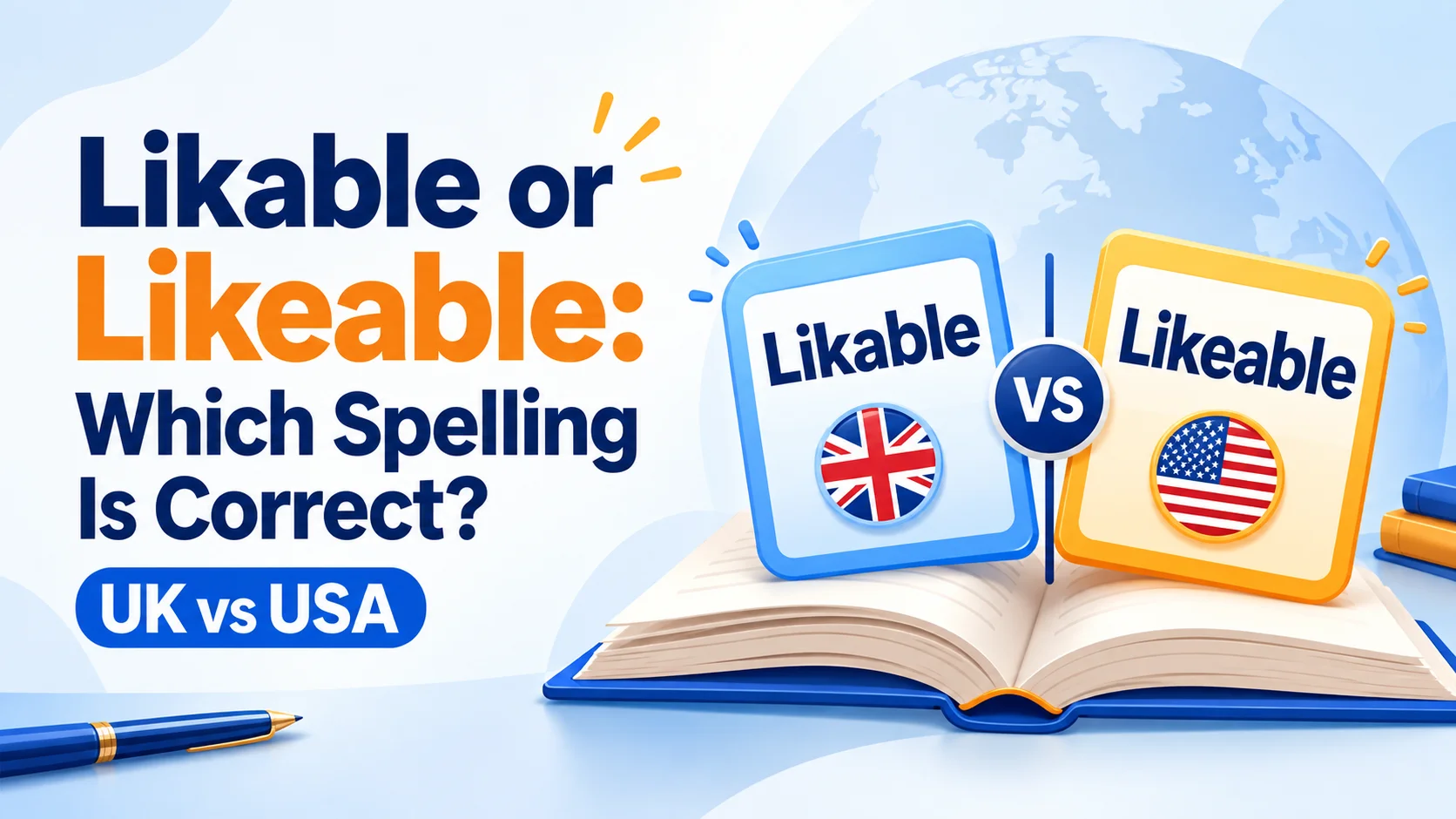
Likable or likeable—which spelling should you use? The good news is that both forms are correct English. The difference is mainly one of regional spelling preference, not meaning or grammar. Likeable is especially common in British English, while likable is especially common in American and other North American English. Major dictionaries, including Cambridge and Oxford, recognize the two forms as variants.
That distinction matters if you are writing for a particular audience. A British newspaper, UK school assignment, or British-facing website will generally look more natural with likeable, whereas American business writing, journalism, and websites commonly use likable. Neither spelling makes your sentence grammatically right or wrong. What matters most is choosing the spelling that fits your variety of English and then using it consistently.
In this guide, you will learn what likable and likeable mean, why both spellings exist, how UK and US usage differs, whether pronunciation changes, which version to use in formal or professional writing, and what to do when your audience is international. You will also see practical examples, common mistakes, a comparison table, and answers to the questions writers most often have about this easily confused spelling pair.
Likable vs Likeable: Quick Answer
The short answer is simple:
Both “likable” and “likeable” are correct.
Likable is generally preferred in American English, while likeable is especially common in British English.
Cambridge labels likeable as mainly UK and says US English usually uses likable. Its corresponding entry for likable labels that form mainly US. Oxford similarly identifies likeable as especially British and likable as especially North American.
At a glance
| Question | Answer |
| Is likable correct? | Yes |
| Is this correct? | Yes |
| Preferred in American English | likable |
| Preferred in British English | likeable |
| Do they mean different things? | No |
| Is the pronunciation different? | Generally no |
| Is either spelling a grammar mistake? | No |
| Best approach | Match your target variety of English |
The important distinction is therefore regional convention rather than correctness.
What Does Likable or Likeable Mean?
Both spellings describe someone or something that is pleasant, appealing, or easy to like. Cambridge defines the adjective in essentially these terms, while Oxford describes it as meaning pleasant and easy to like.
For example:
- She is a very likeable person.
- He is an extremely likable character.
- The new teacher has a warm and likeable personality.
- The movie has a surprisingly likable main character.
The word can describe people, fictional characters, products, ideas, performances, experiences, or personalities.
Likable and likeable are adjectives
Both forms are adjectives, so they can appear in the same grammatical positions.
Before a noun:
She has a likeable personality.
After a linking verb:
The new character is likable.
The grammatical role does not change when the spelling changes.
What does “easy to like” actually imply?
Calling someone likable does not necessarily mean that the person is perfect, admirable, talented, or morally good.
For example:
The character is flawed, but very likable.
Here, likable describes the character’s appeal to the audience. It does not claim that everything the character does is good.
That distinction becomes useful in reviews, storytelling, journalism, and criticism, where a person or character may be complicated but still attract sympathy or affection.
Why Are There Two Spellings?
The two forms developed around the adjective plus the suffix -able. The spelling difference reflects different conventions for handling the final e of the base word. Collins traces the word to like + -able and dates the word to the early eighteenth century.
The resulting forms are:
- like + able → likeable
- like + able → likable
English spelling does not always apply one perfectly predictable rule to every word ending in -e. That is why it is better to learn established spellings rather than assume that one universal rule determines every form.
Cambridge’s usage notes are particularly useful here: its likeable entry identifies the form as mainly British, while likable is identified as mainly American.
Why American English uses “likable” more often
American English commonly prefers likable, without the extra e. This is the form you are most likely to encounter in US-oriented dictionaries and American publications.
Oxford specifically describes likable as especially North American English and likeable as especially British English.
Why British English uses “likeable” more often
British English commonly retains the e in likeable. Oxford labels likeable as especially British English, and Cambridge similarly marks it as mainly UK.
This does not mean British writers never use likable, or that American writers never use likeable. Dictionaries recognize both forms.
Likable vs Likeable: UK and US English
The easiest practical rule is:
US English → likable
UK English → likeable
But treat this as a usage preference, not an absolute law.
American English: “likable”
If your audience primarily uses American English, likable is usually the safer choice.
Examples:
- He is a very likable teacher.
- The film’s main character is surprisingly likable.
- She has an energetic and likable personality.
Cambridge identifies likable as mainly US and gives the same meaning as likeable.
British English: “likeable”
For British English, likeable is generally the more characteristic form.
Examples:
- He is a very likeable teacher.
- The film’s main character is surprisingly likeable.
- She has an energetic and likeable personality.
Oxford specifically lists likeable as especially British English and gives likable as the North American alternative.
Is “likeable” wrong in American English?
No.
Likeable is recognized in American English as an alternative spelling. Collins, for example, lists it as an alternative form of likable.
If you are writing for Americans, however, likable will usually look more natural and consistent with the dominant US convention.
Is “likable” wrong in British English?
Again, no.
British English dictionaries recognize likable, even though likeable is generally the more characteristic British spelling. Collins explicitly gives both forms in its British English treatment.
So a British reader is unlikely to misunderstand likable. The issue is preference, not comprehension.
Does the Meaning or Pronunciation Change?
One of the easiest mistakes is to assume that removing the e somehow creates a different word. It does not.
Same meaning
Both words mean essentially easy or pleasant to like.
Compare:
She is a likable person.
and
She is a likeable person.
The meaning remains the same.
Essentially the same pronunciation
The spelling difference does not create a meaningful pronunciation distinction. Cambridge gives the same basic pronunciation for the two forms.
This is important because some spelling differences between British and American English can involve pronunciation, but likable/likeable is primarily an orthographic difference.
Neither spelling is more formal
There is no rule saying that likeable is more formal because it contains an extra letter.
Likewise, likable is not an informal abbreviation.
The appropriate choice depends on English variety, house style, audience, and consistency.
How to Choose Between Likable and Likeable
When you are unsure, do not ask, “Which one is the real English spelling?”
Ask:
“Who am I writing for, and which English variety am I using?”
That question produces a much more reliable answer.
Use “likable” when writing in American English
Choose likable when your content follows American English conventions, particularly for:
- US websites
- American school or college work
- US business communication
- American publications
- American-facing marketing content
- Content written according to a US style guide
Use “likeable” when writing in British English
Choose likeable when your content follows British English conventions, particularly for:
- UK publications
- British websites
- UK educational writing
- British business communication
- UK-focused marketing
- Content following British spelling conventions
Follow the style guide when one exists
Professional writers should not make every spelling decision independently.
If an employer, publisher, university, client, or publication has a house style guide, follow it.
A style guide may determine not only whether you write likable or likeable, but also choices such as:
- colour vs color
- organise vs organize
- centre vs center
- travelling vs traveling
The larger principle is consistency across the document.
What if your audience is international?
For an international audience, choose a clear spelling system rather than switching between varieties.
For example, if the rest of your article uses British forms such as colour, centre, and organise, using likeable will usually produce a more coherent British-English style.
If your article uses color, center, and organization, likable will generally fit better.
Expert tip: Readers notice inconsistent spelling more readily than they notice which regional convention you selected. Pick one variety and apply it consistently.
Likable or Likeable in Real-World Sentences
The spelling becomes easier once you see how the adjective behaves in different contexts.
Describing a person
US English:
Maya is friendly, confident, and likable.
UK English:
Maya is friendly, confident, and likeable.
Both sentences communicate the same idea.
Describing a fictional character
The author created a flawed but likable protagonist.
Or, in British spelling:
The author created a flawed but likeable protagonist.
This usage is common in book reviews, film criticism, television reviews, and literary discussion.
Describing a product or brand
The adjective can also describe something people respond positively to:
The company has created a simple, likable brand identity.
The meaning here is closer to appealing or pleasant than literally “a thing that can be liked.”
Describing an experience
The hotel has a relaxed atmosphere and a likeable staff.
More naturally, you might write:
The hotel has a relaxed atmosphere, and its staff are very likeable.
The second version makes it clearer that likeable describes the people rather than the atmosphere.
Comparative and superlative forms
The adjective can also appear in comparisons:
- more likable
- most likable
- more likeable
- most likeable
For example:
The second character is more likable than the first.
British-style version:
The second character is more likeable than the first.
The same regional spelling preference continues into related forms.
Related Forms: Likability, Likeability, Unlikable, and Unlikeable
The adjective is part of a larger word family, and this is where writers sometimes encounter additional spelling choices.
| Word | Common US tendency | Common UK tendency | Meaning |
| Adjective | likable | likeable | Easy to like |
| Noun | likability | likeability | Quality of being easy to like |
| Negative adjective | unlikable | unlikeable | Not easy to like |
| Adverb | unlikably | unlikeably | In a way that is not easy to like |
Collins recognizes both likability and likeability, as well as the related forms.
However, these forms can vary by dictionary and regional usage, so do not assume that every related word will follow an identical pattern in every publication.
A practical writing rule
If you are maintaining American English, a consistent family might look like:
likable → likability → unlikable
For British English:
likeable → likeability → unlikeable
The important word here is consistency.
Common Mistakes With Likable and Likeable
Mistake 1: Calling one spelling “wrong”
This is the biggest misconception.
Both forms are recognized English spellings. Cambridge and Oxford explicitly identify the regional distinction rather than treating one form as an error.
Mistake 2: Assuming the extra “e” changes the meaning
It does not.
The e is a spelling difference, not a semantic marker.
Mistake 3: Mixing English varieties unnecessarily
A single spelling choice is rarely a problem. A document full of inconsistent regional spellings looks less carefully edited.
For example, using:
color, centre, organize, likeable
creates a mixture of conventions.
That may happen accidentally, especially when writers use different online sources for spelling checks.
Mistake 4: Treating regional preference as a grammar rule
Likable vs likeable is primarily a spelling issue.
Grammar determines how the adjective functions in the sentence; regional spelling determines which written form is preferred.
Mistake 5: Choosing a spelling solely because it “looks more correct”
English spelling often reflects history and regional convention rather than visual logic.
When two dictionary-recognized forms exist, audience and consistency are better decision criteria than appearance.
Likable vs Likeable: Decision Guide
| Your situation | Recommended spelling | Why |
| US audience | likable | Matches common American usage |
| UK audience | likeable | Matches common British usage |
| North American English | likable | Oxford identifies it as especially North American |
| British publication | likeable | Consistent with British convention |
| Existing US house style | likable | Follow the established style |
| Existing UK house style | likeable | Follow the established style |
| International audience | Either | Choose one variety and stay consistent |
| Casual personal writing | Either | Regional preference is usually sufficient |
| Academic writing | Match institution/style guide | Consistency matters most |
Likable or Likeable in Professional and Academic Writing
Professional writing rewards consistency more than unnecessary correction.
Suppose you are preparing a report for an American company. If the company’s established materials use American spelling, writing likable fits naturally with that style.
A British publication may make the opposite choice:
The candidate was experienced, articulate, and highly likeable.
Neither sentence is inherently more professional.
A useful editing checklist
Before submitting a document, check:
- Which English variety am I using?
- Does my employer, school, client, or publication have a style guide?
- Have I used the same spelling throughout?
- Are related words consistent?
- Have I accidentally mixed British and American spelling?
- Have I changed a spelling simply because another version “looked right”?
This small check can prevent a surprising number of avoidable editing inconsistencies.
Likable or Likeable for SEO and Content Writing
SEO does not require you to stuff both variants into an article.
If your website targets a US audience, naturally writing likable makes sense. A UK-focused site can naturally use likeable.
You do not need sentences such as:
“This likable, or likeable, character…”
just to mention both keywords.
That damages readability without adding useful information.
Search-focused writing should instead answer the underlying intent. Someone searching “likable or likeable” is usually trying to determine:
- whether either spelling is wrong;
- which one belongs to UK English;
- which one belongs to US English;
- whether the meaning changes;
- which version they should use.
A useful article answers those questions directly and then moves on.
SEO recommendation: Mention the variant naturally where it helps the reader, but make clarity and consistency the primary goals.
A Simple Memory Trick
If you regularly confuse these spellings, use this shortcut:
UK → likeable
US → likable
Think of the British version as keeping the “e” and the American version as dropping it.
Just remember that this is a memory aid for the usual preference, not a rule saying that the alternative is invalid.
Oxford and Cambridge both recognize the regional relationship between the two forms.
Conclusion
Likable and likeable are both correct, so there is no need to treat this as a right-versus-wrong spelling battle. The practical distinction is regional: likable is especially common in American and North American English, while likeable is especially common in British English. Major dictionaries such as Cambridge and Oxford support this distinction. For most writers, the best decision is therefore straightforward: match the spelling to your audience, follow any relevant style guide, and remain consistent. If you are writing for readers in the United States, choose likable. If you are writing in British English, likeable will usually be the better fit. One final actionable tip: decide your English variety before you begin editing, rather than changing individual words whenever they look unfamiliar. A common mistake to avoid: never assume that the spelling you do not normally use is automatically incorrect. In this case, both forms have a legitimate place in English.
Frequently Asked Questions
Q1. Which is correct, likable or likeable?
Both likable and likeable are correct English spellings. The main difference is regional preference. Likable is especially associated with American and North American English, while likeable is especially associated with British English. The meaning and grammatical function remain the same.
Q2. Is “likeable” British or American?
Likeable is especially British, although it is also used in American English. Cambridge labels it mainly UK and notes that US English usually uses likable. Therefore, likeable is the natural choice when you are deliberately following British spelling conventions.
Q3. Is “likable” only American English?
No. Likable is not exclusively American. British dictionaries recognize the spelling too. However, it is particularly associated with American and North American English. If your document follows British conventions, likeable will generally be the more characteristic choice.
Q4. Does likable mean something different from likeable?
No. There is no meaningful difference in definition. Both adjectives describe someone or something that is pleasant or easy to like. The spelling difference does not create a separate meaning, grammatical category, or pronunciation. The choice is primarily a matter of regional spelling convention.
Q5. Which spelling should I use in formal writing?
Use the form that matches your English variety and applicable style guide. American formal writing generally favors likable, while British formal writing generally favors likeable. Neither is inherently more formal. Above all, maintain consistency throughout the document.