

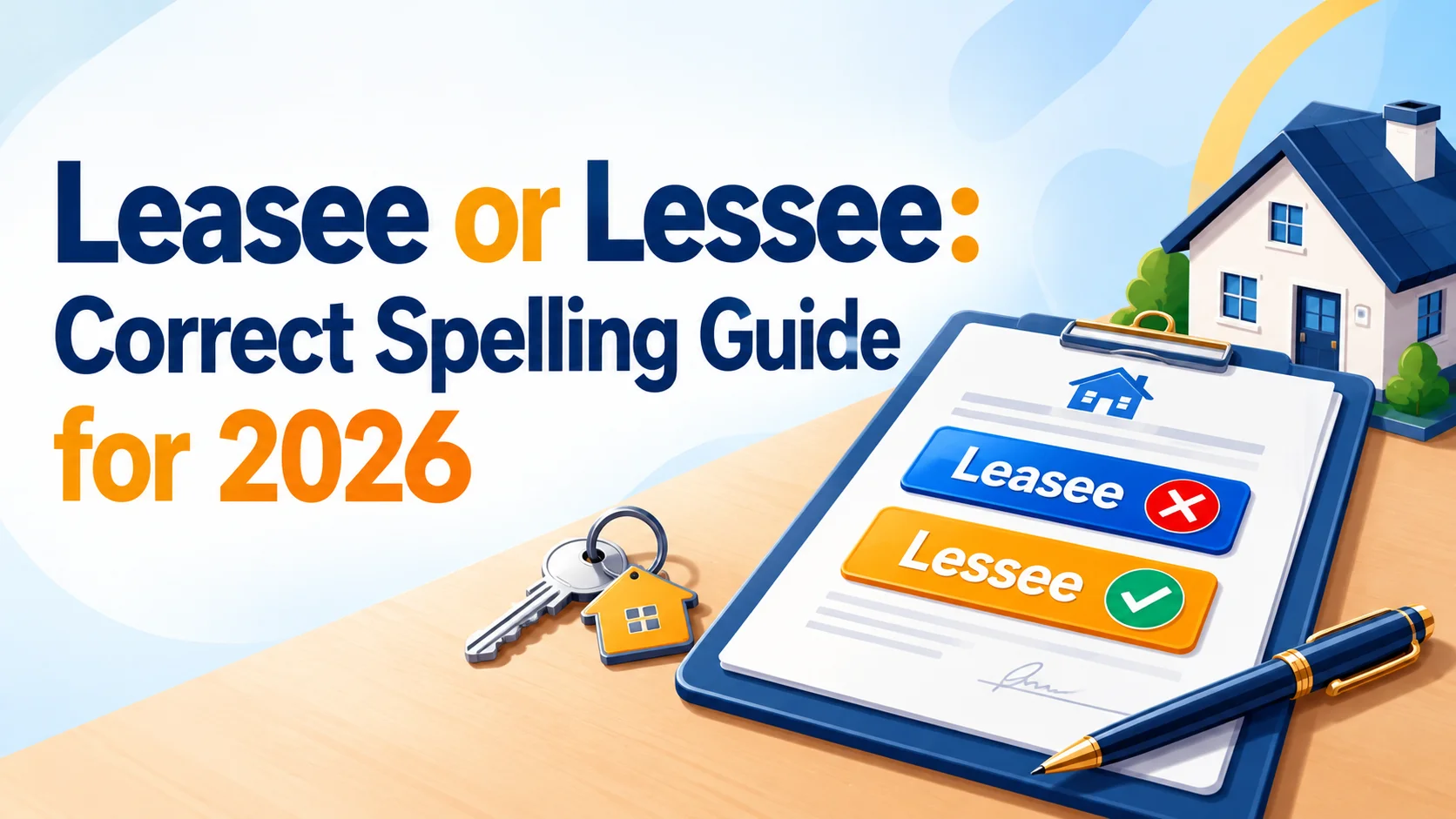
Leasee or lessee—which spelling should you use when referring to someone who rents or uses property under a lease? The correct standard spelling is lessee. Although “leasee” looks logical because it appears to combine “lease with the familiar ending -ee, it is not the standard form used in modern formal English. Lessee is the established legal and business term for the person or organization that receives the right to use something under a lease. This distinction matters when writing rental agreements, business documents, emails, or other professional material.
The confusion becomes easier to understand when you look at the three related terms: lease, lessor, and lessee. A lease is the agreement; the lessor is the party granting the lease; and the lessee is the party receiving the right to use the leased property. Depending on the context, that property could be an apartment, office, vehicle, piece of equipment, land, or another asset. Legal references consistently use lessee for this role.
This guide explains why lessee is correct, why lessee is commonly written by mistake, how lessee differs from tenant and lessor, and how to use the word naturally in sentences. You will also see practical examples, a comparison table, common mistakes, pronunciation guidance, and answers to questions people frequently have when dealing with leases. By the end, you should be able to recognize the correct spelling immediately—and understand exactly what the word means.
Leasee or Lessee: Which Spelling Is Correct?
The correct spelling is lessee.
Leasee is generally a misspelling when someone intends to refer to the party who receives the right to use property under a lease. In standard English, especially in legal, business, property, and contractual writing, use lessee.
| Word | Correct standard term? | Meaning |
| Lessee | Yes | The party that receives the right to use something under a lease |
| Leasee | No, in standard usage | Common spelling mistake based on the word “lease” |
| Lessor | Yes | The party that grants the lease |
| Lease | Yes | The agreement giving someone the right to use property for a specified period |
For example:
The lessee must make the monthly payments according to the lease agreement.
The word lessee is not limited to housing. Cambridge defines it as a person who has the right to use something such as land, a building, or equipment according to a lease. Its Business English definition also recognizes an organization as a lessee.
Quick rule: If you mean “the person or organization receiving the leased-use rights,” write lessee, not lessee.
What Does Lessee Mean?
A lessee is a person or organization that obtains the right to use property or another asset under a lease.
In everyday language, you might call this person a tenant or renter when discussing a home or apartment. Lessee, however, is the more formal term and is particularly common in contracts and other legal or business documents.
A lease does not normally transfer ownership to the lessee. Instead, it gives the lessee specified rights to possess or use the property for an agreed period, subject to the conditions of the agreement and applicable law. Cornell Law School’s Legal Information Institute describes a lease as an arrangement in which the lessor grants the lessee the right to possess and use property for a specified period.
Lessee in Simple English
A simple way to understand lessee is:
A lessee is the person or organization that leases something from someone else.
For example, imagine Sara rents an apartment from its owner.
- Sara = lessee
- Apartment owner = lessor
- Rental contract = lease
The same basic relationship can apply to commercial property, vehicles, equipment, and other leased assets.
Lessee in a Rental Agreement
In a residential lease, the lessee is normally the person or people who receive the contractual right to occupy and use the property.
The agreement may specify matters such as:
- Rent payments
- Lease duration
- Maintenance responsibilities
- Permitted uses of the property
- Renewal conditions
- Rules concerning alterations
- Termination provisions
Exactly what the lessee must do depends on the agreement and the applicable law. It is therefore better not to assume that every lease gives tenants identical rights or responsibilities.
Lessee in Commercial Leasing
A business can also be a lessee.
Suppose a company signs a five-year agreement to occupy an office building. The company may be identified in the contract as the lessee, while the property owner or leasing party is the lessor.
The word can also appear in leases involving:
- Retail premises
- Warehouses
- Office buildings
- Agricultural land
- Vehicles
- Machinery
- Specialized equipment
Federal regulations provide examples of this broader usage. For instance, U.S. regulations define a lessee in certain transportation contexts as the party acquiring the use of leased equipment.
Can a Company Be a Lessee?
Yes.
Lessee does not necessarily mean an individual person. Depending on the agreement, a company, organization, or other legal entity may be the lessee.
For example:
Greenfield Ltd. is the lessee under the commercial property agreement.
Here, lessee identifies the contractual party rather than describing an individual human being.
Lessee vs. Lessor: Understanding the Two Sides of a Lease
The most important distinction to learn is lessor vs. lessee.
They describe opposite sides of the leasing relationship.
| Term | Role | Simple meaning |
| Lessor | Grants the lease | The party providing the right to use the asset |
| Lessee | Receives the lease | The party receiving the right to use the asset |
| Lease | Agreement | The contract establishing the leasing arrangement |
Cornell’s legal materials use this distinction consistently: the lessor grants the use of property, while the lessee acquires that use.
Who Is the Lessor?
The lessor is the party that grants the right to use the property or asset under the lease.
In a typical apartment rental, the property owner or landlord may be the lessor.
However, ownership and leasing arrangements can become more complicated. For example, a party may have a particular legal interest in an asset without simply being described as its everyday “owner.” The safest approach in formal writing is to use lessor for the party identified by the lease as granting the relevant rights.
Who Is the Lessee?
The lessee is the party receiving the contractual right to use the leased asset.
That party may have significant rights during the lease term, but those rights do not automatically mean the lessee owns the underlying property.
This distinction is particularly important when reading contracts. Confusing lessor and lessee can reverse the meaning of an obligation.
Lessor vs. Lessee in One Example
Imagine a company rents a warehouse from a property owner.
- The property owner grants the right to use the warehouse → lessor
- The company receives that right → lessee
- The written contract establishing the arrangement → lease
A sentence such as “the lessee shall pay rent” therefore refers to the company using the warehouse, not the party providing it.
Lessee vs. Tenant: Are They the Same?
Lessee and tenant often refer to the same party in a residential context, but they are not identical in every situation.
Tenant is a common everyday term associated particularly with renting real estate. Lessee is a more formal term that emphasizes the party’s position under a lease.
Cornell’s legal reference notes that when the leased property is real estate, the lessee is referred to as a tenant.
When “Tenant” Is More Natural
In ordinary conversation, people usually say:
“The tenant paid the rent.”
rather than:
“The lessee paid the rent.”
Both can make sense, but tenant sounds more natural in everyday residential situations.
When “Lessee” Is More Appropriate
Lessee is especially useful when discussing:
- Contracts
- Legal terminology
- Commercial leases
- Formal property documents
- Equipment leasing
- Vehicle leasing
- Regulatory definitions
It is also useful when the writer wants to describe the contractual relationship rather than simply the person’s occupation of a property.
Lessee, Renter, and Tenant: Quick Comparison
| Term | Typical context | Formality | Can refer to non-housing arrangements? |
| Lessee | Contracts and leases | High | Yes |
| Tenant | Homes and rented property | Medium | Usually property-related |
| Renter | Everyday language | Low/medium | Commonly housing and personal property |
These categories can overlap. The best word depends on what you are trying to emphasize.
Why Is “Leasee” a Common Misspelling?
The spelling leasee is understandable as a mistake because English often forms nouns describing a recipient with -ee.
For example:
- employer → employee
- interviewer → interviewee
- payer → payee
Someone seeing lease may therefore reason:
lease + ee = leasee
The problem is that established English vocabulary does not always follow a perfectly predictable spelling formula. Lessee is the standard word that has developed through the language’s legal vocabulary.
This is an important spelling lesson: a word can look logically constructed and still not be the established English form.
Does “Leasee” Come From the Word “Lease”?
The two words are obviously related in meaning, but that does not mean the correct noun must be formed simply by attaching -ee to the modern spelling of lease.
Lessee is the established term. Modern legal and business sources use it consistently to identify the party receiving leased-use rights.
So, when proofreading a contract or article, do not “correct” lessee to lessee simply because lease appears to be the root.
Why “Lessee” Looks Unusual
The spelling contains ss before ee, which can initially look unfamiliar.
That unusual appearance is one reason people may hesitate when writing it. Once you associate lessee with its partner lessor, however, the spelling becomes much easier to remember.
The Origin and History of Lessee
Lessee belongs to the formal vocabulary that developed around leases and legal rights.
Its history helps explain why spelling it as leasee is unreliable. English legal vocabulary contains many words whose modern spelling reflects historical forms rather than a simple, transparent combination of today’s common words.
Cambridge’s dictionary entry identifies lessee as a specialized legal noun and gives its pronunciation as /lesˈiː/. It also notes the word’s use for a person or organization using something under a lease.
The practical lesson is more useful than memorizing a complicated etymological history:
Treat “lessee” as an established vocabulary item, not as a word you need to construct from “lease.”
That approach also explains why the spelling should remain lessee in professional documents.
How to Use Lessee Correctly in a Sentence
The word lessee is a countable noun. It can appear as a singular noun, pluralized as lessees, or in possessive forms such as lessee’s and lessees’.
Residential Examples
The lessee must follow the conditions stated in the rental agreement.
The landlord provided the lessee with a copy of the lease.
The lessee’s obligations are described in Section 4.
Commercial Examples
The company became the lessee of the new office space.
The lessee agreed to maintain the equipment during the lease term.
Several lessees occupy units within the commercial building.
Formal and Legal Examples
The agreement sets out the rights and obligations of the lessee.
The lessee may use the premises only for the purposes permitted by the contract.
Both the lessor and lessee signed the agreement.
These examples demonstrate why the word is useful beyond residential renting.
Lessee With Common Prepositions
You may commonly see constructions such as:
- lessee under the agreement
- lessee of the property
- lessee’s responsibilities
- rights of the lessee
- between the lessor and lessee
The exact wording depends on the sentence, but the spelling remains lessee.
Common Mistakes With Lessee
Knowing the correct spelling is only part of using the term accurately.
Mistake 1: Writing “Leasee”
Incorrect:
The leasee must pay rent on time.
Correct:
The lessee must pay rent on time.
The second version uses the standard term.
Mistake 2: Confusing Lessee With Lessor
Incorrectly switching these words can produce a much more serious problem than a spelling error.
If a contract says the lessee must perform an obligation, changing that word to lessor may assign the obligation to the opposite party.
Tip: Before signing or editing a lease, identify who is granting the rights and who is receiving them.
Mistake 3: Assuming Lessee Always Means a House Renter
A lessee can use many types of assets.
For example:
- A company may lease machinery.
- A business may lease a vehicle.
- An organization may lease office space.
- A person may lease land.
Federal regulations use lessee in contexts involving vehicles and equipment as well as other leased interests.
Mistake 4: Assuming the Lessee Owns the Property
A lessee normally receives specified rights of use or possession during the lease term. That does not automatically mean the lessee owns the underlying asset. Cornell’s explanation specifically distinguishes the lessee’s right of possession from the lessor’s retained ownership.
Incorrect vs. Correct Examples
| Common mistake | Better version | Why |
| The leasee signed the contract. | The lessee signed the contract. | Lessee is the standard spelling. |
| The lessee rented the property to the tenant. | The lessor rented the property to the tenant. | The roles were reversed. |
| The lessee owns the apartment because they rent it. | The lessee has the contractual right to use the apartment. | Leasing and ownership are different concepts. |
| The leasee is responsible under the agreement. | The lessee is responsible under the agreement. | Standard terminology is lessee. |
How to Pronounce Lessee
Lessee is pronounced with the stress on the second syllable. Cambridge gives the pronunciation as /lesˈiː/ in both its UK and US entries.
The pronunciation is useful because it reinforces the fact that the word is an established term rather than simply “lease” with an extra ending.
When reading a lease aloud, remember that lessee and lessor refer to opposite parties, so clear pronunciation matters in discussions where contractual roles are important.
An Easy Way to Remember “Lessee”
The most useful memory trick is to learn lessee and lessor together.
Think of them as the two sides of the same lease:
Lessor → gives the lease
Lessee → gets the lease
This is more reliable than trying to derive the spelling from lease.
Remember the Pair: Lessor and Lessee
Both words contain less:
- LESSor → the party granting the lease
- LESsee → the party receiving the lease
The spelling isn’t perfectly intuitive, so memorizing the pair is more effective than relying on pronunciation.
A Quick Spelling Test
Before writing the word, ask:
“Am I talking about the person or organization receiving the right to use something under a lease?”
If yes, the word you want is:
lessee
Not leasee.
Leasee vs. Lessee: Comparison Table
| Feature | Leasee | Lessee |
| Standard English spelling | No | Yes |
| Refers to a lease recipient | Intended meaning, but nonstandard spelling | Yes |
| Appropriate for formal writing | Avoid | Yes |
| Common in legal documents | Not the standard form | Yes |
| Related opposite term | — | Lessor |
| Why people use it | Looks like lease + -ee | Established lexical form |
| Recommended choice | ❌ | ✅ Lessee |
Bottom line: If you are writing about the party receiving leased-use rights, lessee is the spelling to use.
Lessee in Real-World Lease Examples
Understanding the word becomes easier when you see how it works in different situations.
Example 1 — Renting a House
David signs a one-year agreement to rent an apartment.
- Property owner = lessor
- David = lessee
- Rental contract = lease
David’s status as lessee comes from the agreement giving him the right to occupy and use the apartment.
Example 2 — Leasing an Office
A technology company signs a contract for office space.
The company—not necessarily an individual employee—is the lessee if the company is the contractual party receiving the lease rights.
This example is important because it shows why defining a lessee simply as “a renter” can be too narrow.
Example 3 — Leasing Equipment
A construction company leases specialized equipment for a specified period.
The equipment provider is the lessor, while the construction company is the lessee.
The same terminology can therefore apply even when no building or home is involved.
Example 4 — Reading a Lease Agreement
Suppose the first page of a contract identifies:
- Party A: Property owner
- Party B: Business occupying the property
If the document defines Party B as the lessee, later clauses can use that single term instead of repeatedly writing the company’s full legal name.
That is one reason formal contracts rely heavily on defined terms.
Lessee in Legal and Business Documents
Lessee is particularly valuable in formal writing because it identifies a contractual role precisely.
You may encounter it in:
- Residential lease agreements
- Commercial property contracts
- Vehicle leases
- Equipment leases
- Government leasing documents
- Mineral leases
- Transportation regulations
- Business contracts
The exact legal meaning can vary according to the document, industry, and governing law. For example, U.S. federal regulations define lessee differently for particular regulatory purposes, demonstrating why context matters in specialized legal writing.
Why Professionals Prefer the Term
A word such as renter may be perfectly understandable, but lessee identifies a party’s role in a lease.
That precision matters when several people or entities are involved.
For example, a document might discuss:
- owner
- lessor
- lessee
- sublessee
- guarantor
- property manager
Replacing every formal term with “renter” could make the contractual relationships less precise.
Is “Leasee” Ever Correct?
For ordinary standard English, use lessee.
If you encounter leasee somewhere, it may simply be a spelling mistake or an informal/nonstandard formation based on the word lease. Its appearance does not make it the preferred spelling.
There can always be unusual contexts involving names, labels, or individual organizations, but those should not be confused with standard English vocabulary.
For professional writing, the practical recommendation is straightforward:
Write “lessee.”
This is especially important in:
- Legal documents
- Business correspondence
- Property agreements
- Educational writing
- Articles about leasing
- Professional reports
Quick Decision Guide: Which Word Should You Use?
| If you mean… | Use… | Example |
| The agreement | lease | “They signed a lease.” |
| The party granting the lease | lessor | “The lessor approved the request.” |
| The party receiving the leased-use rights | lessee | “The lessee paid the required amount.” |
| A person renting a home, in everyday language | tenant/renter | “The tenant moved in.” |
| The property owner | owner/landlord, where appropriate | “The landlord repaired the unit.” |
A Three-Second Check
Ask yourself:
- Is it the contract? → lease
- Is it the party giving the lease? → lessor
- Is it the party receiving the lease rights? → lessee
That simple distinction eliminates most confusion.
Conclusion
When choosing between leasee or lessee, the correct standard spelling is lessee. It refers to the person or organization that receives the right to use or possess something under a lease. The term can apply to homes, offices, equipment, vehicles, land, and other leased assets, so it is broader than the everyday word tenant. Legal and business sources consistently use lessee for this contractual role. One final actionable tip: remember the three-part relationship: lease = agreement, lessor = grants it, lessee = receives it. That gives you both the spelling and the meaning. A common mistake to avoid is replacing lessee with lessee simply because the latter looks like “lease + -ee.” English vocabulary does not always follow that construction. When accuracy matters, trust the established form: lessee.
Frequently Asked Questions
Q1. Is “leasee” a correct spelling?
Lessee is the standard spelling for the party receiving rights under a lease. Leasee is generally treated as a nonstandard spelling or misspelling in this context. If you are writing a contract, business document, academic paper, or professional article, choose lessee.
Q2. What is the difference between a lessee and a tenant?
A lessee is the party receiving rights under a lease, while tenant is a more familiar term commonly used for someone occupying rented real estate. In residential situations they often describe the same person, but lessee has a more formal contractual emphasis.
Q3. Is the lessee the owner of the property?
Usually, no. A lessee receives specified rights to use or possess property under a lease, while the lessor generally retains ownership of the underlying property. However, particular arrangements can involve complex ownership or lease interests, so the actual contract and applicable law control.
Q4. Can a business be called a lessee?
Yes. Lessee can refer to an organization as well as an individual. A company leasing office space, equipment, land, or another asset can be the lessee if it is the party receiving the relevant lease rights. Cambridge’s Business English definition expressly includes organizations.
Q5. What is an easy way to remember lessee vs. lessor?
Learn them as a pair. The lessor grants the lease, while the lessee receives the leased-use rights. If you remember the two roles together, you are less likely to confuse the spelling or accidentally reverse the parties when reading a contract.