
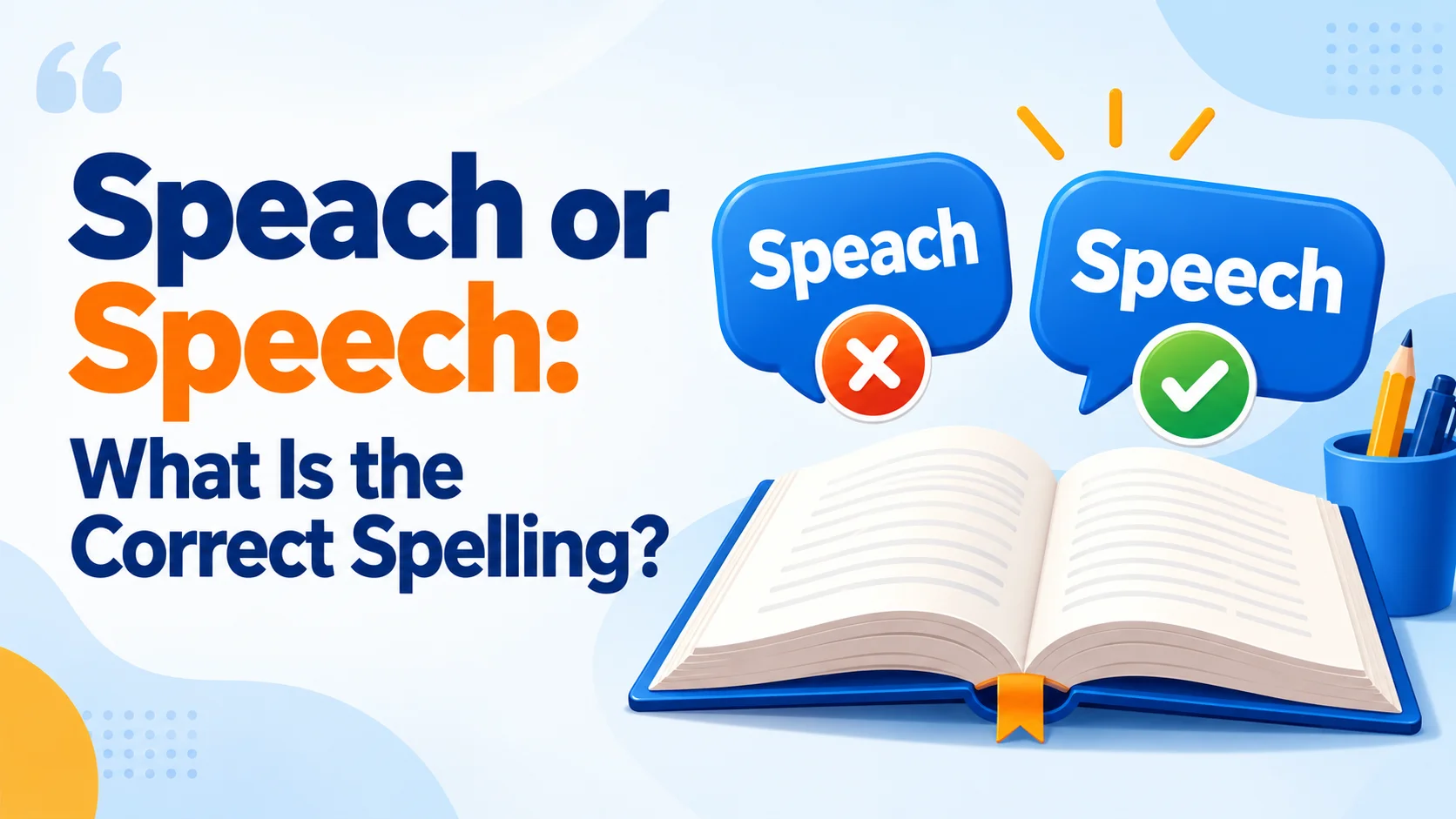
Speech or speech? The correct spelling is speech. Although speech looks and sounds plausible, especially when you are spelling the word from pronunciation, it is a misspelling, not a standard alternative. The word speech is used for spoken communication, a person’s manner of speaking, and a formal talk delivered to an audience. This small spelling difference matters in school assignments, professional writing, emails, presentations, and public-speaking contexts, where accuracy affects how polished your writing appears.
The confusion usually comes from the way speech is pronounced. English spelling does not always follow pronunciation closely, so writing the word exactly as it sounds can lead to mistakes. You may also connect it with words such as speak and expect the spelling to follow the same pattern. In this guide, you will see the difference between speech and speech, learn how the correct spelling developed, understand its pronunciation and meanings, and discover practical ways to remember it.
Whether you are an English learner, student, writer, or simply checking a word before submitting something important, the useful rule is straightforward: write speech, never speech, in standard English. We will also look at British and American usage, common phrases such as free speech and speech therapy, examples in everyday writing, related words, frequent mistakes, and a short practice exercise. By the end, you should be able to recognize and use speech confidently without having to stop and second-guess the spelling.
Speach or Speech: Which Spelling Is Correct?
Speech is the correct spelling in standard English.
Speach is a common spelling mistake. It does not function as a standard alternative spelling of speech in ordinary modern English.
The difference is only one vowel, but that single letter changes whether the word is correctly written:
Correct: speech
Incorrect: speach
For example:
- Correct: She gave a short speech at the ceremony.
- Incorrect: She gave a short speech at the ceremony.
The same rule applies regardless of whether you are writing about everyday conversation, public speaking, communication, or a formal address.
Quick answer: Speech or speech?
| Spelling | Standard English? | What it means |
| Speech | Yes | Spoken communication, a way of speaking, or a formal address |
| Speach | No | A common misspelling of speech |
There is no British-versus-American spelling distinction here. Both British English and American English use speech.
What Does Speech Mean?
The noun speech has several closely related meanings. Understanding them makes it easier to recognize the word in different contexts.
Speech as the ability to speak
Speech can refer to a person’s ability to produce spoken language.
For example:
The child is developing clear speech.
Here, speech refers to the physical and linguistic production of spoken sounds.
This meaning is common in discussions of language development, communication, and speech therapy.
Speech as spoken communication
The word can also refer more generally to language expressed aloud.
Her speech was clear and easy to understand.
In this case, speech describes spoken communication rather than one particular presentation.
Speech as a formal address
A speech can also be a prepared talk given to an audience.
The principal delivered a speech to the students.
This is probably the meaning people have in mind when they talk about writing a speech, giving a speech, or preparing a speech.
Speech and freedom of expression
You may also encounter speech in phrases involving communication and expression.
For example, free speech refers broadly to the freedom to express opinions or ideas, subject to the laws and circumstances of a particular society.
The important spelling point remains the same: speech, with ee, not speech.
Speech Examples in Sentences
Seeing the correct spelling in different situations is one of the easiest ways to make it familiar.
Everyday communication
- His speech became clearer with practice.
- The doctor asked whether she had noticed any changes in her speech.
- The child has made noticeable progress in speech development.
Public speaking
- She practiced her speech several times before the event.
- The speaker delivered an inspiring speech to the audience.
- He forgot part of his speech but continued confidently.
School and education
- I need to prepare a speech for my English class.
- The students participated in a speech competition.
- Her speech focused on the importance of education.
Professional writing
- The CEO’s speech was discussed during the meeting.
- Please review the speech before the presentation.
- The organization published the full speech after the event.
Notice that the spelling never changes simply because the context changes.
Why Do People Spell Speech as “Speach”?
If speech is so common, why does speech appear so often?
The mistake is understandable because English spelling contains many words whose written forms cannot be predicted perfectly from their pronunciation.
Pronunciation creates confusion
When people hear speech, they hear a long ee sound. Someone unfamiliar with the written word may try to represent that sound using ea, producing speech.
That approach works in some English words but not here.
Compare:
- speech — correct
- teach — correct
- reach — correct
- beach — correct
Because ea commonly represents the same general vowel sound, speech can look convincing to an English learner.
The problem is that spelling is based on established word forms, not simply on choosing letters that can represent a sound.
Confusion with speak
Another source of uncertainty is the relationship between speech and speech.
They belong to the same word family, but their spellings are not identical:
- speak — verb
- speech — noun
- speaker — noun
- spoken — adjective/past participle
A learner might assume that the spelling of one word should predict the spelling of all the others. English does not always work that neatly.
Typing and memory errors
Sometimes speech is simply a typo or a spelling error remembered from previous exposure.
Online content can make this worse. If someone repeatedly sees an incorrect spelling, the wrong version may begin to look familiar. Familiarity is not proof of correctness.
When a word looks uncertain, checking a reliable dictionary or spell checker is better than relying on visual memory.
How to Spell Speech Correctly
The standard spelling is:
S-P-E-E-C-H
The easiest part to remember is the double E:
sp + ee + ch = speech
A simple memory trick for speech
Think:
“Speech has two E’s.”
You can connect the double ee with the sound in words such as see:
See the EE in speech.
It is a small mnemonic, but it gives you a fixed visual pattern to recall when you are writing quickly.
Speech and speak: a useful word family
Learning related words can also reinforce the spelling:
- speak
- speech
- speaker
- speaking
- spoken
However, do not try to construct speech mechanically from speech. Instead, learn speech as its own spelling while recognizing that the words are related in meaning.
Expert tip: When learning commonly confused words, memorize the troublesome spelling pattern rather than trying to invent the spelling from pronunciation each time.
Speech Pronunciation: Is It Pronounced Like “Speach”?
The pronunciation of speech is approximately /spiːtʃ/.
The important point for spelling is the long ee vowel sound.
That sound can be represented by different spellings in English. For example:
- see
- team
- piece
- speech
This is why pronunciation alone cannot reliably tell you whether a word should contain ee, ea, ie, or another spelling pattern.
So while speech may look like a reasonable attempt to spell the sound, standard English uses speech.
Pronunciation vs. spelling
A useful principle for English learners is:
Hear the word to learn its pronunciation; check the written form to learn its spelling.
Do not assume that two words with similar sounds must use the same letter pattern.
Is “Speach” a Word?
In ordinary standard English, speech is not the correct spelling of the noun speech.
If you encounter speech online, in a message, or in an informal post, it is usually a spelling mistake.
There can be unusual circumstances in which a sequence of letters appears as part of a proper name, username, brand, fictional term, or historical material. Such an appearance does not make speech an accepted alternative spelling of the ordinary English word speech.
For schoolwork, business writing, articles, emails, and other standard writing, use speech.
Is Speech Spelled Differently in British and American English?
No. This is one area where British and American English agree completely.
| English variety | Correct spelling | Example |
| British English | speech | She gave a speech. |
| American English | speech | She gave a speech. |
Some English words do have spelling differences between British and American usage, such as colour/color and centre/center. Speech is not one of them.
Therefore, changing your preferred English variety does not change the answer to speach or speech?
Speech is correct in both.
Common Mistakes With Speech
Writing “speach” instead of “speech”
This is the most direct mistake.
❌ He prepared a speach.
✅ He prepared a speech.
The correction is simply to replace ea with ee.
Assuming pronunciation determines spelling
English has many examples where pronunciation does not give you the complete spelling.
If you spell every unfamiliar word exactly as it sounds, you are likely to make mistakes. This is particularly common among learners who are still developing English vocabulary.
Confusing speech with speak
These words are related but have different grammatical roles:
I speak English.
I gave a speech in English.
Speak is normally a verb, while speech is a noun.
Copying errors from online sources
Search results, social media posts, comments, and user-generated content can contain spelling mistakes.
If you see speech several times, that does not make it correct. For important writing, verify questionable spellings using a reputable dictionary or another dependable language reference.
Speech in Everyday, Academic, and Professional Writing
The word appears in much more than public-speaking contexts.
In school and student writing
Students commonly encounter speech when preparing presentations, competitions, or classroom assignments.
I am writing a speech about environmental protection.
The word can also describe communication ability:
The lesson discussed children’s speech development.
In emails and professional communication
A workplace message might refer to a speech given by a manager, executive, politician, or guest speaker.
Please send me the final version of the speech before the event.
Here, using the correct spelling matters because professional documents are expected to be carefully edited.
In news and public speaking
News reports frequently use speech when discussing remarks delivered publicly.
The minister’s speech addressed several economic issues.
In everyday conversation
The word is also used naturally when discussing the way someone talks:
His speech was difficult to hear over the noise.
The context changes, but the spelling does not.
Common Phrases Using “Speech”
Learning common word combinations is useful because you will encounter the correct spelling repeatedly.
Free speech
The ability to express opinions or ideas, generally discussed in the context of rights and laws.
Speech therapy
Professional support intended to address communication-related difficulties, which can include speech and language concerns.
Speech recognition
Technology that enables a computer or device to process human speech.
Speech writing
The process of preparing written material intended to be delivered orally.
Speech contest
A competition in which participants prepare and present speeches.
Speech pathologist
A professional who assesses and treats communication and related swallowing difficulties, depending on their professional scope and jurisdiction.
These expressions all contain speech, never speech.
Speech vs. Related Words
Understanding the word family helps prevent another type of mistake: using speech when another related word is required.
| Word | Typical grammatical role | Basic meaning | Example |
| speech | Noun | Spoken communication or a formal talk | Her speech was excellent. |
| speak | Verb | To use spoken language | They speak English. |
| speaker | Noun | Someone who speaks or gives a talk | The speaker arrived early. |
| speaking | Verb form/gerund | The act of using spoken language | Speaking clearly takes practice. |
| spoken | Past participle/adjective | Expressed orally | The instructions were spoken clearly. |
A useful distinction is:
You speak. You give a speech. A speaker gives a speech.
That simple relationship helps clarify both vocabulary and grammar.
Speech in Formal and Academic Writing
In formal writing, accuracy becomes especially important because readers often notice spelling errors even when the underlying idea is clear.
Use speech when referring to:
- A formal address
- Spoken communication
- A person’s manner or ability of speaking
- Speech-related education or therapy
- Technologies involving spoken language
For example:
The student’s speech was well organized and appropriate for the audience.
When writing about a specific formal address, articles and possessives can change according to context:
- a speech
- the speech
- the speaker’s speech
- her speech
- the speech delivered yesterday
The spelling remains speech in every case.
Speech Writing: What Does a Speech Usually Include?
If you are searching for speech because you have been asked to write one, spelling is only the first step. A basic speech generally has three broad parts.
Introduction
Introduce the topic and give the audience a reason to pay attention.
Main body
Develop the central points using explanations, examples, evidence, or arguments appropriate to the audience.
Conclusion
Bring the main idea together and leave the audience with a clear final message.
The structure will vary according to whether you are writing a school speech, persuasive speech, ceremonial address, presentation, or professional talk. The audience and purpose should determine the level of formality.
Quick Comparison: Speech vs. Speech
| Feature | Speech | Speach |
| Standard English spelling | ✅ Yes | ❌ No |
| Used in formal writing | ✅ Yes | ❌ No |
| Used in British English | ✅ Yes | ❌ No |
| Used in American English | ✅ Yes | ❌ No |
| Can refer to spoken communication | ✅ Yes | ❌ No |
| Can refer to a formal address | ✅ Yes | ❌ No |
| Commonly confused because of pronunciation | — | ✅ Yes |
| Recommended spelling | Use this | Avoid this |
How to Remember “Speech” Every Time
If you frequently make this mistake, use a simple three-step approach:
- Look for the double E:
spEEch - Connect it with the word family:
speak → speech → speaker - Use it in a sentence:
“I have to give a speech tomorrow.”
Repeatedly seeing the word in meaningful contexts is more useful than memorizing an isolated letter sequence.
A quick spelling check
Before submitting schoolwork or professional writing, ask:
Does this word contain EE?
If you mean the standard English word for spoken communication or a formal address, the answer is yes: speech.
Practice: Speech or Speech?
Choose the correct spelling in each sentence.
- She delivered a short (speech / speach).
- His (speech / speach) was clear and organized.
- I need to prepare a (speech / speach) for tomorrow.
- The teacher discussed (speech / speach) development.
- The politician gave a televised (speech / speach).
Answers
- speech
- speech
- speech
- speech
- speech
A useful observation is that the answer never changes merely because the context changes. The standard spelling is consistently speech.
Conclusion
When choosing between speech or speech, there is a clear answer: speech is the correct standard English spelling. The confusion usually comes from pronunciation and from the fact that English uses several different letter patterns for similar sounds. Once you remember the double E in speech, the mistake becomes much easier to avoid. The word can describe spoken communication, a person’s manner of speaking, or a formal address, and it appears in expressions such as free speech, speech therapy, and speech recognition. One final actionable tip: whenever you hesitate, write S-P-E-E-C-H rather than spelling from sound. A common mistake to avoid is assuming that a spelling seen repeatedly online must be correct. In careful writing, choose the established form: speech.
Frequently Asked Questions
Q1. Is “speach” the correct spelling?
No. Speech is the correct standard English spelling. Speech is generally a misspelling, often caused by pronunciation or confusion over whether the long “ee” sound should be written as ee or ea. Use speech in school, professional, academic, and formal writing.
Q2. Why is “speech” commonly misspelled?
The mistake is largely understandable because English spelling does not always correspond directly to pronunciation. The long ee sound in speech can be represented by different letter patterns in English. Learners may therefore choose ea by analogy with words such as teach or reach.
Q3. Is “speech” accepted in British English or American English?
No. Speech is the standard spelling in both British English and American English. Unlike words such as colour/color, there is no regional spelling variation here. If you are writing for either audience, use speech.
Q4. What is the difference between “speak” and “speech”?
Speak is primarily a verb, while speech is a noun. You might say, “I speak English,” but “I gave a speech in English.” They are related words, but their spelling and grammatical functions are different.
Q5. How can I remember the spelling of “speech”?
Remember the visual pattern sp + ee + ch. A simple mnemonic is “See the EE in speech.” If you associate the word with its related forms and speaker and practice it in complete sentences, the correct spelling becomes easier to recall.