

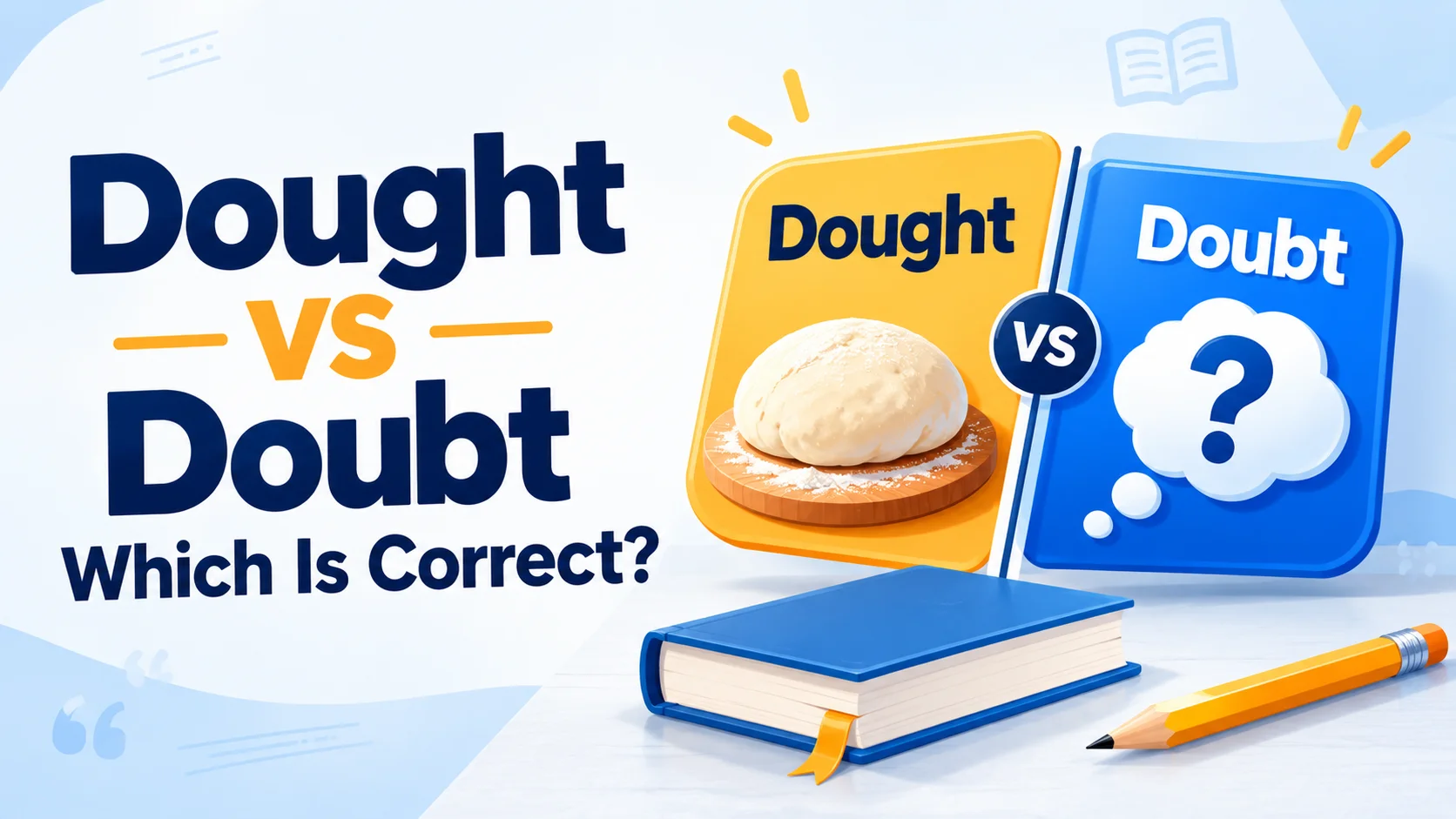
Dought vs doubt is an easy spelling mix-up because both forms look plausible at first glance. If you are trying to express uncertainty, hesitation, or a lack of belief, the word you want is doubt. It is a standard modern English word that works as both a noun and a verb. Cambridge Dictionary lists doubt with the pronunciation /daʊt/ in both British and American English.
The confusion usually comes from English spelling rather than meaning. The b in doubt is silent, so the word sounds like “dowt.” That makes dought seem reasonable, especially when learners already know words such as thought, bought, and brought. But spelling by sound does not work reliably in English. The written form remains in doubt, even though the b cannot be heard.
There is also an interesting historical detail: doubt has existed in older forms of English, so simply saying that the letter combination has never appeared in English would be inaccurate. Historical dictionaries record forms such as doubt connected with older words, while Middle English sources also show doubt as a historical spelling associated with dout/doute. In modern standard English, however, doubt is the spelling you should use when you mean uncertainty.
Dought vs Doubt: The Quick Answer
If you are writing a sentence about uncertainty, disbelief, or questioning something, choose doubt.
Correct: I doubt that he will arrive on time.
Incorrect: I doubt that he will arrive on time.
The difference is straightforward:
- Doubt = uncertainty or questioning.
- Dought = not the normal modern spelling of doubt.
- Doubt can be a noun or verb.
- Doubt is pronounced /daʊt/, with a silent b.
- Historical English and dialect sources contain forms of doubt, but those are not a reason to use it in ordinary modern writing.
The simplest rule
If you mean “I am not certain,” write doubt.
What Does “Doubt” Mean?
Doubt describes a lack of certainty. It can involve questioning whether something is true, whether something will happen, or whether someone or something can be trusted.
Cambridge defines the noun as a feeling of not being certain, particularly about whether something is true or good. As a verb, doubt can mean not feeling certain, thinking something is unlikely, or not believing someone or something.
Doubt as a Noun
As a noun, doubt refers to the uncertainty itself.
Examples:
- I have some doubt about his explanation.
- Her decision raised serious doubts.
- There is no doubt that practice improves performance.
- The future of the project is in doubt.
You will often see doubt with prepositions such as about, over, and in.
For example:
There is some doubt about the accuracy of the report.
The controversy has cast doubt over the company’s plans.
Doubt as a Verb
As a verb, doubt means to question something or feel that it may not be true or likely.
Examples:
- I doubt his story.
- She doubts that the plan will work.
- We doubt whether they can finish today.
- I doubt it.
The verb can also refer specifically to questioning someone’s honesty or statement. Cambridge gives constructions such as doubt someone and doubt someone’s word for this meaning.
Doubt Does Not Always Mean Strong Disbelief
This is an important distinction for learners.
If you say:
I doubt that it will rain.
You are expressing low confidence that it will rain. You are not necessarily claiming that rain is impossible.
By contrast:
I know that it will not rain.
is a much stronger statement.
So doubt often occupies a middle ground between certainty and disbelief.
Is “Dought” a Correct English Word?
In ordinary modern English, dought is not the spelling you should use for the meaning of uncertainty.
If you write:
I have doubt about the decision.
a modern reader will almost certainly understand that you intended:
I have doubt about the decision.
However, there is a useful historical qualification.
Dought in Historical English
Historical English sources do record dought and related spellings. The Middle English Dictionary lists dought(e) among historical forms of dout/doute, a word associated with uncertainty and doubt.
Separate historical and Scottish sources also record dought as a form connected with an older verb meaning to be useful, capable, or of worth. The Dictionary of the Older Scottish Tongue records doubt as a past-tense form of dow.
There is another interesting historical connection: the Middle English Dictionary records dought among historical forms of dough.
So the accurate answer is not simply “doubt has never existed.”
Instead:
Dought can occur in historical or dialectal English, but it is not the modern spelling of doubt.
For a school assignment, email, website, essay, or everyday message, use doubt when you mean uncertainty.
Dought vs Doubt: Side-by-Side Comparison
| Feature | Doubt | Dought |
| Standard modern spelling for uncertainty | Yes | No |
| Meaning of uncertainty | Yes | No |
| Noun | Yes | No, in this modern sense |
| Verb | Yes | No, in this modern sense |
| Pronunciation | /daʊt/ | Depends on historical usage |
| Common in modern writing | Very common | Extremely rare |
| Appropriate for school writing | Yes | No, unless discussing historical language |
| Appropriate for professional writing | Yes | No, when meaning uncertainty |
| Historical appearances | Yes | Yes, in several older forms/uses |
| Best choice for “I am uncertain” | Doubt | Not dought |
The practical distinction
If your sentence means:
“I am not certain.”
use:
I doubt it.
Not:
I doubt it.
That single substitution solves most doubt vs doubt questions.
Why Do People Spell “Doubt” as “Dought”?
The mistake is understandable because English gives learners several reasons to hesitate.
The Silent B Makes Doubt Tricky
The spelling is:
D-O-U-B-T
But the pronunciation is:
/daʊt/
The b is silent. Cambridge gives the British and American pronunciation as /daʊt/.
When people spell words based primarily on what they hear, they may remove letters they cannot hear—or add letters that seem to fit a familiar spelling pattern.
That can produce dought.
The “-ought” Pattern Looks Familiar
English has common words such as:
- thought
- bought
- brought
- fought
- sought
Because these are familiar, dought visually looks like it could belong to the same family.
But spelling patterns are not always productive. You cannot simply take the pronunciation of a word and construct its spelling by copying another word’s ending.
English Spelling Preserves History
The spelling of doubt is partly historical. Middle English forms included spellings such as doute and dout, while later spelling changes reintroduced the b associated with the word’s Latin history. Historical linguistic sources connect the word with Old French doute/douter and Latin dubitare.
That is why modern spelling and pronunciation do not line up perfectly.
Expert tip: When an English word contains a silent letter, learn the complete spelling as a visual unit instead of trying to reconstruct it from pronunciation.
Why Is the B Silent in “Doubt”?
The silent b is a historical feature rather than a pronunciation rule you can infer from the modern spelling.
The word developed through forms related to Old French doute/douter, ultimately connected with Latin forms such as dubius and dubitare. Historical spelling changes later brought the b back into the written English form to reflect that Latin relationship.
The pronunciation, however, did not simply acquire a /b/ sound.
This is why:
- doubt → /daʊt/
- debt → /det/
- subtle → /ˈsʌtəl/
all contain written letters that are not pronounced.
The useful lesson
Do not expect every letter in English to have a separate sound.
In doubt, the b belongs to the spelling even though it does not belong to the pronunciation.
How to Pronounce “Doubt” Correctly
The standard pronunciation is:
doubt → /daʊt/
It sounds approximately like “dowt.”
What Not to Say
Avoid pronouncing the word as though the b were audible:
“d-b-out” ❌
Instead, say it as one syllable:
“dowt” ✅
A Simple Pronunciation Trick
Think of the word:
out → doubt
They share the same main vowel sound.
The spelling changes, but the b remains silent.
How to Use “Doubt” Correctly in a Sentence
Understanding the spelling is only half the job. The next step is knowing how the word behaves grammatically.
“Doubt” as a Noun
Use the noun when the uncertainty itself is the subject or object.
Examples:
- I have some doubts about his explanation.
- Her decision caused doubt among the team.
- There is no doubt that she worked hard.
- His qualifications are beyond doubt.
A useful pattern is:
doubt + about/over + noun
There are doubts about the proposal.
Cambridge also records doubt about and doubt over as common constructions.
“Doubt” as a Verb
Use the verb when someone is questioning or not believing something.
Examples:
- I doubt his explanation.
- She doubts that the project will succeed.
- They doubt whether the plan is practical.
- I doubt it.
Doubt + Whether or If
Both whether and if can occur after doubt in many contexts.
For example:
I doubt whether he will come.
I doubt if he will come.
Cambridge specifically records both patterns.
For formal writing, whether can be a useful choice when you are explicitly considering alternatives.
Doubt + That
You can also use a that-clause:
I doubt that they will agree.
The that may be omitted in many ordinary sentences:
I doubt they will agree.
Both are understandable, although the shorter version often sounds more natural in everyday English.
Common Expressions With “Doubt”
Certain phrases are worth learning as complete units because they occur frequently.
| Expression | Meaning | Example |
| without a doubt | certainly | She is without a doubt the best candidate. |
| no doubt | certainly or probably, depending on context | No doubt they will hear the news soon. |
| in doubt | uncertain or questionable | The future of the project is in doubt. |
| cast doubt on | make something seem less certain | The evidence cast doubt on his explanation. |
| benefit of the doubt | temporarily accept someone as truthful or deserving despite uncertainty | I’ll give her the benefit of the doubt. |
| beyond reasonable doubt | the legal standard expressed in criminal proceedings | The case must be proved beyond reasonable doubt. |
Cambridge lists several of these expressions, including in doubt, without a doubt, cast doubt on, and beyond reasonable doubt.
Common Mistakes With “Doubt”
Writing “Dought” Because It Sounds Right
Wrong: I dought his answer.
Correct: I doubt his answer.
The solution is to memorize the spelling rather than spelling the word phonetically.
Pronouncing the B
Incorrect: “d-b-out”
Correct: “dowt”
The written b is silent.
Confusing Doubt With Drought
These words are unrelated in meaning.
- Doubt = uncertainty.
- Drought = an extended period of unusually low rainfall.
Example:
I doubt that the forecast is correct.
The region is suffering from a severe drought.
Confusing Doubt With Dough
These are also completely different words.
- Doubt = uncertainty.
- Dough = a mixture used to make bread, pastries, and similar foods.
Example:
I doubt that the bakery is open.
She kneaded the dough.
Assuming Every “-ought” Word Works the Same Way
This is a classic spelling trap.
Words that look similar do not necessarily share the same history or pronunciation. English spelling contains patterns, but it also contains many historical exceptions.
Doubt vs Uncertainty, Suspicion, and Hesitation
These words overlap, but they are not perfect substitutes.
| Word | Main idea | Example |
| Doubt | Questioning whether something is true or likely | I doubt his explanation. |
| Uncertainty | Lack of definite knowledge or confidence | There is uncertainty about the result. |
| Suspicion | A feeling that something may be wrong, dishonest, or hidden | The unusual behavior raised suspicion. |
| Hesitation | Difficulty deciding or acting | Her hesitation delayed the decision. |
| Disbelief | Inability or unwillingness to accept something as true | He stared at the result in disbelief. |
This distinction matters when you are writing precisely.
For example, a student who has not yet received an exam result may experience uncertainty. A student who thinks the marking may contain an error may have doubts. If they suspect someone deliberately changed the result, suspicion becomes more appropriate.
Choosing the most precise word makes writing clearer.
Dought vs Doubt: Examples in Real Writing
Everyday Conversation
“Do you think she’ll come?”
“I doubt it.”
Here, doubt expresses low confidence.
School Writing
The evidence raises doubts about the accuracy of the original conclusion.
This is appropriate because the writer is questioning a conclusion rather than claiming it is definitely false.
Professional Writing
We have some doubt about whether the proposed schedule is realistic.
This sounds measured rather than unnecessarily absolute.
Text Messages
Even informal writing should use the correct spelling:
I doubt he’ll be there.
Being casual does not change the spelling.
Academic Writing
The results cast doubt on the reliability of the earlier measurement.
This construction is useful when evidence makes an earlier claim less certain.
A Simple Memory Trick for Spelling “Doubt”
If you frequently write dought, use a three-part memory method.
1. Memorize the Visual Form
Break it into:
DOU + B + T
The B is silent, but it stays in the spelling.
2. Connect It With “Dubious”
The words doubt and dubious have a historical relationship through Latin roots associated with uncertainty and hesitation.
That gives you a useful visual association:
doubt → dubious → D-U-B
3. Learn the Phrase, Not Just the Word
Instead of memorizing doubt alone, learn common chunks:
- I doubt it
- without a doubt
- no doubt
- in doubt
- cast doubt on
- have doubts about
Seeing the correct spelling repeatedly makes recall easier.
When Should You Use “Doubt” Instead of “Dought”?
Use this quick decision process:
- Do you mean uncertainty?
→ Use doubt. - Are you questioning whether something is true or likely?
→ Use doubt. - Are you writing a school, professional, academic, or everyday sentence?
→ Use doubt. - Did you write “dought” because that is how the word sounds?
→ Change it to doubt. - Are you studying an old English, Middle English, or Scottish text?
→ Check the historical context before changing the spelling. Historical sources genuinely contain dought and related forms.
That final point is important. A historical spelling should not automatically be “corrected” when the purpose is to reproduce an original text accurately.
Doubt or Doubt? A Quick Practice Test
Choose the correct word.
- I ______ that he knows the answer.
- There is no ______ about her ability.
- The new evidence raised ______ about the original claim.
- I ______ whether they will finish today.
- She has some ______ about the plan.
Answers
- doubt
- doubt
- doubts
- doubt
- doubt
A useful check is to replace the word mentally with uncertainty or question. If the sentence still makes sense, you probably need doubt.
Conclusion
When deciding between doubt vs doubt, the practical answer is simple: choose doubt whenever you mean uncertainty, questioning, hesitation, or a lack of belief. It is the standard modern English word and can function as both a noun and a verb. Its pronunciation, /daʊt/, explains much of the spelling confusion because the b is completely silent. At the same time, English history deserves a small footnote. Dought does appear in historical and dialectal records, so it is not accurate to claim that the letter sequence has never existed as a word or form. Those specialized historical uses, however, do not make doubt a modern replacement for doubt. One final actionable tip: memorize doubt visually as D-O-U-B-T and learn it in phrases such as without a doubt and I doubt it. A common mistake to avoid: spelling English entirely by sound. In this case, the silent b is precisely the letter you need to remember.
Frequently Asked Questions
Q1. Is “dought” a correct spelling of “doubt”?
No, not when you mean uncertainty in modern English. The standard spelling is doubt. Historical dictionaries do record dought and related forms in older varieties of English, but those historical uses do not make it an alternative modern spelling of doubt.
Q2. Why is the B silent in “doubt”?
The silent b reflects the word’s historical development. English inherited forms related to Old French doute/douter, while later spelling changes connected the written form more visibly with Latin roots such as dubius and dubitare. The pronunciation retained no /b/ sound.
Q3. How do you pronounce “doubt”?
Doubt is pronounced /daʊt/ in both British and American English according to Cambridge. It is a single syllable and sounds approximately like “dowt.” The b is silent, so you should not pronounce it as a separate consonant.
Q4. Is “doubt” a noun or a verb?
It is both. As a noun, doubt means uncertainty: “I have some doubt about the plan.” As a verb, it means to question or feel uncertain: “I doubt that the plan will work.” This flexibility makes doubt common in everyday and formal English.
Q5. What is the difference between “doubt” and “drought”?
Doubt concerns uncertainty or lack of belief, while drought refers to a prolonged period of unusually low rainfall. Their spellings and meanings are unrelated. For example, “I doubt the prediction” expresses uncertainty, whereas “The region is experiencing a drought” describes a weather or climate condition.