

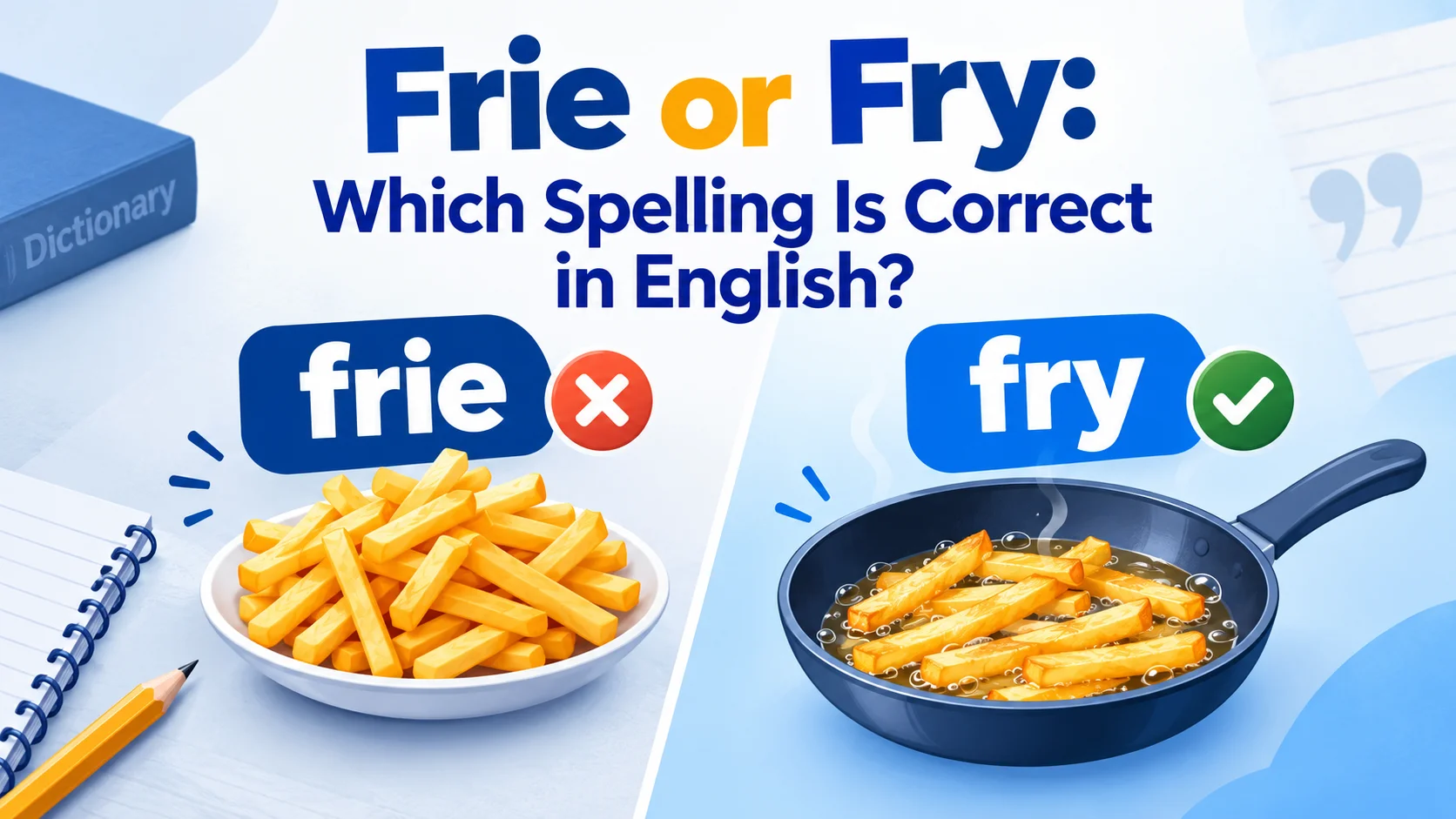
Frie or Fry is a common spelling question because the two forms look close enough to cause hesitation, especially when writing quickly. If you mean to cook food in hot oil or fat, the correct modern English spelling is fry. Standard dictionaries list fry as the verb, with forms such as fries, fried, and frying.
The confusion becomes more understandable when you look at English spelling patterns. Words such as tried and cried contain -ied, so a learner might naturally wonder whether fry should become frie. It does not. The base verb remains fry, while its grammatical forms change according to established English spelling rules. Learning the complete word family is much more useful than memorizing one isolated spelling.
There is also an interesting historical detail: frie has existed in older forms of English, including as a Middle English noun associated with young fish or fish spawn. That historical form is not the modern spelling of the cooking verb. So, for everyday modern English, recipes, schoolwork, emails, websites, and professional writing, the practical rule is simple: write “fry,” not “frie,” when you mean cooking food.
Frie or Fry: The Quick Answer
If you are deciding between frie and fry, choose fry when you mean cooking something in hot oil or fat.
- ✅ Fry the eggs for three minutes.
- ❌ Frie the eggs for three minutes.
- ✅ I want to fry some potatoes.
- ❌ I want to frie some potatoes.
The same spelling applies in both major varieties of English. British and American English both use fry for the cooking verb. Oxford lists the verb with the forms fry, fries, fried, and frying, while Cambridge likewise gives fry as the standard verb.
Is “Frie” a Word?
There is an important distinction here.
Frie is not the standard modern spelling of the cooking verb “fry.” If someone writes frie the onions, the expected correction is fry the onions.
However, it would be too broad to claim that the letter sequence frie has never appeared anywhere in English. Historical English records contain frie as an older form connected with fry in the sense of young fish.
That historical fact does not change the answer for modern spelling. A learner writing about cooking should use fry.
Is “Fry” a Word?
Yes. Fry is an established modern English word with several meanings.
As a verb, it can mean to cook food in hot oil or fat. As a noun, it can refer to fried food, a gathering involving fried food, or young fish, depending on context. Merriam-Webster records these separate noun and verb uses.
Fry vs. Frie at a Glance
| Form | Standard modern English? | Main use | Example |
| fry | Yes | Base verb; also a noun | Fry the onions. |
| fries | Yes | Third-person verb or plural food noun | She fries eggs. / We ordered fries. |
| fried | Yes | Past tense, past participle, adjective | He fried the chicken. |
| frying | Yes | -ing form | She is frying fish. |
| frie | No, not as the modern cooking verb | Usually a misspelling of fry | Frie the eggs. ❌ |
| frie in historical English | Historical/rare | Older forms with different historical meanings | Not the normal modern cooking spelling |
The most useful takeaway is not simply “fry is right.” It is to remember the entire modern word family:
fry → fries → fried → frying
That pattern will prevent several related mistakes at once.
What Does “Fry” Mean?
“Fry” as a Verb
The most familiar meaning of fry is to cook food in hot oil or fat. Oxford defines it as cooking something in hot fat or oil, or being cooked that way.
Examples:
- Fry the onions until they are soft.
- I usually fry an egg for breakfast.
- She fried the fish in a pan.
- They are frying potatoes for dinner.
The verb can be transitive, meaning it takes an object:
Fry the chicken.
It can also be intransitive when the focus is on the food undergoing the cooking process:
The bacon is frying.
Cambridge also records informal non-cooking meanings of fry, including becoming extremely hot or damaging something through excessive heat.
“Fry” as a Noun
The word fry can also be a noun, but the meaning depends on context.
In food-related English, a fry can refer to a gathering where food is fried, as in fish fry. Merriam-Webster also records fries as a noun referring to French fries or similar fried foods.
There is another noun meaning that has nothing to do with cooking: fry can mean young or newly hatched fish. Cambridge and Oxford both record this sense.
So the sentence determines the meaning:
- I will fry the vegetables. → cooking verb
- We ordered fries. → fried potato pieces
- The pond contains young fry. → young fish
Why Is It “Fry” and Not “Frie”?
The easiest answer is that fry is the established modern English spelling. English spelling is not always predictable from pronunciation, and it is not safe to create a spelling simply because it resembles another word.
The pronunciation of fry is /fraɪ/, the same basic vowel sound heard in words such as try and dry. Oxford and Cambridge both give this pronunciation.
The spelling frie may look plausible because English contains many words with ie. But spelling patterns have to be learned according to the word and its grammatical forms.
Fry → Fries
When fry becomes the third-person singular present form, the final y changes to i before -es:
fry → fries
For example:
- I fry eggs.
- You fry eggs.
- They fry eggs.
- She fries eggs.
The same spelling appears when fries is the plural noun:
We ordered two portions of fries.
Oxford specifically lists fries as the third-person singular form of the verb and as the plural form of the food noun.
Fry → Fried
The past tense and past participle are fried:
- I fried the eggs.
- She fried the vegetables.
- The chicken was fried.
- We had fried rice.
The correct spelling is fried, not fryed.
This is another reason it helps to learn fry as a word family rather than trying to spell each form from pronunciation.
Fry → Frying
The -ing form is frying:
- I am frying the onions.
- She is frying chicken.
- The fish is frying in the pan.
The spelling is not firing.
Oxford gives frying as the -ing form of fry.
Fry, Fries, Fried, and Frying: What’s the Difference?
| Form | Grammatical role | When to use it | Example |
| fry | Base verb | After to, modal verbs, or with I/you/we/they | I will fry the eggs. |
| fries | Verb | With he/she/it in the present tense | She fries eggs. |
| fries | Noun | More than one fry/French fry | He ordered fries. |
| fried | Past tense | Completed action | He fried the fish. |
| fried | Past participle/adjective | Perfect/passive constructions or description | The fish was fried. |
| frying | -ing form | Continuous actions or gerunds | They are frying fish. |
This table solves a common problem: not every form should be forced back into “fry.” The correct form depends on the sentence.
For example, saying She fry eggs is wrong, even though fry is the correct base spelling. The correct sentence is She fries eggs.
Why Do People Spell “Fry” as “Frie”?
The mistake is understandable, particularly for English learners.
Confusion With “-ie” Words
English has many words containing ie, including piece, field, believe, and chief. It also has words where y changes to i in particular grammatical forms.
That variety can make spelling rules feel inconsistent. Someone who knows that try becomes tired might wonder whether fry should somehow become fried. The answer is that the base form remains fried.
Pronunciation Does Not Give You the Whole Spelling
The word fry sounds like it ends in the long “i” sound. But English does not spell that sound in only one way.
Compare:
- fry
- try
- high
- pie
- night
They share a similar vowel sound but use different spellings.
That is why listening carefully is useful for pronunciation but not enough to determine spelling.
Typing Can Reinforce the Error
A quick search, text message, or social-media comment may contain frie simply because someone typed too quickly. Once a misspelling appears repeatedly, it can begin to look familiar.
Familiarity, however, is not the same as correctness.
Common Mistakes With “Fry”
“Frie” Instead of “Fry”
❌ Frie the potatoes until golden.
✅ Fry the potatoes until golden.
Use fry when it is the base verb.
“Frieing” Instead of “Frying”
❌ The onions are frieing.
✅ The onions are frying.
The standard -ing form is frying.
“Fryed” Instead of “Fried”
❌ We fryed the chicken.
✅ We fried the chicken.
The past tense is fried, not fryed.
“Frys” Instead of “Fries”
❌ The restaurant sells frys.
✅ The restaurant sells fries.
When fry is used as a food noun in the plural, the standard form is fries.
“She Fry” Instead of “She Fries”
❌ She fry eggs every morning.
✅ She fries eggs every morning.
This is a grammar problem as well as a spelling problem. With he, she, or it in the simple present, the verb is fries.
Is “Fry” Spelled Differently in British and American English?
No. Fry is standard in both British and American English.
There are differences in food vocabulary between the varieties. For example, Oxford notes that French fry is especially North American, while British English usually uses chip for that type of food.
But that does not create a frie/fry spelling difference.
| Meaning | American English | British English |
| Cooking in hot oil/fat | fry | fry |
| Past form | fried | fried |
| -ing form | frying | frying |
| Potato pieces | fries / French fries | Usually chips |
| Incorrect cooking spelling | frie ❌ | frie ❌ |
So if you are writing for an American audience, British audience, or international English audience, fry is the safe standard choice.
Fry vs. French Fries: Why the Confusion Happens
The relationship between fry and fries can make the spelling question more confusing.
A person may encounter all of these expressions:
- fry the potatoes
- fried potatoes
- frying potatoes
- French fries
- a plate of fries
They look different, but they belong to the same modern word family.
Merriam-Webster defines French fry as a strip of potato typically cooked by frying, while Oxford notes that fries can refer to long, thin pieces of potato fried in oil or fat.
Is It “Fry” or “Fries”?
The answer depends on the grammatical job.
Use fry:
I am going to fry the potatoes.
Use fries:
I ordered fries with my meal.
Use fries as a verb:
The restaurant fries its potatoes in oil.
The spelling is therefore not simply a matter of choosing your favorite version. Grammar determines the form.
Fry in Real Sentences
1. Examples With “Fry”
- Please fry the onions before adding the tomatoes.
- I usually fry an egg in the morning.
- They fry fish for dinner on Fridays.
- You can fry the vegetables in a little oil.
2. Examples With “Fries”
- She fries the eggs separately.
- The restaurant serves fries with its burgers.
- He ordered a large portion of fries.
3. Examples With “Fried”
- We had fried chicken for lunch.
- She fried the onions before adding the sauce.
- The rice was fried with vegetables.
4. Examples With “Frying”
- The cook is frying the fish.
- I could smell onions frying in the kitchen.
- Frying vegetables can change their texture and flavor.
Cambridge and Oxford both use examples involving foods such as eggs, onions, chicken, and fish to illustrate the verb and its forms.
Fry in Formal and Informal Writing
A spelling error may seem small, but the appropriate standard depends on where you are writing.
School and Academic Writing
Use fry, fries, fried, or frying according to grammar.
For example:
The instructions explain how to fry the vegetables.
Avoid frie because school and academic writing generally require standard spelling.
Emails and Professional Writing
If you are writing a recipe, product description, restaurant review, food article, or business message, fry is the professional choice.
A single spelling mistake rarely changes the meaning, but repeated errors can make otherwise clear writing look less carefully edited.
Text Messages and Social Media
Informal writing is more tolerant of typos, abbreviations, and casual language. Even so, if you want your writing to be understood as correct standard English, use fry.
This is especially important for public posts, websites, captions, and content intended for a wider audience.
The Origin of “Fry”
The history of fry explains why its modern spelling should not be reconstructed from the spelling of other words.
Merriam-Webster traces the cooking verb through Middle English friend and Anglo-French frire to Latin ** frigere **, meaning “to roast.” Oxford similarly gives the verb’s origin through Old French frire and Latin frigere.
Merriam-Webster records the first known use of the cooking verb in English in the 13th century.
There is a separate historical story behind fry meaning young fish. Older forms include frie, which helps explain why historical records may contain that spelling.
That distinction matters:
Historical spelling is not automatically modern standard spelling.
A reader researching old English texts may encounter frie. Someone writing a modern recipe should write fry.
Quick Grammar Guide to “Fry”
| Grammar form | Correct spelling | Example |
| Base form | fry | I want to fry the fish. |
| Third-person singular | fries | She fries the fish. |
| Past simple | fried | She fried the fish. |
| Past participle | fried | The fish was fried. |
| Present participle | frying | She is frying the fish. |
| Noun, food | fry / fries | We ordered fries. |
A Simple Sentence Test
When unsure, first decide what the sentence is doing.
Are you describing the action?
→ Use fry, fries, fried, or frying according to tense and subject.
Are you naming the food?
→ You may need fries.
Are you looking at an old historical text?
→ Do not automatically “correct” an unusual historical form without checking its historical context.
This approach is more reliable than trying to remember a single isolated spelling rule.
A Practical Checklist for Choosing the Right Form
Before publishing or submitting a sentence, check:
- Do I mean cooking in hot oil or fat? → Use the fry word family.
- Is it the basic verb? → fry
- Is the subject he, she, or it in the present tense? → fries
- Is the action already completed? → fried
- Is the action happening now? → frying
- Am I referring to the food? → Usually fries in the relevant context.
- Did I accidentally type frie? → Replace it with the correct modern form.
How to Remember the Spelling
A useful memory trick is to learn the family rather than the single word:
Fry → fries → fried → frying
Once these four forms are familiar, several common mistakes become much easier to spot.
Another helpful comparison is:
- try → tries → tried → trying
- fry → fries → fried → frying
The two verbs behave similarly in several forms. You do not need to invent frie to explain the pronunciation.
Memory tip: If you mean the cooking action, start with FRY. The spelling FRIE should immediately look suspicious.
Is “Frie” Ever Correct?
For ordinary modern English writing, frie should not replace fry when you mean the cooking verb.
However, language history is more complicated than a simple “never existed” claim. Middle English sources contain frie as a noun connected with young fish or fish spawn, and historical dictionaries document related forms.
There can also be proper names or words from other languages that happen to be spelled Frie or frie. Those cases are unrelated to the modern English cooking verb.
Therefore, the best practical rule is:
If your sentence means “cook in hot oil or fat,” use “fry.”
Conclusion
The answer to “Frie or Fry?” is straightforward for modern English: fry is the correct spelling when you mean the action of cooking food in hot oil or fat. Its standard forms include fries, fried, and frying, and those forms follow their own grammatical patterns. Major dictionaries such as Merriam-Webster, Oxford, and Cambridge all support this modern usage. It is worth remembering that fire does have a historical connection to English, so saying that the sequence has never existed would be misleading. But historical forms are not the same thing as contemporary spelling conventions. One final actionable tip: memorize the complete sequence fry → fries → fried → frying rather than memorizing fry alone. A common mistake to avoid: do not create frie, firing, or fryer simply because they seem logical. In modern English, the established forms are already clear. When the meaning is cooking, choose “fry” and let the sentence determine the grammatical form.
Frequently Asked Questions
Q1. Is it “frie” or “fry”?
Fry is the correct modern English spelling when you mean to cook something in hot oil or fat. Frie is not the standard spelling of this cooking verb. The related forms are fries, fried, and frying, depending on the grammar of the sentence.
Q2. Is “frie” ever a real English word?
Frie does appear in historical English records, including Middle English, where it had a meaning associated with young fish or fish spawn. That is different from modern fry meaning cooking. In contemporary everyday English, use fry for the cooking verb.
Q3. Is it “fryed” or “fried”?
The correct past-tense and past-participle form is fried. For example, She fried the eggs and the chicken was fried. Fried is a spelling error. Oxford lists fried as the past form of fry.
Q4. Why is “frying” not spelled “frieing”?
The correct -ing form is frying. English does not form it by replacing the final y with ie. The standard verb forms are fry, fries, fried, and frying, so frying should be avoided in modern English.
Q5. Is “fry” the same in British and American English?
Yes. Fry is the standard spelling in both British and American English. The bigger regional difference concerns the food name: American English commonly uses fries, while British English generally uses chips for the corresponding potato dish.