

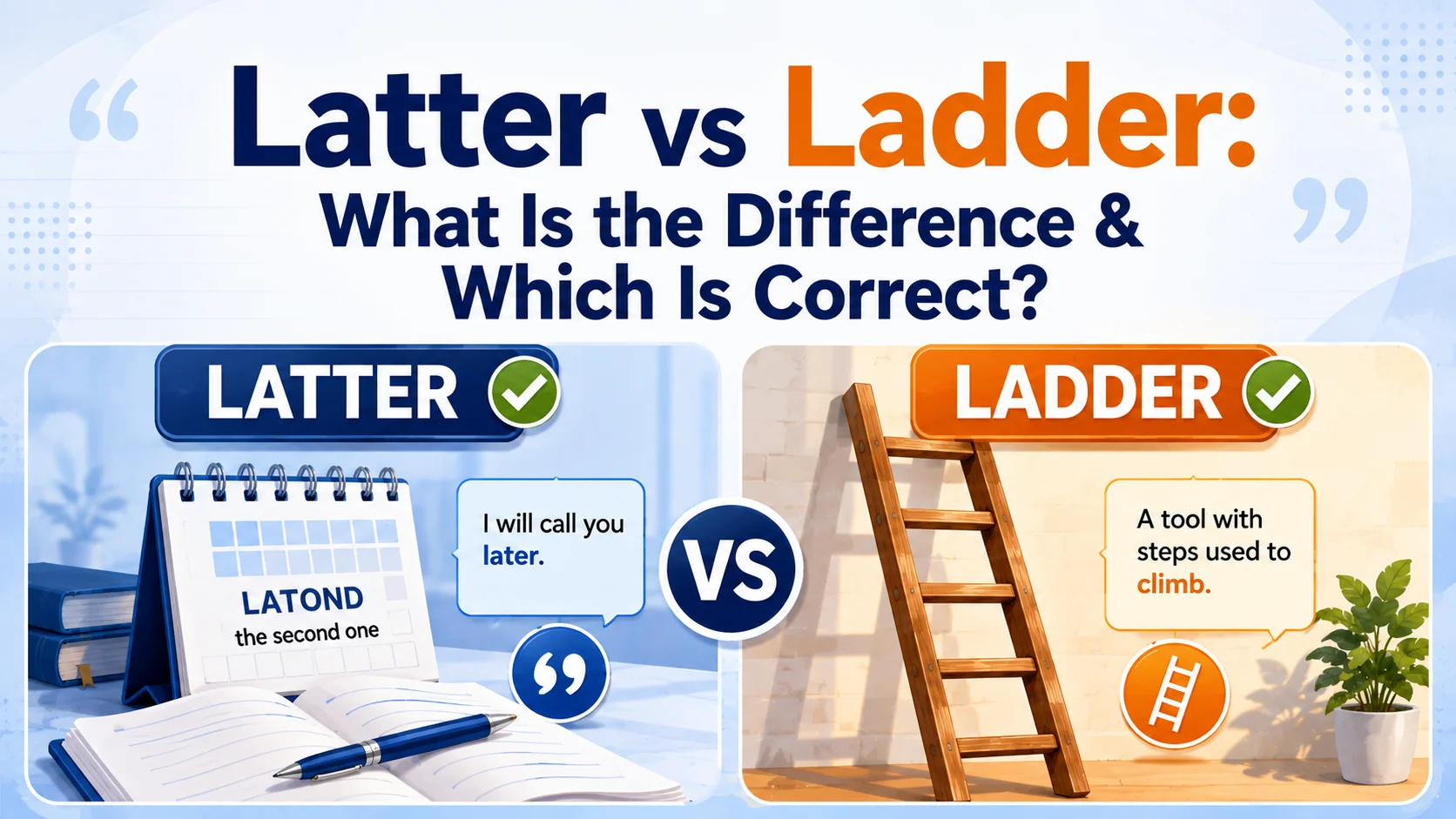
Latter and ladder are easy to confuse because they look and sound remarkably similar, but they perform completely different jobs in English. One usually helps you identify the second of two things already mentioned; the other is a physical structure you use to climb up or down. A single letter changes the meaning entirely, so choosing the wrong one can make an otherwise clear sentence confusing or unintentionally funny.
The good news is that you don’t need to memorize a complicated grammar rule. Once you understand the context behind each word, the distinction becomes straightforward. In this guide, you’ll learn what latter means, what ladder means, how to pronounce them, when each word is appropriate, how latter relates to former, and why latter should not automatically be treated as a synonym for later or last. You’ll also see practical examples that show the difference in real writing.
The most useful rule is simple: latter refers back to something in a sequence or comparison, while ladder normally refers to something used for climbing. For example, “I was offered tea or coffee, and I chose the latter” means you chose coffee. On the other hand, “I used a ladder to reach the roof” describes a piece of equipment. By the end of this article, you’ll be able to distinguish latter vs ladder quickly, even when you’re writing under pressure.
Latter vs Ladder: Quick Answer
Both latter and ladder are correct English words. The correct choice depends entirely on what you mean.
- Latter = the second of two people, things, choices, or groups previously mentioned.
- Ladder = a structure with rungs or steps used for climbing.
- Latter can also mean nearer to the end of a period or sequence, as in “the latter part of the year.”
- Ladder can be used figuratively, too, as in “the corporate ladder” or “the economic ladder.”
| Word | Main meaning | Typical use | Example |
| Latter | The second of two things mentioned | Comparisons and references | “I prefer the latter.” |
| Latter | Near or toward the end | Time or stages | “The latter part was difficult.” |
| Ladder | A climbing structure | Physical objects | “He climbed the ladder.” |
| Ladder | A series of levels or stages | Figurative language | “She moved up the career ladder.” |
So, if you’re asking “Which spelling is correct?”, neither spelling is universally correct. Latter and ladder are both legitimate words; the meaning you intend determines which one belongs in your sentence.
What Does “Latter” Mean?
Latter has two important meanings, and understanding both prevents a lot of confusion.
The most familiar use is “the second of two things or people that have already been mentioned.” Cambridge Dictionary gives the example of someone choosing between two options and selecting the latter. Merriam-Webster likewise defines latter in this sense as the second of two, while also recognizing its use for the last of several items.
For example:
I was offered a train ticket or a bus ticket. I chose the latter.
Here, latter = bus ticket because the bus ticket was mentioned second.
A useful way to visualize it is:
First item → former
Second item → latter
Latter Means “The Second One” in a Comparison
Suppose you write:
Sarah considered studying biology or chemistry. She eventually chose the latter.
The two choices are:
- Biology
- Chemistry
Therefore, the latter refers to chemistry.
This is why latter normally needs a clear reference. If a reader sees:
I prefer the latter.
they may reasonably ask, “The latter of what?”
The word isn’t a replacement for a noun in isolation. It works because the surrounding context tells the reader what the two possibilities are.
Examples of “Latter”
- I could work from home or from the office, and I chose the latter.
- The company sells laptops and tablets; the latter category has grown rapidly.
- We discussed the advantages and disadvantages of both plans. The latter were easier to address.
- She considered walking or taking the train and chose the latter.
- The first proposal focused on speed, while the latter emphasized reliability.
In each example, latter points backward.
Latter Can Also Mean “Near the End”
This is an important meaning that beginners sometimes miss.
In expressions such as “the latter part,” “the latter stages,” “the latter half,” and “the latter years,” the word refers to a later or concluding portion of something.
For example:
The latter half of the movie was much more dramatic.
Here, latter isn’t identifying the second item in a pair. It means the part nearer the end.
Cambridge specifically defines this adjective sense as being near or toward the end of something.
Other examples include:
- the latter stages of the competition
- the latter half of the century
- in his latter years
- during the latter part of the project
This meaning is particularly common in formal, academic, historical, and professional writing.
What Does “Ladder” Mean?
A ladder is primarily a physical structure designed for climbing. A conventional ladder has two long sides connected by horizontal rungs or steps.
Merriam-Webster defines a ladder as a structure for climbing up or down, and it also records broader figurative meanings involving a series of levels or stages.
For example:
He placed the ladder against the wall.
The word refers to a real object.
Common Uses of “Ladder”
You might use ladder when talking about:
- Painting a ceiling
- Cleaning windows
- Reaching a high shelf
- Repairing a roof
- Climbing into a loft
- Performing construction work
- Accessing elevated equipment
Examples:
Please hold the ladder while I climb.
She used a step ladder to reach the top shelf.
The electrician carried an extension ladder into the building.
A stepladder is a particular type of ladder that can stand independently and has broad steps. An extension ladder can be extended to provide additional reach.
“Ladder” Can Have a Figurative Meaning
You don’t always need an actual climbing structure.
English frequently uses ladder metaphorically to describe a hierarchy or progression:
- career ladder
- corporate ladder
- social ladder
- economic ladder
For example:
She worked hard to climb the corporate ladder.
Nobody expects her to carry a metal ladder into the office. The expression describes progressing through levels of an organization or social system.
Merriam-Webster also records ladder as a series of ascending stages or levels, which explains these expressions.
Latter vs Ladder: The Main Difference
The easiest distinction is based on meaning, not spelling.
| Question | Use latter | Use ladder |
| Are you referring to the second of two previously mentioned things? | ✓ | |
| Are you referring to the end of a period or stage? | ✓ | |
| Are you talking about something used for climbing? | ✓ | |
| Are you describing a hierarchy or progression? | ✓ | |
| Does the word point backward to something already mentioned? | Usually | No |
| Is it normally a physical object? | No | Usually |
Compare these sentences:
I was offered a promotion or a bonus, and I chose the latter.
I needed a ladder to change the light fixture.
The first sentence involves two choices. The second involves climbing equipment.
That difference is more important than the fact that the words look nearly identical.
Why Do People Confuse Latter and Ladder?
There are several reasons this pair causes mistakes.
They Differ by Only One Letter
Latter contains tt.
Ladder contains dd.
That tiny spelling difference is easy to overlook when you’re typing quickly.
More importantly, both words begin with “latt-/ladd-” and contain similar vowel sounds. A writer who knows the meaning but doesn’t stop to check the spelling can easily choose the wrong word.
Their Pronunciations Are Close
Cambridge gives the UK pronunciation of latter as /ˈlæt.ər/ and the US pronunciation as /ˈlæt̬.ɚ/.
The words are therefore close enough in sound to create confusion, especially for English learners.
In careful pronunciation, the important difference is the consonant:
- latter → /t/
- ladder → /d/
In many American accents, the t in latter may sound similar to a quick d because of the way the sound is pronounced between vowels. That makes the two words even harder to distinguish by ear.
Spell-Check May Not Save You
This is a classic wrong-word problem.
If you type:
I climbed the latter.
your spell-checker may not complain because latter is spelled correctly.
The problem isn’t spelling in isolation. The problem is that the word doesn’t make sense in the intended context.
The same thing happens in reverse:
I chose the ladder.
That sentence is grammatically possible if you’re literally choosing a ladder, but if the intended meaning was “the second option,” you’ve chosen the wrong word.
Context matters more than spell-check.
Latter vs Ladder Pronunciation
For learners, pronunciation can help, but it shouldn’t be your only method of distinguishing the words.
How to Pronounce “Latter”
In British English:
/ˈlæt.ə/
It sounds roughly like:
LAT-uh
The first syllable is stressed.
How to Pronounce “Ladder”
The pronunciation is very similar, but the middle consonant is different.
A useful learner’s approximation is:
LAD-uh
The d is voiced, whereas the t in latter is traditionally represented by a /t/ sound in British English.
A Better Strategy Than Listening Alone
If you’re unsure whether you’ve heard latter or ladder, look at the sentence around it.
Ask:
Is the speaker identifying an option or referring to something near the end?
If yes, you probably need latter.
Ask:
Is the speaker talking about something you climb?
If yes, you need ladder.
Meaning is the more reliable test.
Latter vs Former: The Grammar Pair You Should Know
If you’re learning latter, you should learn former at the same time.
These two words form a useful pair when referring to two previously mentioned things.
- Former = the first one
- Latter = the second one
For example:
Emma considered medicine and engineering. She chose the former.
Former = medicine.
Now change the sentence:
Emma considered medicine and engineering. She chose the latter.
Latter = engineering.
Cambridge defines former in this specific noun use as the first of two people, things, or groups previously mentioned.
The Simple Formula
When you have:
A + B
then:
former = A
latter = B
A quick example:
Dogs and cats are both popular pets, but the former require more outdoor exercise while the latter are often more independent.
Here:
- former = dogs
- latter = cats
Why This Matters in Formal Writing
Former and latter are particularly useful when you want to avoid repeating nouns.
Instead of:
The first proposal focuses on cost, while the second proposal focuses on quality.
you might write:
The first proposal focuses on cost, while the latter focuses on quality.
This can make formal prose more concise. However, clarity should come first. If the sentence contains several competing nouns or ideas, repeating the noun may actually be easier for the reader.
Expert tip: Don’t use latter simply because it sounds sophisticated. Use it when the reference is unmistakable.
How to Use “Latter” Correctly in Real Sentences
When Comparing Two Choices
We could travel by train or by plane. I prefer the latter.
The latter = plane.
When Referring to Two Ideas
The article discusses accuracy and readability. The latter is especially important for beginners.
The latter = readability.
In Workplace Communication
We can schedule the meeting for Tuesday or Thursday. The latter works better for me.
The latter = Thursday.
This is perfectly grammatical, but in a very casual message, “Thursday works better for me” may be even clearer.
In Academic Writing
The study considers environmental and economic effects. The latter receive less attention in previous research.
Here, latter efficiently points back to the second topic.
However, academic writers should be careful when several ideas appear between the original nouns and latter. A distant reference can force readers to reread the sentence.
When Referring to the End of Something
The latter stages of the experiment produced different results.
Here, latter means the later stages, not “the second of two.”
Similarly:
The latter half of the book is more technical.
That means the part toward the end.
When Should You Use “Ladder”?
Use ladder when the meaning involves climbing, rungs, levels, or a progression.
Physical Climbing
The painter climbed the ladder.
Household Tasks
We need a ladder to reach the attic.
Workplace Situations
The technician brought an extension ladder.
Figurative Progression
He hopes to move up the corporate ladder.
The last example demonstrates why context remains important. A ladder doesn’t have to be physical, but it still represents a series of levels.
Latter vs Later vs Ladder: Three Words You Shouldn’t Mix Up
This is one of the most useful distinctions for English learners because all three words can appear in similar-looking sentences.
| Word | Meaning | Example |
| Latter | Second of two; toward the end | “I chose the latter.” |
| Later | At a subsequent time | “I’ll call you later.” |
| Ladder | Climbing structure; series of levels | “He climbed the ladder.” |
Consider these three sentences:
I’ll finish the report later.
This is about time.
The latter option is cheaper.
This is about the second option.
The ladder is in the garage.
This is about a physical object.
A Simple Test
If you could replace the word with “afterward,” you probably mean later.
If you could replace it with “the second one,” you probably mean latter.
If you could replace it with “climbing equipment,” you probably mean ladder.
These substitution tests are often more useful than trying to remember spelling rules.
Can “Latter” Refer to More Than Two Things?
This question has a slightly more nuanced answer than the usual grammar rule suggests.
Traditional usage advice often recommends restricting former and latter to situations involving two items. That remains a sensible rule when clarity matters.
However, major dictionaries recognize that latter is also used to refer to the last item in a series of more than two. Merriam-Webster explicitly documents this usage and notes that evidence for it goes back centuries.
For example:
We discussed the budget, schedule, and staffing, and the latter received the most attention.
This can be understood as referring to staffing, the last item mentioned.
Still, there’s an important practical point: just because a usage is established doesn’t mean it’s always the clearest choice.
If you’re writing for a broad audience, this may be clearer:
We discussed the budget, schedule, and staffing, and the last issue received the most attention.
Or simply:
We discussed the budget, schedule, and staffing. Staffing received the most attention.
For formal or high-stakes writing, explicit nouns can eliminate ambiguity.
Is “Latter” the Same as “Second”?
Not always.
In a sentence such as:
Of the two options, I prefer the latter.
Latter effectively means the second one.
But latter can also refer to something near the end of a period or sequence:
During the latter part of the century…
You wouldn’t normally replace that with “second part” because the intended meaning isn’t necessarily “number two.” It means the later or concluding portion.
So the words overlap in some contexts but aren’t interchangeable everywhere.
Is “Latter” the Same as “Last”?
Again, not always.
When two things are mentioned:
I compared the first model with the latter.
Latter identifies the second item.
But last generally identifies the final item in a sequence or the most recent item in a relevant context.
Consider:
We discussed three proposals, and the last proposal was rejected.
That’s direct and clear.
Although latter can occur with more than two items, as noted above, last is often the safer choice when you’re explicitly talking about the final member of a larger series.
Is “Latter” Interchangeable With “Later”?
No.
This is a very common spelling mistake.
Later is related to time:
I’ll finish the assignment later.
Latter is related to position, sequence, or the end:
Of the two assignments, I preferred the latter.
A useful memory association is:
later → time
latter → the other/second one
There is also a historical connection between latter and ideas of being later or toward the end, which helps explain why the words look similar. Merriam-Webster traces latter to an Old English comparative related to late.
Common Mistakes With Latter and Ladder
Mistake 1: Using “Ladder” for the Second Option
Incorrect:
I was offered tea or coffee, and I chose the ladder.
Unless you literally chose a ladder, this is wrong.
Correct:
I was offered tea or coffee, and I chose the latter.
Mistake 2: Using “Latter” for a Physical Object
Incorrect:
Please bring the latter so I can reach the roof.
Correct:
Please bring the ladder so I can reach the roof.
Mistake 3: Using “Latter” Without a Clear Reference
This sentence creates a problem:
The latter was more useful.
The reader needs to know what “the latter” refers to.
Better:
We compared email and live chat. The latter was more useful for urgent questions.
Now the reference is obvious.
Mistake 4: Confusing Latter With Later
Incorrect:
I’ll send the document latter.
Correct:
I’ll send the document later.
Mistake 5: Assuming a Correctly Spelled Word Must Be Correct
This is perhaps the most important proofreading lesson.
Latter is spelled correctly in:
She climbed the latter.
But the sentence doesn’t communicate the intended meaning if you’re talking about climbing equipment.
Always proofread for meaning, not just spelling.
Is “Latter” Appropriate in Everyday Conversation?
Yes. There is nothing grammatically wrong with using latter in speech.
However, it can sound somewhat more formal than alternatives such as:
- the second one
- the second option
- that one
- the last one, depending on context
For example:
Would you prefer the red car or the blue car?
I’ll take the latter.
This is perfectly natural, although:
I’ll take the blue one.
may sound more relaxed in everyday conversation.
In professional and academic writing, latter can be particularly useful because it avoids unnecessary repetition.
The best choice depends on audience, tone, and clarity, not on whether one version is inherently “better English.”
Practical Editing Checklist for Latter vs Ladder
Before you publish, send, or submit a sentence, run through this quick check:
| Question | If yes, choose |
| Am I referring to the second of two previously mentioned things? | Latter |
| Am I referring to a later/end portion of something? | Latter |
| Am I talking about something used to climb? | Ladder |
| Am I describing a hierarchy or progression? | Ladder |
| Am I talking about a time after now or another event? | Later |
| Is my reference to “the latter” unclear? | Rewrite the sentence |
| Have I mentioned two clear options? | Check whether former/latter is appropriate |
A particularly useful editing habit is to replace latter temporarily with “the second one.” If the sentence still makes sense, you’ve probably chosen the right word.
Likewise, replace ladder with “climbing structure.” If that substitution makes sense, ladder is probably correct.
Latter vs Ladder: Practice Quiz
Choose latter, ladder, or later for each sentence.
- I can meet you today or tomorrow; the ______ works better for me.
- Please move the ______ away from the doorway.
- I’ll finish the report ______ this afternoon.
- She chose the second proposal because the ______ was more practical.
- We used a ______ to reach the roof.
- The ______ stages of the project were the most challenging.
- He hopes to climb the corporate ______.
- Of the two desserts, I preferred the ______.
- Can you put the ______ in the shed after you’re finished?
- We can discuss that issue ______.
Answer Key
- latter — It refers to the second option, tomorrow.
- ladder — It is a physical object.
- later — The sentence refers to a subsequent time.
- latter — It identifies the second proposal.
- ladder — It is used for climbing.
- latter — It means the part nearer the end.
- ladder — “Corporate ladder” is a figurative expression for levels of advancement.
- latter — It refers to the second dessert.
- ladder — A physical object stored in a shed.
- later — It refers to a future time.
Conclusion
The difference between latter vs ladder becomes much easier once you stop treating them as a spelling problem and start treating them as a meaning problem. Latter points back to a previously mentioned choice or item, commonly the second of two, and it can also describe something toward the end of a period. Ladder, by contrast, usually names a structure used for climbing, although it can also describe a hierarchy such as the corporate ladder. One final actionable tip: when you’re unsure, replace latter with “the second one” and ladder with “climbing structure.” The sentence will usually reveal which word you need. A common mistake to avoid is relying entirely on spell-check: both words are correctly spelled, so software may not notice a wrong-word error. In the end, remember the meaning first, the spelling second—and context will usually make the right choice obvious.
Frequently Asked Questions
Q1. Is “latter” or “ladder” correct?
Both are correct, but they mean different things. Latter generally refers to the second of two previously mentioned things or to a later part of something. Ladder usually means a structure used for climbing. The context determines which spelling belongs in your sentence.
Q2. Does “latter” always mean the second of two things?
No. That is its most familiar reference meaning, but latter can also describe something near or toward the end of a period or sequence. Major dictionaries also record its use for the last item in a series of more than two, although last may be clearer in such cases.
Q3. What is the difference between “latter” and “former”?
When the words refer back to two previously mentioned things, former means the first and latter means the second. For example, in “We compared tea and coffee; I preferred the latter,” latter refers to coffee. This paired use is common in formal and academic writing.
Q4. Is “latter” the same as “later”?
No. Later normally relates to time, as in “I’ll call you later.” Latter relates to position or sequence, as in “I chose the latter.” Although their meanings have historical connections, modern English uses them for different purposes, so they shouldn’t be treated as interchangeable.
Q5. Why does “latter” sometimes sound like “ladder”?
In many accents, particularly American English, the t in latter can be pronounced in a way that sounds very similar to the d in ladder. Cambridge lists distinct dictionary pronunciations, but actual speech varies by accent and speaking style. When listening, context is often more reliable than sound alone.