

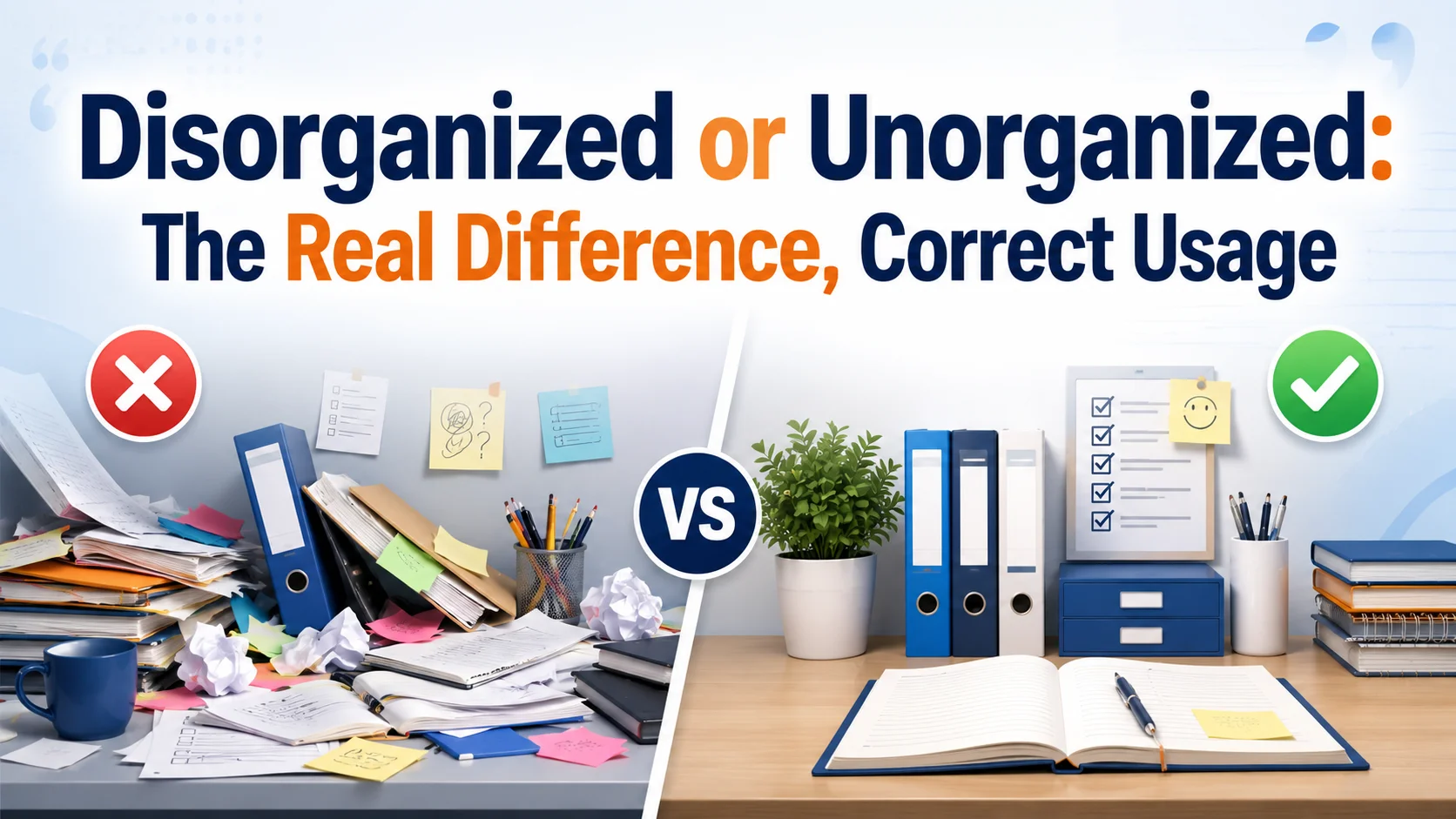
Disorganized or unorganized can both describe something that lacks order, but they aren’t always interchangeable. If you’re trying to choose the right word, the most useful distinction is one of emphasis: disorganized usually draws attention to poor planning, disorder, or ineffective organization, while unorganized can simply mean that something has not been organized. Both are established English adjectives, and neither is automatically “more correct.” Oxford lists unorganized as less frequent than disorganized for the meaning “badly planned,” while also giving it a separate sense meaning “not having been organized.”
The confusion becomes easier to understand when you look beyond the prefixes dis- and un-. A messy desk, a poorly managed project, uncategorized data, and a person who regularly forgets appointments can all involve a lack of organization, but the most natural adjective may differ. Disorganized often carries a stronger suggestion that something is poorly arranged or managed. Unorganized can be more descriptive when the point is simply that organization hasn’t been established. Context, the noun you’re describing, and the tone you want all matter.
One popular rule says that disorganized means something was organized and then lost its structure, while unorganized means it was never organized in the first place. That’s a useful shortcut, but it isn’t a hard grammar rule. Dictionaries don’t require that timeline. Merriam-Webster defines disorganized broadly as lacking coherence, system, or a central organizing agency, while unorganized means not organized and can include things that haven’t been brought into a coherent whole. In this guide, you’ll learn how the words actually work, where they overlap, and how to choose between them confidently.
Disorganized vs Unorganized: Quick Answer
Both disorganized and unorganized are correct English words.
The practical difference is this:
- Disorganized usually emphasizes poor order, poor planning, disorder, or ineffective organization.
- Unorganized usually emphasizes the absence of organization or the fact that something has not been organized.
- Disorganized is generally more common when describing a person’s habits, a badly run event, or a system that works poorly.
- Unorganized is especially useful when describing something that simply hasn’t been organized, such as unorganized data or a collection of photographs.
- The two words overlap, so the difference isn’t an absolute either/or rule.
Cambridge defines disorganized as “badly planned and without order” and also uses it for someone who isn’t good at planning or organizing. Oxford, meanwhile, explicitly lists unorganized as a less frequent equivalent of disorganized while separately defining it as “not having been organized.”
The One-Sentence Rule
Use “disorganized” when the problem is poor or disorderly organization; use “unorganized” when the main point is simply that organization is absent.
It’s a guideline, not a law.
Quick Examples
My desk is disorganized.
This suggests the desk is messy or poorly arranged.
The photographs are unorganized.
This can simply mean the photographs haven’t been sorted into albums, folders, dates, or categories.
But these aren’t mutually exclusive:
The photographs are disorganized.
That sentence is also possible if the collection is difficult to navigate or poorly arranged.
What Is the Difference Between Disorganized and Unorganized?
The difference is largely semantic rather than grammatical. Both words are adjectives formed from organized, and both can describe a lack of order.
What changes is the perspective.
Imagine a box containing 2,000 photographs.
If you say:
The photographs are unorganized.
you’re primarily telling the reader that no useful organization has been applied.
If you say:
The photographs are disorganized.
you’re more likely to suggest that the collection is messy, confusing, poorly arranged, or difficult to manage.
The distinction becomes even clearer with people and systems. Cambridge specifically defines disorganized in terms of poor planning and a person’s inability to organize effectively. Oxford similarly defines it as being badly planned or being unable to plan or organize well.
Disorganized Emphasizes Disorder or Poor Structure
Disorganized often describes a problem with the way things are arranged or managed.
For example:
The meeting was disorganized.
This doesn’t merely mean that nobody had created an agenda. It suggests the meeting itself didn’t run in an orderly or effective way.
Likewise:
Her work schedule is disorganized.
The implication is that the schedule is difficult to follow, poorly planned, or inefficient.
Unorganized Emphasizes a Lack of Organization
Unorganized can be more neutral when the important fact is that something hasn’t been organized.
For example:
The survey responses are still unorganized.
The sentence doesn’t necessarily accuse anyone of doing a poor job. It may simply mean the responses haven’t yet been sorted, categorized, or entered into a structured system.
This is one reason unorganized data is a natural expression. Oxford specifically gives unorganized data as an example of its “not having been organized” sense.
Why the Two Words Can Overlap
Real English doesn’t divide every situation into two neat boxes.
Merriam-Webster defines unorganized broadly as “not organized,” including material that isn’t brought into a coherent or well-ordered whole.
At the same time, Merriam-Webster defines disorganized as lacking coherence, system, or a central guiding structure.
Those definitions naturally overlap.
So don’t force a sentence into unorganized merely because something was “never organized,” or into disorganized merely because something looks messy. Consider what you actually want to communicate.
What Does “Disorganized” Mean?
Disorganized means lacking effective order, structure, planning, or coordination.
It can describe:
- People
- Rooms
- Offices
- Schedules
- Meetings
- Projects
- Businesses
- Systems
- Records
- Arguments
- Work habits
Cambridge gives two especially useful senses: something can be badly planned and without order, or a person can be not good at planning or organizing things.
Common Characteristics of Something Disorganized
A disorganized situation often has one or more of these features:
- Things are difficult to find.
- Tasks aren’t coordinated.
- Plans are unclear.
- Information is scattered.
- Responsibilities aren’t defined.
- Deadlines are missed.
- A system exists but doesn’t work well.
- People don’t know what they’re supposed to do.
For example:
The conference was completely disorganized; attendees weren’t told where to go.
The problem isn’t simply that there was no organization. The organization was ineffective enough to cause confusion.
Disorganized in Everyday Life
My bedroom is disorganized.
Her calendar is completely disorganized.
I have a disorganized pile of paperwork on my desk.
These examples all focus on disorder or poor arrangement.
Disorganized in Professional Contexts
The company has a disorganized filing system.
The project became disorganized after the manager left.
The team has a disorganized workflow.
Here, the adjective can imply consequences: wasted time, unclear responsibilities, duplicated work, or difficulty finding information.
Disorganized When Describing a Person
This is one of the strongest everyday uses.
He’s very disorganized.
This usually means he has difficulty planning, arranging, remembering, or managing things effectively. Cambridge explicitly recognizes this use.
Notice that it describes a pattern of behavior rather than necessarily saying the person is incapable or careless.
Still, calling someone disorganized can sound judgmental. In professional feedback, a more specific description is often more useful:
She sometimes loses track of deadlines when several projects overlap.
That’s more actionable than simply saying:
She’s disorganized.
What Does “Unorganized” Mean?
Unorganized means not organized.
That sounds simple, but it matters because unorganized has a broader literal relationship to the word organized. Merriam-Webster defines it as “not organized,” including something not brought into a coherent or well-ordered whole.
Oxford gives another useful distinction: unorganized can mean not having been organized, as in unorganized data. It also lists unorganized as a less frequent equivalent of disorganized in the “badly planned” sense.
Common Situations Where “Unorganized” Sounds Natural
You’ll often see unorganized when something has not yet been arranged into a system:
- unorganized data
- unorganized files
- unorganized photographs
- unorganized materials
- unorganized information
- an unorganized collection
For example:
The researcher received a large amount of unorganized data.
The emphasis is on the state of the data, not necessarily on someone having managed it badly.
Is “Unorganized” Less Negative?
It can sound less critical, but don’t turn that into a universal rule.
Compare:
The files are unorganized.
with:
The filing system is disorganized.
The first may sound like a neutral description of a current state. The second more strongly suggests that the system itself is poorly designed or poorly maintained.
But unorganized can still sound negative:
The entire event was unorganized.
That doesn’t sound particularly flattering.
So tone depends on context and collocation, not simply on the prefix un-.
Unorganized Doesn’t Always Mean “Never Organized”
This is an important correction to a common online explanation.
You may hear:
Disorganized = organized before, then lost organization.
Unorganized = never organized.
That distinction can sometimes help you think about the words, but it isn’t a grammatical requirement.
Someone can describe a newly created event as disorganized because the planning is poor. Conversely, something that had previously been arranged can later be described as unorganized if its current state is simply not organized.
The dictionaries don’t impose a “previously organized” condition on disorganized.
Disorganized vs Unorganized: Side-by-Side Comparison
| Feature | Disorganized | Unorganized |
| Core meaning | Lacking effective order or organization | Not organized |
| Common emphasis | Disorder, poor planning, ineffective structure | Absence of organization |
| Describes people naturally? | Very common | Less common in this sense |
| Describes systems? | Yes | Yes |
| Describes data? | Yes | Especially natural when not yet organized |
| Can imply inefficiency? | Often | Sometimes |
| Always means something was previously organized? | No | No |
| Can be neutral? | Sometimes | Often, depending on context |
| Can sound critical? | Yes | Yes |
| Are they synonyms? | Partly | Partly |
The Most Important Difference Is Emphasis
Think of the contrast this way:
Unorganized:
“There isn’t an organizing system here.”
Disorganized:
“The organization is poor, confusing, or ineffective.”
That distinction is often more useful than memorizing a rigid rule about what happened in the past.
Disorganized vs Unorganized: Does “Disorganized” Mean It Was Organized Before?
No—not necessarily.
The idea comes from the way the prefix dis- can sometimes suggest reversal or separation. That makes disorganized intuitively sound like something that has lost organization.
Sometimes that’s exactly what a writer means:
The filing system became disorganized after several employees left.
But the word also applies to something that may never have been properly organized:
The new project was disorganized from the beginning.
The second example makes the problem obvious: there was no requirement for a previously successful organizational system.
When the “Was Organized Before” Idea Helps
It can be a useful mental shortcut when describing a breakdown of an existing system:
The office was organized last month, but it’s disorganized now.
Here, the contrast is clear.
When the Rule Breaks Down
Consider:
The new committee was disorganized from its first meeting.
There was no previous well-functioning committee structure that had broken down.
Or:
I received an unorganized pile of receipts.
The receipts may have been sorted before. The sentence doesn’t tell us their history.
A Better Rule to Remember
Disorganized focuses on poor or disorderly organization. Unorganized focuses on the absence of organization.
That rule handles far more real-world sentences than the “before versus never” formula.
Which Word Should You Use?
Use the following decision guide when you’re writing.
Choose “Disorganized” When You Mean:
- badly planned
- messy
- chaotic or confusing
- poorly coordinated
- inefficiently arranged
- difficult to manage
- lacking effective structure
- someone who struggles to organize
Examples:
The meeting was disorganized.
He’s extremely disorganized.
We need to fix this disorganized workflow.
Choose “Unorganized” When You Mean:
- not organized
- not yet sorted
- not categorized
- lacking an established organizational system
- not formally organized
Examples:
The files are still unorganized.
We received unorganized data from several sources.
The photographs remain unorganized.
When Either Word Can Work
Consider:
The documents are disorganized.
and:
The documents are unorganized.
Both can be grammatical.
The first suggests the documents are messy, confusing, or poorly arranged.
The second can simply state that the documents haven’t been organized.
If your intended meaning is precise, choose the adjective that makes that emphasis clearest.
Common Collocations: Which Word Sounds Natural With Which Noun?
Vocabulary isn’t just about dictionary definitions. Collocation—the words that naturally occur together—is a major part of sounding fluent.
Common Collocations With “Disorganized”
- disorganized person
- disorganized mind
- disorganized office
- disorganized desk
- disorganized schedule
- disorganized workflow
- disorganized meeting
- disorganized project
- disorganized company
- disorganized records
Common Collocations With “Unorganized”
- unorganized data
- unorganized files
- unorganized photographs
- unorganized materials
- unorganized collection
- unorganized information
- unorganized group
- unorganized workers
The distinction isn’t absolute. Oxford actually identifies unorganized as less frequent than disorganized for the “badly planned” meaning, while retaining its independent “not having been organized” sense.
Why Collocations Matter
Suppose you’re describing a colleague.
She’s an unorganized person.
The meaning is understandable, but:
She’s a disorganized person.
is generally the more established and natural choice.
Now consider data:
We received unorganized data.
That is particularly natural when the data hasn’t yet been processed into categories or a usable structure.
The lesson is simple: don’t choose between the words from definitions alone. Look at the noun you’re modifying.
Disorganized vs Unorganized in Different Contexts
Workplace and Business Communication
The distinction can affect how criticism sounds.
The team has a disorganized workflow.
This suggests the process itself is inefficient.
The files are unorganized.
This may simply mean they haven’t been sorted.
If you’re giving feedback to a colleague, specificity is better than labels:
The project documentation isn’t organized consistently, so team members are having trouble finding the latest versions.
That’s more useful than:
Your documentation is disorganized.
The first identifies the problem that needs fixing.
Academic Writing
In academic contexts, disorganized can describe an argument, essay, or presentation that lacks logical structure:
The essay is disorganized and difficult to follow.
Unorganized can work when materials have not been arranged:
The researcher reviewed a collection of unorganized notes.
For academic prose, unstructured may sometimes be more precise:
The interview responses were unstructured.
That describes the nature of the material without necessarily suggesting poor performance.
Education and Students
A teacher might say:
The student is disorganized.
This suggests a recurring difficulty with planning, materials, deadlines, or study habits.
But if the immediate problem is a particular set of papers, a more precise description would be:
The student’s notes are unorganized.
There is a useful professional lesson here: describe the observable problem before labeling the person.
Technology and Data
This is an area where unorganized can be especially useful.
The company has years of unorganized customer data.
The focus is on data that hasn’t been structured or categorized.
Compare:
The company’s data-management process is disorganized.
Now the emphasis is on the process and its poor organization.
Home and Personal Life
My closet is disorganized.
This suggests clutter or poor arrangement.
These clothes are unorganized.
This is possible, but often sounds less natural if you simply mean that the closet is messy.
For physical spaces, disorganized, messy, cluttered, or untidy may communicate more naturally depending on what you actually mean.
Events and Groups
The event was disorganized.
This strongly suggests poor planning or coordination.
The event was unorganized.
This is understandable, but it can sound less idiomatic in this context. If you mean that the event lacked formal organization, you might instead say:
The event wasn’t well organized.
That phrasing is often clearer and more natural.
Is a Person Disorganized or Unorganized?
When describing a person’s general habits, disorganized is usually the better choice.
She’s disorganized.
means she has difficulty keeping things planned, ordered, or under control.
Cambridge explicitly includes this meaning in its definition. Oxford likewise defines disorganized as “not able to plan or organize well.”
What “Unorganized Person” Suggests
Unorganized person isn’t impossible. Readers will understand it.
However, it is generally less idiomatic than disorganized person when you’re describing someone’s organizational habits.
You might use unorganized more naturally for a person’s specific belongings or materials:
His files are unorganized.
rather than:
He is unorganized.
Why Describing the Behavior Can Be Better
In workplace, education, or performance feedback, labels can be vague.
Instead of:
Mark is disorganized.
try:
Mark sometimes misses deadlines because several tasks aren’t tracked in one place.
The second sentence identifies an observable behavior and points toward a solution.
That is both clearer and more constructive.
Tone and Professionalism: Does One Word Sound Better?
Neither word is automatically professional or unprofessional.
The important question is what you’re communicating.
Why “Disorganized” Can Sound More Critical
Disorganized often suggests that organization is working badly.
The department is disorganized.
That may imply poor management, unclear responsibilities, or inefficient processes.
When “Unorganized” Can Sound More Neutral
The historical records are unorganized.
This can sound like a straightforward description of their current condition.
But don’t assume unorganized is always diplomatic:
The whole company is unorganized.
That still sounds strongly critical.
Choose Precision Before Softness
A common mistake is to choose unorganized simply because disorganized feels too harsh.
That’s not always a good strategy.
If a process genuinely causes missed deadlines and confusion, disorganized may be the accurate word.
If the materials simply haven’t been sorted yet, unorganized may be more accurate.
Professional Alternatives
Sometimes neither adjective is ideal.
Try:
- not yet organized
- poorly structured
- lacking structure
- not clearly arranged
- inconsistently organized
- loosely organized
- not systematically arranged
- needs a clearer system
These alternatives allow you to identify the specific issue without making an unnecessarily broad judgment.
Common Mistakes With Disorganized and Unorganized
Mistake 1: Treating Them as Completely Different Words
They’re not exact opposites.
There is significant overlap, and reputable dictionaries recognize that overlap. Oxford explicitly gives unorganized as a less frequent equivalent of disorganized for one sense.
Mistake 2: Believing Disorganized Always Means “Previously Organized”
It doesn’t.
The new project was disorganized from day one.
The project didn’t need to have been organized previously.
Mistake 3: Assuming Unorganized Is Always More Polite
It isn’t.
The meeting was unorganized.
can still sound like criticism.
Tone comes from the whole sentence.
Mistake 4: Using Unorganized Because Disorganized Sounds Negative
Don’t sacrifice precision to soften a sentence.
If you mean poorly planned, disorganized is usually the more direct choice.
Mistake 5: Using Unorganized for a Person Without Considering Naturalness
She’s unorganized.
is understandable, but:
She’s disorganized.
is usually more idiomatic for a person’s general inability to plan or organize.
Mistake 6: Ignoring the Noun
This is one of the easiest ways to make a word-choice decision harder than it needs to be.
Compare:
disorganized person
unorganized data
disorganized meeting
unorganized photographs
Collocation provides a useful clue.
Disorganized vs Unorganized vs Unstructured vs Chaotic
Sometimes the best answer isn’t either of the two words you’re comparing.
| Word | What it emphasizes | Example |
| Disorganized | Poor order, planning, or coordination | “The meeting was disorganized.” |
| Unorganized | Absence of organization | “The files are unorganized.” |
| Unstructured | Lack of a defined framework | “The interview was unstructured.” |
| Unsystematic | Lack of a consistent method | “The research was unsystematic.” |
| Messy | Physical untidiness or disorder | “His desk is messy.” |
| Chaotic | Severe disorder or lack of control | “The evacuation became chaotic.” |
Merriam-Webster defines unstructured as lacking structure or organization, including something not formally organized into a conventional pattern.
When “Unstructured” Is Better
Use unstructured when the issue is a framework, not necessarily mess.
The interview was unstructured.
The discussion followed an unstructured format.
When “Unsystematic” Is Better
Use unsystematic when you mean that something isn’t being done according to a consistent method.
The researchers used an unsystematic approach.
That’s more specific than simply calling the research disorganized.
When “Chaotic” Is Too Strong
Not every disorganized situation is chaotic.
A mildly disorganized desk isn’t necessarily chaotic. Likewise, an inefficient workflow may be disorganized without being completely uncontrolled.
Choose the strongest word that the facts actually support.
Disorganized vs Unorganized: Grammar and Word Formation
Both words function primarily as adjectives.
They can appear before a noun:
an unorganized collection
a disorganized office
Or after a linking verb:
The collection is unorganized.
The office is disorganized.
The Prefixes “Un-” and “Dis-”
The prefixes can offer a useful starting point, but they don’t tell the whole story.
Un- commonly forms words expressing negation or absence.
Dis- can express negation, separation, reversal, or related meanings depending on the word.
That’s why you shouldn’t assume every pair formed with un- and dis- will behave identically.
Grammarly notes that both disorganized and unorganized indicate a lack of organization, while disorganized can additionally suggest messiness and unorganized can emphasize lack of organization.
Why Prefix Analysis Isn’t Enough
English vocabulary has developed over centuries. Individual words acquire established meanings, collocations, and stylistic patterns that can’t always be predicted mechanically from their prefixes.
So treat prefix meanings as clues, not a complete usage rule.
Disorganized vs Unorganized in British and American English
There is a genuine spelling difference related to organized/organised, but that is separate from the semantic difference between disorganized and unorganized.
Cambridge lists disorganized as the American spelling and notes that British English usually uses disorganised. Oxford similarly lists disorganised as the British form.
For unorganized, Oxford also gives unorganised as the British English spelling.
British English
disorganised
unorganised
American English
disorganized
unorganized
The -ise/-ize distinction doesn’t change the basic meaning.
If you’re writing for a US audience, use the -ize spellings consistently. For British English, -ise is standard in many style contexts.
Pronunciation of Disorganized and Unorganized
The two words aren’t difficult once you break them into syllables.
How to Pronounce “Disorganized”
Cambridge gives approximately:
UK: /dɪˈsɔː.ɡə.naɪzd/
US: /dɪˈsɔːr.ɡə.naɪzd/
The main stress falls on the second syllable: dis-OR-ganized.
How to Pronounce “Unorganized”
Oxford gives:
UK: /ʌnˈɔːɡənaɪzd/
US: /ʌnˈɔrɡənaɪzd/
Again, the main stress falls on the central syllable:
un-OR-ganized
Common Pronunciation Mistakes
English learners sometimes:
- stress the first syllable too heavily
- omit a syllable
- pronounce organized as though it were spelled phonetically
- confuse the spelling with the pronunciation
The safest approach is to learn organized first and then add the prefix.
Real-World Examples: Disorganized or Unorganized?
Workplace Example
Situation: A company has thousands of files, but employees use different naming conventions and can’t find current versions.
The company’s document system is disorganized.
This emphasizes the poorly functioning system.
If you’re describing the files before anyone has sorted them:
The company received a large collection of unorganized files.
Here the emphasis is on their lack of organization.
Classroom Example
A student keeps assignments in several notebooks and regularly forgets deadlines.
The student is disorganized.
That’s a statement about the student’s organizational habits.
But:
The student’s notes are unorganized.
focuses on the materials rather than the person.
Data Example
Suppose a researcher receives thousands of survey responses in mixed formats.
The survey data is unorganized.
This emphasizes that the data hasn’t been properly arranged or categorized.
After repeated attempts to manage the dataset result in inconsistent structures:
The data-management process is disorganized.
Now the problem is the system or workflow.
Personal Example
My desk is disorganized.
This naturally suggests clutter and poor arrangement.
You could say:
My papers are unorganized.
if you specifically mean they haven’t been sorted.
The second sentence is narrower. The first describes the overall condition of the workspace.
How to Choose the Right Word Without Overthinking It
Use this five-step process.
Step 1: Identify What You’re Describing
Is it a:
- person?
- desk?
- meeting?
- process?
- data set?
- collection?
- schedule?
- organization?
- group?
The noun often gives you an immediate clue.
Step 2: Identify the Actual Problem
Ask:
Is there disorder or poor planning?
If yes, disorganized is often the natural choice.
Has something simply not been arranged or structured?
If yes, unorganized may fit better.
Step 3: Consider the Tone
Are you:
- making a neutral observation?
- giving workplace feedback?
- describing a problem?
- writing academically?
- speaking casually?
If you’re criticizing a person, specific behavior is usually more useful than either adjective.
Step 4: Check the Collocation
Ask yourself:
Does this adjective naturally occur with this noun?
Disorganized person sounds very natural.
Unorganized data is well established.
Collocation is often a better guide than trying to apply a rigid prefix rule.
Step 5: Choose Clarity Over Cleverness
If you’re stuck between two adjectives, rewrite the sentence.
Instead of:
The process is disorganized.
you might write:
The process lacks a consistent filing system.
Instead of:
The files are unorganized.
you might write:
The files haven’t been sorted by project or date.
A precise sentence often beats a perfect-sounding adjective.
A Practical Decision Table for Disorganized vs Unorganized
| If you want to say… | Usually choose… | Why |
| “It is poorly planned.” | Disorganized | Emphasizes ineffective planning |
| “It is confusing and disorderly.” | Disorganized | Focuses on disorder |
| “The person struggles to plan.” | Disorganized | Common collocation for people |
| “The data hasn’t been sorted.” | Unorganized | Emphasizes absence of organization |
| “The photographs haven’t been arranged.” | Unorganized | Focuses on their current state |
| “There is no established system.” | Unorganized | Highlights lack of organization |
| “The existing system doesn’t work well.” | Disorganized | Highlights poor organization |
| “The material lacks a formal framework.” | Unstructured | More precise than either word |
Remember: These are practical usage preferences, not rigid grammatical laws. English allows overlap between disorganized and unorganized.
When Neither “Disorganized” Nor “Unorganized” Is the Best Word
Good writing isn’t about forcing every situation into the keyword you’re researching.
Sometimes another adjective is more accurate.
Use “Unstructured” for Framework Problems
The interview was unstructured.
This tells the reader that the interview didn’t follow a defined framework.
Use “Messy” for Physical Untidiness
His desk is messy.
If the main issue is clothes, papers, cups, and objects scattered around, messy may be more direct than either disorganized or unorganized.
Use “Chaotic” for Severe Disorder
The evacuation became chaotic.
Chaotic is stronger. It suggests a much higher level of confusion or lack of control.
Use “Unsystematic” for Poor Methods
The investigation was unsystematic.
This is especially useful when discussing research, procedures, analysis, or methodology.
The editorial principle is straightforward:
Don’t ask only, “Which of these two words is correct?” Ask, “What exactly is wrong with the situation?”
That question often leads you to the best word.
Conclusion
The choice between disorganized or unorganized isn’t governed by a simple “one is correct, the other is wrong” rule. Both are legitimate English adjectives, and their meanings overlap. The most useful distinction is one of emphasis: disorganized commonly highlights poor planning, disorder, or ineffective organization, while unorganized can emphasize that something simply lacks organization. The popular idea that disorganized always means “previously organized” isn’t reliable enough to use as a strict rule. One final actionable tip: look at the noun and the exact problem you’re describing. A disorganized person, a disorganized meeting, and unorganized data are all natural combinations for slightly different reasons. A common mistake to avoid is choosing unorganized just because it sounds softer. Accuracy comes first.
Frequently Asked Questions
Q1. Is “disorganized” or “unorganized” correct?
Both are grammatically correct adjectives. Disorganized is generally more frequent for people, poor planning, disorder, and ineffective systems. Unorganized is also valid and is especially useful when emphasizing that something has simply not been organized. Oxford explicitly recognizes both meanings.
Q2. Is disorganized more negative than unorganized?
Often, yes in practical tone, but not as an absolute rule. Disorganized commonly suggests poor planning, confusion, or inefficiency, so it can sound more critical. Unorganized may sound more neutral when describing materials that haven’t been arranged, but context determines the actual tone.
Q3. Does disorganized mean something was organized before?
No. A thing can be called disorganized even if it was never properly organized. The word describes its current lack of effective order or structure. The idea that disorganized always means “previously organized, then disrupted” is a useful shortcut, not a requirement of English usage.
Q4. Is “unorganized” a synonym for “disorganized”?
They are partly synonymous, but not perfectly interchangeable. Oxford lists unorganized as a less frequent equivalent of disorganized for one meaning, while also giving unorganized the distinct sense “not having been organized.” Context and collocation determine which word sounds more natural.
Q5. Should I say “disorganized person” or “unorganized person”?
Disorganized person is generally the more natural phrase when describing someone’s difficulty with planning or organization. Cambridge specifically defines disorganized as including a person who isn’t good at planning or organizing. For professional feedback, however, describing the person’s specific behavior can be clearer and less judgmental.