

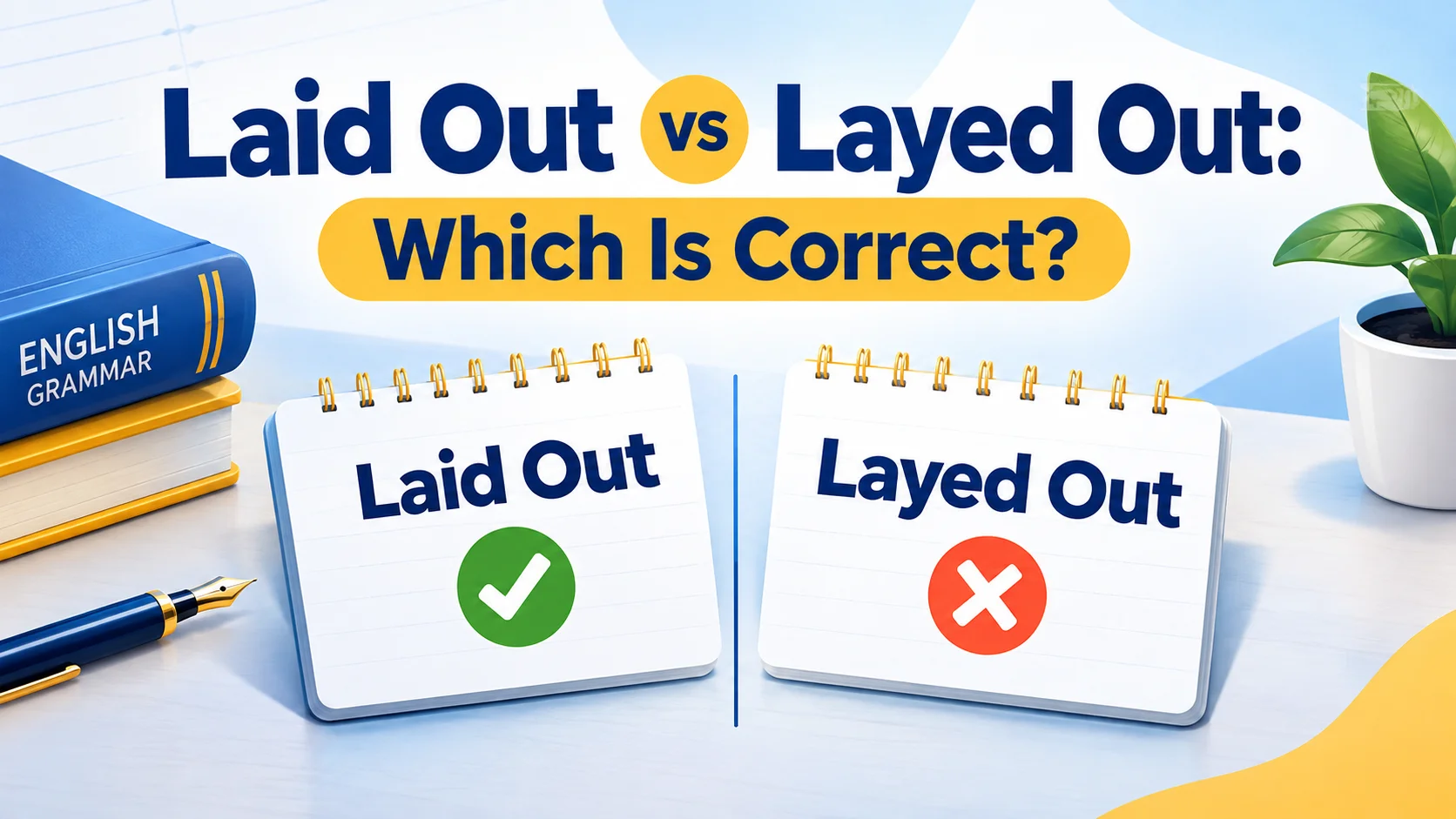
If you are unsure about laid out vs layed out, the correct spelling in standard English is laid out. Although “layed out” may look reasonable because many English verbs form their past tense by adding -ed, the verb lay is irregular. Its past tense and past participle are both laid. You might use “laid out” when describing documents arranged on a desk, a plan explained clearly, or clothes prepared for the next day. Choosing the right form matters because a small spelling mistake can distract readers from your message, especially in professional writing, schoolwork, and published content.
The confusion becomes easier to understand when you look at how lay, laid, and laying work. English has several verbs with similar meanings but different grammatical patterns, and lay is often confused with lie. For example, you can lay out your notes before a meeting, but you lie down when you want to rest. These expressions are related to different actions, so their forms cannot be exchanged freely. Understanding the basic verb pattern helps you avoid “layed out” and recognize other mistakes involving past tense, present tense, and past participles.
In this guide, you will learn what laid out means, why “layed out” is not the standard spelling, and how to use the phrase naturally in different situations. You will also see the difference between lay out, laid out, and layout, along with practical examples involving everyday conversations, workplace communication, planning, and physical arrangements. A comparison table, common-error corrections, and a simple memory trick will help you make the right choice quickly. By the end, you should be able to identify the correct form without second-guessing yourself every time you write it.
Laid Out vs Layed Out: The Quick Answer
Laid out is correct. “Layed out” is a common spelling mistake in standard contemporary English.
The phrase laid out is the past tense or past participle form of the phrasal verb lay out. Depending on the context, it can mean arranging something, presenting information clearly, planning something, or spending money.
Compare these examples:
- Correct: She laid out the documents before the meeting.
- Incorrect: She layed out the documents before the meeting.
- Correct: The manager has laid out the new requirements.
- Incorrect: The manager has layed out the new requirements.
The key is to remember that lay is an irregular verb. Its relevant forms are lay, laid, and laid, not lay, layed, and layed.
| Form | Correct usage | Example |
| Base form | Lay out | Please lay out the materials. |
| Simple past | Laid out | She laid out the materials yesterday. |
| Past participle | Laid out | She has laid out the materials. |
| Present participle | Laying out | She is laying out the materials. |
| Related noun | Layout | The layout looks organized. |
Quick rule: Whenever you need the past tense or past participle of lay out, write laid out.
What Does “Laid Out” Mean?
Laid out is the past form of lay out, a phrasal verb with several meanings. The intended meaning depends on what is being laid out and the surrounding sentence.
Laid Out Means Arranged or Placed
The most straightforward meaning is to put things in a particular position or order. You might lay out clothing, ingredients, paperwork, tools, or furniture so everything is ready to use.
Examples:
- I laid out my clothes before going to bed.
- The teacher laid out the worksheets on each desk.
- They laid out the tools before repairing the bicycle.
- She laid out the ingredients for the recipe.
This meaning is especially common when someone prepares items in advance. Arranging them beforehand can save time and make a task easier to complete.
Laid Out Means Explained or Presented Clearly
The phrase can also describe information presented in an organized, understandable way. Instead of physically placing objects somewhere, a person sets out ideas, facts, expectations, or instructions.
Examples:
- The report laid out the reasons for the delay.
- Our supervisor laid out the team’s responsibilities.
- The proposal laid out three possible solutions.
- The teacher laid out the assignment requirements.
In professional writing, this meaning often appears in discussions of plans, policies, arguments, and expectations. It suggests that the information has been presented clearly enough for others to understand.
For example, “The contract laid out the payment terms” means the contract specified those terms. It does not mean someone physically arranged the contract on a table.
Laid Out Means Planned or Designed
When discussing a project, building, schedule, or strategy, laid out can mean planned or organized according to a particular design.
Examples:
- The architect laid out the rooms according to the client’s needs.
- We laid out a schedule for the coming month.
- The team laid out its strategy before launching the campaign.
- The garden was laid out in neat rows.
Notice that the phrase can describe both the act of planning and the resulting arrangement. The surrounding words help readers identify which meaning is intended.
Laid Out Means Spread Across an Area
Sometimes, laid out describes objects spread over a surface or space.
Examples:
- The maps were laid out across the conference table.
- The designer laid out fabric samples for the client.
- The equipment was laid out on the floor.
- The photographs were laid out in chronological order.
This meaning overlaps with arranging objects, but the emphasis is often on the spread or distribution of items rather than simply placing one object somewhere.
Laid Out Means Spent Money
In informal English, lay out money means to pay or spend money, often a substantial amount.
Examples:
- We laid out $300 for the replacement parts.
- She laid out a considerable amount for the equipment.
- They had to lay out extra money to finish the repairs.
Here, laid out refers to spending, not arranging or explaining. The phrase is often used when the speaker wants to emphasize the cost of something.
Laid Out Can Describe Someone Being Exhausted or Unconscious
In informal contexts, laid out can describe someone who has been left extremely tired, knocked unconscious, or lying flat, depending on the expression and situation.
Examples:
- The long shift left him completely laid out.
- The boxer was laid out by a powerful punch.
These uses are context-dependent. If you encounter the phrase in a conversation about sports, exhaustion, or an injury, it may have nothing to do with planning or arranging objects.
Is “Layed Out” Ever Correct?
For ordinary contemporary English, “layed out” is not the standard spelling. The correct form is laid out, whether you are writing a casual message, a school assignment, a business email, or a formal report.
You may see “layed” in social media posts, informal comments, or other user-generated text. Its appearance does not make it the accepted past-tense form of lay. Readers might understand what the writer means, but the spelling remains nonstandard.
The mistake is understandable. Many regular English verbs form their past tense by adding -ed:
- Play → played
- Stay → stayed
- Walk → walked
- Explain → explained
Because lay ends in the same sound pattern that appears in many familiar verbs, writers may assume it follows the same rule. However, English also contains irregular verbs whose past forms must be learned individually.
Examples include:
- Go → went
- Take → took
- Bring → brought
- Lay → laid
The best approach is not to guess based on the ending. Learn the correct forms of irregular verbs and use them consistently.
What About Dictionaries That Show Unusual Forms?
A word may appear in historical texts, regional speech, quotations, or informal online writing without being the standard form recommended for general use.
If you are checking a disputed spelling, consult a reputable dictionary and look at the verb’s listed forms. For standard modern writing, use lay, laid, and laid. There is no need to use “layed out” to make your writing sound more casual or conversational.
Lay, Laid, Laying, and Lie: Understanding the Difference
One reason people write “layed out” is that they are uncertain about the verb lay itself. Another source of confusion is lie, which can describe resting or reclining.
The distinction becomes clearer when you focus on the action.
- Lay usually means to put or place something somewhere. It normally takes an object.
- Lie usually means to recline or rest. In this sense, it does not take a direct object.
For example:
- “Please lay the book on the desk.” You are placing an object.
- “I need to lie down.” You are resting yourself.
The Forms of “Lay”
| Verb form | Correct form | Example |
| Base form | Lay | I lay the folder on the desk every morning. |
| Third-person singular | Lays | She lays the folder on the desk. |
| Simple past | Laid | She laid the folder on the desk yesterday. |
| Past participle | Laid | She has laid the folder on the desk. |
| Present participle | Laying | She is laying the folder on the desk. |
These forms explain why laid out is correct. The phrasal verb lay out follows the same pattern: lay out, laid out, laid out, and laying out.
The Forms of “Lie”
When lie means to recline, its forms are different.
| Verb form | Correct form | Example |
| Base form | Lie | I lie down after work. |
| Third-person singular | Lies | He lies on the sofa. |
| Simple past | Lay | He lay on the sofa yesterday. |
| Past participle | Lain | He has lain on the sofa for an hour. |
| Present participle | Lying | He is lying on the sofa. |
The past tense of lie is lay, which is one reason the verbs are easy to confuse. Compare “I laid out the blanket” with “I lay on the blanket.” The first describes placing something; the second describes resting.
How to Choose the Right Verb
Ask yourself one question: Is someone placing something, or is someone resting?
If a person places objects, lay is usually the appropriate verb. If a person reclines, lie is usually correct.
Compare:
- Present: I lay out the documents.
- Past: I laid out the documents.
- Present: I lie down for a nap.
- Past: I lay down for a nap.
Do not confuse the past tense of lie with the past tense of lay. When you are writing laid out, remember that it comes from lay out, not from lie down.
Lay Out vs Laid Out vs Layout
These expressions look and sound related, but they serve different grammatical purposes. Knowing which one your sentence needs will help you avoid more than just the “layed out” error.
Lay Out: The Base Verb
Lay out describes an action that someone performs now, regularly, or in the future. It can mean arranging objects, explaining information, or planning something.
Examples:
- Please lay out the documents before the meeting.
- We will lay out the options tomorrow.
- The designer needs to lay out the page.
Laid Out: The Past Tense or Past Participle
Laid out is used when the action happened in the past or when the past participle is required in a perfect or passive construction.
Examples:
- She laid out the documents yesterday.
- The company has laid out its expectations.
- The options were laid out in the proposal.
The auxiliary verb and the sentence structure determine how the past participle is used. After has, have, or had, for example, use laid out, not layed out.
Laying Out: An Ongoing Action
Use laying out when the action is in progress or when the phrase functions as a participle.
Examples:
- He is laying out the plans now.
- They are laying out the chairs for the event.
- Laying out the requirements early can prevent confusion.
The word laying does not take an e after lay. “Layeing” and “layeing out” are not correct spellings.
Layout: The Noun
Layout is a noun that refers to the arrangement or design of something, such as a website, document, room, or printed page.
Examples:
- The website layout is easy to navigate.
- We changed the layout of the living room.
- The magazine has a clean page layout.
Compare these sentences:
- “The designer laid out the page.” This describes an action.
- “The page layout looks clean.” This describes the arrangement itself.
A useful editing test is to ask whether the sentence describes an action or names a design. If it names the design, layout may be the word you need.
| Expression | Grammar | Main purpose | Example |
| Lay out | Base verb | Describe an action | Lay out the schedule. |
| Laid out | Past tense or past participle | Describe a completed action | She laid out the schedule. |
| Laying out | Present participle | Describe an ongoing action | She is laying out the schedule. |
| Layout | Noun | Name an arrangement or design | The schedule’s layout is clear. |
Laid Out in Sentences: Practical Examples
Seeing the phrase in different settings makes its meaning easier to recognize. The following examples show how laid out works in everyday and professional English.
Physical Arrangements
- I laid out my clothes for the trip.
- The chef laid out the ingredients on the counter.
- We laid out the chairs in a circle.
- The mechanic laid out the replacement parts.
- She laid out the photographs in chronological order.
Explaining Information
- The manager laid out the new attendance policy.
- The report laid out the project’s main risks.
- He laid out his argument in three clear points.
- The instructor laid out the steps for completing the task.
- The agreement laid out each party’s responsibilities.
Planning and Design
- The architect laid out the floor plan.
- They laid out a timeline for the renovation.
- Our team laid out the marketing strategy.
- The organizers laid out the route for the race.
- The designer laid out the text and images on the page.
Spending Money
- We laid out $200 for the repair.
- They laid out more money than expected.
- She laid out a substantial amount for new equipment.
Informal Uses
- After the exhausting hike, I was completely laid out.
- The fighter was laid out by a single punch.
These examples demonstrate why context matters. The spelling remains laid out, but the phrase can communicate several different ideas.
Incorrect “Layed Out” Examples and Their Corrections
The following table addresses common mistakes that can appear when writers are unsure which verb form to use.
| Incorrect sentence | Correct sentence | Explanation |
| She layed out the paperwork. | She laid out the paperwork. | The past tense of lay is laid. |
| They have layed out the plan. | They have laid out the plan. | The past participle is laid. |
| He is layed out the clothes. | He is laying out the clothes. | An ongoing action uses laying out. |
| We will laid out the chairs. | We will lay out the chairs. | A modal verb such as will is followed by the base form. |
| The layout was carefully laided out. | The layout was carefully laid out. | The past participle is laid, not laided. |
| She has laying out the options. | She has laid out the options. | The perfect construction uses has laid out. |
A useful proofreading habit is to look at the words immediately before the verb. Words such as will, is, has, and was affect which verb form belongs in the sentence.
- After will, use lay out: “They will lay out the plan.”
- After that, an ongoing action takes laying out: “They are laying out the plan.”
- After has, use laid out: “They have laid out the plan.”
- In a passive construction, use laid out: “The plan was laid out clearly.”
This approach helps you correct the spelling while also checking the sentence’s grammar.
Is “Laid Out” Correct in American and British English?
Yes. Laid out is the standard spelling in both American and British English. This is not a case where one country uses one spelling and another country uses a different version.
For example, writers in both varieties would normally write:
- The documents were laid out on the table.
- The report laid out the key findings.
- The company has laid out its plans.
Some English words have recognized regional spelling differences, such as color and colour. The difference between laid out and layed out does not work that way. In standard writing, layed out is not the British alternative to the American spelling.
If you are writing for an international audience, use laid out and focus on making the sentence’s meaning clear.
Common Mistakes With “Laid Out”
Adding “-ed” to an Irregular Verb
The most direct error is treating lay as a regular verb. English spelling patterns can encourage this mistake, but the correct past form is laid.
Fix: Memorize the sequence lay → laid → laid.
Confusing “Lay Out” With “Lie Down”
These phrases describe different actions. You lay out something you are arranging or presenting; you lie down when you recline.
- Correct: I laid out the towels.
- Correct: I lay down after work.
Confusing “Layout” With “Laid Out”
Use layout when referring to a design or arrangement. Use laid out when describing an action or the result of an action.
- “The layout needs improvement.”
- “The information was laid out clearly.”
Using the Wrong Form After an Auxiliary Verb
A sentence can contain the right basic idea but still have incorrect grammar. For example, “We will laid out the documents” is wrong because “will” takes the base form of the verb.
Fix: Check the structure before choosing the verb form: will lay out, is laying out, and has laid out.
How to Remember That “Laid Out” Is Correct
You do not need to memorize a long grammar lesson every time this phrase appears. One short pattern is enough:
Lay → Laid → Laid
The first form is the base verb. The second is the simple past. The third is the past participle.
Use this memory trick in a real sentence:
- Today, I lay out my notes.
- Yesterday, I laid out my notes.
- I have laid out my notes before every meeting.
Another useful reminder is that “laid appears in familiar expressions such as “laid the groundwork” and “laid the foundation.” Neither expression uses “layed.”
When proofreading, try replacing the phrase with a clear past-tense sentence. If you mean that someone arranged, presented, or planned something in the past, laid out is the form you want.
Conclusion
When choosing between laid out vs layed out, use laid out in standard English. The spelling follows the irregular verb lay, whose past tense and past participle are both laid. That rule applies whether you are describing arranged objects, a clearly explained proposal, a project plan, or money spent. Remember the related forms, too: lay out describes the base action, laying out describes an ongoing action, and layout is a noun for an arrangement or design. One final actionable tip: read your sentence aloud and check whether its tense matches the action you mean. A common mistake to avoid is adding -ed automatically to irregular verbs. Once you recognize the pattern lay → laid → laid, choosing the correct form becomes much easier.
Frequently Asked Questions
Q1. Is “layed out” ever acceptable in English?
In standard contemporary English, “layed out” is considered a misspelling of laid out. You might encounter it in informal writing or online posts, but it is not the recommended form for schoolwork, professional communication, or edited publications. Use laid out for correct standard English.
Q2. Is “laid out” past tense or past participle?
Laid out can function as both the simple past and the past participle of lay out. For example, “She laid out the documents yesterday” uses the simple past, while “She has laid out the documents” uses the past participle after has.
Q3. What is the difference between “lay out” and “laid out”?
Lay out is the base form, as in “Please lay out the materials.” Laid out is the past tense or past participle, as in “She laid out the materials” or “She has laid out the materials.” The correct form depends on the sentence’s tense and grammatical structure.
Q4. Is “laid out” one word or two words?
Laid out is written as two separate words. By contrast, layout is one word and functions as a noun meaning an arrangement or design. Write “The page layout looks good,” but “The designer laid out the page carefully.”
Q5. Does “laid out” have more than one meaning?
Yes. Depending on context, laid out can mean arranged physically, presented information clearly, planned, or spent money. In informal expressions, it can also describe someone who is exhausted or knocked unconscious. Look at the surrounding words to determine the intended meaning.