
Himself vs. hisself can look like a tiny spelling difference, but the two forms have a more interesting history than you might expect. If you are writing a school assignment, email, article, report, or other standard English text, the form you normally want is himself. It is the standard reflexive pronoun associated with he and is used when a male person is both the doer and receiver of an action, as in He blamed himself. It can also add emphasis: He himself made the decision.
So why does hisself appear at all? The answer is not simply that people “made up” a misspelling. Hisself has a documented history and continues to occur in dialectal and informal varieties of English. Merriam-Webster labels it “chiefly dialectal,” while the American Heritage Dictionary describes it as a form found in some vernacular dialects. This distinction matters because a form can be genuine English usage without being the appropriate choice for Standard English.
In this guide, you will learn why himself is the standard form, where hisself comes from, how reflexive pronouns work, and when you might encounter hisself in real language. You will also see practical examples, a comparison of him, his, himself, and hisself, common mistakes, and a simple test you can use whenever you are unsure. By the end, you should be able to choose the right form without relying on guesswork.
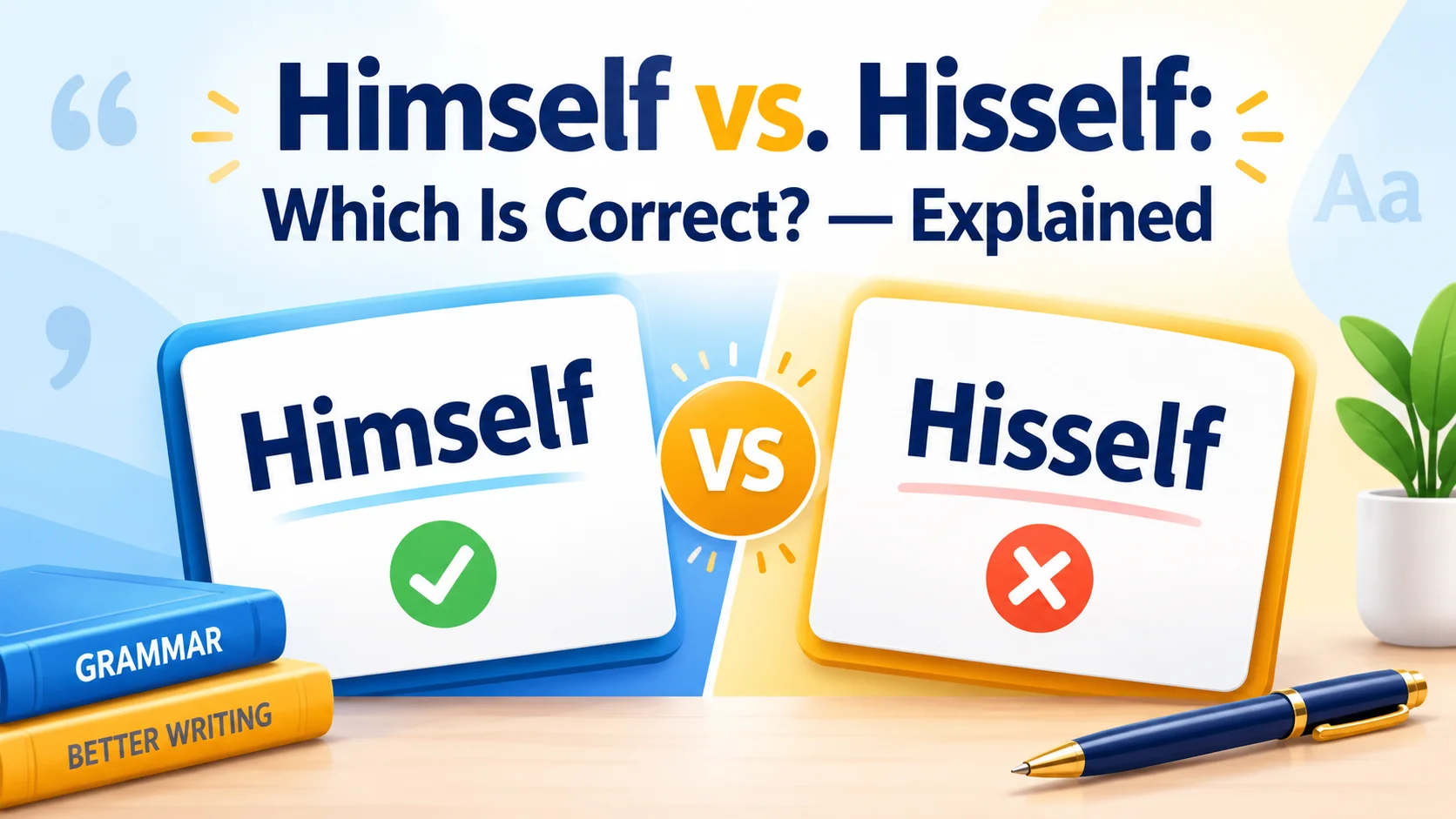
Himself vs. Hisself: Which Is Correct?
For Standard English, himself is the correct choice.
Hisself is a real word in the sense that dictionaries document it, but it is generally classified as dialectal, nonstandard, or informal, rather than the standard reflexive form. Merriam-Webster defines hisself as a chiefly dialectal form meaning himself, while Collins labels it “not standard.”
| Form | Standard English? | Typical use | Example |
| himself | Yes | Standard writing and speech | He introduced himself. |
| hisself | No, not in Standard English | Certain dialects, informal speech, historical or character dialogue | He did it hisself. |
The practical rule is straightforward:
Use “himself” in standard English. Use “hisself” only when you intentionally need to represent a particular dialect, informal voice, or historical usage.
That second point is important. Calling hisself simply a “misspelling” misses part of the linguistic story. It has existed for centuries and has survived in varieties of English.
What Does “Himself” Mean?
Himself is a reflexive pronoun and can also function as an intensive, or emphatic, pronoun.
The standard reflexive-pronoun system includes:
| Subject pronoun | Reflexive pronoun |
| I | myself |
| you | yourself |
| he | himself |
| she | herself |
| it | itself |
| we | ourselves |
| you | yourselves |
| they | themselves |
Cambridge Grammar explains that reflexive pronouns ending in -self or -selves generally refer back to the subject of a clause.
Himself as a Reflexive Pronoun
The most important use occurs when the person performing an action is also the person affected by it.
For example:
- He blamed himself for the mistake.
- James taught himself Spanish.
- The boy hurt himself.
- He looked at himself in the mirror.
In James taught himself Spanish, James is both the person doing the teaching and the person receiving the action. That is why himself is appropriate.
Compare:
- James taught him Spanish.
Here, he refers to another male person. The subject and object are no longer the same.
This distinction is one of the easiest ways to understand reflexive pronouns: the reflexive form usually points back to the subject.
Himself for Emphasis
Himself does not always function as the object of a verb. It can also emphasize a person.
Consider:
The manager himself approved the request.
The sentence would still be grammatical without himself:
The manager approved the request.
Adding himself highlights the fact that the manager personally did it.
Another example:
The author himself responded to the criticism.
The emphasis is on the author’s personal involvement.
This use is called intensive or emphatic use. Cambridge and Oxford both recognize himself as a form used to emphasize a male subject or object.
Himself With “By”
The phrase by himself commonly has two closely related meanings:
- Alone
- Without help
For example:
- He lives by himself. → He lives alone.
- He repaired the bicycle by himself. → He repaired it without assistance.
Oxford gives the same distinction for by himself: it can mean either “alone” or “without help.”
Context tells you which meaning is intended.
Himself Does Not Always Mean “Alone”
A common beginner’s mistake is assuming that himself means “alone.”
It does not.
Compare:
- He cooked dinner himself. → He personally cooked it.
- He cooked dinner by himself. → He cooked it alone or without help.
- He burned himself. → The action affected him.
- He himself called the doctor. → The word adds emphasis.
The surrounding words determine the meaning.
Why Does “Hisself” Exist?
At first glance, hisself seems perfectly logical.
English has:
- my + self → myself
- your + self → yourself
- her + self → herself
So a learner might naturally reason:
- his + self → hisself
That reasoning is understandable. In fact, the existence of hisself reflects a real pattern in English varieties.
The standard form, however, is himself, not hisself.
The interesting part is that Standard English’s reflexive system is not completely uniform. The American Heritage Dictionary explains that forms such as himself and themselves differ from the otherwise more straightforward possessive-plus-self pattern. Some vernacular varieties regularize that pattern, producing forms such as hisself and theirselves.
In other words, hisself is not necessarily random. It can represent a regularized grammatical pattern within a dialect.
Where Does “Hisself” Come From?
Hisself has a long history.
Merriam-Webster records its first known use in the 12th century and identifies it as chiefly dialectal. Collins likewise traces the word to Middle English.
Historical forms related to hisself existed in earlier stages of English, and the form survived in some regional varieties even as himself became the established standard form.
That history gives us an important lesson about English:
A word can be historically established and still be nonstandard in contemporary formal English.
The same principle applies to many dialect forms. A dictionary’s inclusion of a word does not automatically mean that the word is interchangeable with the standard form in every context.
Hisself in Dialect and Vernacular English
Modern dictionaries identify themselves with dialectal usage. The American Heritage Dictionary specifically notes its use in some vernacular American dialects, particularly in the South and South Midland United States.
It can also appear in British regional speech.
This means that if you encounter:
He fixed it hisself.
the speaker may be using a genuine regional or social variety of English rather than accidentally spelling himself incorrectly.
That distinction becomes especially important when reading fiction, transcripts, historical material, or dialogue.
Himself vs. Hisself: The Grammar Behind the Difference
The best way to remember the standard form is to understand the pronoun system rather than memorizing one isolated spelling.
Standard English uses:
- he as the subject form
- him as the object form
- his as the possessive form
- himself as the reflexive/intensive form
| Word | Grammatical role | Example |
| he | Subject pronoun | He opened the door. |
| him | Object pronoun | I called him. |
| his | Possessive | That is his bag. |
| himself | Reflexive/intensive pronoun | He introduced himself. |
The crucial detail is that himself is historically and grammatically associated with the object form him rather than being formed from his in modern Standard English. Oxford gives the word’s origin as Old English and analyzes himself as the reflexive form of he.
This explains why the apparently logical construction his + self is not the standard modern form.
How to Use “Himself” Correctly
When the Subject and Object Are the Same
Use himself when the action comes back to the same male person.
Examples:
- He introduced himself to the class.
- Michael reminded himself to check the time.
- The player blamed himself for the mistake.
- He bought himself a new notebook.
A useful question is:
Who performed the action, and who received it?
If the answer is the same male person, himself may be the appropriate reflexive form.
When You Want to Add Emphasis
Use himself when you want to stress personal involvement.
Examples:
- The principal himself spoke to the parents.
- He himself wrote the letter.
- The designer himself approved the final version.
In these sentences, himself is not needed to complete the basic grammar. It adds emphasis.
After “By”
Use by himself when the meaning is “alone” or “without assistance.”
Examples:
- He completed the project by himself.
- He went to the library by himself.
- The child learned to ride the bicycle by himself.
Be careful not to replace himself with hisself in standard writing.
Himself, Him, and His: What’s the Difference?
These three forms are often confused because they all relate to the same pronoun family.
Him
Use him when a male person is the object of a verb or preposition.
I saw him yesterday.
His
Use his to show possession.
That is his notebook.
It can also stand independently:
The blue notebook is his.
Himself
Use himself when referring back to the male subject or when adding emphasis.
He saw himself in the mirror.
He himself chose the notebook.
A Quick Decision Table
| If you mean… | Use | Example |
| The male person doing the action | he | He called me. |
| The male person receiving the action | him | I called him. |
| Something belonging to him | his | I found his phone. |
| The same male person as subject/object | himself | He found himself in trouble. |
| Emphasis on the male person | himself | He himself explained it. |
Common Mistakes With Himself and Hisself
Mistake 1: Using Himself in Formal Writing
If you are writing an essay, application, report, professional email, or educational assignment, himself is the appropriate standard form.
Instead of:
He completed the work hisself.
write:
He completed the work himself.
Mistake 2: Assuming Himself Is Simply a Spelling Error
This is too simplistic.
Hisself is documented by major dictionaries and has a long history. Merriam-Webster calls it chiefly dialectal, while the American Heritage Dictionary explains how such forms occur in vernacular varieties.
So the better description is:
“Hisself is a nonstandard or dialectal form of himself.”
Mistake 3: Thinking His + Self Must Always Equal Himself
English does not create every reflexive pronoun by simply attaching -self to the possessive form.
The standard system includes:
- myself
- yourself
- himself
- herself
- itself
- ourselves
- yourselves
- themselves
Cambridge lists these as the standard reflexive forms.
Mistake 4: Using Himself When Him Is Required
Not every reference to a male person calls for himself.
Incorrect:
I gave the book to himself.
Standard English normally requires:
I gave the book to him.
Himself becomes appropriate when it refers back to the relevant subject or is being used emphatically.
Mistake 5: Assuming Himself Always Means Alone
As shown earlier, himself can indicate reflexive action or emphasis. By himself is the construction that commonly conveys “alone” or “without help.”
Can “Hisself” Ever Be Used?
Yes—but context matters.
In Dialectal Speech
Someone may naturally use hisself as part of a regional or social variety of English.
In that setting, changing every occurrence automatically to himself could remove information about the speaker’s voice.
In Fiction and Dialogue
Authors sometimes use nonstandard forms to represent how a character speaks.
For example, a fictional character might say:
He did the whole thing hisself.
If the spelling is deliberately representing dialect, changing it to himself could make the dialogue sound less authentic.
In Historical or Linguistic Discussion
Himself is also relevant when discussing the history and variation of English. Its documented history means it can appear in historical sources and linguistic analysis.
When Should You Avoid Himself?
For ordinary standard writing, avoid it in:
- School assignments
- Academic essays
- Professional reports
- Business emails
- Formal applications
- General informational articles
- Standard edited content
The goal is not to declare dialects “bad English.” It is to match the form to the context.
Himself vs. Hisself in Different Writing Situations
| Situation | Recommended form | Why |
| School assignment | himself | Standard English expected |
| Academic paper | himself | Formal edited usage |
| Business email | himself | Clear professional standard |
| Blog article | himself | Standard general readership |
| Casual personal message | Usually himself | Still the standard form |
| Fictional dialogue | hisself may be appropriate | Can represent dialect |
| Linguistic research | Either, depending on subject | Context determines purpose |
| Historical quotation | Preserve original form when appropriate | Accuracy matters |
A Simple Test: Should You Use Himself or Hisself?
When you are editing a sentence, ask three questions.
1. Is this Standard English?
If yes, choose himself.
2. Am I intentionally representing a dialect or character’s speech?
If yes, hisself may be appropriate.
3. Am I simply trying to express the reflexive form of “he”?
If yes, use himself.
A quick memory formula is:
He → him → his → himself
Examples:
- He fixed the computer.
- I thanked him.
- That is his computer.
- He fixed the computer himself.
This is more reliable than thinking “his + self = hisself.”
A Real-World Editing Scenario
Imagine a student writes:
Ahmed completed the project hisself.
The intended meaning is clear. However, if this is a formal school assignment, the editor should change it to:
Ahmed completed the project himself.
Now imagine the same sentence appears in a novel where the author is deliberately representing a character’s regional speech.
In that situation:
Ahmed completed the project hisself.
might be retained.
The words have not suddenly changed meaning. The communicative purpose has changed.
This is an important professional editing principle: good editing is not simply about replacing every nonstandard form. It is about determining what the writer is trying to accomplish and which variety of English the text is using.
Why “Hisself” Can Sound Natural
There is a linguistic reason many people find hisself intuitively understandable.
Several common reflexive forms have an apparent possessive-plus-self structure:
- my + self → myself
- your + self → yourself
- her + self → herself
- our + selves → ourselves
- your + selves → yourselves
That makes his + self → hisself look perfectly regular.
The American Heritage Dictionary notes that vernacular speakers can regularize irregular patterns in the standard system, which helps explain forms such as hisself.
So the form is interesting precisely because it reveals something about how speakers perceive grammatical patterns. People are not necessarily making random mistakes; they may be applying a pattern consistently within their variety of English.
Standard English vs. Dialect: A Useful Distinction
One of the biggest misconceptions surrounding hisself is that a nonstandard form must be meaningless or evidence of poor language ability.
That conclusion does not follow.
Languages contain regional, social, historical, and informal varieties. A form can be perfectly meaningful within one variety while not being part of the standard form expected in formal writing.
For practical purposes, however, most learners need a clear answer:
If you are learning or writing Standard English, use “himself.”
That recommendation is compatible with recognizing that hisself has a legitimate place in the history and variation of English.
Quick Reference: Himself vs. Hisself
| Question | Answer |
| Which form is standard? | Himself |
| Is hisself a documented word? | Yes |
| Is hisself standard in formal English? | No |
| Can hisself occur in dialects? | Yes |
| Can hisself appear in fiction? | Yes, when dialect is intentional |
| Is himself a reflexive pronoun? | Yes |
| Can himself add emphasis? | Yes |
| Can “by himself” mean alone? | Yes |
| Is “hisself” simply nonsense? | No |
| Best choice for school or professional writing? | Himself |
Five Practical Examples
Example 1: Reflexive Action
Correct: He blamed himself for the mistake.
The subject he and the person being blamed are the same.
Example 2: Emphasis
Correct: The coach himself spoke to the players.
Himself emphasizes the coach’s personal involvement.
Example 3: Without Help
Correct: He completed the assignment by himself.
Here, by himself means he completed it without assistance.
Example 4: Standard vs. Dialectal
Standard: He repaired the car himself.
Dialectal/nonstandard: He repaired the car hisself.
The second form may be intentional in a particular variety of English, but it is not the standard choice for formal writing.
Example 5: Him, Not Himself
Correct: I spoke to him after class.
The sentence does not require a reflexive pronoun because it does not refer back to a subject performing the same action.
Conclusion
When deciding between himself vs. hisself, the practical answer is clear: use himself in Standard English. It is the established reflexive and emphatic form associated with him, while himself is generally treated as a dialectal or nonstandard variant. That does not make himself meaningless or historically insignificant. The form has a documented history and continues to occur in some varieties of English. The important skill is knowing when language variation is intentional and when standard grammar is expected. If you are writing an assignment, professional message, or formal article, choose yourself. If you are reproducing a character’s dialect or discussing linguistic variation, he may have a legitimate purpose. One final actionable tip: remember the sequence he → him → his → himself. A common mistake to avoid is assuming that every possessive form automatically produces the reflexive form. In Standard English, the correct choice is simply: himself.
FAQs
Q1. Is “hisself” grammatically correct?
Hisself is not the standard reflexive pronoun in modern Standard English. However, dictionaries document it as a dialectal or nonstandard form meaning himself. It can therefore be legitimate within certain varieties of English even though it is not the recommended choice for formal writing.
Q2. Why do people say “hisself” instead of “himself”?
The form can arise from regularizing the reflexive-pronoun pattern: speakers may naturally associate his with self and produce hisself. It also has a long historical record and survives in some regional varieties.
Q3. Can I use “hisself” in a school assignment?
Generally, no. If your assignment expects Standard English, use it yourself. Even though hisself is a documented dialectal form, it can be marked as nonstandard in formal educational writing. Save it for contexts where representing dialect is actually part of the purpose.
Q4. Is “himself” only used when someone does something alone?
No. Himself has several functions. It can refer back to a male subject, emphasize a person, or appear in expressions such as by himself. The meaning “alone” comes particularly from constructions such as by himself, not from himself by itself.
Q5. Is “hisself” an old English word?
It has historical roots reaching back to Middle English and earlier documented usage. Modern dictionaries record the form while generally marking it as dialectal or nonstandard. That history explains why himself can appear in older texts as well as some modern regional speech.