

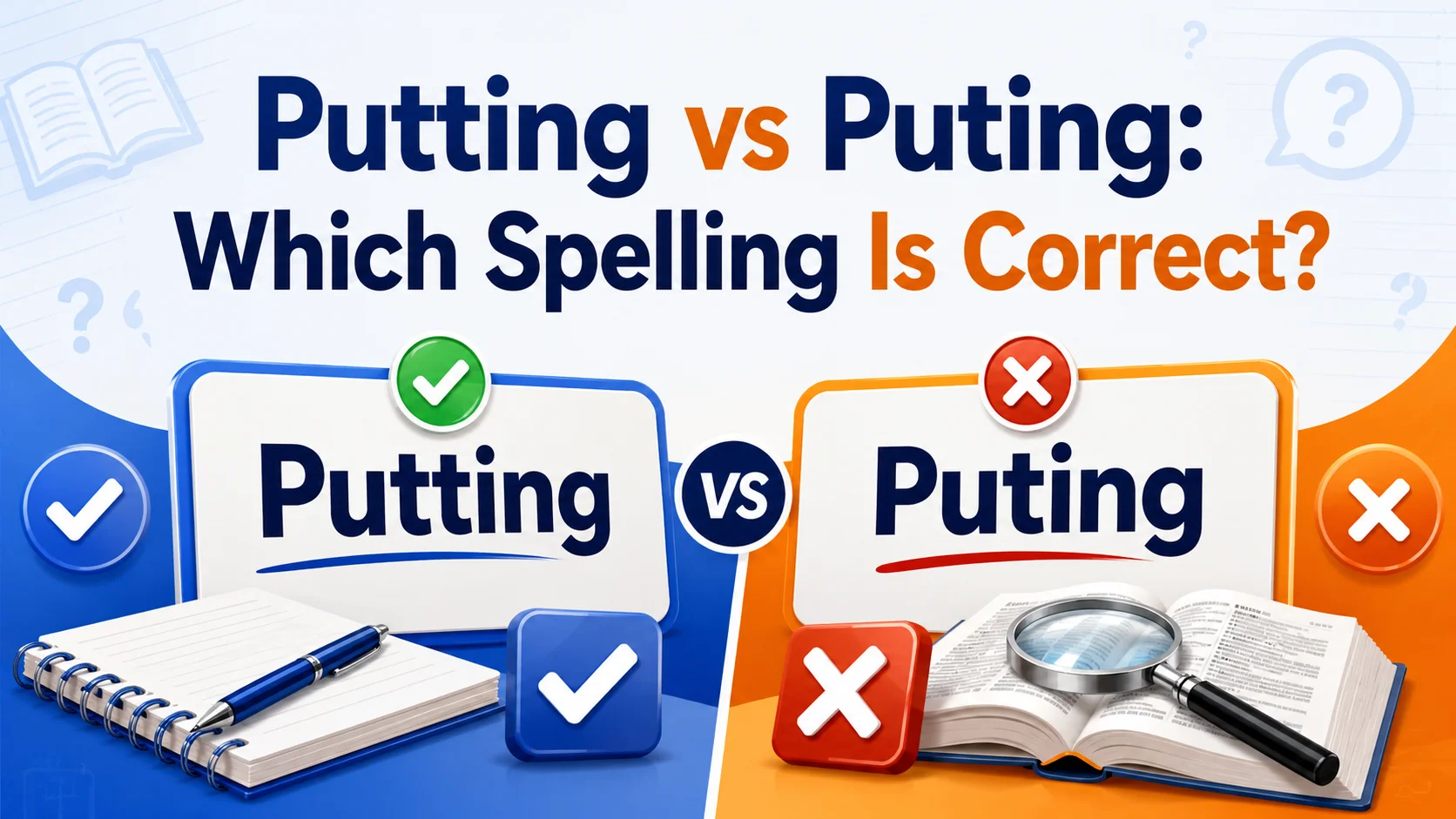
Putting is the correct spelling, while puting is a misspelling in standard English. The confusion usually happens because the verb put already ends in t, and English spelling rules can make it unclear whether another consonant should be added before -ing. In this case, however, the correct form is putting, with two t’s. You’ll see it when talking about placing something somewhere, taking an action, or participating in activities such as golf. Understanding why the spelling works this way makes it easier to recognize similar patterns and avoid the error in everyday writing.
The important point is that putting isn’t simply a word you have to memorize. It follows the spelling behavior of the verb put when the -ing ending is attached. Because put is a short verb ending in a single consonant after a short vowel, the final t is doubled before -ing. That gives us put + ting = putting. The form puting leaves out one of those consonants, so it doesn’t belong in standard written English. This distinction matters in emails, schoolwork, professional documents, captions, and any writing where accurate spelling affects credibility.
Once you know the rule, the choice becomes straightforward. Putting is used as the present participle and gerund of put, and it can appear in several grammatical structures. You might write, “She is putting the books on the shelf,” or “Putting your phone away can help you focus.” The same spelling also appears in specialized contexts, such as putting in golf. This guide explains the difference between putting and puting, why the second form is incorrect, how the doubling rule works, and how to spot similar spelling patterns without relying on guesswork.
Quick Answer: Putting or Puting?
Putting is correct. Puting is incorrect in standard English.
The base verb is put. When you add -ing, the final consonant is doubled:
put + ing → putting
So if you’re writing a sentence such as:
- “I am putting the groceries away.”
- “He is putting his shoes on.”
- “She’s putting the documents in order.”
you should always use putting with two t’s.
| Form | Correct? | Example |
| put | Yes | Please put the book here. |
| putting | Yes | She is putting the book here. |
| puting | No | She is puting the book here. |
| putted | Usually no for ordinary uses of put | He put the box there. |
Quick rule: If you mean the -ing form of “put,” spell it “putting,” not “puting.”
Why Is “Putting” Spelled With Two T’s?
The double t is caused by a common English spelling rule involving the addition of -ing.
When certain short, one-syllable verbs end in a single consonant preceded by a single vowel, English often doubles the final consonant before adding a suffix beginning with a vowel.
For example:
- run → running
- sit → sitting
- stop → stopping
- swim → swimming
- plan → planning
- put → putting
The purpose of this spelling pattern is partly connected to preserving the pronunciation and structure of the original word.
With put, the word is only one syllable and ends in t. Adding -ing gives us:
put + ing = putting
The spelling therefore contains two t’s.
The Spelling Pattern in Simple Terms
Think of the process this way:
Base verb: put
Suffix: -ing
Result: putting
The final t is doubled rather than removed.
This is why puting isn’t an alternative spelling. It represents an incomplete application of the spelling rule.
Putting vs Puting: The Difference at a Glance
There is no difference in meaning between the two forms because puting is not the standard spelling of the word. The real distinction is between the accepted English form and a spelling error.
| Feature | Putting | Puting |
| Standard English | Yes | No |
| Spelling | Correct | Incorrect |
| Base verb | Put | Intended to be put |
| Ending | -ing | -ing |
| Number of t’s | Two | One |
| Used in formal writing | Yes | No |
| Used in everyday writing | Yes | No |
| Example | “I’m putting it away.” | “I’m puting it away.” |
If a spelling checker highlights puting, replace it with putting.
What Does “Putting” Mean?
Putting is the -ing form of the verb “put.” The meaning depends on the sentence, but the central idea usually involves placing, positioning, moving, or causing something to be in a particular state or location.
For example:
- “She is putting the dishes in the cabinet.”
- “They are putting pressure on the team.”
- “He is putting together a presentation.”
- “We’re putting the plan into action.”
The word can also function as a gerund, where it behaves like a noun:
Putting things off can create unnecessary stress.
Here, putting is not describing what someone is currently doing. Instead, the entire activity of delaying things is being discussed.
Common Meanings of Putting
Depending on context, putting can describe:
- Placing something somewhere
“She is putting the keys on the table.” - Moving something into a particular position
“He’s putting the chair against the wall.” - Applying or adding something
“They’re putting fresh paint on the door.” - Beginning or arranging an activity
“The team is putting together a proposal.” - Causing someone or something to enter a condition
“The decision is putting everyone under pressure.” - Golfing
“She is putting for the win.”
The spelling remains putting in every one of these uses.
Putting as a Verb
As a verb, putting normally appears with a form of be when it functions as the present participle.
Present continuous
“I am putting the files away.”
Past continuous
“I was putting the files away when you called.”
Future continuous
“I will be putting the new system into place tomorrow.”
It can also occur in participial phrases:
“Putting the problem aside, they continued the discussion.”
The grammatical role changes according to the sentence, but the spelling does not.
Examples of Putting as a Verb
- “She is putting her coat on.”
- “We’re putting the furniture together.”
- “He was putting the groceries away.”
- “They’re putting the final touches on the project.”
- “I’m putting my phone on silent.”
Putting as a Gerund
A gerund is an -ing form of a verb that functions as a noun.
For example:
Putting things off can make a problem worse.
Here, putting refers to the activity itself.
Other examples include:
- Putting safety first is essential.
- Putting your ideas into writing takes practice.
- Putting the pieces together required patience.
- Putting money aside can help with unexpected expenses.
This distinction is useful because readers sometimes assume every word ending in -ing is functioning as a verb. The form may instead act as a noun, adjective, or part of a verb phrase.
Putting in Golf: A Different Context, Same Spelling
One particularly common use of putting occurs in golf.
In golf, putting refers to hitting the ball with a putter, generally on or around the green, with the goal of getting the ball into the hole.
For example:
“Her putting improved significantly this season.”
You might also see:
- putting stroke
- putting green
- putting technique
- putting practice
- putting distance
- putting accuracy
Notice that the spelling remains putting. The specialized meaning doesn’t change the underlying spelling.
Why Do People Write “Puting”?
The misspelling puting is understandable because English has many different rules for adding -ing.
A writer may reason:
put + ing = puting
That looks mathematically logical, but English spelling doesn’t always work by simply attaching letters mechanically.
The same issue appears with words such as:
- run → running
- sit → sitting
- stop → stopping
- begin → beginning
The final consonant is doubled in these forms.
Another Source of Confusion: Words That Don’t Double
Not every verb doubles its final consonant.
For example:
- read → reading
- clean → cleaning
- help → helping
- open → opening
- jump → jumping
This can make the rule feel inconsistent.
The important point is that put belongs to the group where the final consonant is doubled before -ing.
When Does English Double the Final Consonant?
The doubling rule is broader than putting, but it has conditions.
A common pattern involves a one-syllable verb ending in a single consonant preceded by a single vowel.
Examples:
| Base verb | + -ing | Result |
| run | + ing | running |
| sit | + ing | sitting |
| stop | + ing | stopping |
| plan | + ing | planning |
| swim | + ing | swimming |
| put | + ing | putting |
The rule also applies in many longer verbs when the final syllable is stressed, although spelling conventions become more complicated there.
For a beginner, the safest practical approach is to learn the common pattern and recognize frequent examples rather than trying to apply one rule mechanically to every verb.
Expert tip: English spelling rules are useful guides, not perfect formulas. When a verb’s stress pattern or ending changes, the doubling behavior can change too.
Why “Puting” Is Incorrect
The spelling puting removes one of the two consonants required in the standard form.
Compare:
put → putting
with:
put → puting
The second version doesn’t represent the accepted English spelling.
You may occasionally encounter puting online because of typing errors, autocorrect problems, informal posts, or users who aren’t sure about the spelling. Its appearance in online material doesn’t make it a recognized standard spelling.
Correct vs Incorrect Examples
| Incorrect | Correct |
| I am puting the books away. | I am putting the books away. |
| She is puting on her jacket. | She is putting on her jacket. |
| We’re puting the plan together. | We’re putting the plan together. |
| He was puting pressure on them. | He was putting pressure on them. |
| They are puting everything in order. | They are putting everything in order. |
The fix is simple: double the t.
Common Phrases With “Putting”
Learning common phrases can make the correct spelling easier to remember because you’ll repeatedly see putting in familiar expressions.
Putting something somewhere
“She’s putting the books on the shelf.”
Putting something together
“We’re putting together a presentation.”
This can mean physically assembling something or organizing information.
Putting something off
“He keeps putting off the assignment.”
This means delaying something.
Putting something into practice
“The students are putting the new method into practice.”
This means applying an idea rather than merely discussing it.
Putting pressure on someone
“The deadline is putting pressure on the team.”
Putting it simply
- “Putting it simply, the plan isn’t ready.”
Putting things first
“She believes in putting family first.”
These expressions are useful because they show how frequently the correct spelling occurs in natural English.
Putting vs Puting in Different Types of Writing
The spelling issue matters in virtually every form of standard written English, but the consequences vary by context.
Academic Writing
In an essay or research assignment, puting can look like an ordinary spelling mistake and may distract from your argument.
Use:
“The study examines how putting information into context affects comprehension.”
Professional Writing
In workplace communication, correct spelling supports clarity and professionalism.
Use:
“We are putting the revised procedure into place.”
Casual Writing
Even in texts and social media posts, putting is the standard spelling. Casual communication may tolerate abbreviations and typos, but that doesn’t make puting correct.
Creative Writing
Authors may intentionally reproduce a character’s spelling errors in dialogue, but that’s a stylistic choice rather than evidence that puting is a standard form.
A Simple Way to Remember “Putting”
The easiest memory trick is to connect the spelling to the base word.
PUT has a T at the end → PUTTING keeps that T and adds another one.
Think:
PUT + TING = PUTTING
You can also remember it visually:
PUT → PUTTING
The two t’s stand next to each other.
If you see puting, ask yourself:
“Where did the second T go?”
That quick check can catch the error before you submit an assignment or send an important message.
Common Mistakes With Putting
The most obvious error is writing puting, but there are other mistakes worth watching for.
1: Using “puting”
Incorrect:
“She is puting the documents away.”
Correct:
“She is putting the documents away.”
2: Confusing “putting” with “put”
The form you need depends on the grammar of the sentence.
Correct:
“I put the book on the desk yesterday.”
Correct:
“I am putting the book on the desk now.”
You shouldn’t automatically replace put with putting. The tense and sentence structure determine which form belongs.
3: Adding unnecessary changes
The base verb put is irregular in several grammatical forms:
- Present: put
- Past: put
- Past participle: put
- Present participle: putting
The past tense doesn’t become putted in ordinary standard usage.
Putting vs Other -ing Spelling Patterns
Comparing putting with other verbs helps clarify why the double consonant appears.
| Verb | -ing form | Pattern |
| put | putting | Double consonant |
| run | running | Double consonant |
| sit | sitting | Double consonant |
| make | making | Drop silent e |
| write | writing | Drop silent e |
| read | reading | Add -ing directly |
| help | helping | Add -ing directly |
This comparison shows why simply memorizing “add -ing” isn’t enough. English spelling changes can involve doubling, dropping a final e, or making no spelling change at all.
A Practical Decision Guide
When you’re unsure whether to write putting or puting, use this quick process:
| Question | Answer | What to write |
| Is the base verb put? | Yes | Start with put |
| Are you adding -ing? | Yes | Double the final t |
| Are you describing an ongoing action? | Usually | putting |
| Are you using the word as a gerund? | Possibly | putting |
| Is the spelling “puting”? | Yes | Correct it to putting |
This approach works better than relying only on how the word sounds because putting and puting may look deceptively similar when you’re typing quickly.
Practice: Can You Choose the Correct Spelling?
Try completing these sentences before checking the answers.
- She is ________ the groceries away.
- We are ________ together a new schedule.
- He keeps ________ off his homework.
- They are ________ the final pieces into place.
- I am ________ my phone on silent.
Answers
- putting
- putting
- putting
- putting
- putting
The repeated answer is intentional: whenever the intended word is the -ing form of put, the correct spelling is putting.
Does Pronunciation Help You Spell “Putting”?
Pronunciation can help a little, but it isn’t a reliable spelling test.
Putting is generally pronounced with the consonant sound associated with put followed by the -ing ending. The doubled t is primarily a spelling convention rather than a signal that you pronounce two completely separate t sounds.
This is important because English spelling often preserves distinctions that aren’t obvious from pronunciation alone.
So don’t try to hear two separate t’s before deciding how to spell the word. Instead, connect the form to its base verb:
put → putting
That is much more reliable.
Is “Puting” Ever Correct?
In standard English, no. If you’re using the word as the present participle or gerund of put, the accepted spelling is putting.
You may encounter puting in:
- Typographical errors
- Informal online posts
- User-generated content
- Search queries
- Unedited messages
Those appearances don’t establish puting as a standard spelling.
There can be unusual situations in which a sequence of letters happens to appear inside a name, technical identifier, or another proper noun, but that is different from treating puting as the standard English form of put.
How to Proofread “Putting” Quickly
If you’re proofreading a document, don’t rely entirely on spellcheck. A simple visual scan can catch this particular error.
Search for:
puting
Then replace it with:
putting
You can also use your document editor’s search function to find every occurrence. This is especially useful in longer assignments, reports, or articles where the same word may appear several times.
Quick Proofreading Checklist
Before submitting your writing, ask:
- Did I write putting with two t’s?
- Am I using putting because the sentence requires the -ing form?
- Did I accidentally type puting?
- Am I confusing put with putting?
- Does the surrounding sentence make grammatical sense?
A ten-second check can eliminate a surprisingly common typo.
The Bigger Spelling Lesson
The putting vs puting confusion illustrates a broader point about English: spelling often reflects grammatical patterns rather than simple letter-by-letter addition.
When you add a suffix, the original word may:
- Keep its spelling,
- Double a consonant,
- Drop a final silent e,
- Or undergo another spelling adjustment.
For example:
- run → running
- hope → hoping
- make → making
- stop → stopping
- put → putting
Understanding these patterns is more useful than memorizing isolated words because the same knowledge can help you with many other English spelling decisions.
Best practice: Learn the base word, identify the suffix, and then check whether English requires a spelling change before the suffix is added.
Final Comparison: Putting vs Puting
| Point | Putting | Puting |
| Correct English spelling | Yes | No |
| Base word | Put | Intended as put |
| Form | -ing form | Misspelling |
| Double consonant | tt | t |
| Meaning | Placing, positioning, applying, etc. | No standard meaning as an English -ing form of put |
| Suitable for formal writing | Yes | No |
| Suitable for everyday writing | Yes | No |
Image Alt Text Suggestions
If you’re creating a featured image or educational graphic for this article, useful descriptive alt text could include:
- “Putting vs puting spelling comparison showing putting as correct”
- “Putting spelled with two t’s versus incorrect puting”
- “English spelling rule for put plus ing becoming putting”
These descriptions communicate the actual educational purpose of the image without stuffing unnecessary keywords.
Conclusion
The choice between putting and puting is straightforward once you recognize the spelling pattern. Putting is the correct standard-English form of put when -ing is added, while puting is a misspelling. The double t follows a familiar consonant-doubling pattern seen in words such as running and sitting. One final actionable tip: whenever you type the -ing form of put, mentally check the spelling as put + ting = putting. A common mistake to avoid is assuming that every -ing form is created by simply attaching the letters ing to the base verb. English spelling often requires adjustments. Once you recognize those patterns, putting becomes an easy word to spell correctly—and one less error to catch during proofreading.
FAQs
Q1. Is “putting” the correct spelling?
Yes. Putting is the standard English spelling of the -ing form of put. It is formed by doubling the final t before adding -ing. The spelling puting is incorrect when you mean the verb put in its present participle or gerund form.
Q2. Why does “put” become “putting”?
The final consonant is doubled when the suffix -ing is added to put. This follows a common English spelling pattern found in short verbs such as run → running and sit → sitting. Therefore, put + ing becomes putting, not puting.
Q3. Can “puting” ever be used in English?
Puting isn’t the standard spelling of the -ing form of put. You might see it as a typo, especially in informal online writing or quickly typed messages. If you’re writing standard English, schoolwork, business communication, or edited content, use putting.
Q4. Is “putting” a verb or a noun?
Putting can perform different grammatical roles. It can be part of a verb phrase, as in “She is putting the books away,” or function as a gerund, as in “Putting things off creates problems.” Its grammatical role depends on how it is used in the sentence.
Q5. What is an easy way to remember “putting”?
Connect the spelling directly to the base verb: PUT + TING = PUTTING. Remember that the final t in put is doubled before -ing. If you find yourself typing puting, pause and ask where the second t went. That simple check usually catches the mistake immediately.