

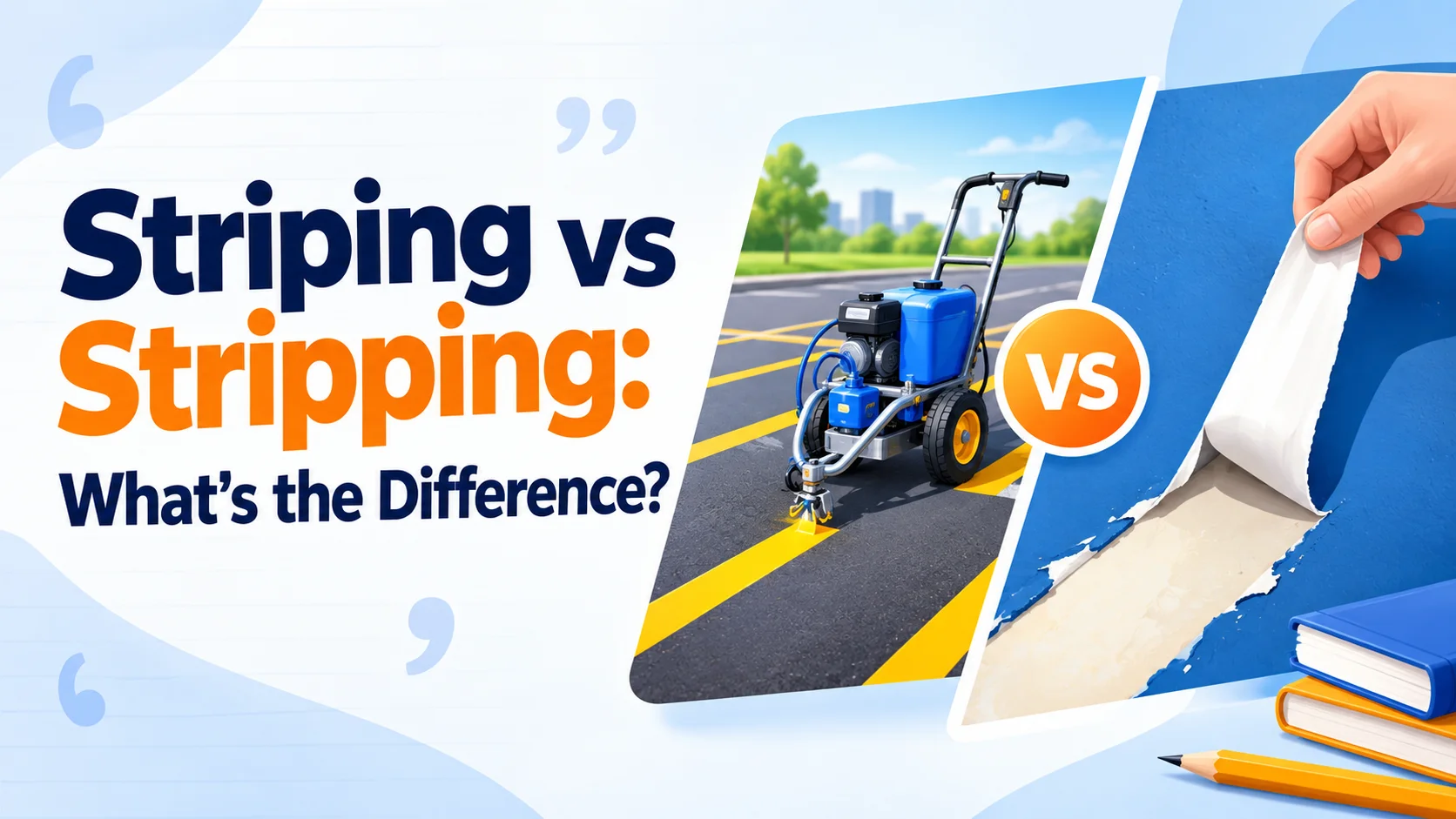
Striping vs stripping can look like a tiny spelling difference, but the two words describe completely different actions. Striping means adding, marking, or creating stripes, while stripping generally means removing something such as paint, insulation, a coating, or a covering. That single extra p changes both the word’s origin and its meaning. The distinction matters in everyday writing, but it becomes especially important in technical contexts such as road work, parking-lot maintenance, electrical work, flooring, automotive repair, and manufacturing.
The confusion becomes easier to understand when you trace each word back to its base verb. Striping comes from stripe, meaning to mark something with stripes. Stripping comes from strip, meaning to remove a covering, layer, or other material. Standard dictionaries recognize these as separate forms: Merriam-Webster lists stripe with the present participle striping, while strip has the present participle stripping.
This guide breaks down striping vs stripping with spelling rules, sentence examples, industry-specific meanings, common mistakes, and a practical way to choose the right word quickly. You’ll also see why stripping has two p’s, why spellcheck may not save you, and how the difference changes meaning in phrases such as parking-lot striping, paint stripping, and wire stripping. By the end, the distinction should be straightforward: striping creates or marks stripes; stripping removes something.
Striping vs Stripping: The Quick Answer
The simplest way to remember the difference is:
Striping adds or creates stripes. Stripping removes something.
| Word | Base word | Main meaning | Example |
| Striping | stripe | Adding or marking stripes | The crew is striping the parking lot. |
| Stripping | strip | Removing something | The crew is stripping the old paint. |
The two words are not interchangeable.
If a worker paints white lines onto a road, that is striping. If a worker removes an old coating from a surface, that is stripping.
Both words are legitimate English, so the issue is not whether one spelling is “correct” in isolation. The issue is whether the spelling matches the action you mean.
What Does “Striping” Mean?
Striping is the present participle or gerund form of stripe. As a verb, stripe means to mark or furnish something with stripes. Merriam-Webster gives striping as the present participle of stripe, and Dictionary.com defines striping as the act of decorating or otherwise providing something with stripes.
A stripe is generally a long, narrow band that differs from the surrounding surface in color, texture, or appearance.
So striping can refer to:
- Painting lines on a road
- Marking parking spaces
- Applying decorative stripes to a vehicle
- Marking boundaries on a sports field
- Adding visual lines or bands to products
- Creating striped patterns on fabric or other surfaces
Examples of “Striping” in Sentences
- The contractor is striping the parking lot after the new asphalt cures.
- The highway department completed lane striping overnight.
- The grounds crew is striping the soccer field before the match.
- The manufacturer added reflective striping to the safety garment.
- The car received custom striping along its doors.
In every example, something is being marked, decorated, or given stripes.
What Does “Stripping” Mean?
Stripping comes from the verb strip. The verb has several meanings, but one of its most important senses is removing a covering, surface, layer, or material. Merriam-Webster includes removing clothing, coverings, surface matter, equipment, and other material among the meanings of strip.
That gives stripping a very different conceptual direction from striping.
Think of it this way:
- Striping: something is being put on or marked
- Stripping: something is being taken off or removed
For example:
- Paint stripping removes paint.
- Wire stripping removes insulation from a wire.
- Floor stripping removes old finish or sealer.
- Data stripping can mean removing selected information or attributes from data.
Examples of “Stripping” in Sentences
- The workers are stripping the old paint from the doors.
- The electrician is stripping the insulation from the wire.
- The maintenance team is stripping the old floor finish.
- The technician finished stripping unnecessary information from the dataset.
- The renovation requires stripping the damaged wallpaper before repainting.
Here, the common idea is removal.
Striping vs Stripping at a Glance
The distinction becomes especially clear when the two words are placed next to each other.
| Situation | Correct word | Why? |
| Adding parking-space lines | Striping | Lines are being added |
| Removing old parking paint | Stripping | Existing material is being removed |
| Painting lane markings | Striping | The surface is being marked |
| Removing paint from metal | Stripping | Paint is being removed |
| Adding decorative lines to a vehicle | Striping | Stripes are being applied |
| Removing wire insulation | Stripping | Insulation is being removed |
| Adding lines to a sports field | Striping | Field markings are being created |
| Removing old floor finish | Stripping | The existing finish is being removed |
This distinction is more reliable than simply memorizing the spellings because it connects each word to the action behind it.
Why Are “Striping” and “Stripping” So Easy to Confuse?
There are several reasons.
First, both words begin with strip-, so visually they look almost identical. Second, both are common -ing forms, which makes the difference easy to overlook while typing. Third, the words are related in appearance but come from different base verbs.
There is also a practical problem: spellcheck usually cannot identify the mistake.
If you type:
The workers are stripping the parking lot.
A spellchecker may not flag it because stripping is a correctly spelled English word. It simply does not mean what you probably intended.
Likewise:
The electrician is striping the wire.
The spelling itself is valid English, but it is probably the wrong word if you mean removing insulation.
That is why this is primarily a meaning and word-choice problem, not just a spelling problem.
Why Does “Stripping” Have Two P’s but “Striping” Has One?
This is the spelling question behind the entire confusion.
The two words come from different base forms:
stripe → striping
strip → stripping
When -ing is added to stripe, the final silent e is removed:
stripe + ing → striping
But strip follows the consonant-doubling pattern used in forms such as running and stopping:
strip + ing → stripping
The doubled p helps preserve the relationship to the short-vowel base word strip and distinguishes it visually from stripe. English spelling conventions use consonant doubling in a number of similar forms.
The Difference in One Line
Stripe + ing = striping
Strip + ing = stripping
That is the most useful spelling rule to remember.
Other Examples of the Pattern
Consider:
- run → running
- stop → stopping
- sit → sitting
- plan → planning
The exact rules governing consonant doubling have additional conditions, but for this particular pair, remembering the two base verbs is enough.
Striping vs Stripping: The Grammar Behind the Words
Grammatically, both striping and stripping can function as present participles or gerunds.
Striping as a Verb
The contractor is striping the road.
Here, striping forms part of the progressive verb phrase is striping.
Striping as a Noun or Gerund
Proper striping improves the organization of the parking area.
Here, striping refers to the activity or process itself.
Stripping as a Verb
The workers are stripping the old coating.
The word describes an action that is currently happening.
Stripping as a Noun or Gerund
Paint stripping requires careful surface preparation.
Here, stripping names the process.
So the grammatical role does not determine which spelling to use. The base verb and intended meaning determine it.
Striping vs Stripping: Sentence Examples
The fastest way to make the difference stick is to compare realistic sentences.
Correct Striping Examples
- The crew began striping the parking lot after the pavement dried.
- Fresh road striping made the lane boundaries easier to see.
- The groundskeeper is striping the football field for Saturday’s game.
- The company specializes in decorative automotive striping.
- Reflective striping was added to the work jackets.
Correct Stripping Examples
- The contractor is stripping the old paint from the metal railing.
- The electrician is stripping the insulation from the conductor.
- The maintenance crew is stripping the old floor finish.
- The technician is stripping unnecessary metadata from the files.
- The restoration team spent the morning stripping the damaged coating.
Paired Examples
The following pairs show how one letter can completely change the action:
The crew is striping the parking lot.
The crew is stripping the parking lot’s old paint.
The technician is stripping the wire.
The technician is striping the equipment with identification lines.
The second sentence in each pair is grammatically possible, but its meaning is different. That is the important point: both spellings can be valid English, but they cannot normally be substituted for one another.
Striping and Stripping in Different Industries
The distinction becomes especially important in professional language because both terms appear frequently in technical fields.
Construction and Roadwork
In road and pavement work, striping commonly refers to applying lane markings, parking lines, arrows, symbols, and other visual markings.
For example:
The contractor scheduled the parking-lot striping for Sunday night.
By contrast, stripping could refer to removing an existing coating, paint, adhesive, or other surface material during renovation.
The practical difference is simple: one process creates markings, while the other removes material.
Automotive Work
Automotive striping can refer to applying decorative or identifying stripes to a vehicle.
For example:
The owner chose blue striping along the sides of the car.
Automotive stripping, depending on the context, may refer to removing paint, trim, components, or other material during restoration or repair.
Electrical Work
Wire stripping is a standard technical expression for removing insulation from the end of a wire so the conductor can be prepared for a connection.
The phrase wire striping would suggest marking the wire with stripes rather than removing insulation.
This distinction is not merely academic. Electrical work involves serious safety risks, and OSHA accident records document incidents involving workers stripping insulation from energized conductors.
Safety note: Electrical work should be performed only with appropriate training and safe procedures. The terminology may be simple, but the underlying task is not risk-free.
Flooring and Commercial Cleaning
In floor maintenance, stripping commonly means removing old floor finish, sealer, or buildup before a new finish is applied.
For example:
The facility scheduled floor stripping before applying a new finish.
3M’s floor-care documentation describes stripping products and pads specifically for removing old floor finishes and sealers.
The word striping would have a different meaning if it referred to creating lines or visual markings on a floor.
Manufacturing and Industrial Settings
Manufacturers may use striping for visual identification, decorative markings, safety lines, or other applied bands.
Stripping, meanwhile, may describe removing coatings, insulation, layers, or unwanted material from a component.
The object being acted upon often makes the intended word obvious.
A Closer Look at Road and Parking-Lot Striping
Parking-lot striping is one of the clearest real-world examples of the word.
A parking area may need markings for:
- Individual parking spaces
- Accessible parking spaces
- Traffic lanes
- Directional arrows
- Pedestrian crossings
- Loading areas
- Fire lanes
- No-parking zones
When these markings are painted or otherwise applied, the work is commonly called striping.
The important distinction is that the term describes the application of markings, not simply any work performed on the pavement.
For example:
The parking lot was resurfaced last week and will be striped tomorrow.
Here, striped means marked with lines or stripes.
If an old coating or paint needs to be removed first, that part of the job could instead involve stripping.
A Closer Look at Paint, Floor, and Wire Stripping
The meaning of stripping becomes clearer when you focus on what is being removed.
Paint Stripping
Paint stripping involves removing existing paint or coating from a surface.
The restoration crew is stripping the old paint before refinishing the door.
The exact removal method depends on the material, coating, surface, and project requirements. The important linguistic point is that stripping identifies the removal process.
Floor Stripping
Floor stripping generally involves removing old finish or sealer from a floor before further maintenance.
The facility is stripping the old floor finish before applying a new coating.
This terminology is also used by professional floor-care manufacturers.
Wire Stripping
Wire stripping means removing insulation from a wire.
The electrician is stripping the insulation before making the connection.
The object matters here. You are not adding stripes to the wire; you are removing a covering.
Common Mistakes With Striping and Stripping
Mistake 1: “Stripping the Parking Lot”
If you mean painting or repainting parking-space lines, striping the parking lot is normally the intended phrase.
Incorrect for that meaning:
The company is stripping the parking lot tomorrow.
Better:
The company is striping the parking lot tomorrow.
The first sentence suggests removal rather than marking.
Mistake 2: “Striping the Paint”
If the goal is to remove paint, the appropriate term is stripping.
The workers are stripping the paint from the railing.
Using striping would imply that stripes are being added to the paint rather than removed.
Mistake 3: “Wire Striping”
If an electrician is removing insulation, the conventional term is wire stripping.
The electrician is stripping the wire.
This is a good example of why technical vocabulary depends heavily on context.
Mistake 4: Trusting Spellcheck Too Much
A spelling checker can tell you whether a word exists in its dictionary. It cannot always determine whether you chose the correct meaning.
Both striping and stripping are valid words. Therefore, proofreading requires more than checking for red underlines.
Striping vs Stripping: A Simple Decision Test
When you are unsure, ask one question:
Am I adding/creating stripes, or am I removing something?
| If the action is… | Choose… | Example |
| Adding lines | Striping | striping the road |
| Creating a striped design | Striping | striping a vehicle |
| Marking a field | Striping | striping the field |
| Removing paint | Stripping | stripping the paint |
| Removing insulation | Stripping | stripping a wire |
| Removing floor finish | Stripping | stripping the floor |
| Removing unwanted information | Stripping | stripping metadata |
If you can identify the base verb, the spelling usually becomes obvious.
Striped vs Stripped: What’s the Difference?
The same distinction appears in the past tense and past participle forms.
Striped comes from stripe and generally means marked or decorated with stripes.
The car was striped with a contrasting color.
Stripped comes from strip and generally means having something removed.
The old coating was stripped from the surface.
The spelling difference again carries meaning:
- stripe → striped
- strip → stripped
This is useful because people sometimes remember striping vs stripping but then make the same mistake with striped vs stripped.
Are Striping and Stripping Ever Interchangeable?
Generally, no.
They come from different verbs and describe different actions. A sentence may become grammatical but semantically wrong if you replace one with the other.
Consider:
The contractor is striping the parking lot.
This indicates that parking lines are being added.
Change one word:
The contractor is stripping the parking lot.
Now the reader expects something to be removed.
The surrounding context can occasionally make unusual uses understandable, but that does not make the two words interchangeable. In professional writing, use the word that accurately describes the physical or conceptual action.
How to Remember the Difference
Use this two-part memory trick:
Striping = Stripe + ing
Think of a stripe.
If you are creating stripes, you are striping.
Stripping = Strip + ping
Think of strip as removing a layer.
If you are taking something away, you are stripping.
A compact version is even easier:
Striping adds stripes. Stripping removes something.
When proofreading, identify the base word first. If the intended verb is stripe, write striping. If it is a strip, write stripping.
Practical Proofreading Checklist
Before publishing or submitting a sentence containing either word, check:
- Am I describing adding or creating stripes?
- Or am I describing removing something?
- Does the base verb make sense as a stripe?
- Or should the base verb be stripped?
- Is the context technical, where terminology matters?
- Would changing the word alter the physical action?
- Have I relied on spellcheck instead of checking meaning?
This takes only a few seconds and prevents most errors.
Conclusion
Striping vs stripping becomes much easier once you stop treating it as a spelling puzzle and connect each word to its base verb. Striping comes from stripe and describes adding, marking, or creating stripes. Stripping comes from strip and describes removing a covering, coating, layer, insulation, or other material. That distinction carries into professional language, from road markings and automotive decoration to electrical and floor-maintenance work. One final actionable tip: whenever you hesitate, replace the -ing form with its base verb. If you mean stripe, choose striping; if you mean strip, choose stripping. A common mistake to avoid: relying on spellcheck alone. Both words are valid, so the software may approve the wrong one. Choose based on meaning first, spelling second. Once you remember “striping adds stripes; stripping removes,” this confusing pair becomes surprisingly easy to get right.
FAQs
Q1. Is it “striping” or “stripping” a parking lot?
Use striping when you mean adding or repainting parking-space lines, arrows, or other pavement markings. Use stripping only when the context involves removing paint, coating, or another surface material. The correct word depends on whether the action adds markings or removes material.
Q2. Is it “striping” or “stripping” paint?
Use stripping when paint is being removed from a surface. For example, “The contractor is stripping the old paint.” Striping paint would normally suggest applying paint in stripes, which is a completely different activity.
Q3. Why does “stripping” have two P’s?
Stripping comes from the verb strip, not stripe. When -ing is added, the final consonant is doubled: strip + ing = stripping. By contrast, stripe loses its silent final e: stripe + ing = striping.
Q4. Is “striping” a real English word?
Yes. Striping is a standard English word meaning the act or process of marking something with stripes, or the resulting striped pattern. Dictionaries such as Merriam-Webster and Dictionary.com recognize it as a noun, while striping is also the present participle of the verb stripe.
Q5. Can spellcheck tell me whether to use striping or stripping?
Usually not reliably. Both striping and stripping are correctly spelled English words, so spellcheck may accept either one. You need to determine the intended meaning yourself: striping relates to stripes; stripping relates to removal.