

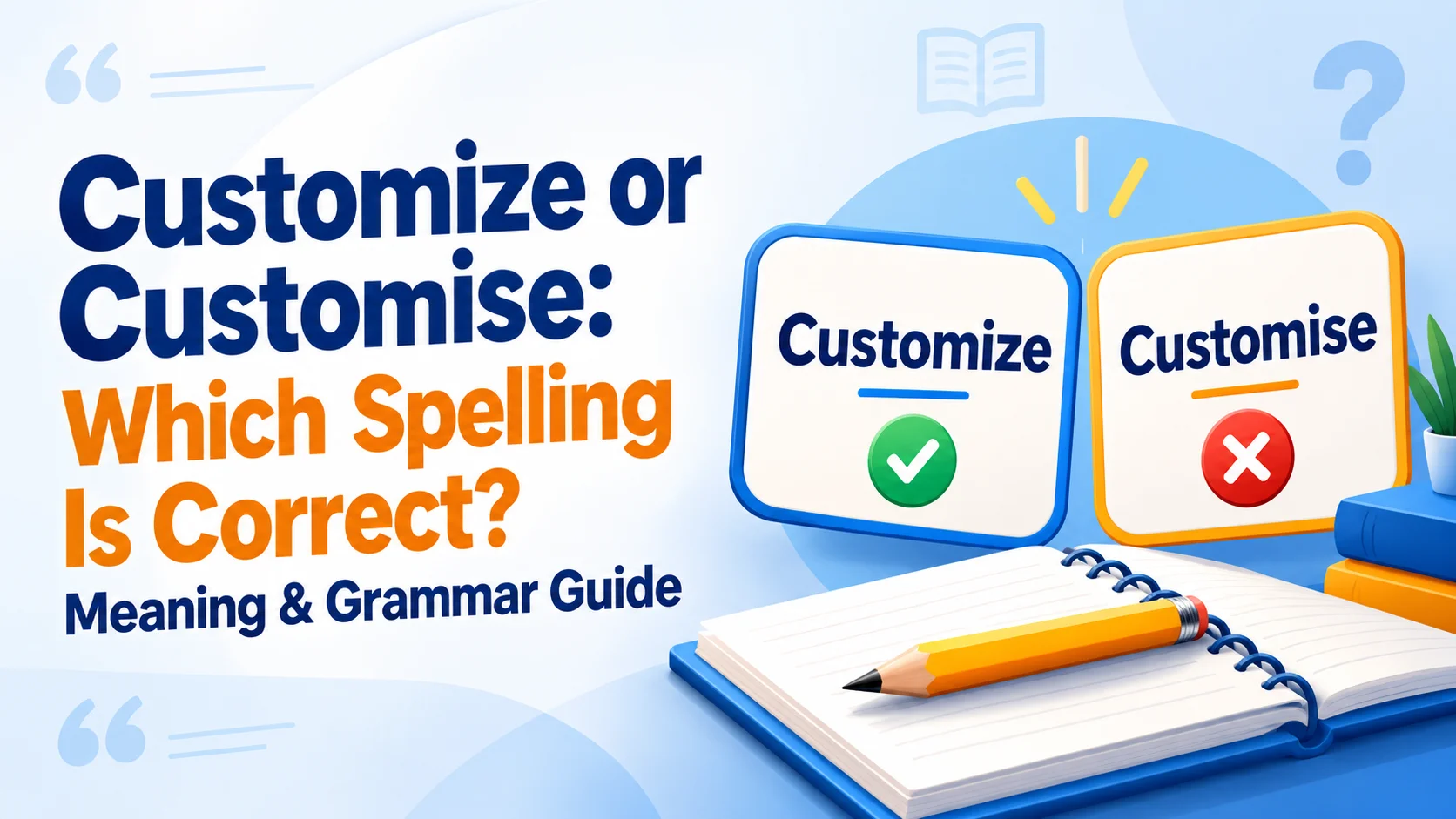
Customize and customize mean the same thing, but the spelling you choose depends largely on the variety of English you are writing. Customize is the usual American English form, while customise is commonly used in British English. Neither is simply a misspelling of the other.
This distinction matters whenever you are writing for a specific audience. A US software company might tell customers to “customize your settings,” while a UK website may say “customize your settings.” The underlying meaning does not change. What changes is the regional spelling convention used by the writer, publication, organization, or style guide.
In this guide, you’ll learn what customize/customise means, why both spellings exist, how their grammatical forms differ, and which version to use in websites, business writing, academic work, marketing, and SEO. You’ll also see practical examples that make the choice straightforward instead of relying on guesswork.
Customize or Customise: Quick Answer
The short answer is:
Use “customize” in American English and “customise” when following a British English spelling style that uses -ise. Both forms mean the same thing.
Cambridge Dictionary defines customize as making or changing something according to a buyer’s or user’s needs and identifies customise as the usual UK form. Oxford Learner’s Dictionaries likewise lists customise as a British English variant.
| Question | Customize | Customise |
| Meaning | Make something suit particular needs | Same |
| Main association | American English | British English |
| Pronunciation | Generally /ˈkʌstəmaɪz/ | Generally /ˈkʌstəmaɪz/ |
| Past tense | customized | customised |
| Noun | customization | customisation |
| -ing form | customizing | customising |
| Best approach | US-oriented style | UK-oriented style |
There is an important nuance: British English is not completely uniform about -ise and -ize spellings. Some British publishers and organizations prefer -ise, while Oxford University Press uses -ize where that form is available. The University of Oxford’s own current style guide, for example, prefers -ise in its institutional communications.
So, when writing professionally, the safest rule is not simply “British equals -ise.” Instead, follow the style guide of the publication or organization you are writing for.
What Does Customize or Customise Mean?
Customize/customise is a verb meaning to make or change something so that it suits a particular person, purpose, or set of requirements.
For example:
- You can customize the appearance of an app.
- Customers can customize their orders.
- The company customized the software for a particular client.
- The training program was customised for beginners.
The word is especially common in technology, e-commerce, manufacturing, education, marketing, and customer service because these fields frequently involve adapting something to individual requirements.
Cambridge gives examples involving software and products, while Oxford defines the verb in terms of making or changing something to suit the needs of its owner or user.
Customize/Customise Meaning in Simple Terms
A simple way to remember the meaning is:
Customize/customise = change something to make it fit a particular need or preference.
Imagine buying a laptop. The standard model may already work, but you might choose different storage, software, accessories, or settings. Those changes can be described as customization.
The same principle applies to a website where users choose their language, layout, notifications, or display preferences.
Customize/Customise in a Sentence
Here are examples in different contexts:
- Technology: “Users can customize the dashboard.”
- Education: “The course can be customized for different learning needs.”
- Business: “We customize our services for each client.”
- E-commerce: “Customers can customise the product before ordering.”
- Software: “You can customize the keyboard shortcuts.”
The object being changed can be a product, service, system, design, experience, or setting.
Customize/Customise as a Verb
Customize/customise is primarily used as a transitive verb, meaning it commonly takes an object.
For example:
The designer customized the website.
Here, the website is the thing being customized.
You will also see the pattern:
customize/customise something for someone
For example:
The company customized the software for the client.
Another common structure is:
customize/customise something to particular requirements
For example:
The vehicle was customized to the customer’s requirements.
Customize vs Customise: What Is the Difference?
The principal difference is spelling convention, not meaning.
Both forms describe the same action. They also normally have the same pronunciation. The choice reflects the variety of English or house style being used.
This is similar to other regional pairs such as:
- color / colour
- center / centre
- organize / organise
- analyze / analyse
However, spelling systems are not always perfectly divided by country. British English contains some variation, and individual publishers can establish their own preferences.
“Customize” in American English
Customize is the standard form you should expect in American English.
Examples:
- “Customize your account settings.”
- “The company offers customized software.”
- “Customers can customize their orders.”
- “The platform provides several customization options.”
American English generally uses the -ize pattern in words where that spelling is part of the accepted variation.
“Customise” in British English
Customise is widely used in British English, particularly by organizations and publications that prefer the -ise convention.
Examples:
- “Customise your account settings.”
- “The company offers customized software.”
- “Customers can customise their orders.”
- “The platform provides several customisation options.”
Cambridge explicitly labels customise as the UK form, while Oxford’s institutional style guide recommends -ise/-isation spellings for its communications.
Are Both Spellings Correct?
Yes, when used according to the appropriate spelling convention.
It is inaccurate to tell every writer that customise is wrong because customize appears in an American dictionary, or vice versa.
The better question is:
Which English variety are you using?
A US publication can correctly use customize. A British publication can correctly use customise. A publication with its own established style should follow that style.
Customize vs Customise: Grammar and Word Forms
The spelling difference continues into related forms. This is where writers sometimes make avoidable mistakes.
| Grammatical form | American English | British English, -ise style |
| Base verb | customize | customise |
| He/she/it | customizes | customises |
| Past tense | customized | customised |
| Past participle | customized | customised |
| -ing form | customizing | customising |
| Noun | customization | customisation |
| Adjective | customizable | customisable |
Cambridge lists forms such as customization, customized, and customizable, with the corresponding UK forms customisation, customised, and customisable.
Present and Base Form
- US: customize
- UK -ise style: customise
Example:
Users can customize the dashboard.
or
Users can customize the dashboard.
Third-Person Singular
Add -s:
- customizes
- customises
Example:
The application customizes the display automatically.
In British -ise style:
The application customises the display automatically.
Past Tense and Past Participle
The forms are:
- customized
- customised
Example:
We customized the report for the client.
British version:
We customized the report for the client.
Present Participle and Gerund
The forms are:
- customizing
- customising
Example:
She is customizing her profile.
British version:
She is customising her profile.
Noun Forms
The noun follows the same regional pattern:
- customization
- customisation
For example:
The software offers extensive customization.
British -ise style:
The software offers extensive customisation.
Adjective and Related Forms
Another useful pair is:
- customizable
- customisable
The adjective means that something can be customized/customised.
For example:
This software is highly customizable.
or:
This software is highly customisable.
Expert tip: Don’t switch conventions halfway through a document. If you have chosen customise, related forms such as customised and customisation should normally follow the same style.
Why Are There Two Spellings of Customize/Customise?
The difference belongs to a much broader history of English spelling.
Words ending in -ize and -ise can appear differently depending on the English variety and the style authority being followed. Oxford University explains that its own institutional style uses -ise/-yse/-isation, while its broader publishing tradition can differ.
That is why it is risky to create an overly simple rule such as:
“Every British word must end in -ise.”
In actual professional writing, dictionaries and house-style preferences matter.
For example, the University of Oxford’s current institutional style guide recommends organise rather than organize, whereas an Oxford-related publishing style can prefer -ize in words where both forms are available in British English.
The practical lesson is more useful than memorizing the history:
Choose an English variety, identify the relevant style guide, and remain consistent.
American English vs British English: Which Should You Use?
Your audience should usually determine your starting point.
Use “Customize” for American English
Choose customize when your content is specifically written for an American audience, especially when following an American publication or company style.
Typical contexts include:
- US software interfaces
- American business websites
- US product documentation
- American academic or professional writing
- US-focused marketing campaigns
Example:
Customize your subscription preferences before completing registration.
Use “Customise” for British English
Choose customise when your publication uses a British style that prefers -ise.
Typical contexts include:
- UK websites
- British business communication
- UK educational materials
- British marketing content
- Organizations whose house style specifies -ise
Example:
Customise your subscription preferences before completing registration.
What About Canadian, Australian, and Other English Varieties?
This is where country-based rules become less reliable.
English-speaking countries do not all use identical spelling conventions. A publisher may also impose a house style that differs from what you might expect from the country alone.
Therefore, if the audience is outside the US or UK:
- Identify the publication’s preferred English variety.
- Check its style guide if available.
- Look at established pages from the same organization.
- Use a reputable dictionary for uncertain forms.
- Apply the selected convention consistently.
What Should International Websites Use?
For a global website, consistency is more valuable than trying to please every regional spelling preference on one page.
If your main audience is American, customize may be the natural choice. If your primary audience is British, customise may be better.
For large international organizations, separate localized versions can be appropriate. For example, a US English site and UK English site can use their respective conventions without creating confusing mixtures.
Customize vs Personalize: Are They the Same?
Not exactly.
Customize focuses on changing something to meet particular requirements or preferences. Personalization often emphasizes making something more relevant to an individual.
The distinction can be subtle.
“Customize the software”
means change its features, settings, or configuration.
“Personalize the recommendations”
suggests making recommendations more relevant to a particular person.
There is considerable overlap. A company might customize a product and personalize the customer’s experience at the same time.
A useful distinction is:
| Word | Typical emphasis | Example |
| Customize/customise | Adapt or modify something | Customize the dashboard |
| Personalize/personalise | Make something individually relevant | Personalize your recommendations |
| Tailor | Adapt specifically to requirements | Tailor the course to beginners |
| Modify | Make a change | Modify the design |
Don’t replace customize with personalize simply because they appear in the same SEO keyword group. Choose the word that accurately describes the action.
How Customize/Customise Is Used in Real Life
Websites and Apps
Digital products use the word frequently because users can alter settings and interfaces.
Examples:
- Customize your profile.
- Customise notification settings.
- Customize the dashboard layout.
- Customise your privacy preferences.
The word works particularly well when users are actively selecting options.
Products and Services
Retailers may let customers select:
- colors
- materials
- sizes
- configurations
- accessories
- engraving or design options
A product page might therefore say:
Customize your order before adding it to your cart.
The British version would be:
Customise your order before adding it to your basket.
Notice that regional language can involve more than one word. Style consistency extends beyond a single spelling choice.
Business and Marketing
Businesses use the concept to communicate flexibility:
We customize solutions to meet client requirements.
This can be useful when the product is not one-size-fits-all.
However, businesses should avoid claiming something is “fully customizable” when customers can only make a few predetermined choices. Clear writing should describe the actual degree of flexibility.
Education and Learning
The word is also useful for describing adaptable educational experiences:
Teachers can customize activities for different skill levels.
British style:
Teachers can customize activities for different skill levels.
The key idea is adaptation to a learner’s needs.
Everyday Conversation
The term is no longer limited to technical or corporate writing.
You can customize:
- phone settings
- computer shortcuts
- clothing
- meal orders
- profiles
- notifications
- home products
- learning plans
That broad usage explains why the spelling question appears frequently in everyday writing as well as professional content.
Customize or Customise in SEO: Which One Should You Use?
For SEO, audience alignment should come before keyword repetition.
Suppose a company sells software primarily to customers in the United States. Its interface, landing pages, help documentation, and marketing copy will generally benefit from a consistent American English style.
A UK-focused company may naturally use customise.
The mistake is assuming that an SEO article needs to force both spellings repeatedly. It doesn’t.
A better SEO approach
Use the spelling that matches your target audience in:
- page titles
- headings
- body content
- product descriptions
- navigation
- calls to action
- supporting content
If research shows that audiences in different regions use different search wording, localized content can address those differences naturally.
For example, a UK page can use customise throughout instead of inserting customize awkwardly several times.
SEO tip: Search engines can understand spelling variants and regional language, but readers still notice inconsistent editorial style. Optimize for the audience first.
Customize or Customise in Professional Writing
The best choice depends on the document’s purpose and style authority.
Business Emails
Use the spelling preferred by your company or recipient’s established style.
Reports
Follow the organization’s house style. Don’t change between British and American spelling simply because different sources use different forms.
Academic Writing
Your institution, journal, publisher, or supervisor may specify a particular English variety.
Product Documentation
Consistency is especially important because users encounter the same terminology repeatedly across interfaces, help pages, and manuals.
Marketing Copy
Match the market you are targeting. A campaign aimed at US customers should normally sound like US English; a UK campaign should follow its chosen British style.
Common Mistakes With Customize and Customise
Mixing American and British Spellings
A document that begins with customise but later uses customized can look poorly edited.
The problem isn’t that either individual word is wrong. The issue is inconsistency.
Treating “Customise” as Incorrect
This is one of the most common misconceptions.
Customise is a legitimate spelling used in British English. Cambridge specifically identifies it as the usual UK form.
Switching Only the Main Verb
Writers sometimes change:
customise → customize
but forget related forms such as:
customisation → customization
Check the entire word family when changing style.
Assuming British English Has One Universal Rule
British spelling can contain legitimate variation between dictionaries, publishers, and institutions.
For example, Oxford University currently uses -ise in its institutional style, while another Oxford publishing style can prefer -ize where that variant is available.
The professional solution is to follow the designated style authority, not to argue that one suffix is always correct.
A Simple Decision Rule for Writers
When you’re unsure which spelling to use, work through this short checklist:
| Question | Decision |
| Writing for a US audience? | Use customize |
| Writing for a UK publication using -ise? | Use customise |
| Does the organization have a house style? | Follow the house style |
| Do academic assignments have a required style? | Follow the institution/publisher |
| International audience? | Choose one consistent English variety |
| Unsure about related forms? | Check a reputable dictionary |
| Already started the document? | Match the spelling pattern already established |
A 10-Second Test
Ask yourself:
Who will read this?
Then ask:
Which English style does the publication or organization use?
Finally:
Have I used the same convention throughout the document?
If you can answer all three, you have probably made the right choice.
Customize vs Customise: Practical Examples
American English
You can customize the dashboard to display your preferred information.
The company offers customized software for small businesses.
Users have several customization options.
The interface is highly customizable.
British English Using -ise
You can customize the dashboard to display your preferred information.
The company offers customized software for small businesses.
Users have several customisation options.
The interface is highly customisable.
The meaning remains unchanged. What changes is the spelling system.
Is “Customize” or “Customise” More Common?
There is no single worldwide frequency that makes one spelling universally “correct.”
The apparent winner depends heavily on where the English is being used.
American publications naturally produce more instances of customisation, while British publications that use -ise naturally produce more customise. A global web count can therefore be misleading because it combines different audiences, industries, countries, and editorial styles.
For practical writing, regional appropriateness is more useful than trying to identify one globally dominant spelling.
If you are writing for a particular market, use the spelling expected by that market rather than selecting whichever version appears more frequently on the entire internet.
Customize/Customise Pronunciation
The two spellings are generally pronounced the same.
Cambridge gives the pronunciation as approximately:
/ˈkʌs.tə.maɪz/
So the difference is primarily visible in spelling, not in pronunciation.
That means you should not assume that hearing someone pronounce the word will tell you whether they would write customize or customize.
This is one reason the spelling can cause confusion for English learners: the sound does not provide a reliable clue to the written form.
Customize or Customise: A Writer’s Best-Practice Checklist
Before publishing, check:
- Is the target audience primarily American, British, or international?
- Does the organization have a house style?
- Have you chosen to customize or customise deliberately?
- Are related forms consistent?
- Did you accidentally mix other US and UK spellings?
- Does the terminology match your audience?
- If SEO matters, does the wording reflect genuine search intent?
- Have you avoided inserting both variants unnaturally?
- Did you check uncertain forms against a reputable dictionary?
This takes only a few minutes and can prevent dozens of small editorial inconsistencies.
Final Takeaway
Customize and customise describe the same action: adapting something to suit a person’s needs or preferences. The main distinction is regional and editorial spelling, not grammar or meaning. American English normally uses customize, while British English commonly uses customise, although British publishers can legitimately follow different -ise/-ize conventions.
The smartest choice is therefore contextual. Identify your audience, check the applicable style guide, and keep the entire document consistent. Don’t treat a regional spelling as a mistake simply because another English variety uses a different form.
One final actionable tip: when editing, search for the entire word family—not just customize/customise. Check customized/customised, customization/customisation, and customizable/customisable too. A common mistake to avoid: mixing regional spelling systems without realizing it. Good professional writing is not about choosing the spelling that looks most familiar; it is about making a deliberate choice and applying it consistently.
Frequently Asked Questions
Q1. Is “customize” or “customise” correct?
Both are correct within their respective spelling conventions. Customize is the standard American English form, while customise is commonly used in British English. The important issue is not choosing a universally “correct” version but matching the English variety and style guide used by your audience.
Q2. Is “customise” British or American English?
Customise is primarily associated with British English. Cambridge lists it as the UK form of customisation. However, British publishers and organizations can have different preferences concerning -ise and -ize spellings, so always check the relevant house style when precision matters.
Q3. Are customize and customise pronounced differently?
Generally, no. The two forms normally have the same pronunciation, approximately /ˈkʌstəmaɪz/. The difference is primarily written spelling. Regional accents can naturally affect pronunciation, but the -ize versus -ise distinction itself does not normally create a different pronunciation.
Q4. Which spelling should I use for SEO?
Use the spelling that matches your target audience and regional English style. A US-focused website can consistently use customize, while a UK-focused site may use customise. Don’t repeat both versions artificially. Strong SEO depends more on satisfying the reader’s intent than mechanically inserting spelling variants.
Q5. Why does British English sometimes use “-ise” and sometimes “-ize”?
British English permits variation in this area. Some dictionaries, publishers, and organizations prefer -ise, while others, including Oxford University Press in certain contexts, use -ize where it is an accepted alternative. The safest professional practice is to follow the specific style guide governing your work.