

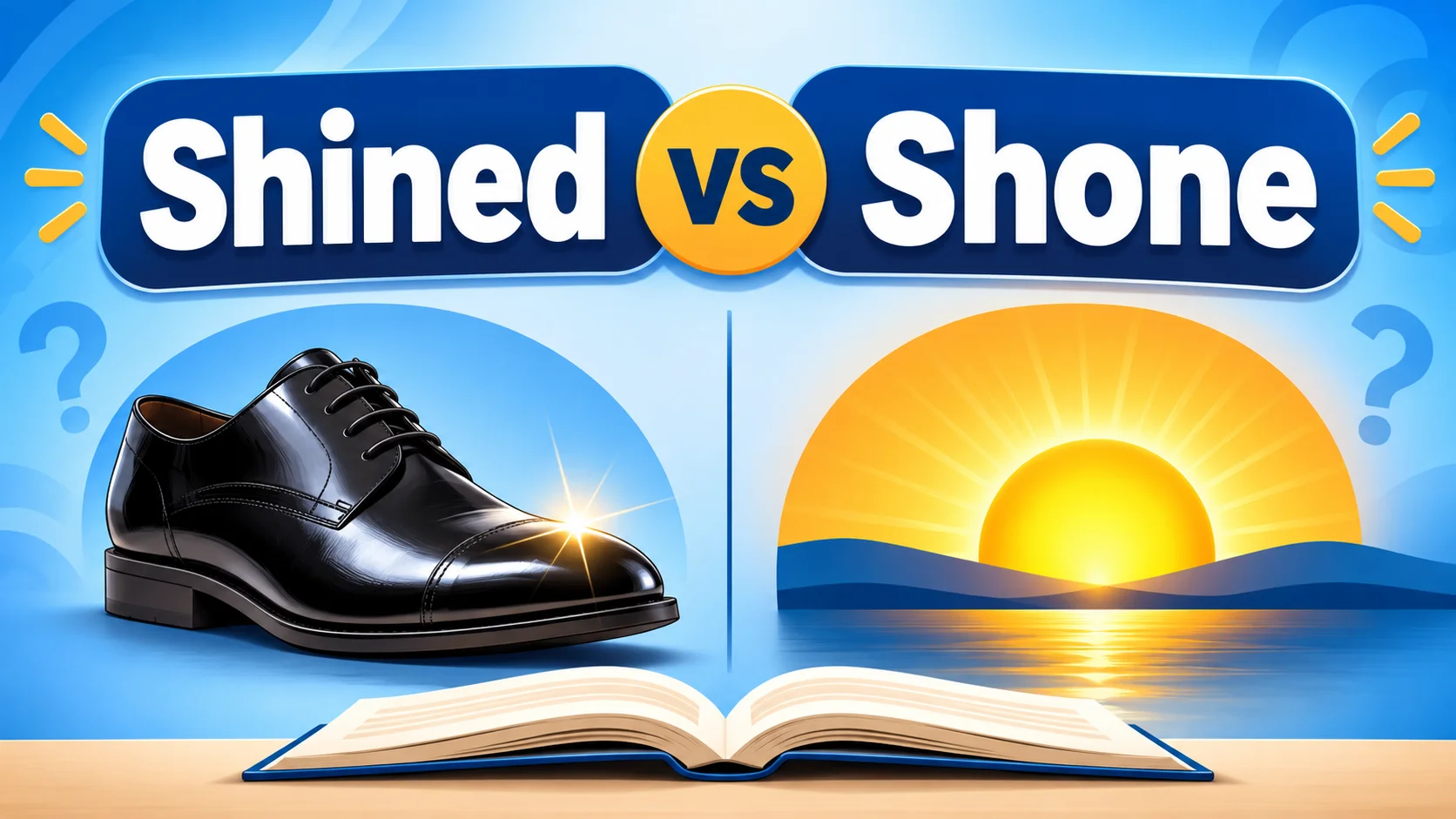
Shined vs shone can both be correct past forms of shine, but choosing between them depends on what “shine” means in the sentence. That is why the familiar advice that one form is simply “American” and the other “British” can be misleading. The distinction is more useful when you look at the verb’s meaning, whether it takes an object, and what is actually doing the shining.
For example, The sun shone through the clouds and She shined his shoes before the ceremony are both standard constructions. In the first sentence, the sun gave off light; in the second, someone polished an object. Likewise, He shined a flashlight into the room uses shined because someone actively directed a light. Context, rather than spelling alone, determines the natural choice.
This guide explains shined vs shone from the ground up, including their grammar, meanings, transitive and intransitive uses, British and American usage, verb forms, perfect tenses, common mistakes, and real-world examples. You will also see why the simple rule “shined takes an object, shone does not” is useful but incomplete—and how to choose the right form when a sentence seems less obvious.
Shined vs Shone: The Quick Answer
Both shined and shone are correct forms of the verb shine. The best choice depends primarily on the sense of shine being used.
A practical guide is:
- Shined is commonly used when someone polishes something: She shined her shoes.
- Shined is also commonly used when someone directs a light: He shined a flashlight into the garage.
- Shone is commonly used when something emits or gives off light: The sun shone brightly.
- Shone is especially natural with the sun, moon, stars, and other sources of light: The moon shone through the window.
There is an important qualification, however. English usage is not governed by an absolute “shined for transitive, shone for intransitive” rule. Meaning, construction, dialect, and established usage all matter.
| If you mean… | Usually use | Example |
| Polish or make something glossy | shined | He shined his shoes. |
| Direct a light somewhere | shined | She shined a flashlight at the door. |
| Give off or emit light | shone | The sun shone all afternoon. |
| Describe natural light | shone | The moon shone through the clouds. |
Quick memory aid: If a person is actively doing something with a light or polishing an object, shined is often the natural choice. If something is simply giving off light, shone is usually the better choice.
Shined vs Shone at a Glance
The two forms come from the same verb, but they have developed different patterns of use.
| Feature | Shined | Shone |
| Base verb | shine | shine |
| Common role | Regular past form | Traditional irregular past form |
| Polishing | Very common | Generally not used |
| Directing light | Common | Less typical |
| Emitting light | Less typical | Very common |
| Common with sun/moon/stars | Unusual | Very common |
| Often transitive | Yes | Usually no |
| Often intransitive | Less common | Yes |
| Example | He shined the silver. | The moon shone brightly. |
The important point is that neither form is simply the “correct” past tense in every situation.
Consider these sentences:
Maria shined her boots before the trip.
The morning sun shone through the curtains.
Changing shined to shone in the first sentence would not preserve the normal meaning. Likewise, replacing shone with shined in the second would sound unnatural in standard usage.
What Does “Shined” Mean?
“Shined” as the Past Tense of Shine
Shined is the regular -ed past form of shine. It is particularly established in senses where shine means to polish something or direct a beam of light.
For example:
- I shined my shoes before the interview.
- She shined the silverware.
- The guard shined a flashlight toward the entrance.
The form is therefore not a mistake or an informal substitute for shone. It has its own well-established uses.
“Shined” When You Polish or Improve the Appearance of Something
One of the clearest uses of shined is when someone makes an object cleaner, brighter, smoother, or more polished.
Examples:
- He shined his leather shoes.
- She shined the brass handles.
- The children shined their boots for the parade.
- I shined the metal until it looked almost new.
Here, the sentence normally contains an object receiving the action.
A useful pattern is:
Someone + shined + something
For example:
Daniel shined his shoes.
Daniel is performing the action, and his shoes receive it.
“Shined” When You Direct a Light Somewhere
Another common use occurs when a person deliberately aims a light at, toward, onto, or into something.
Examples:
- She shined a flashlight into the basement.
- The detective shined a light under the car.
- He shined his torch at the lock.
The important idea is directed illumination. The person is not necessarily producing the light; they are controlling where it goes.
This explains why shined is natural in:
He shined a flashlight through the window.
The flashlight is being directed through the window.
Is “Shined” Always Transitive?
No. The transitive pattern is extremely useful for understanding shined, but it should not be treated as an unbreakable grammatical law.
Transitive means the verb has a direct object:
She shined the shoes.
Intransitive means there is no direct object:
The sun shone brightly.
The distinction often corresponds neatly to the different meanings of shine, but English verbs do not always fit into one mechanical formula. That is why meaning should come before memorization.
What Does “Shone” Mean?
“Shone” as the Past Tense of Shine
Shone is the traditional irregular past form of shine. It is particularly common when shine means to emit or give off light.
Examples include:
- The sun shone brightly.
- The moon shone over the lake.
- The stars shone above us.
In these examples, the subject itself is the source of illumination.
One pronunciation point is worth remembering: shone is normally pronounced like “shown.” That can cause confusion with shown, but the two words belong to different verbs.
- The moon shone brightly. → from shine
- She has shown me the photograph. → from show
“Shone” When Something Gives Off Light
When the subject is naturally producing or radiating light, shone is the conventional choice.
For instance:
- The sun shone through the clouds.
- The candle shone in the dark.
- The moon shone over the water.
- The stars shone above the mountains.
The sentence is describing the behavior or appearance of the light source, not someone manipulating it.
Why “Shone” Usually Appears Without a Direct Object
Consider:
The sun shone brightly.
There is no direct object. Brightly describes how the sun shone.
You can add prepositional phrases:
The sun shone through the clouds.
The moon shone on the water.
The phrases through the clouds and on the water do not turn clouds or water into direct objects of shone. They describe the direction, location, or circumstances of the light.
That distinction becomes particularly useful when checking whether a sentence is grammatically natural.
The Real Grammar Difference Between Shined and Shone
The most useful way to understand these forms is to combine grammar with meaning.
Transitive Shine: When Someone Shines Something
A transitive construction commonly looks like:
Subject + shine + direct object
Examples:
- She shined the shoes.
- He shined a flashlight at the wall.
- The worker shined the metal.
In each case, something is being acted upon or deliberately illuminated.
Intransitive Shine: When Something Shines
An intransitive construction commonly looks like:
Subject + shine
Examples:
- The sun shone brightly.
- The stars shone all night.
- The moon shone through the trees.
Here, the subject is the thing that shines.
Why the “Transitive = Shined, Intransitive = Shone” Rule Is Useful but Not Absolute
This shortcut helps beginners because it captures the most common contrast:
Shined → someone polished or directed something.
Shone → something emitted light.
But calling it an absolute rule creates problems.
English has more than one established past form because shine has developed different senses and patterns over time. Dictionaries and usage guides recognize this variation, and regional preferences can also affect which form a writer encounters.
So instead of asking only:
“Does the verb have an object?”
ask:
“What does shine mean here?”
That question usually leads you to the correct form much faster.
When Should You Use “Shined”?
Use “Shined” for Polishing Shoes and Other Objects
This is one of the safest contexts for shined.
- He shined his dress shoes.
- She shined the boots.
- They shined the silver before dinner.
If the intended meaning is polish, shined is the natural choice.
Use “Shined” When You Direct a Light
Use shined when someone deliberately directs a beam.
- She shined a flashlight into the closet.
- The ranger shined a light along the trail.
- He shined the spotlight toward the stage.
The object can be a flashlight, spotlight, lamp, or simply a light.
Common patterns include:
- shined a light at something
- shined a light on something
- shined a light into something
- shined a light through something
“Shined” in Figurative or Extended Uses
Shine also has figurative meanings, but you should not automatically apply shined simply because something is metaphorically “bright.”
For example, She shone on the stage may be interpreted metaphorically as “she performed exceptionally well,” while she shined the stage would normally suggest physically directing or applying light to it.
The safest approach is to determine whether the verb describes physical illumination, polishing, or figurative excellence before selecting the past form.
When Should You Use “Shone”?
Use “Shone” for the Sun, Moon, and Stars
This is one of the strongest patterns in standard English.
- The sun shone all afternoon.
- The moon shone through the clouds.
- The stars shone brightly above the desert.
These examples describe naturally occurring illumination.
Use “Shone” for Light That Was Emitted
Other light sources can also take shone when the sentence describes the light they emitted.
- A warm light shone from the window.
- The candle shone in the darkness.
- A bright lamp shone above the entrance.
The exact noun and context can affect which construction sounds most natural, but the central idea remains light being emitted or appearing.
Use “Shone” in Literary and Descriptive Writing
Shone appears frequently in narrative descriptions:
The moon shone over the quiet lake.
Morning sunlight shone through the trees.
That does not mean shone is inherently more formal than shined. It simply fits naturally with descriptions of light and is well established in literary prose.
Shined vs Shone With Direct Objects
This is where many otherwise careful writers become uncertain.
“He Shined His Shoes” — Why Shined Works
The meaning is polished:
He shined his shoes before the wedding.
His shoes are the direct object. The sentence describes an action performed on them.
“He Shone His Shoes” — Why This Usually Sounds Wrong
If the intended meaning is “polished,” shone his shoes is not the normal modern construction.
The problem is not simply that shone is an “incorrect past tense.” Rather, the meaning associated with shone does not normally match the polishing sense of the sentence.
“She Shined a Flashlight” — Why This Is Different
Here, shined means directed:
She shined a flashlight into the attic.
This is another established transitive use.
“The Sun Shone on the House” — Why Shone Works
In:
The sun shone on the house.
the house is not a direct object of shone. It is the object of the preposition on.
The sentence describes sunlight falling on the house, so shone is natural.
Shined vs Shone in American and British English
It is tempting to turn this into a simple regional rule:
“Americans say shined; British speakers say shone.”
That is too broad.
Both American English and British English use shone, especially when referring to light from the sun, moon, stars, or another source. Both varieties also recognize shined, particularly in contexts involving polishing and directing light.
Regional usage can influence frequency and preference, but the semantic distinction remains more useful than a nationality-based rule.
Is “Shone” More Common in British English?
Shone is firmly established in British English and is also standard in American English.
A British writer can naturally write:
The sun shone through the window.
There is no need to replace it with shined simply because the audience is American or international.
Is “Shined” More Common in American English?
Shined is especially familiar in American English in constructions such as:
- shined his shoes
- shined a flashlight
- shined a light on something
But that does not make shone a British-only form.
Does the Correct Form Depend on Your Audience?
Audience matters less than meaning and construction.
For professional writing, the best practice is to use the form that matches the intended sense and is natural for your variety of English.
If you’re writing for an international audience, conventional forms such as the sun shone and he shined his shoes are unlikely to create ambiguity.
The Forms of the Verb “Shine”
| Verb form | Form | Example |
| Base form | shine | Stars shine at night. |
| Third-person singular | shines | The lamp shines brightly. |
| Present participle | shining | The sun is shining. |
| Past | shined / shone | She shined her shoes. / The sun shone. |
| Past participle | shined / shone | He has shined the shoes. / The sun has shone all day. |
Shine
The base form appears after to and with plural subjects or certain auxiliary constructions:
I want the metal to shine.
Shines
The present-tense third-person singular form is:
The moon shines brightly.
Shining
Shining is the present participle and gerund:
The sun is shining.
Shined and Shone
Both can function as past forms, but their preferred contexts differ.
She shined her shoes.
The sun shone brightly.
Has Shined vs Has Shone
Both forms can appear as past participles:
She has shined her shoes several times.
The sun has shone brightly all morning.
The choice again follows the sense and usage pattern rather than a universal rule that only one participle is grammatical.
Shined vs Shone in Perfect Tenses
Perfect constructions are worth examining because they expose a common misconception: the distinction is not limited to simple past sentences.
“Has Shined” and “Has Shone”
Compare:
He has shined the silverware.
Here, the meaning is associated with polishing.
Now compare:
The sun has shone through the clouds all morning.
Here, the sun is the source of the light.
The auxiliary has does not determine which form to use. The underlying meaning of shine still matters.
Why Past Participles Make the Choice More Complicated
Learners sometimes memorize a single chart:
shine → shone → shone
But that does not adequately explain actual modern usage.
For a learner, it is better to remember the verb’s major senses:
- shine → emit light → shone
- shine → polish/direct light → shined
This approach is more useful than memorizing isolated forms because it helps you construct new sentences correctly.
Shined vs Shone: Example Sentences in Real Context
Everyday Conversations
A: Did you clean your shoes?
B: Yes, I shined them before I left.
A: Was it bright outside this morning?
B: Yes. The sun shone almost all morning.
The contrast becomes obvious when the forms appear in realistic situations.
Weather and Nature
- The sun shone through the clouds.
- The moon shone over the ocean.
- The stars shone brightly after the storm.
- The morning sun shone through the trees.
Cleaning and Polishing
- She shined her boots before the ceremony.
- He shined the brass handle.
- They shined the silverware for the dinner party.
Flashlights and Other Light Sources
- He shined a flashlight under the bed.
- She shined a light through the keyhole.
- The officer shined his flashlight toward the vehicle.
Workplace and Formal Writing
- The technician shined a light on the damaged component.
But:
- The emergency light shone through the doorway.
The first sentence emphasizes deliberate direction; the second describes the light being emitted or visible.
Common Expressions and Collocations With Shine
Certain combinations are so familiar that they provide useful clues.
“The Sun Shone”
The sun shone brightly throughout the afternoon.
This is one of the clearest examples of the emitted-light sense.
“The Moon Shone”
The moon shone over the valley.
Again, the moon is the source of illumination.
“Shined His Shoes”
He shined his shoes before the interview.
This strongly signals the polishing sense.
“Shined a Light”
She shined a light into the dark room.
This signals deliberate direction.
“Shone Brightly”
The stars shone brightly above the city.
The adverb brightly naturally complements the emitted-light sense.
Common Mistakes With Shined and Shone
Mistake: Using “Shined” Every Time You Mean “Shine” in the Past
Knowing that shined is a valid word does not mean it replaces shone everywhere.
❌ The sun shined through the clouds.
✅ The sun shone through the clouds.
When the sun is simply emitting light, shone is the conventional choice.
Mistake: Assuming “Shone” Is Always the Correct Form
The opposite mistake is equally problematic.
❌ She shone her shoes before the interview.
✅ She shined her shoes before the interview.
When the intended meaning is polish, shined is the normal form.
Mistake: Treating Every Phrase After “Shone” as a Direct Object
Consider:
The moon shone on the water.
The phrase on the water does not mean that water is a direct object. It is a prepositional phrase describing where the light fell.
That is why shone remains perfectly natural.
Mistake: Confusing “Shone” With “Shown”
This is a spelling and pronunciation trap.
| Word | Verb | Meaning |
| shone | shine | gave off light |
| shown | show | presented or revealed |
Examples:
- The sun shone through the window.
- She has shown me the report.
If you can replace the word with “displayed” or “revealed,” you probably need shown, not shone.
Mistake: Assuming British English and American English Follow Completely Different Rules
The two varieties overlap substantially. Both use shone for emitted light and shined in established transitive contexts.
Treating the difference as a national spelling rule makes the explanation less accurate and can lead writers to choose the wrong form.
Shined vs Shone: Which One Is Correct?
Use this decision process when you’re unsure.
| Ask yourself | If the answer is yes | Likely choice |
| Does shine mean “polish”? | Someone improved an object’s surface | shined |
| Is someone deliberately directing a light? | A person controls where the beam goes | shined |
| Is the subject itself giving off light? | Sun, moon, stars, lamp, etc. | shone |
| Is the sentence describing natural illumination? | Light is simply being emitted | shone |
| Does the sentence have a direct object? | Something receives the action | Often shined |
Choose “Shined” When…
Use shined when the sentence means:
- polished something
- cleaned something to make it shine
- directed a flashlight or other light
- deliberately illuminated something
Examples:
She shined her shoes.
He shined a flashlight into the garage.
Choose “Shone” When…
Use shone when the sentence means:
- emitted light
- radiated light
- appeared bright
- described natural or ambient illumination
Examples:
The sun shone through the clouds.
The moon shone over the lake.
If Both Forms Seem Possible
Ask five questions:
- What does shine mean in this sentence?
- Is someone polishing or directing something?
- Is the subject itself producing light?
- Is there a true direct object or merely a prepositional phrase?
- Does the form sound natural in the variety of English you’re using?
That checklist is much more reliable than trying to memorize dozens of isolated examples.
Shined vs Shone: A Simple Memory Trick
A useful shortcut is:
Shined = someone did something with the shine.
Shone = something gave off the shine.
So:
- He shined his shoes. → he polished them.
- She shined a flashlight into the room. → she directed it.
- The sun shone through the clouds. → the sun emitted light.
Just remember that this is a memory aid, not an absolute grammar law. If a sentence uses an unusual or figurative sense of shine, context and established usage should take priority.
Conclusion
Shined and shone are both legitimate forms of shine, but they normally serve different meanings. Use shined when someone polishes an object or deliberately directs a light; use shone when something gives off or radiates light, as in the sun shone or the moon shone through the clouds. The distinction becomes much easier once you stop treating the forms as competing spellings and instead identify the sense of the verb. One final actionable tip: when you’re uncertain, rewrite the sentence mentally using polished, directed a light, or gave off light. The replacement that preserves the intended meaning usually points you toward the right form. A common mistake to avoid is assuming that shone is always correct because it is the traditional irregular form. In real English, context determines the form.
Frequently Asked Questions
Q1. Is “shined” grammatically correct?
Yes. Shined is grammatically correct and is especially common when shine means to polish something or direct a light. For example, He shined his shoes and She shined a flashlight into the room are both standard constructions. It is not simply an incorrect version of shone.
Q2. Is “shone” grammatically correct?
Yes. Shone is the traditional irregular past form of shine and is especially common when something emits light. Sentences such as The sun shone brightly and The moon shone through the clouds are standard English. The form is used in both American and British English.
Q3. Which is correct: “the sun shined” or “the sun shone”?
For ordinary descriptions of sunlight, “the sun shone” is the standard choice. For example, The sun shone all afternoon. Here, shine means that the sun emitted light. Using shined in this context may sound nonstandard or awkward to many readers.
Q4. Is it “shined my shoes” or “shone my shoes”?
Use “shined my shoes” when you mean that you polished them. For example: I shined my shoes before the interview. This is a transitive use of shine. Shone is not the normal choice for the polishing sense in contemporary standard English.
Q5. Is it “shined a light” or “shone a light”?
When someone deliberately directs a light somewhere, “shined a light” is generally the natural choice: She shined a light into the hallway. However, shone remains appropriate when the sentence describes light being emitted rather than deliberately directed.