

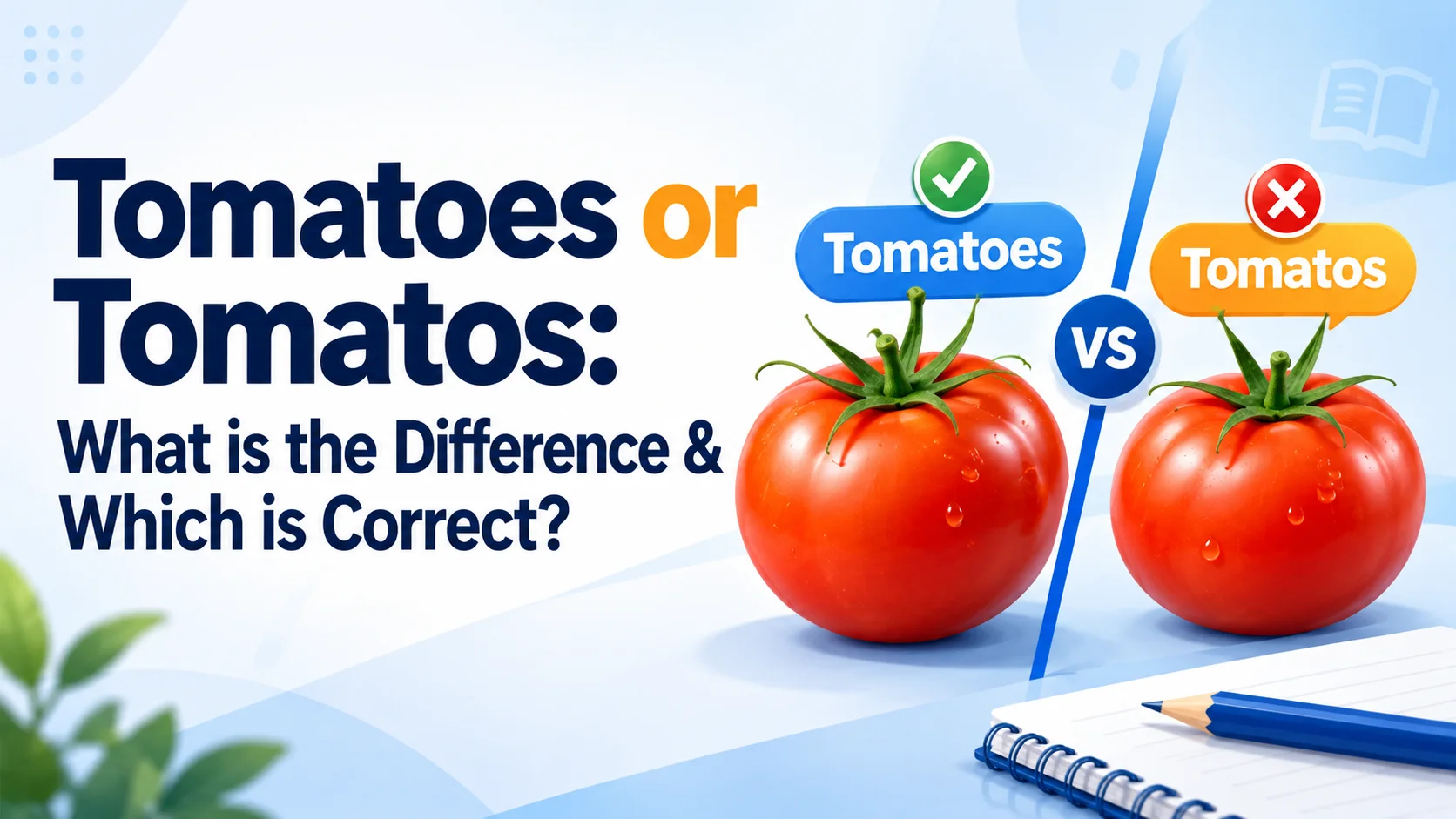
Tomatoes or tomatos can look like a simple spelling question, but the extra “e” in tomatoes causes plenty of confusion. If you’re writing about more than one tomato, the correct standard spelling is tomatoes. Tomatos is a misspelling, not an alternative plural form. The confusion usually comes from a reasonable assumption: many English nouns simply take -s when they become plural. Yet English has several spelling patterns for words ending in -o, and tomato belongs to the group that normally takes -es. Knowing that small distinction can save you from an easy-to-miss spelling error.
The good news is that you don’t need to memorize a complicated grammar rule. Tomato is singular, while tomatoes is plural. You use tomato when you’re talking about one, as in “I bought a tomato,” and tomatoes when you’re talking about two or more, as in “I bought five tomatoes.” The apostrophe forms create another common trap: tomato’s and tomatoes’ are possessive forms, not ordinary plurals. Once you understand what each ending does, the differences become much easier to recognize.
This guide goes beyond simply telling you which spelling is correct. You’ll learn why tomatoes takes -es, why tomatos looks tempting, how tomato’s differs from tomatoes, how the word behaves in British and American English, and how to use it naturally in recipes, emails, schoolwork, and everyday writing. You’ll also see practical examples, common mistakes, a quick decision guide, and a short practice exercise so you can confidently choose the right form whenever tomatoes or tomatos comes up.
Quick Answer: Is It “Tomatoes” or “Tomatos”?
Tomatoes is the correct standard plural spelling of tomato.
Correct: I bought three tomatoes.
Incorrect: I bought three tomatos.
The difference is only one letter, but that letter matters. When tomato becomes plural, the standard spelling adds -es, producing tomatoes.
Dictionaries such as Cambridge list tomatoes as the plural of tomato. The word tomato refers to the familiar round fruit commonly eaten raw or cooked, while tomatoes refers to more than one.
So, if you’re writing an article, recipe, email, assignment, shopping list, or social-media post, use:
tomato → tomatoes
Not:
tomato → tomatos
The Difference in One Line
Tomatoes is the correct plural; tomatos is a spelling mistake.
There’s no difference in meaning between them because tomatos isn’t the standard plural form at all. Someone who writes tomatos normally intends to write tomatoes.
Tomato vs. Tomatoes: Singular and Plural Forms
Before looking at the spelling rule, it’s useful to separate the two basic forms.
Tomato
Tomato is the singular noun.
Use it when you’re referring to one tomato.
Examples:
- “I sliced a tomato for the sandwich.”
- “That tomato is perfectly ripe.”
- “She planted a tomato in the garden.”
- “The recipe requires one tomato.”
The singular form stays exactly as tomato.
Tomatoes
Tomatoes is the plural noun.
Use it when you’re referring to two or more tomatoes.
Examples:
- “I bought six tomatoes.”
- “The tomatoes are ready to harvest.”
- “Add the chopped tomatoes to the pan.”
- “These tomatoes are sweeter than the ones I bought yesterday.”
The important spelling change is:
tomato + es = tomatoes
Tomato vs. Tomatoes at a Glance
| Form | Number | Example |
| tomato | One | “I ate one tomato.” |
| tomatoes | Two or more | “I ate two tomatoes.” |
| tomatos | Not standard | “I ate two tomatos.” ✗ |
There is also a grammar difference beyond spelling. Because tomato is singular, it normally takes a singular verb:
“The tomato is ripe.”
With tomatoes, use a plural verb:
“The tomatoes are ripe.”
That distinction becomes particularly useful when you’re checking your own writing.
Why Is “Tomatoes” the Correct Spelling?
The standard plural of tomato is formed by adding -es, not simply -s.
English grammar references specifically list tomato among nouns ending in -o that take -es in the plural. Cambridge’s grammar guidance gives the pattern tomato → tomatoes, while also noting that some other words ending in -o take only -s.
So the correct transformation is:
tomato → tomatoes
not:
tomato → tomatos
The Simple Rule Behind the Plural
A useful learner-friendly rule is:
Some nouns ending in -o form their plurals with -es.
Examples include:
- tomato → tomatoes
- potato → potatoes
- hero → heroes
- echo → echoes
However, don’t turn this into an absolute rule for every English word ending in -o. English has exceptions and mixed patterns.
For example:
- photo → photos
- piano → pianos
- video → videos
- memo → memos
This is why “just add -s to every noun” doesn’t work for tomato, while “always add -es to every word ending in -o” doesn’t work either.
The safest approach is to learn common plural forms individually while recognizing the patterns that make them easier to remember.
Why “Tomatos” Looks Plausible but Is Incorrect
The mistake makes sense.
Many regular English plurals are formed by adding -s:
- book → books
- car → cars
- apple → apples
- chair → chairs
A learner may therefore see tomato and naturally write:
tomato + s = tomatos
The problem is that standard English uses -es for this particular noun:
tomato + es = tomatoes
That extra e isn’t optional.
Tomatoes vs. Tomatos: Comparison Table
| Feature | Tomatoes | Tomatos |
| Standard spelling | Correct | Incorrect |
| Singular | Tomato | Tomato |
| Plural | Tomatoes | Not standard |
| Meaning | More than one tomato | Intended as plural of tomato |
| Used in formal writing | Yes | No |
| Used in recipes | Yes | No |
| Common learner error | No | Yes |
| Extra “e” | Required | Missing |
If you see tomatos in a text, the intended meaning is usually obvious. However, being understandable doesn’t make a spelling nonstandard.
That distinction matters in school assignments, professional writing, edited publications, websites, recipes, and formal documents, where standard spelling is expected.
Is “Tomatos” Ever Correct?
For the ordinary English plural of tomato, no. The standard form is tomatoes.
You may encounter tomatos online because people make spelling mistakes. User-generated content, comments, informal posts, and unedited text can contain nonstandard spellings.
Seeing an incorrect form repeatedly doesn’t turn it into a standard alternative.
Think of it this way:
Tomatos may appear in writing, but tomatoes is the standard spelling you should use.
This is an important distinction for language learners. Search engines can return misspellings, and people can understand them from context, but neither fact makes a spelling correct.
Why Do People Spell It “Tomatos”?
There are several understandable reasons.
The “Just Add -S” Mistake
The most obvious explanation is that writers apply the common plural pattern:
singular + s = plural
That works for many nouns, so tomatos can feel perfectly logical at first glance.
The difficulty is that English plural spelling isn’t completely uniform.
Confusion From Other “-O” Plurals
Words ending in -o don’t all behave alike.
Compare these:
| Singular | Plural |
| tomato | tomatoes |
| potato | potatoes |
| hero | heroes |
| echo | echoes |
| photo | photos |
| piano | pianos |
| video | videos |
| radio | radios |
This mixed pattern explains why learners can hesitate.
The best practical lesson is not “all -o words use -es.” Instead, remember:
Tomato is one of the common nouns that takes -es: tomatoes.
Pronunciation Doesn’t Always Reveal the Spelling
Spoken English can make spelling decisions difficult.
A person may know exactly what word they mean but still be unsure whether the written plural needs -s or -es.
That’s why visual memory helps:
TOMATO → TOMATOES
The spelling is easier to retain when you see the entire transformation rather than trying to construct it from sound.
Tomato, Tomatoes, Tomato’s, and Tomatoes’: What’s the Difference?
This is where a simple spelling question becomes a grammar question.
The four forms have different jobs.
Tomato
Tomato is singular.
“The tomato is ripe.”
You’re talking about one tomato.
Tomatoes
Tomatoes is plural.
“The tomatoes are ripe.”
You’re talking about more than one.
Tomato’s
Tomato’s normally indicates possession by one tomato.
“The tomato’s skin was unusually thick.”
Here, tomato’s means something belonging to or associated with one tomato.
The apostrophe does not simply make tomato plural.
So this is incorrect:
“I bought three tomato’s.” ✗
The correct sentence is:
“I bought three tomatoes.” ✓
Tomatoes’
Tomatoes’ is the plural possessive form.
“The tomatoes’ skins were removed before cooking.”
Here, you’re talking about the skins belonging to multiple tomatoes.
A Simple Apostrophe Comparison
| Form | Function | Example |
| tomato | Singular | “The tomato is ripe.” |
| tomatoes | Plural | “The tomatoes are ripe.” |
| tomato’s | Singular possessive | “The tomato’s skin is thin.” |
| tomatoes’ | Plural possessive | “The tomatoes’ skins were removed.” |
A Useful Test
If you’re simply counting tomatoes, don’t use an apostrophe.
one tomato
two tomatoes
ten tomatoes
The apostrophe belongs to a different grammatical job.
Common Spelling and Grammar Mistakes With Tomato
Writing “Tomatos” Instead of “Tomatoes”
This is the most common spelling problem.
❌ “The market sells fresh tomatos.”
✓ “The market sells fresh tomatoes.”
Remember the -es ending.
Writing “Tomato’s” as the Plural
An apostrophe doesn’t normally create a plural noun.
❌ “We bought five tomato’s.”
✓ “We bought five tomatoes.”
The apostrophe in tomato’s changes the grammatical function rather than simply indicating more than one.
Forgetting the Plural Ending
Sometimes writers leave the noun singular even when the sentence refers to several items.
❌ “I bought three tomato.”
✓ “I bought three tomatoes.”
A number greater than one normally requires the plural form here.
Assuming Every Word Ending in “-O” Uses the Same Rule
This is a subtler mistake.
You shouldn’t memorize:
“Every word ending in O gets ES.”
That isn’t accurate.
English includes both patterns:
tomato → tomatoes
but:
photo → photos
Cambridge’s plural guidance explicitly identifies this mixed behavior among nouns ending in -o.
Misspelling the Singular Form
Another occasional mistake is writing:
“tomatoe”
The standard singular spelling is simply:
tomato
The e appears when the noun becomes plural:
tomato → tomatoes
That’s an easy distinction to remember.
How to Use “Tomatoes” Correctly in a Sentence
Once you know the spelling, the next step is using it naturally.
Everyday Sentences
- “I need to buy some tomatoes.”
- “The tomatoes are on the kitchen counter.”
- “She washed the tomatoes before cutting them.”
- “We grew several tomatoes this summer.”
- “These tomatoes aren’t ripe yet.”
Cooking and Recipe Examples
Recipes frequently use the plural because ingredients are often measured by quantity.
“Chop three tomatoes and add them to the bowl.”
“Roast the tomatoes until their skins begin to soften.”
“Add the diced tomatoes to the sauce.”
“The recipe calls for two large tomatoes.”
The noun remains plural regardless of whether the tomatoes are whole, sliced, chopped, roasted, or diced.
School and Academic Examples
“The experiment compared the growth of tomato plants under different conditions.”
Notice that tomato plants doesn’t use tomatoes because tomato is functioning as a modifier before plants.
This is an important point: not every sentence containing several plants needs the word tomatoes.
Compare:
“The tomatoes grew quickly.”
with:
“The tomato plants grew quickly.”
In the first sentence, tomatoes is the noun being discussed. In the second, tomato modifies plants.
Workplace and Professional Examples
“The supplier delivered 500 crates of fresh tomatoes.”
“The report compares the quality of locally grown tomatoes.”
“Please confirm the quantity of tomatoes required for Friday’s order.”
Professional writing doesn’t change the plural. The same standard spelling applies.
Common Phrases With “Tomatoes”
You’ll often encounter tomatoes in food, gardening, agriculture, and everyday conversation.
Common examples include:
- fresh tomatoes
- ripe tomatoes
- cherry tomatoes
- green tomatoes
- canned tomatoes
- chopped tomatoes
- diced tomatoes
- roasted tomatoes
- sun-dried tomatoes
- sliced tomatoes
- heirloom tomatoes
- garden tomatoes
However, there’s an interesting grammatical distinction between phrases such as tomatoes and tomato sauce.
In tomato sauce, tomato is functioning as a noun modifier. It describes the type of sauce.
You don’t normally write:
“tomatoes sauce”
The same principle appears in:
- tomato soup
- tomato plant
- tomato salad
- tomato juice
- tomato paste
The exact grammar depends on how the word is being used, not simply on whether the real-world object exists in a quantity greater than one.
Tomatoes in British and American English
The spelling tomatoes is standard in both British and American English.
What can differ is pronunciation.
Cambridge gives a British pronunciation with a final sound commonly represented as “-təʊ” and an American pronunciation with “-toʊ.”
So you may hear the word pronounced differently depending on the speaker’s variety of English, but the written plural remains:
tomatoes
This is a useful reminder that pronunciation differences don’t necessarily create spelling differences.
Whether you’re writing for a British, American, Canadian, Australian, or international audience, tomatoes is the standard plural spelling.
The Word “Tomato”: Why Its History Helps Explain the Spelling
You don’t need to know the history of tomato to spell its plural correctly, but its history helps explain why English doesn’t always follow a simple “add -s” pattern.
The word entered English through a history involving Spanish and Indigenous American languages, and its spelling became established in English as tomato. Modern dictionaries now consistently give tomatoes as its plural form.
For everyday writing, however, the historical background is less important than the established modern form.
The practical takeaway remains:
tomato → tomatoes
Language often preserves patterns that don’t seem completely predictable from today’s perspective. That’s one reason spelling sometimes needs to be learned through both rules and familiarity.
A Reliable Memory Trick for “Tomatoes”
Here’s an easy way to remember the spelling:
Tomato + ES = Tomatoes
Think of the final part visually:
TOMATO + ES
→ TOMATOES
You can also connect it with a few familiar words:
- potato → potatoes
- tomato → tomatoes
- hero → heroes
But don’t extend the pattern to every -o word.
For example:
- photo → photos
- piano → pianos
- video → videos
The best memory trick is therefore word-specific rather than universal:
When you mean more than one tomato, remember the E before S.
Tomatoes vs. Tomatos: Real-World Examples
Seeing the word in different situations helps you recognize the correct form automatically.
In Text Messages
“Can you pick up some tomatoes on your way home?”
Casual writing still uses the standard spelling.
In Social Media Posts
“Finally harvested my first tomatoes of the season!”
Even informal posts benefit from standard spelling when there is no reason to use a nonstandard form.
In Emails
“Could you please order ten tomatoes for tomorrow’s event?”
The plural remains tomatoes in professional correspondence.
In Recipes
“Dice four tomatoes and place them in a large bowl.”
Recipes are particularly useful examples because they frequently switch between singular and plural quantities.
In School Assignments
“The researchers measured the growth of tomato plants.”
Notice again that tomato can appear before another noun as a modifier.
In Professional Writing
“The farm supplies fresh tomatoes to several local retailers.”
Formal writing should use the standard plural tomatoes.
How to Check Yourself Before Writing “Tomatos”
When you’re unsure, use this quick process.
Step 1: Ask How Many
If you’re talking about one:
tomato
If you’re talking about more than one:
tomatoes
Step 2: Check the Ending
Make sure the plural contains:
-oes
not:
-os
Step 3: Remove the Apostrophe
If you’re simply making the word plural, don’t write:
tomato’s
Use:
tomatoes
Step 4: Check the Sentence
Make sure the verb agrees with the noun.
“The tomato is fresh.”
“The tomatoes are fresh.”
Step 5: Look at the Function of the Word
If tomato is describing another noun, the singular form may be correct:
- tomato sauce
- tomato plants
- tomato soup
- This prevents you from changing the word to tomatoes merely because the sentence discusses several things.
A Quick Practice: Tomato or Tomatoes?
Fill in each blank with tomato or tomatoes.
- I bought one ______ from the market.
- She added three ______ to the salad.
- The ______ is still green.
- These ______ are ready to eat.
- We planted several ______ plants.
- Please slice two ______.
- He picked a ripe ______ from the garden.
- The recipe requires four ______.
- The farmer grows several varieties of ______.
- I accidentally dropped the ______.
Answers
- tomato
- tomatoes
- tomato
- tomatoes
- tomato
- tomatoes
- tomato
- tomatoes
- tomatoes
- tomato
The fifth and ninth examples are especially useful because they show how context controls the form.
In tomato plants, tomato modifies plants, so it stays singular.
In varieties of tomatoes, the noun itself is plural, so tomatoes is required.
A Quick Decision Guide
When you’re deciding between the two spellings, use this simple guide:
| What you mean | Correct form | Example |
| One fruit | tomato | “I bought a tomato.” |
| More than one | tomatoes | “I bought tomatoes.” |
| Something belonging to one tomato | tomato’s | “The tomato’s skin is thin.” |
| Something belonging to several tomatoes | tomatoes’ | “The tomatoes’ skins are thin.” |
| Incorrect plural | tomatos | Avoid this form |
This four-form distinction solves most tomato-related spelling and grammar problems.
Conclusion
When choosing between tomatoes or tomatos, the answer is straightforward: use tomatoes whenever you mean more than one tomato. The singular is tomato, the plural is tomatoes, and the apostrophe forms have separate possessive functions. Tomatos is simply a spelling error, even though the intended meaning is usually easy to understand. One final actionable tip: remember the transformation visually—tomato + es = tomatoes—rather than trying to apply a blanket rule to every word ending in -o. A common mistake to avoid is using tomato’s as a plural. If you’re counting the fruit, there’s no apostrophe: one tomato, two tomatoes. Once that distinction becomes familiar, you’ll rarely have to stop and think about the spelling again.
Frequently Asked Questions
Q1. Is “tomatos” or “tomatoes” correct?
Tomatoes are correct. It is the standard plural of tomato in English. Tomatos is a misspelling. The correct plural adds -es, changing tomato to tomatoes. This spelling is used in both British and American English, even though pronunciation can differ.
Q2. Why does tomato become tomatoes instead of tomatos?
Tomato is one of the English nouns ending in -o that commonly forms its plural with -es. Therefore, the standard form is tomatoes. English has other -o words that take only -s, so the pattern isn’t completely universal.
Q3. Is “tomato’s” correct for more than one tomato?
No. Tomato’s is normally a singular possessive form, not a plural. For more than one tomato, write tomatoes. If several tomatoes possess something, use tomatoes’, as in “The tomatoes’ leaves were damaged.”
Q4. Is “tomatoes” spelled the same in British and American English?
Yes. Tomatoes is the standard plural spelling in both British and American English. The pronunciation of tomato can differ between the two varieties, but that pronunciation difference does not change the written plural.
Q5. What is the plural of tomato?
The plural of tomato is tomatoes. For example, “I bought one tomato” becomes “I bought three tomatoes.” Remember the spelling as tomato + es = tomatoes. The form tomatos is not the standard English plural.