

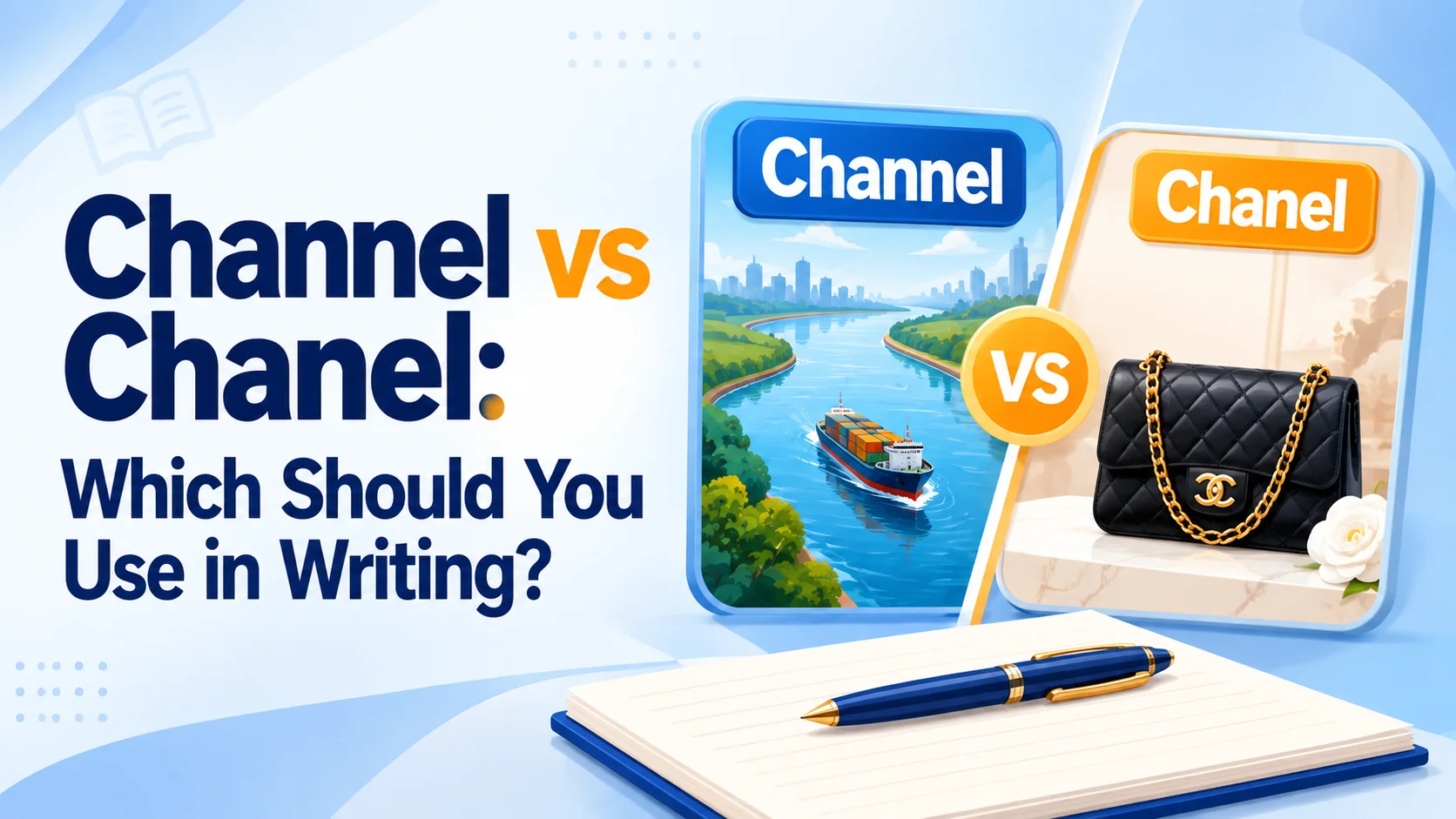
Channel vs Chanel is a surprisingly common spelling question because the two words look and sound closely related, but they serve completely different purposes. Channel is an ordinary English word used for a path, method, medium, communication route, broadcast outlet, or online platform. Chanel, by contrast, is a proper name, most commonly associated with the French fashion and beauty house founded by Gabrielle “Coco” Chanel. Choosing the wrong spelling can change the meaning of an otherwise correct sentence.
The easiest way to separate them is to focus on meaning before spelling. If you are talking about a YouTube account, communication method, television station, marketing route, waterway, or a way of directing something, you almost certainly need a channel. If you are referring to the luxury fashion house, its products, or its founder, Chanel is the appropriate spelling. This distinction matters in everything from school assignments and business emails to product descriptions and social media posts.
This guide explains channel and Chanel in plain English, including their meanings, grammar, capitalization, pronunciation, spelling differences, and real-world usage. You will also see practical examples, a quick decision guide, common mistakes, and less obvious cases such as channelled/channeling. By the end, you should be able to choose the right word immediately rather than relying on how the two terms sound.
Channel vs Chanel: The Quick Answer
| Word | What it means | Typical use | Capitalization | Example |
| channel | A path, route, medium, or means of communication | YouTube, TV, marketing, communication, waterways | Usually lowercase | “She created a YouTube channel.” |
| Chanel | A proper name associated with the fashion house and Coco Chanel | Fashion, beauty, fragrances, accessories | Capitalized | “She bought a Chanel fragrance.” |
Quick rule:
Channel has two Ns. Chanel has one.
If you mean a medium, route, platform, or way of directing something, choose a channel. If you mean the fashion brand or its namesake, choose Chanel.
Cambridge defines channel across several contexts, including broadcasting, physical passages, communication, electrical signals, and making products available. Merriam-Webster likewise lists meanings ranging from waterways and communication routes to online media accounts.
What Does “Channel” Mean?
Channel is a versatile English word. It can be a noun or a verb, and its meaning changes according to context.
The underlying idea is often a route through which something moves. That “something” might be water, information, a television signal, a product, money, or even someone’s effort.
Channel as a Physical Passage or Path
A channel can literally be a route through which water or another substance flows.
For example:
- “The farmers dug an irrigation channel.”
- “The boat entered a narrow channel.”
- “Rainwater flowed through the drainage channel.”
This is one of the oldest and most concrete meanings of the word. Cambridge describes a channel as a passage for water or liquids, or a deeper navigable part of a body of water.
The same basic idea appears in phrases such as shipping channel, water channel, and drainage channel.
Channel as a Way of Communicating
A channel can also mean a method or route for communication.
Consider:
- “Email is our main communication channel.”
- “The two companies established official channels for communication.”
- “Customers can contact support through several channels.”
Here, there is no physical passage. The word is being used metaphorically: information moves through a particular route.
This meaning is especially common in business, government, technology, and professional writing. Cambridge includes “a way of communicating with people or getting something done” among its meanings of channel.
Channel in Television and Broadcasting
When you switch your television, you change the channel.
Examples include:
- “What channel is showing the match?”
- “The news is on another channel.”
- “This program airs on a sports channel.”
The word can refer to a broadcasting station, a numbered television option, or a frequency used for broadcasting.
So writing TV Channel is incorrect when you mean a television station. The correct phrase is TV channel.
Channel in Digital Media and Social Platforms
Modern technology has expanded the word’s everyday use.
A person can have a:
- YouTube channel
- broadcast channel
- content channel
- streaming channel
- social media channel
For example:
“I started a YouTube channel about science.”
This is a channel, not Chanel, because the account is a medium through which content reaches an audience. Merriam-Webster specifically includes online media-sharing accounts among the modern meanings of channel.
Channel in Marketing and Business
Businesses commonly use channels to describe ways of reaching customers or distributing products.
Examples include:
- marketing channel
- sales channel
- distribution channel
- communication channel
- digital channel
- retail channel
For instance:
“The company sells its products through several distribution channels.”
In this context, channel means a route through which a product, service, or information reaches its intended destination. Cambridge’s Business English definition describes a channel as a way products or services are made available to customers.
Channel as a Verb
One detail that beginners sometimes miss is that channel can also be a verb.
To channel something means to direct it toward a particular place, purpose, or situation.
Examples:
- “She channeled her energy into studying.”
- “The organization channeled funds into the project.”
- “The pipes channel water away from the building.”
Cambridge defines the verb as directing something into a particular place or situation, while Merriam-Webster includes the sense of conveying or directing something into or through a channel.
Expert tip: When you see channel used as a verb, Chanel cannot be substituted for it. “She Chanelled her energy” is not a spelling variant; it changes a common English verb into a proper name.
What Does “Chanel” Mean?
Chanel is fundamentally different from the channel. It is a proper name, most famously associated with the French luxury fashion house founded by Gabrielle “Coco” Chanel.
The company itself uses the stylized form CHANEL in its official branding. Its official history states that Gabrielle Chanel opened her first hat boutique in Paris in 1910, and that the business later developed into a major couture house.
Chanel as a Luxury Fashion Brand
When someone writes:
- “She bought a Chanel bag.”
- “The Chanel collection attracted attention.”
- “He gave her Chanel perfume.”
The word refers to the brand.
The spelling Chanel is therefore essential. Writing “channel perfume” would normally suggest a different word entirely.
Chanel as a Person’s Name
The name also refers to Gabrielle “Coco” Chanel, the designer associated with the founding of the fashion house.
That creates an important context distinction:
“Chanel changed the history of fashion.”
Here, the name may refer to the person.
“The Chanel fragrance was released internationally.”
Here, it refers to the brand.
The official Chanel site identifies Gabrielle “Coco” Chanel as the founder and traces the House’s beginnings to 1910.
Why “Chanel” Is Capitalized
Because Chanel is a proper name, it normally begins with a capital letter.
Compare:
- channel → ordinary English noun
- Chanel → proper name
This is not merely a stylistic preference. Capitalization helps readers understand what kind of word they are seeing.
Channel vs Chanel in Grammar and Capitalization
Spelling is only part of the distinction. Grammar and capitalization provide additional clues.
When “channel” Is Lowercase
Use lowercase channel when it is functioning as an ordinary noun or verb:
- “We need another communication channel.”
- “The television channel changed its schedule.”
- “She channeled her frustration into writing.”
- “The company opened a new sales channel.”
Even when channel is part of a phrase, it normally remains lowercase unless a specific proper name or title requires capitalization.
When “Channel” Is Capitalized
A specific title or official name can cause capitalization, but this is different from channel automatically being a proper noun.
For example:
“The program airs on Channel 4.”
Here, Channel 4 functions as part of a specific broadcasting designation.
By contrast:
“I watched the program on a television channel.”
There is no specific proper name, so the channel remains lowercase.
Why “Chanel” Should Usually Remain Capitalized
When you mean the fashion house or the person, write Chanel, not Chanel.
Examples:
- “The article discusses Chanel.”
- “She purchased a Chanel fragrance.”
- “Chanel was an influential fashion designer.”
The brand’s own website uses CHANEL as its official brand styling.
Channel vs Chanel in Different Writing Contexts
The right spelling becomes much easier once you consider the subject of the sentence.
| Writing context | Correct word | Example |
| YouTube | channel | “Her YouTube channel is growing.” |
| Television | channel | “Which channel is broadcasting it?” |
| Marketing | channel | “Email is an important marketing channel.” |
| Communication | channel | “Use the official communication channel.” |
| Waterway | channel | “The boat entered the shipping channel.” |
| Directing effort | channel | “He channeled his energy into research.” |
| Fashion brand | Chanel | “The designer worked with Chanel.” |
| Chanel products | Chanel | “She bought a Chanel fragrance.” |
| Coco Chanel | Chanel | “Chanel influenced twentieth-century fashion.” |
Academic and Technical Writing
In academic or technical writing, channel appears frequently because disciplines use the word for routes through which information, signals, substances, or processes move.
For example:
“The system transmits data through a separate communication channel.”
In electronics, a channel can describe a route through which a signal travels. Cambridge includes this electrical meaning in its dictionary entry.
The important point is that technical usage does not change the spelling to Chanel.
Business and Professional Writing
Business writers regularly use channel in phrases such as:
- customer communication channel
- distribution channel
- sales channel
- marketing channel
- digital channel
A useful editing question is:
“Am I describing a route through which something reaches someone?”
If yes, channel is probably the right choice.
Digital and Social Media Writing
This is one of the most common modern contexts for the mistake.
Correct:
“Subscribe to my YouTube channel.”
Incorrect:
“Subscribe to my YouTube Channel.”
The second version is especially easy to spot because YouTube accounts are channels, not fashion brands.
Fashion and Beauty Writing
The context reverses in fashion writing.
Correct:
“The article reviews a Chanel fragrance.”
Correct:
“Chanel is known for its fashion and beauty products.”
Here, using channel would produce an entirely different meaning.
Channel vs Chanel Examples in Sentences
The fastest way to understand the distinction is to see how each word behaves in complete sentences.
Correct Uses of “Channel”
- “She created a YouTube channel for educational videos.”
- “The company uses email as a primary communication channel.”
- “The boat moved carefully through the narrow channel.”
- “Which television channel is showing the documentary?”
- “The organization created a new distribution channel.”
- “He channeled his creativity into the project.”
Correct Uses of “Chanel”
- “She was wearing a Chanel fragrance.”
- “The article examines Chanel’s influence on fashion.”
- “The Chanel collection attracted worldwide attention.”
- “Gabrielle Chanel founded the fashion house.”
- “The store sells several Chanel beauty products.”
Incorrect vs Correct Sentences
| Incorrect | Correct | Why? |
| “I started a YouTube Channel.” | “I started a YouTube channel.” | A YouTube account is a channel. |
| “She bought a channel handbag.” | “She bought a Chanel handbag.” | The sentence refers to the fashion brand. |
| “Use the official communication Chanel.” | “Use the official communication channel.” | Communication uses a route or medium. |
| “She loves channel perfume.” | “She loves Chanel perfume.” | The perfume is associated with the brand. |
| “He Channeled his energy into sports.” | “He channeled his energy into sports.” | The verb is channel. |
Common Channel vs Chanel Mistakes
Writing “Chanel” When You Mean “Channel”
This mistake often appears in:
- YouTube descriptions
- school assignments
- marketing documents
- social media posts
- business emails
The problem usually comes from phonetic similarity. Someone remembers the sound but not the spelling.
The fix is simple: identify the meaning first.
Writing “Channel” When You Mean “Chanel”
This is less common in everyday writing but can occur in fashion-related content.
For example:
“She purchased a Channel perfume.”
The intended meaning is clearly the Chanel brand, so the spelling needs correction.
Forgetting the Extra N in “Channel”
A useful visual trick is:
chaNNel → two Ns
ChaNel → one N
You do not need to memorize a complicated rule. When proofreading, simply ask whether the word means a route or medium. If it does, check for the double n.
Writing “chanel” for the Brand
There are actually two separate problems here:
- Spelling: Chanel has one n.
- Capitalization: Chanel is a proper name.
Therefore, “chanel” is generally incorrect when referring to the brand.
Treating the Two Words as Interchangeable
They are not alternate spellings.
Channel and Chanel have different meanings, grammatical behavior, and capitalization patterns. One cannot be substituted for the other simply because they sound similar.
Channel vs Chanel Pronunciation
Pronunciation can contribute to the confusion, particularly for learners who encounter these words in conversation before seeing them written.
How “Channel” Is Pronounced
Channel is pronounced approximately:
CHAN-uhl
Cambridge gives the pronunciation as /ˈtʃæn.əl/ in both British and American English.
How “Chanel” Is Pronounced
The brand name Chanel is pronounced differently from ordinary English channels, with the final syllable sounding closer to -NEL.
That difference is easier to hear than to describe in spelling, so when accuracy matters, checking a reputable dictionary or the brand’s own pronunciation in context is preferable to relying solely on phonetic memory.
Why Similar Pronunciation Leads to Spelling Errors
Both words begin with a similar “chan” sound, and fast speech can make the distinction less obvious.
That is why writers should use meaning and context, not pronunciation alone, to choose the spelling.
How to Remember Channel vs Chanel
The Extra-N Memory Trick
Remember:
Channel = two Ns
Chanel = one N
If you’re writing about something that acts as a route or medium, look for the double N.
Use Meaning as Your First Check
Ask yourself:
Is this a route, medium, platform, or method?
→ channel
Is this the fashion brand, its products, or its founder?
→ Chanel
This works better than trying to remember isolated spelling rules because it connects the spelling to meaning.
Check Capitalization
A quick capitalization check can also help:
- ordinary English concept → channel
- proper name/brand → Chanel
Memory shortcut: Channel carries something; Channel names someone or something.
Channel vs Chanel: A Practical Decision Guide
When proofreading your writing, use this three-step check.
| Question | If yes, use |
| Are you describing a medium, route, platform, or communication method? | channel |
| Are you describing a physical passage for water or another flow? | channel |
| Are you referring to television, radio, YouTube, or digital media? | channel |
| Are you describing the act of directing energy, money, or effort? | channel |
| Are you referring to the fashion and beauty brands? | Chanel |
| Are you referring to Gabrielle “Coco” Chanel? | Chanel |
| Is the word being used as a brand/proper name? | Chanel |
A Five-Second Proofreading Test
Before submitting an assignment or publishing a sentence, replace the questionable word mentally:
- “a route/medium” → if that makes sense, use channel
- “the fashion brand” → if that makes sense, use Chanel
This test is particularly useful when proofreading quickly.
Related Spelling Questions: Channel, Channeled, and Channelled
There is another spelling issue worth separating from Chanel: the past tense and present participle of channel.
Both channeled and channelled are used, depending largely on the variety of English.
Examples:
- American English: channeled, channeling
- British English: channelled, channelling
Merriam-Webster lists both forms, noting channeled/channelled and channeling/channelling.
Neither form is related to the brand name Chanel.
So:
“She channeled her creativity into painting.”
or
“She channelled her creativity into painting.”
Both can be correct depending on the style of English being used.
Conclusion
Channel vs Chanel is not really a choice between two spellings of the same word. They belong to different categories and serve completely different purposes. Channel describes a route, medium, platform, passage, communication method, or the act of directing something. Chanel is a proper name associated with Gabrielle “Coco” Chanel and the luxury fashion house. One final actionable tip: whenever you hesitate, forget pronunciation for a moment and ask what the sentence actually means. If information, water, products, signals, or content moves through it, you probably need a channel. If you’re referring to the fashion house or its namesake, use Chanel. A common mistake to avoid: assuming that Chanel is simply a shortened spelling of channel. It isn’t. Remember the practical rule—channel has two Ns; Chanel has one—and the distinction becomes almost automatic. With that small check, you’ll avoid one of the easiest spelling mix-ups in everyday and professional writing.
Frequently Asked Questions
Q1. Is “Chanel” the correct spelling of “channel”?
No. Chanel and channel are different words. Use a channel for a communication method, television station, YouTube account, physical passage, marketing route, or the verb meaning “to direct.” Use Chanel when referring to the fashion brand or its namesake, Gabrielle “Coco” Chanel.
Q2. Is it “YouTube channel” or “YouTube Channel”?
The correct expression is YouTube channel. A YouTube channel is an online account through which a creator publishes content. Chanel would refer to the fashion brand or name, so using it in this context is a spelling error rather than an alternative form.
Q3. Should “Chanel” always be capitalized?
When Chanel refers to the person or fashion house, it should be treated as a proper name and capitalized. By contrast, channel is normally lowercase when used as an ordinary noun or verb. Specific titles or names can create separate capitalization rules.
Q4. Is “channel” a noun or a verb?
Channels can be both. As a noun, it can mean a route, medium, passage, or broadcasting outlet. As a verb, it means to direct something toward a particular purpose or place. For example, you can channel your energy into studying.
Q5. Why are channel and Chanel so easy to confuse?
The words share several letters and begin with a similar sound, while only one letter distinguishes their spelling pattern in the middle. The most reliable solution is to identify the meaning first: a route or medium is a channel; the fashion name is Chanel.