

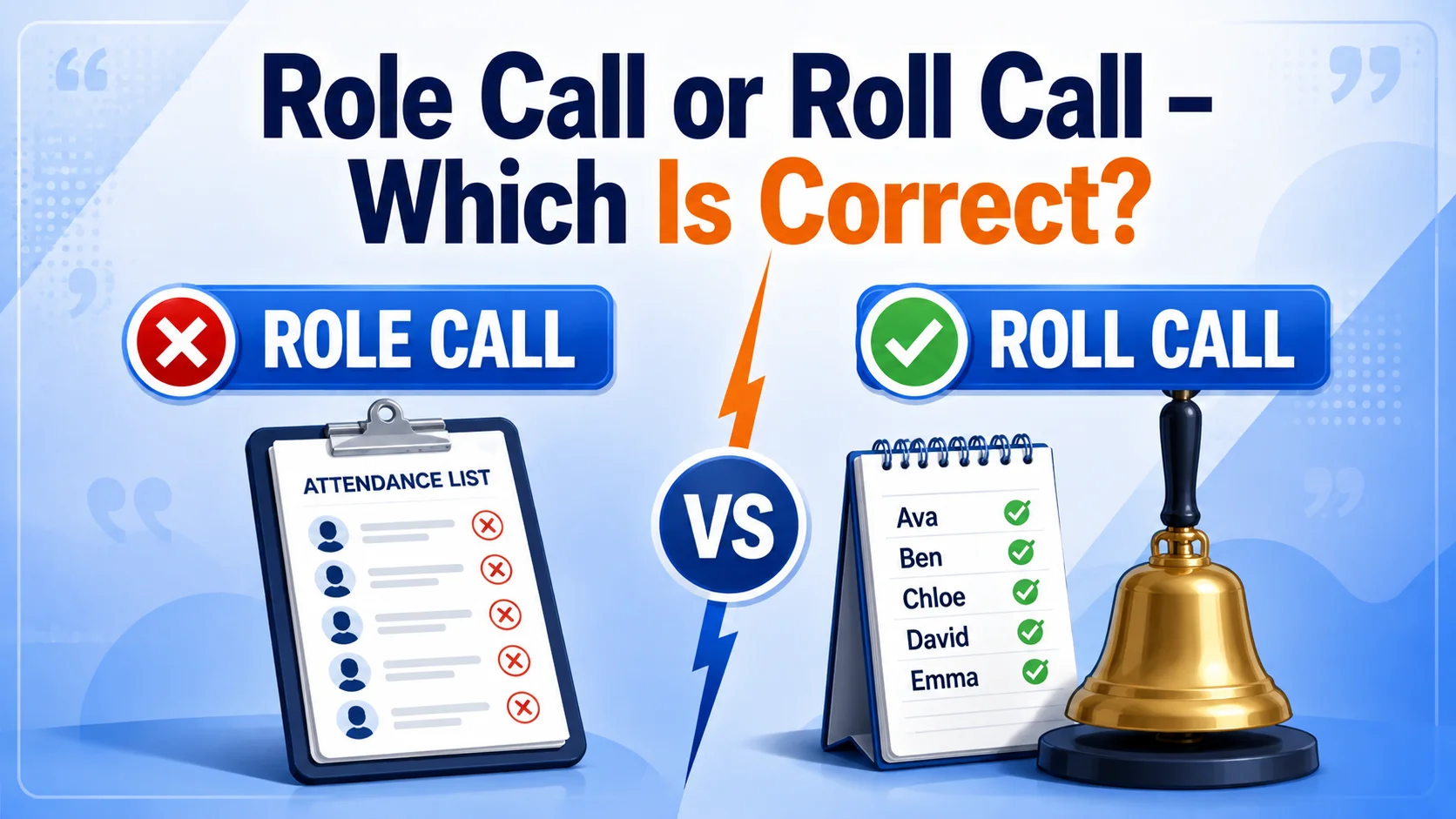
Role call and roll call sound exactly alike, but only one is the standard spelling for the familiar expression meaning the calling of names to check who is present. The correct phrase is roll call. If a teacher reads students’ names, a military officer checks a unit’s attendance, or a meeting leader confirms who has arrived, you’re taking roll call. The word roll refers to a list or register of names, not to a person’s job, function, or position.
The confusion is understandable because role is a very common English word. It means a function, position, character, or part played by someone, while roll has several meanings, including a list of names. Since both words are pronounced alike, they’re homophones, so hearing the phrase doesn’t tell you which spelling to choose. The difference becomes obvious once you connect roll with a roster, register, or list.
In this guide, you’ll learn exactly why roll call is correct, what role and roll mean separately, where the expression came from, how to use it in classrooms, workplaces, government, the military, and other settings, and how to avoid the mistake in your own writing. You’ll also see examples, a comparison table, and a simple memory trick that makes the spelling easy to remember.
What Does “Roll Call” Mean?
Roll call is a noun phrase referring to the act of reading or calling names from a list to determine who is present. Cambridge defines it as reading aloud the names of people on a list to make sure they’re present, while Merriam-Webster similarly defines it as calling off a list of names, especially for checking attendance.
Think of a teacher standing at the front of a classroom:
“Aisha?”
“Here.”
“Daniel?”
“Present.”
The teacher is conducting roll call.
The same basic idea applies outside school. A military unit may conduct roll call, a workplace may check attendance before a shift, and a legislative body may use a roll call to identify members individually.
The basic meaning in plain English
Roll call = calling the names on a list to check who is present.
It can refer to:
- The process of checking attendance
- The time when attendance is checked
- The list of names itself in some contexts
- A formal record of members or participants
- A roll call vote, in which individual members are called by name to record their votes
Merriam-Webster also gives roll call a related meaning involving a list or roster.
Why “Roll Call” Is Correct
The key is the meaning of roll.
Although roll commonly makes people think of something turning over or moving in a circular motion, the word has another established meaning: a list or register of names.
That is the sense being used in roll call.
Historically, a roll could refer to a written document or record, particularly one written on a rolled piece of parchment. Over time, roll developed the meaning of a register, list, or catalog. Etymonline traces this sense back centuries and identifies roll call as the act of calling over such a list.
So the phrase makes more sense when you mentally expand it:
roll = list of names
call = read or announce the names
Therefore:
roll call = call the names on the roll
Why “role call” doesn’t fit
Role has a completely different meaning. It commonly refers to:
- A person’s function
- A person’s position
- A character played by an actor
- A responsibility within a group
- A part someone performs in a situation
For example:
- She played the role of Juliet.
- His role is to manage the project.
- Parents have an important role in education.
- Everyone understood their role on the team.
None of these meanings relates to a list of names being called.
Role vs. Roll: Understand the Two Words
The easiest way to stop making this mistake is to understand the underlying words rather than memorizing one isolated spelling.
| Word | Main meaning | Example |
| role | Function, position, character, or part | She has an important role in the project. |
| roll | To move by turning; also a list/register | The teacher checked the roll. |
| roll | A small rounded food item | He ordered a bread roll. |
| roll | A continuous movement or sound | We heard the roll of thunder. |
| roll call | Calling names from a list to check attendance | The teacher took roll call. |
Merriam-Webster notes that role and roll are distinct words despite their identical pronunciation. It also explains that roll has a much broader range of meanings, including the sense of an official list.
A useful distinction
Ask yourself:
Am I talking about someone’s function or position?
If yes, you probably need role.
Am I talking about a list, register, or attendance check?
If yes, you need roll.
Why People Confuse “Role Call” and “Roll Call”
This isn’t usually a grammar problem. It’s primarily a homophone spelling problem.
Both words sound the same
In standard English pronunciation, role and roll are pronounced alike. That means someone who knows the expression only from hearing it may naturally guess the spelling.
The same problem appears with other homophones:
- their / there / they’re
- your / you’re
- to / too / two
- principal / principle
- stationary / stationery
With role call / roll call, the context usually resolves the ambiguity.
“Role” feels semantically plausible
People often hear roll call and unconsciously connect it with roles in a group.
For example, if someone says:
“We need to do a roll call before the meeting.”
A reader might think about everyone’s roles or positions in the meeting.
But the actual phrase has nothing to do with job roles. It comes from the sense of roll meaning a list or register.
The phrase is learned by sound
This mistake is especially common when someone has heard the expression many times but hasn’t encountered it in writing.
That creates a familiar pattern:
Heard: “roll call”
Assumed spelling: “role call”
The solution isn’t to focus on pronunciation. Pronunciation can’t distinguish the two. Meaning can.
The History Behind “Roll Call”
The expression has a surprisingly practical history.
The noun roll developed a meaning associated with a written record or list. Etymonline notes that roll originally referred to a rolled document or parchment and later acquired the sense of a register, list, or catalog.
The phrase roll call emerged from the practice of calling over a roll—in other words, reading the names recorded on a list.
Etymonline dates the phrase to the 18th century, with roll call recorded from around 1775 and the verbal expression “call the roll” attested earlier. Merriam-Webster gives a first known use of roll call in 1763.
So the spelling isn’t arbitrary. It reflects an older meaning of roll that has survived in modern English.
From written list to modern attendance check
The basic structure has remained remarkably stable:
written roll → list of names → names called aloud → presence confirmed
Today, the physical list might be a printed sheet, a digital attendance system, or a legislative record, but the underlying concept remains the same.
Where Do We Use “Roll Call”?
Roll call isn’t limited to classrooms. Its meaning can apply anywhere people need to verify the presence or participation of individuals on a defined list.
In schools
A teacher may take roll call at the beginning of class.
Example:
“The teacher took roll call before starting the lesson.”
Here, the purpose is straightforward: determine which students are present.
In the military
Military organizations have long used formal attendance procedures.
Example:
“The soldiers assembled for morning roll call.”
The context can involve accountability, readiness, and personnel tracking.
In workplaces
Some workplaces use roll call when attendance or staffing needs to be confirmed.
Example:
“The supervisor conducted roll call before the night shift began.”
In ordinary corporate settings, however, terms such as attendance check, staff check-in, or team check-in may sound more natural depending on the workplace.
In emergencies
Roll call can become particularly important when people need to be accounted for.
Example:
“After the evacuation, the supervisor conducted a roll call.”
Here, the purpose isn’t merely routine attendance. It is confirming that everyone has been safely accounted for.
In government and legislative settings
A roll call vote is a more specialized use. Members are called individually and asked to indicate their vote. Cambridge specifically identifies this as a voting process, particularly associated with bodies such as the U.S. Congress.
Example:
“The bill passed after a roll call vote.”
This is another strong example of why roll is correct: the phrase refers to a list of members, not their roles.
How “Roll Call” Works in a Sentence
Roll call functions primarily as a noun phrase.
As a noun
“Roll call begins at 8:00 a.m.”
“I missed roll call this morning.”
“The students were quiet during roll call.”
“We had a quick roll call before leaving.”
You can also use articles and modifiers with it:
- the roll call
- a roll call
- morning roll call
- formal roll call
- attendance roll call
“Take roll” vs. “take roll call”
You may also encounter:
“The teacher took roll.”
This is a shorter expression meaning the teacher checked attendance.
You can also say:
“The teacher took roll call.”
Both are understandable, although usage varies by context and region.
“Call the roll”
Another established construction is:
“The instructor called the roll.”
This means the instructor read the names on the attendance list.
The phrase can therefore appear in several related forms:
| Expression | Meaning |
| roll call | Attendance check by calling names |
| take roll | Check attendance |
| take roll call | Conduct roll call |
| call the roll | Read names from the roll |
| roll call vote | Vote by calling members individually |
Roll Call vs. Role Call: Side-by-Side Comparison
The distinction is simple once you place the words next to their meanings.
| Feature | Roll Call | Role Call |
| Standard expression? | Yes | No |
| Refers to attendance? | Yes | No |
| Refers to a list of names? | Yes | No |
| Contains roll meaning register/list? | Yes | No |
| Related to someone’s function or position? | No | Role itself is |
| Example | “We had roll call at 9.” | “Role call” is incorrect for this meaning |
Remember: Roll call is about a roll (list) being called. It isn’t about people’s roles.
Common Examples: Correct vs. Incorrect
Seeing the error in context makes it easier to avoid.
| Incorrect | Correct | Why? |
| The teacher took role call. | The teacher took roll call. | Attendance involves a list of names. |
| We had role call at 8 a.m. | We had roll call at 8 a.m. | Roll means the attendance list. |
| The captain conducted role call. | The captain conducted roll call. | Names are being checked. |
| The Senate held a role call vote. | The Senate held a roll call vote. | Members are called individually. |
| Please be present for role call. | Please be present for roll call. | The phrase concerns attendance. |
Correct examples
“The students assembled before roll call.”
“We were asked to remain quiet during roll call.”
“The officer checked the roster during roll call.”
“The committee requested a roll call vote.”
“Everyone had to answer when their name was called during roll call.”
When Should You Actually Use “Role”?
The fact that role call is incorrect doesn’t mean role is an unimportant word. It simply belongs in completely different contexts.
Use role when you’re talking about a person’s function, responsibility, position, or character.
Examples
“Her role in the project is to manage communications.”
“The actor received the lead role.”
“Parents play a major role in a child’s education.”
“Each team member has a different role.”
“His role as captain requires leadership.”
Notice that none of these sentences involves a list of names being called.
A useful contrast
Consider this sentence:
“The teacher explained each student’s role before taking roll call.”
Both words are correct—but they mean entirely different things.
- role = function or responsibility
- roll call = attendance check
That single sentence demonstrates why the distinction matters.
Common Mistakes With Roll Call
Writing “role call” because it sounds right
This is the most common error.
Fix: Think list, not position.
Assuming pronunciation determines spelling
It doesn’t. Role and roll are homophones.
Fix: Determine the intended meaning first.
Thinking “roll” only means turning
English words often have multiple meanings. Roll can refer to movement, food, sound, a list, and other concepts.
Fix: Learn the specific dictionary sense used in the expression.
Overcorrecting in unrelated sentences
Don’t replace role with roll simply because you’re thinking about roll call.
For example:
“She has an important role in the company.”
That sentence needs role, not roll.
A Simple Trick to Remember the Correct Spelling
Here’s the most reliable memory trick:
Roll call = call the roll
Imagine a teacher holding a roll/register containing everyone’s names.
The teacher calls the roll.
That gives you:
ROLL → list of names
CALL → read those names aloud
So:
ROLL + CALL = ROLL CALL
A second trick is to connect roll with roster. Both relate to lists of people.
Roll = roster/list → Roll call = calling the list
You don’t need to memorize a complicated grammar rule. You only need to connect roll with its list/register meaning.
Is “Role Call” Ever Correct?
For the standard attendance expression, no. If you mean the process of calling people’s names from a list, the conventional spelling is roll call. Major dictionaries define the expression that way.
However, English can theoretically create unusual phrases in specific contexts. Someone could use role call creatively to mean something like “a calling or listing of roles,” but that would be an original construction rather than the established phrase.
For normal writing, editing, schoolwork, business communication, journalism, and formal documents, don’t use role call when you mean attendance.
If you’re writing professionally
Choose:
roll call
Avoid:
role call
The standard form is clearer, recognizable, and immediately understood.
Roll Call in Formal and Professional Writing
In formal writing, spelling accuracy matters because small errors can affect credibility.
Consider an email to employees:
“All employees must report to the main hall for roll call at 8:30 a.m.”
That is clear and conventional.
Compare it with:
“All employees must report to the main hall for role call at 8:30 a.m.”
The second version may still be understood, but it contains a word-choice and spelling error that could easily have been avoided.
Where accuracy matters most
Pay particular attention to roll call in:
- School policies
- Attendance records
- Military documents
- Workplace instructions
- Emergency procedures
- Government documents
- Legislative reporting
- News articles
- Academic writing
In casual conversation, a listener won’t notice the difference because the words sound identical. In writing, however, the distinction is visible.
A Practical Decision Test
When you’re unsure whether to write role or roll, don’t guess from sound.
Ask one question:
Am I talking about a function or a list?
If you’re talking about a function, position, or character, use:
role
If you’re talking about a list, register, or attendance check, use:
roll
Quick decision chart
| If you mean… | Use |
| A person’s responsibility | role |
| A character played by an actor | role |
| Someone’s position in an organization | role |
| A list of names | roll |
| An attendance register | roll |
| Calling names to check attendance | roll call |
| Individual voting by named members | roll call vote |
This approach works better than trying to remember how the phrase sounds.
“Roll Call” Beyond Attendance
There is another interesting usage worth knowing.
Roll call can sometimes refer more broadly to a list or lineup of people or things, especially when presenting a notable group.
For example:
“The event featured a roll call of leading researchers.”
Here, the phrase doesn’t necessarily mean someone literally stood up and answered “present.” Instead, roll call evokes the idea of a list of names.
Merriam-Webster lists roll call as also referring to a list, while its thesaurus includes terms such as roster, register, directory, catalog, listing, and inventory among related words.
This broader usage explains why you may encounter sentences such as:
“The festival’s roll call of performers included several award-winning artists.”
The phrase still carries the underlying idea of a named list.
“Roll Call” vs. “Roster” vs. “Attendance”
These terms overlap, but they’re not interchangeable in every sentence.
| Term | What it emphasizes | Example |
| roll call | The act of calling names | “Roll call begins at 8.” |
| roster | The list of people | “Check the team roster.” |
| attendance | The state or record of being present | “Attendance was high today.” |
| register | An official list or record | “Her name is on the register.” |
| roll | A list/register in certain contexts | “His name appears on the roll.” |
This distinction is useful for precise writing.
For instance, a teacher might:
- Have a roster of students.
- Conduct roll call.
- Record attendance.
Those are related but different parts of the same process.
Why the Phrase Still Matters Today
You might wonder whether roll call is an old-fashioned expression. It certainly has a long history, but it remains current in modern English.
Cambridge continues to list roll call as a standard noun, and Merriam-Webster’s current dictionary entry includes contemporary examples of the phrase.
It’s particularly common in contexts where accountability and individual identification matter:
- Education
- Military organizations
- Government
- Emergency management
- Formal meetings
- Legislative voting
- Organized groups
Digital attendance systems may reduce the need for someone to physically read a paper list, but the underlying concept remains useful.
A Few Real-World Scenarios
A classroom
A teacher has 25 students and wants to know who is present.
Correct:
“The teacher took roll call before the exam.”
Why? The teacher is calling names from an attendance list.
An emergency evacuation
Employees leave a building after an alarm.
Correct:
“The manager conducted a roll call at the assembly point.”
Why? The manager needs to check everyone against a list.
A legislative vote
Members of a legislative body are asked individually to vote.
Correct:
“The bill passed in a roll call vote.”
Cambridge specifically uses roll call vote for this kind of individually recorded voting process.
4: Discussing responsibilities
A manager assigns tasks to employees.
Correct:
“Everyone understood their role in the project.”
Why not roll? You’re discussing responsibilities, not a list of names.
Conclusion
When you’re deciding between role call or roll call, choose roll call when you mean an attendance check or the calling of names from a list. The spelling is tied to the older meaning of roll as a register or list, not to role, which means a function, position, or character. One final actionable tip: whenever you see the phrase in your draft, replace the sound-based question “Which one sounds right?” with the meaning-based question “Am I calling a list?” If the answer is yes, write roll call. A common mistake to avoid is assuming that role belongs in the phrase because people have different roles in a group. They may have different roles, but you still conduct roll call to determine who’s present. Once you connect roll = list and role = function, the distinction becomes easy to remember.
FAQs
Q1. Is “role call” ever the correct spelling?
For the standard phrase meaning an attendance check, no. The established spelling is roll call because roll refers to a list or register of names. Role means a function, position, or character and doesn’t have the required meaning in this expression.
Q2. Why is it called “roll call” instead of “role call”?
The word roll historically developed a meaning referring to a written list or register. A roll call was essentially the calling of names from that roll. The phrase dates back centuries, preserving an older meaning of roll that is less obvious in everyday speech.
Q3. Is “roll call” one word or two words?
The standard modern form is roll call, written as two words. You may encounter historical or variant forms such as roll-call or rollcall, but roll call is the normal form to use in contemporary general writing. Major dictionaries list it as a two-word noun phrase.
Q4. Can “roll call” refer to something other than attendance?
Yes. Roll call can also refer to a list or lineup of people, and roll call vote describes a vote in which members are called individually. So the expression isn’t limited strictly to classroom attendance.
Q5. What’s the easiest way to remember “roll call”?
Connect roll with roster or register. A roll can be a list of names, and roll call means calling those names. If you’re discussing someone’s job, responsibility, or character, use role instead. List = roll; function = role.