

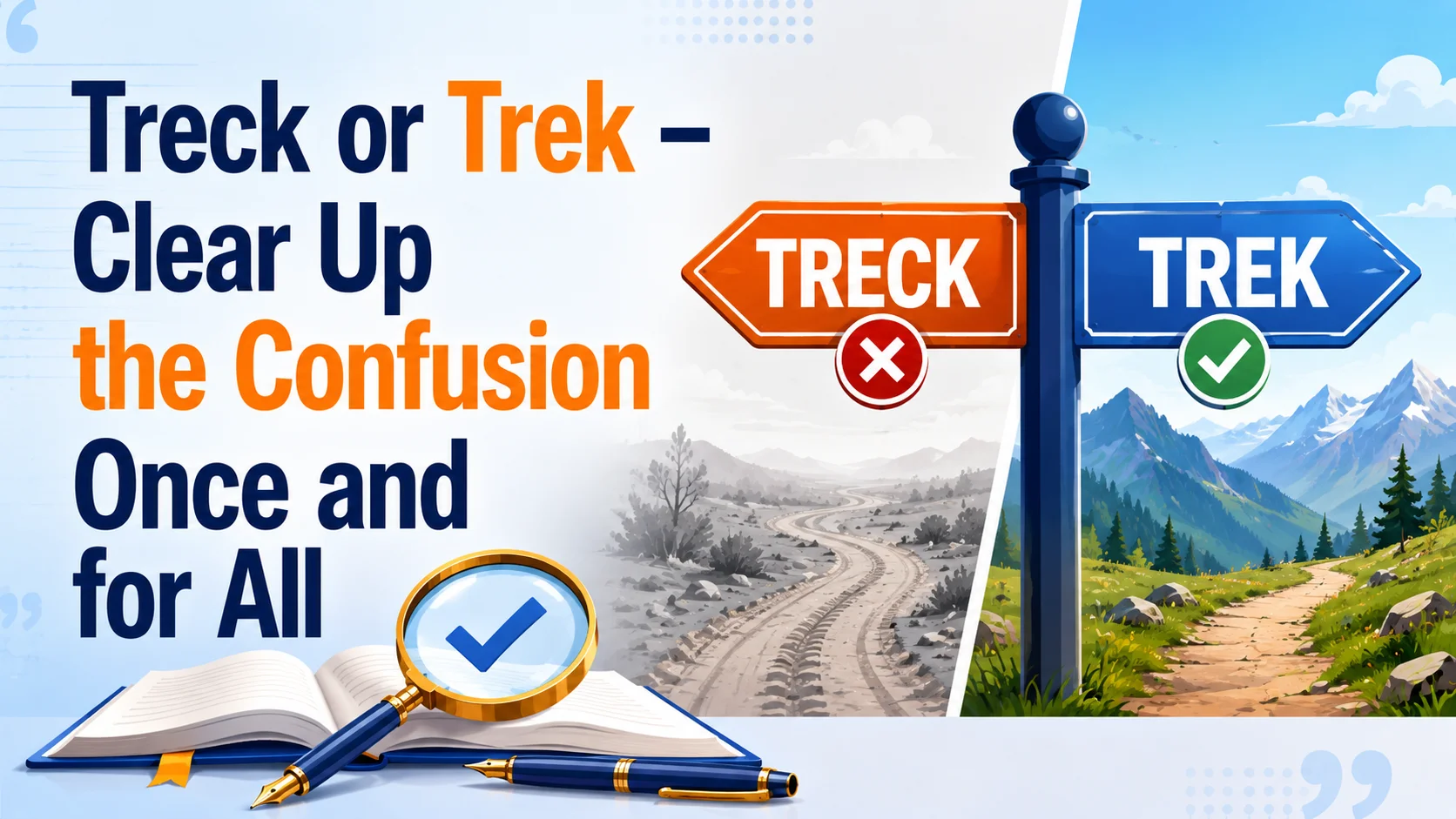
Treck or Trek – Clear Up the Confusion Once and for All helps readers improve spelling accuracy, avoid spelling confusion, and build stronger writing confidence in modern written communication. From my experience in travel writing, educational writing, and blog writing, many people pause mid-sentence and start to second-guess themselves because both treck and trek sound similar in spoken English. This common issue appears across online blogs, social media posts, online discussions, digital writing, and even school writing because of English sound rules, language patterns, and the sharp spoken form that makes people instinctively add a ck ending. In standard modern English, trek is the correct spelling, while treck is treated as a nonstandard spelling, incorrect spelling, and common writing mistake.
The interesting part about trek vs treck is how closely it connects with online communication, internet language, digital communication, and changing communication habits. I once reviewed an adventure guide where a writer repeatedly used “treck” while describing a mountain trip, and several readers immediately noticed the mistake in the comments. That moment highlighted how communication clarity, audience understanding, proper usage, and writing accuracy affect credibility in academic content, professional writing, and everyday writing.
As modern communication, online culture, and digital interaction continue evolving, more people use online search, people search, and different online platforms to ask questions like is treck a word, trek or treck, and Treck or Trek: Which Spelling Is Correct, and What Does It Mean? Whether someone is studying beginner English, improving natural English, preparing an email, writing travel blogs, or creating adventure writing, understanding grammar rules, language structure, spelling conventions, usage examples, sentence usage, and practical usage naturally improves communication effectiveness and overall confidence in writing.
Treck or Trek – Quick Answer
Which spelling is correct?
The correct spelling is trek.
“Treck” is a misspelling and does not appear as a standard word in modern English dictionaries.
Quick comparison table
| Word | Correct? | Meaning | Standard English? |
| Trek | ✅ Yes | A long or difficult journey | Yes |
| Treck | ❌ No | Misspelling of trek | No |
Fast examples
| Correct Usage | Incorrect Usage |
| We plan to trek across the mountains. | We plan to treck across the mountains. |
| Their jungle trek lasted five days. | Their jungle treck lasted five days. |
| She trekked through snow and rain. | She trecked through snow and rain. |
The golden rule
If you’re writing about:
- Travel
- Hiking
- Adventure
- Long journeys
- Difficult movement
…always use a trek.
What Does “Trek” Mean?
The word “trek” describes a long, demanding, or adventurous journey. Usually, it involves physical effort or difficult terrain.
You’ll often hear it connected to:
- Hiking
- Backpacking
- Exploration
- Remote travel
- Survival adventures
Trek as a verb
As a verb, “trek” means to travel slowly or with effort.
Examples:
- We trekked through the forest all day.
- Tourists trek across glaciers every winter.
- The explorers trekked for weeks.
The word creates a vivid image. You instantly picture exhaustion, backpacks, rough trails, and determination.
Trek as a noun
As a noun, “trek” refers to the journey itself.
Examples:
- Their Himalayan trek lasted ten days.
- The desert trek became dangerous.
- That was the hardest trek of my life.
Why the word feels powerful
“Trek” sounds tougher than words like:
- Trip
- Travel
- Walk
- Journey
A trek implies struggle. It carries emotional weight. That’s why travel brands love using it in advertisements.
“Weekend walk” sounds casual.
“Mountain trek” sounds cinematic.
Big difference.
The Origin of Trek
Dutch and Afrikaans roots
The word “trek” comes from Dutch and Afrikaans languages. Originally, it meant:
- Pull
- Drag
- Migrate
- Travel
Dutch settlers in South Africa used the term during long migrations across rough land.
Over time, English speakers adopted the word and reshaped its meaning into what we use today.
Historical connection: The Great Trek
One famous historical example is the Great Trek during the 1830s and 1840s in South Africa.
Dutch-speaking settlers moved inland to escape British colonial control. Their migration permanently linked the word “trek” with endurance and hardship.
How the meaning evolved
At first, “trek” described migration and movement.
Later, it expanded into:
- Adventure travel
- Hiking culture
- Exploration
- Survival journeys
Today, the word appears everywhere from travel blogs to science fiction.
Why “Treck” Is Incorrect
The spelling simply isn’t standard English
“Treck” looks believable because English contains many words ending in “ck”:
- Neck
- Clock
- Trick
- Track
So your brain naturally assumes “treck” follows the same rule.
However, English never standardized that spelling.
Every major dictionary uses only:
Trek
Why people keep writing “treck”
Several factors cause the mistake.
Phonetic spelling habits
People spell words the way they hear them.
Since “trek” ends with a hard sound, many assume it needs “ck.”
Fast typing culture
Typing quickly on phones creates spelling shortcuts and errors.
Social media makes the problem worse because users rarely proofread short posts.
Weak vocabulary exposure
Some people hear “trek” in conversation before seeing it written. When they finally type it, they guess the spelling.
Autocorrect and predictive text
Oddly enough, autocorrect sometimes fails because “treck” resembles valid English structures.
Technology helps. Technology also causes chaos. Welcome to modern writing.
British English vs American English Spelling
Some English words change between American and British spelling:
| American English | British English |
| Color | Colour |
| Traveler | Traveller |
| Organize | Organise |
However, “trek” stays exactly the same worldwide.
Correct spelling everywhere
| Region | Correct Form |
| United States | Trek |
| United Kingdom | Trek |
| Canada | Trek |
| Australia | Trek |
“Treck” is incorrect across all major English dialects.
That makes this rule refreshingly simple.
Trek Meaning in Different Contexts
The word “trek” adapts beautifully across many situations.
Trek in hiking and adventure travel
This is the most common use.
Examples include:
- Mountain trekking
- Jungle trekking
- Glacier treks
- Desert expeditions
Travel companies often use “trek” to make experiences sound exciting and physically challenging.
Trek in everyday conversation
People also use “trek” humorously for annoying tasks.
Examples:
- Walking through that parking lot was a trek.
- Getting to the airport gate felt like a trek.
- Grocery shopping during the storm became a full expedition.
That exaggeration adds personality to casual speech.
Trek in fitness culture
Fitness communities use “trek” constantly.
Examples:
- Charity treks
- Endurance treks
- Survival challenges
- Military-style fitness treks
The word instantly signals difficulty and stamina.
Trek in entertainment and pop culture
One of the most famous uses appears in:
Star Trek
The franchise transformed “trek” into a symbol of exploration, discovery, and adventure across space.
That cultural influence helped the word stay globally recognizable.
Trek as a Verb vs Trek as a Noun
Many learners struggle with this distinction. Thankfully, it’s straightforward.
Trek as a verb
The action of traveling.
Examples:
- We trek every summer.
- They trekked across the canyon.
- Adventurers trek through difficult terrain.
Trek as a noun
The journey itself.
Examples:
- The trek lasted seven days.
- Their jungle trek became dangerous.
- That trek changed his life.
Quick grammar table
| Form | Example |
| Base verb | Trek |
| Past tense | Trekked |
| Present participle | Trekking |
| Noun | Trek |
Common Mistakes With Treck or Trek
Writing based on sound
This causes most spelling mistakes.
English pronunciation often tricks writers because spelling patterns feel inconsistent.
People hear:
“trek”
…and instinctively write:
“treck”
Unfortunately, English doesn’t reward logical guessing.
Adding unnecessary letters
Many short vowel words end with “ck.” That pattern confuses writers.
Examples:
- Black
- Crack
- Stick
However, “trek” breaks away from that structure.
Copying online mistakes
The internet spreads errors quickly.
If enough people write “treck,” others assume it’s acceptable.
That creates a feedback loop of incorrect spelling.
Confusing trek with similar words
Some writers mix up:
| Word | Meaning |
| Trek | Difficult journey |
| Track | Path or trail |
| Travel | General movement |
| Journey | Trip from one place to another |
Trek vs Similar Words
Trek vs journey
A journey can be easy or difficult.
A trek almost always suggests effort.
Examples:
- A train ride is a journey.
- Climbing through the Himalayas is a trek.
Trek vs hike
A hike is usually shorter and recreational.
A trek often involves:
- Longer distance
- Tough conditions
- Multi-day travel
- Remote terrain
Trek vs expedition
An expedition sounds organized and scientific.
A trek feels more physical and personal.
Real-Life Examples of Trek
Everyday examples
- We trekked through muddy trails all afternoon.
- Their mountain trek tested everyone’s endurance.
- The campers completed a winter trek in freezing weather.
- I had to trek across three terminals to catch my flight.
Travel marketing examples
Adventure companies frequently use phrases like:
- Guided trekking tours
- Alpine trekking adventures
- Family trekking packages
- Multi-day wilderness treks
Why?
Because “trek” sounds dramatic and memorable.
Marketing teams understand emotional language extremely well.
Workplace humor examples
People also exaggerate everyday inconveniences using “trek.”
Example:
“I had to trek all the way to the other side of the office for coffee.”
That playful exaggeration makes speech feel more human and relatable.
Is “Treck” Ever Correct?
In standard English? No.
No respected English dictionary lists “treck” as the accepted spelling.
That includes:
- Merriam-Webster
- Cambridge Dictionary
- Oxford English Dictionary
Rare exceptions
“Treck” occasionally appears as:
- A surname
- A username
- A fictional brand name
However, those are proper nouns rather than standard vocabulary.
Important clarification
If you’re writing professionally, academically, or publicly:
Always use “trek.”
Pronunciation of Trek
“Trek” has a short vowel sound.
It rhymes with:
- Deck
- Check
- Neck
Phonetic pronunciation
/trɛk/
The pronunciation itself partly explains the confusion. Since many words with that sound use “ck,” people naturally assume “treck” should exist.
English says:
“Good luck figuring that out.”
Trek in Modern Internet Culture
Why the word remains popular
Adventure culture exploded online during the last decade.
Platforms like:
- YouTube
- TikTok
- Travel blogs
…turned trekking into a lifestyle trend.
Popular modern phrases
You’ll frequently see:
- Solo trek
- Backpacking trek
- Arctic trek
- Trek challenge
- Trek vlog
The word now carries a sense of freedom and personal growth.
SEO and search behavior
Search data shows people often search:
- Treck or trek
- How to spell trek
- Trek meaning
- Trek vs hike
That proves confusion still exists despite the word’s popularity.
Simple Memory Tricks to Remember the Correct Spelling
The “adventure A” trick
Think:
“Adventure uses A. Trek keeps it simple too.”
No extra “c” needed.
Visual memory trick
Picture a backpacker moving light and fast.
“Treck” looks bulky.
“Trek” looks streamlined.
Odd memory tricks work surprisingly well.
The dictionary shortcut
If you’re unsure:
- Trek = real word
- Treck = spelling mistake
Simple wins.
Quick Comparison Table: Treck vs Trek
| Feature | Trek | Treck |
| Correct spelling | ✅ Yes | ❌ No |
| Dictionary recognized | ✅ Yes | ❌ No |
| Used worldwide | ✅ Yes | ❌ No |
| Means difficult journey | ✅ Yes | ❌ No |
| Professional writing acceptable | ✅ Yes | ❌ No |
Why Correct Spelling Still Matters
Some people shrug off spelling mistakes online.
However, spelling still shapes credibility.
Professional impact
Incorrect spelling can affect:
- Job applications
- Academic writing
- Blog authority
- Brand trust
- SEO rankings
Readers notice errors quickly.
Sometimes subconsciously.
First impressions matter
Imagine seeing:
“Join our mountain treck adventure!”
It immediately feels less polished.
One missing letter can quietly damage trust.
That’s the strange power of language.
Final Verdict on Treck or Trek
The answer is crystal clear:
“Trek” is correct. “Treck” is incorrect.
Use “trek” whenever you describe:
- Long journeys
- Hiking adventures
- Difficult travel
- Exploration
- Physical endurance
Remember these key points:
- “Trek” works in all English dialects
- “Treck” is not standard English
- The word comes from Dutch and Afrikaans roots
- Trek can function as both a noun and a verb
- Modern culture keeps the word highly relevant
English spelling sometimes behaves like a mischievous gremlin hiding behind grammar books. Fortunately, this rule stays simple.
Stick with trek every time.
Conclusion
Many people still feel confused about treck, trek, treck or trek, and trek vs treck because both spellings look possible in online writing, blogs, social media, and digital communication. From years of reviewing educational writing, travel writing, and professional writing, I’ve noticed that the confusion usually happens because of English spelling, sound rules, and fast typing habits. In proper modern English, trek is the only correct spelling, while treck is considered an incorrect spelling and nonstandard spelling. Understanding proper usage, grammar rules, usage examples, and spelling conventions improves writing confidence, communication clarity, and overall language understanding. As online culture, internet language, and everyday communication continue evolving, more people search for quick answers about the correct word and proper word usage. Learning contextual meaning, semantic meaning, phrase interpretation, text interpretation, and spelling accuracy helps writers avoid common confusion and communicate more confidently.
FAQs
Q1. Is “treck” a real word in standard English?
No, treck is generally treated as an incorrect spelling and a nonstandard spelling in standard English. The accepted and correct spelling is trek.
Q2. Why do people confuse “treck” and “trek”?
The confusion happens because of spoken English, sharp sound patterns, English spelling habits, and fast digital writing in online communication and social media posts.
Q3. Which spelling should I use in professional writing?
You should always use trek in professional writing, educational writing, academic content, emails, and travel writing for proper communication clarity and writing accuracy.
Q4. What does the word “trek” mean?
Trek usually refers to a long or difficult journey, especially in travel writing, hiking vocabulary, adventure stories, and trekking terminology.
Q5. How can I stop making the “treck” spelling mistake?
Reading usage examples, practicing word comparison, reviewing a spelling guide, and understanding language patterns can improve vocabulary learning, language understanding, and overall writing confidence.