
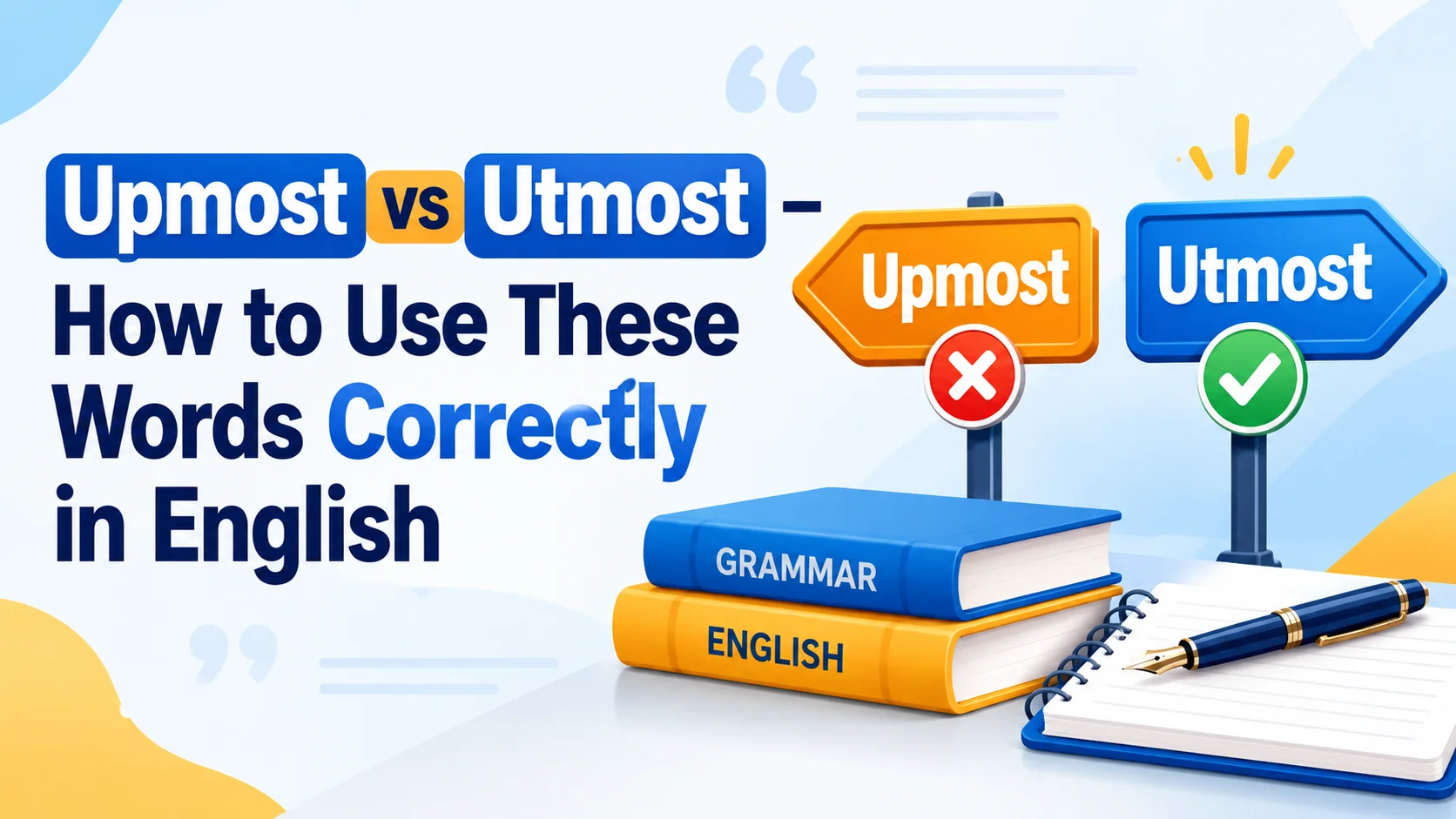
Upmost vs utmost is a common English word-choice problem because the two words look and sound remarkably similar. In most sentences involving respect, care, importance, effort, or attention, the correct word is utmost: “I have the utmost respect for her,” or “Handle the equipment with the utmost care.” By contrast, upmost is a real word, but it is uncommon and means highest or uppermost, usually in a positional sense. Understanding that distinction saves you from one of the most noticeable word-choice mistakes in formal English.
The confusion becomes easier to understand once you stop focusing on spelling and ask what you actually mean. If you’re talking about the greatest possible degree or amount, choose utmost. If you’re describing something at the highest physical or positional level, uppermost is usually the natural modern choice, while upmost can sometimes be used as a variant. Dictionaries distinguish these uses clearly, although there is some overlap in historical and modern meanings.
This guide explains upmost vs utmost with clear definitions, sentence examples, common collocations, comparisons with uppermost, most, at most, and uttermost, and practical ways to remember the difference. You’ll also see why phrases such as “utmost respect” and “utmost importance” are standard, why “upmost importance” is generally a mistake, and when upmost can legitimately appear. By the end, you’ll have a simple rule you can apply while writing, proofreading, or speaking without having to second-guess every sentence.
Upmost vs Utmost: What’s the Difference?
The simplest distinction is this:
Utmost usually means the greatest possible degree, amount, or intensity.
Upmost means highest or uppermost, especially in terms of position.
For example:
- Correct: “I have the utmost respect for your decision.”
- Correct: “Please handle the documents with the utmost care.”
- Possible but uncommon: “The equipment was stored on the upmost level.”
- More natural: “The equipment was stored on the uppermost level.”
Merriam-Webster defines utmost as meaning the greatest or highest degree, quantity, number, or amount, while upmost is defined simply as “uppermost.”
Upmost vs Utmost at a Glance
| Word | Basic meaning | Typical role | Example |
| Utmost | Greatest possible degree or amount | Abstract qualities, effort, importance | “She showed the utmost patience.” |
| Upmost | Highest; uppermost | Position or location | “The upmost section of the structure…” |
| Uppermost | Highest in position, rank, or prominence | Physical and figurative position | “The uppermost shelf was empty.” |
The practical takeaway is even simpler:
Greatest degree → utmost.
Highest position → uppermost.
And if you mean the second idea, uppermost is usually the clearer modern choice.
What Does “Utmost” Mean?
Utmost has two closely related meanings.
First, it can describe the greatest or highest possible degree, quantity, or amount. This is the meaning you’ll encounter most often in everyday and professional English.
For example:
- “This is of the utmost importance.”
- “We treated the matter with the utmost care.”
- “She deserves the utmost respect.”
- “He made the utmost effort to help.”
Second, utmost can refer to an extreme or farthest point. Merriam-Webster notes that the word can describe something at the farthest or most distant point as well as something at the greatest degree.
Utmost as an Adjective
When utmost comes before a noun, it commonly emphasizes that the noun represents the highest possible degree of something.
“The situation requires the utmost caution.”
This doesn’t mean “highest” in a physical sense. It means the greatest possible caution.
Similarly:
“Her safety is of the utmost importance.”
means:
“Her safety is extremely important.”
Utmost as a Noun
Utmost can also function as a noun.
In:
“We did our utmost to finish the project.”
it means the greatest effort or the most we were capable of doing.
Cambridge specifically lists “do/try your utmost” as an established expression meaning to make the greatest possible effort.
Other examples include:
- “We did our utmost to resolve the problem.”
- “She tried her utmost to remain calm.”
- “The team will do its utmost to meet the deadline.”
How to Use “Utmost” Correctly
One reason utmost causes confusion is that English speakers tend to encounter it in a handful of strongly established combinations.
Learning these combinations is more useful than memorizing an isolated definition.
“The Utmost Care”
“Please handle the antique with the utmost care.”
This means the greatest possible care.
It’s especially natural when a situation involves something valuable, fragile, sensitive, or potentially dangerous.
“The Utmost Importance”
“Customer safety is of the utmost importance.”
This is one of the most recognizable uses of utmost.
It means that something has the highest possible importance.
“The Utmost Respect”
“I have the utmost respect for her work.”
Here, utmost emphasizes the highest level of respect.
This is why:
“I have the upmost respect for her.”
is generally considered the wrong choice when the intended meaning is “greatest respect.”
“The Utmost Effort”
“The team made the utmost effort to complete the project.”
The phrase emphasizes maximum effort.
In many contexts, however, “made every effort” or “made a great effort” may sound more natural and less formal.
“To the Utmost”
This expression means to the greatest possible degree.
For example:
“The available resources were used to the utmost.”
Although grammatically possible, this construction can sound formal or literary. In everyday writing, a simpler expression may communicate the same idea more naturally.
“Do Your Utmost”
This is one of the most useful fixed expressions to remember.
“I’ll do my utmost to help.”
It means:
“I’ll do everything I can to help.”
Cambridge identifies do your utmost as an established idiom.
What Does “Upmost” Mean?
Upmost is a real English word. It isn’t simply a misspelling that dictionaries refuse to recognize.
Merriam-Webster defines upmost as “uppermost,” and Collins likewise describes it as another word for uppermost.
Its basic idea is highest in position.
For example:
“The upmost floor of the building…”
Here, the writer is describing the highest floor.
However, there is an important practical point: uppermost is generally the more familiar and clearer choice for this meaning.
So while upmost exists, you shouldn’t automatically substitute it for utmost.
Upmost Examples
You may encounter sentences such as:
- “The upmost section of the tower was damaged.”
- “Birds nested in the upmost branches.”
- “The upmost floor was inaccessible.”
- “The object was placed on the upmost shelf.”
These examples use upmost in a positional sense.
In ordinary modern writing, though, many editors would prefer:
- “The uppermost section of the tower…”
- “The uppermost branches…”
- “The uppermost floor…”
- “The uppermost shelf…”
That’s because uppermost is immediately recognizable as a position word.
Upmost vs Uppermost: Are They the Same?
They’re closely related.
Uppermost means highest in position, rank, authority, or prominence. Merriam-Webster defines it as being situated in the highest or most prominent position.
Collins lists upmost as a variant of uppermost.
So these can overlap:
“the uppermost shelf”
“the upmost shelf”
But they aren’t equally natural in modern usage.
Why “Uppermost” Is Usually Better
The word uppermost contains upper, which directly signals the relationship to physical or figurative position.
Compare:
“The uppermost floor.”
The meaning is immediately obvious.
Now compare:
“The upmost floor.”
This is possible, but it can make readers pause because upmost is much less familiar.
For polished writing, uppermost is usually the safer choice when you mean highest in position.
Why Do People Write “Upmost” When They Mean “Utmost”?
The mistake is understandable.
The spelling of upmost seems to connect naturally with the idea of “highest,” while utmost doesn’t look as transparent to modern readers.
Then consider the pronunciation:
utmost /ˈʌt.moʊst/
upmost /ˈʌp.moʊst/
They’re only one consonant apart.
That makes the words easy to confuse when someone has primarily learned them through speech.
There is another complication: upmost is genuinely a word. So a spell checker won’t necessarily flag it as incorrect.
That creates a particularly tricky proofreading situation:
“I have the upmost respect for your work.”
The sentence looks plausible because upmost is a valid English word. But the intended meaning is greatest respect, not highest physical position.
The correct sentence is:
“I have the utmost respect for your work.”
The Key Question to Ask
Don’t ask:
“Which spelling looks right?”
Ask:
“Am I talking about a degree or position?”
If it’s degree, intensity, importance, or maximum effort, utmost is normally the answer.
If it’s a physical or hierarchical position, uppermost is usually appropriate.
Common Examples: Utmost vs Upmost
The difference becomes much clearer when the words appear side by side.
| Common Mistake | Better Version | Reason |
| “I have the upmost respect for you.” | “I have the utmost respect for you.” | Greatest respect |
| “This is of upmost importance.” | “This is of utmost importance.” | Greatest importance |
| “Handle it with the upmost care.” | “Handle it with the utmost care.” | Greatest care |
| “She made the upmost effort.” | “She made the utmost effort.” | Greatest effort |
| “The upmost shelf was dusty.” | “The uppermost shelf was dusty.” | Highest physical position |
| “The uppermost shelf was dusty.” | “The uppermost shelf was dusty.” | Natural positional use |
“Utmost Respect” vs “Upmost Respect”
This is probably the most searched version of the confusion.
Correct:
“I have the utmost respect for you.”
Incorrect for the intended meaning:
“I have the upmost respect for you.”
Why?
Because you’re not describing where the respect is located. You’re describing how great the respect is.
“Utmost Importance” vs “Upmost Importance”
Correct:
“This matter is of the utmost importance.”
The phrase means the matter is as important as possible.
“Upmost importance” is a common substitution caused by confusion with upmost and uppermost.
“Utmost Care” vs “Upmost Care”
Correct:
“Handle the equipment with the utmost care.”
Again, the issue is degree. You’re asking for the greatest possible care, not care at the highest physical point.
Common Collocations With “Utmost”
One of the fastest ways to master utmost is to recognize the words that commonly follow it.
| Collocation | Meaning | Example |
| utmost respect | greatest respect | “She deserves the utmost respect.” |
| utmost importance | greatest importance | “Safety is of utmost importance.” |
| utmost care | greatest possible care | “Handle it with utmost care.” |
| utmost effort | greatest possible effort | “He made the utmost effort.” |
| utmost attention | greatest attention | “The issue requires our utmost attention.” |
| utmost caution | greatest caution | “Proceed with the utmost caution.” |
| utmost concern | greatest concern | “The matter is of utmost concern.” |
| utmost seriousness | highest degree of seriousness | “The allegation was treated with utmost seriousness.” |
These patterns matter because collocations are often more reliable than isolated word definitions. If you routinely see “utmost respect” and “utmost importance,” you’ll be less likely to replace utmost with the visually tempting upmost.
Utmost vs Most: What’s the Difference?
Both words can express a high degree, but they aren’t interchangeable in every sentence.
Most are broad and extremely common.
“This is the most important issue.”
Utmost is more emphatic and often has a formal or serious tone.
“This is an issue of the utmost importance.”
The second version emphasizes the highest possible level.
Compare These Sentences
“She showed great care.”
“She showed the utmost care.”
The first simply says she was very careful.
The second emphasizes maximum or exceptional care.
That’s why utmost often appears in formal, serious, or emphatic writing.
Cambridge classifies utmost as a formal word in its learner’s dictionary and gives examples involving importance and care.
Utmost vs At Most
These expressions sound somewhat alike, but their meanings are completely different.
Utmost means the greatest possible degree or amount.
At most means no more than a particular maximum.
| Expression | Meaning | Example |
| utmost | Greatest possible degree | “She showed the utmost patience.” |
| at most | No more than | “The journey will take two hours at most.” |
Compare:
“He showed the utmost patience.”
This describes the degree of his patience.
“He waited for ten minutes at most.”
This establishes a maximum amount of time.
The expressions aren’t interchangeable.
Utmost vs Uttermost
Uttermost is closely related to utmost and can mean the greatest or farthest possible degree.
For many sentences, the two words overlap:
- “to the utmost”
- “to the uttermost”
Both can express an extreme or maximum degree.
However, utmost is much more common in everyday modern phrases such as:
- utmost importance
- utmost care
- utmost respect
- do your utmost
Uttermost can sound more literary, formal, or emphatic.
Cambridge treats uttermost as a formal related form in its dictionary entry for utmost.
The History Behind “Utmost” and “Upmost”
The two words are not simply arbitrary spellings of the same word.
Utmost has a very old history. Merriam-Webster traces it to Old English ūtmest, related to ūt, meaning “out.” Its earliest sense involved something like the outermost or farthest point, and the word later developed the familiar sense of the greatest possible degree.
That history explains something that can otherwise seem strange: why does utmost mean “greatest” when it doesn’t contain an obvious word such as great or high?
Historically, the idea of an outermost limit developed into the idea of a maximum limit.
So:
outermost → farthest extent → greatest possible degree
That semantic development is why utmost can still refer to a farthest point in some contexts while more commonly expressing intensity or degree.
Where Does “Upmost” Come From?
Upmost has a different formation. Collins traces it to up- + -most, with recorded use from the sixteenth century, while Merriam-Webster records the word much earlier in English.
Its meaning is connected directly to being up or highest.
That gives us a useful conceptual distinction:
Utmost → extent or maximum degree
Upmost → upward/highest position
Is “Upmost” a Real Word or a Mistake?
It’s a real word.
This is an important point because simply telling learners that “upmost is wrong” isn’t accurate.
Merriam-Webster defines upmost as uppermost, and Collins also lists it as another word for uppermost.
The problem is that people frequently use upmost where utmost is required.
For example:
“She has my upmost respect.”
The word upmost exists, but it doesn’t express the intended meaning here.
A more accurate correction is:
“She has my utmost respect.”
So the right lesson isn’t:
“Never use upmost.”
It’s:
“Don’t use upmost when you mean greatest possible degree.”
That’s a much more useful rule.
When Should You Use Utmost, Upmost, or Uppermost?
Use this decision table when you’re unsure.
| What do you mean? | Best word | Example |
| Greatest possible respect | Utmost | “I have the utmost respect for him.” |
| Greatest possible care | Utmost | “Handle it with the utmost care.” |
| Greatest importance | Utmost | “Safety is of utmost importance.” |
| Maximum effort | Utmost | “We did our utmost.” |
| Highest physical position | Uppermost | “The uppermost shelf was empty.” |
| Highest point or layer | Uppermost | “The uppermost layer was removed.” |
| Highest/upward position, in a context where the variant is acceptable | Upmost | “The upmost section…” |
The Practical Rule
If you can replace the word with:
greatest possible → utmost
If you can replace it with:
highest in position → uppermost
And if you’re considering upmost, ask whether uppermost would be clearer.
In most polished modern writing, it probably will.
Is “Utmost” Appropriate for Professional Writing?
Yes.
In fact, utmost is especially common in formal and professional English.
You might encounter:
- “Customer safety is of the utmost importance.”
- “Please treat this information with the utmost confidentiality.”
- “We appreciate your utmost attention to this matter.”
- “The team made every effort to resolve the issue.”
However, formal doesn’t automatically mean better.
Sometimes greatest, highest, or extreme is clearer.
For example:
“This is of the utmost importance.”
is perfectly natural.
But:
“This is extremely important.”
may be better in a straightforward email.
The best word depends on your audience and tone.
A Good Professional Writing Principle
Don’t use utmost simply because you want your sentence to sound impressive.
Use it when you genuinely want to emphasize the highest possible degree.
That keeps formal writing precise rather than inflated.
Common Mistakes With Upmost and Utmost
Mistake 1: “Upmost Respect”
Usually wrong when you mean greatest respect.
Correct:
“I have the utmost respect for your work.”
Mistake 2: “Upmost Importance”
Use utmost for the standard expression.
Correct:
“This issue is of the utmost importance.”
Mistake 3: “Upmost Care”
Again, you’re describing degree.
Correct:
“The equipment must be handled with the utmost care.”
Mistake 4: Assuming “Upmost” Is Always Incorrect
It isn’t.
Upmost is a dictionary-recognized word meaning uppermost.
Mistake 5: Assuming the Two Words Are Pronounced Identically
They differ at the beginning:
- utmost begins with the sound represented by ut-
- upmost begins with up-
The similarity still makes them easy to confuse in speech, particularly when the words are unfamiliar.
How to Remember Utmost vs Upmost
You don’t need a complicated mnemonic.
Remember “Utmost” as “Ultimate Degree”
Think:
utmost → ultimate → greatest possible
So:
- utmost respect = greatest respect
- utmost care = greatest care
- utmost importance = greatest importance
Remember “Upmost” as “Up”
Think:
upmost → up → highest position
Then connect it to:
uppermost
That gives you:
upmost ≈ uppermost = highest position
The Three-Word Rule
If you remember only this, you’re covered:
Utmost = greatest.
Uppermost = highest.
Upmost = rare variant of uppermost.
Quick Proofreading Checklist
Before you finalize a sentence, ask:
- Am I describing degree or intensity?
- Do I mean greatest possible?
- Am I using a familiar phrase such as utmost respect?
- Am I describing a physical location or position?
- Would uppermost make the meaning clearer?
- Did I choose upmost simply because it sounds like “up”?
If the sentence concerns respect, importance, care, effort, attention, or seriousness, utmost is usually the word you’re looking for.
If it concerns the highest physical or positional point, uppermost is generally the clearest choice.
Practice Quiz: Upmost or Utmost?
Choose the word that best completes each sentence.
- I have the ___ respect for her achievements.
- The matter is of the ___ importance.
- The ___ shelf contained the old photographs.
- Please handle the documents with the ___ care.
- We did our ___ to solve the problem.
- The ___ floor has the best view.
- Safety should be treated with the ___ seriousness.
- The bird landed on the ___ branch.
Answer Key
- utmost — greatest respect
- utmost — greatest importance
- uppermost — highest physical position
- utmost — greatest possible care
- utmost — maximum effort
- uppermost — highest floor
- utmost — highest degree of seriousness
- uppermost — highest branch
Notice the pattern: abstract intensity tends to call for utmost; physical height tends to call for uppermost.
Conclusion
Understanding upmost vs utmost becomes much easier when you focus on meaning rather than spelling. Utmost is the standard choice when you mean the greatest possible degree, as in utmost respect, utmost care, or utmost importance. Upmost is a genuine but uncommon word meaning uppermost, while uppermost is usually the clearer modern choice for describing the highest position. One final actionable tip: when proofreading, replace the word mentally with either “greatest possible” or “highest position.” The intended choice will usually become obvious. A common mistake to avoid is treating upmost as a simple spelling variant of utmost. They have different histories and uses. Once you connect utmost with maximum degree and uppermost with position, this confusing pair becomes surprisingly easy to handle.
Frequently Asked Questions
Q1. Is it “upmost” or “utmost respect”?
The correct choice is “utmost respect” when you mean the greatest possible respect. Upmost means highest or uppermost and is not the standard word in this expression. For example, write, “I have the utmost respect for your decision.”
Q2. Is “upmost” a correct English word?
Yes. Upmost is a legitimate English word, and major dictionaries define it as meaning uppermost. However, it is much less common than uppermost. Don’t use it simply because you think it is an alternative spelling of utmost.
Q3. Is it “utmost importance” or “upmost importance”?
The standard expression is “utmost importance.” It means the greatest possible importance. “Upmost importance” is generally a word-choice error caused by confusing utmost with upmost or uppermost.
Q4. What is the difference between utmost and uppermost?
Utmost generally expresses the greatest possible degree, amount, or intensity, while uppermost describes the highest position, level, or rank. For example, “utmost care” means greatest care, whereas “uppermost shelf” means the highest shelf.
Q5. Is utmost the same as maximum?
They overlap, but they aren’t identical in every context. Utmost often emphasizes the greatest possible degree of an abstract quality, such as respect, care, or importance. Maximum is broader and commonly refers to a numerical, measurable, or established upper limit.