

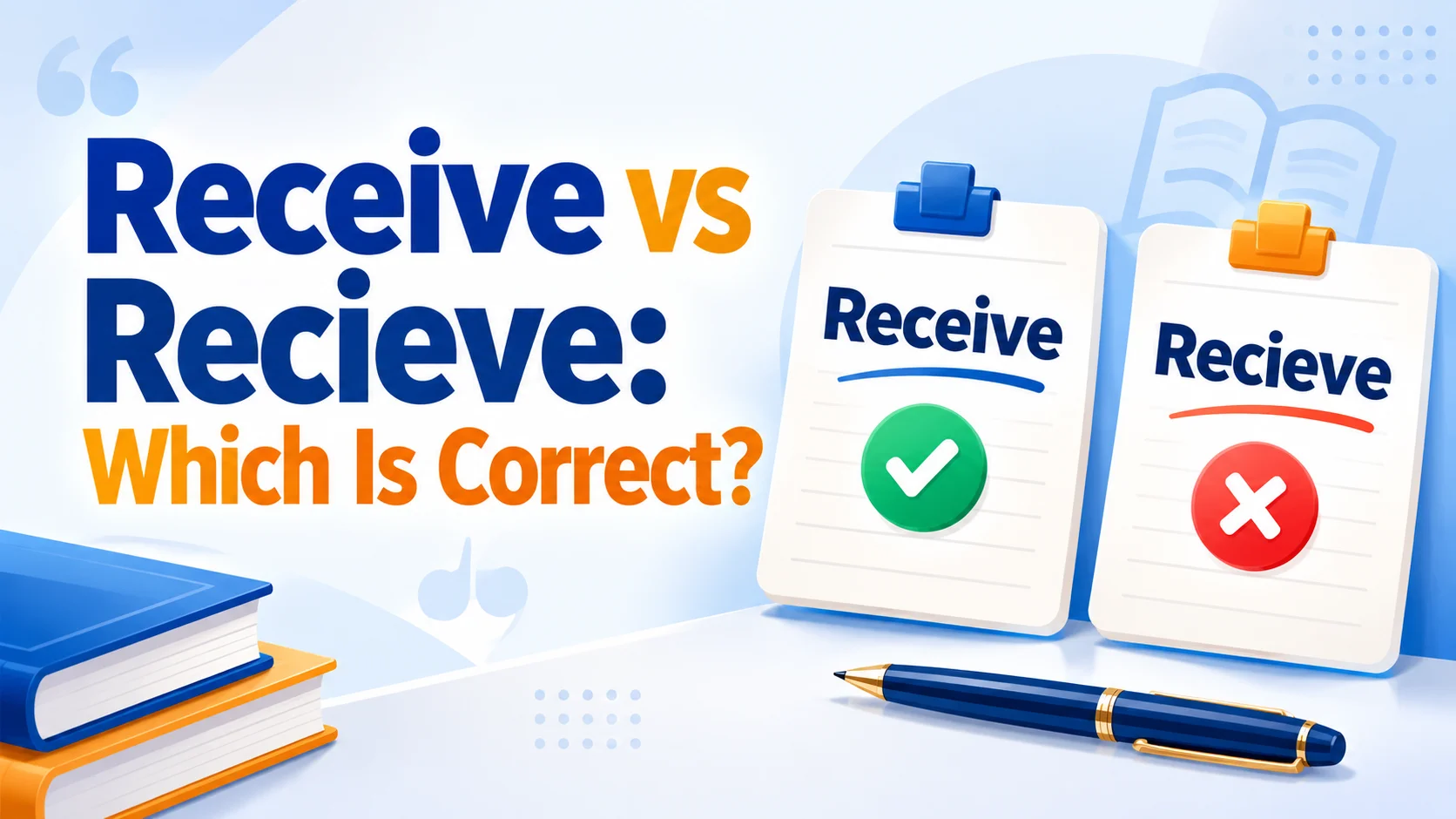
Receive vs Recieve is a common spelling question because both versions look plausible, especially when you are trying to remember the familiar “I before E” rule. The correct spelling is receive, with ei after the letter c. Recieve is a misspelling and should not be used in standard English. This small letter-order mistake appears frequently in emails, schoolwork, forms, and online writing. The good news is that once you understand the -ceive spelling pattern, you do not need to rely on guesswork every time.
The word receive is much more than a spelling-test word. It is a common verb used when someone gets, accepts, or is given something. You can receive a package, receive an email, receive payment, receive an award, or receive information. You will also encounter it in formal expressions such as “payment received” and “please confirm that you received the documents.” Understanding both its spelling and its grammatical forms makes the word easier to use confidently in everyday and professional English.
The confusion usually comes from the order of i and e. Many learners remember “I before E except after C,” then hesitate because they are unsure whether the rule applies. In receive, the letters come after c, giving us cei, so the correct form is receive, not receive. This guide explains why the spelling works, how to use receive in different contexts, which forms are correct, why receiving is not receiving, and how to remember the pattern without memorizing a complicated rhyme.
Receive or Recieve: The Quick Answer
Receive is the correct spelling.
Recieve is incorrect in standard English.
| Spelling | Correct? | Example |
| receive | ✅ Yes | I hope you receive my message. |
| receive | ❌ No | I hope you receive my message. |
| received | ✅ Yes | She received the package yesterday. |
| receiving | ✅ Yes | We are receiving new applications. |
| received | ❌ No | She received the package yesterday. |
| receiving | ❌ No | We are receiving new applications. |
The easiest rule to remember
When receive contains the letter c, remember the sequence:
cei = cei → receive
The word begins re- and then uses the -ceive pattern:
re + ceive = receive
There is no standard English word received with this meaning.
What Does “Receive” Mean?
Receive is a verb meaning to get, accept, or be given something. What you receive can be physical, such as a parcel, or non-physical, such as information, advice, permission, or recognition.
The exact meaning depends on the context.
Receiving a Physical Object
This is probably the most familiar use.
- I received a package this morning.
- She received a birthday gift.
- The office received the documents.
- He received a letter from his friend.
Here, receive describes something coming into someone’s possession.
Receiving Information or Communication
You can also receive something that cannot be physically held.
- Did you receive my email?
- We received the news yesterday.
- I received a text message from the school.
- The computer received the signal successfully.
In these examples, the person or system is the recipient of information.
Receiving Recognition or an Award
Receive is also used when someone is given praise, an award, an honor, or recognition.
- She received an award for her work.
- The author received widespread recognition.
- He received praise from his teacher.
The word does not necessarily mean that the person physically accepted something. It can describe being given a particular status, response, or form of recognition.
Receiving Help, Support, or Services
The same verb works with less tangible forms of assistance.
- The family received financial support.
- Students receive guidance from their teachers.
- Patients receive medical care.
- Customers receive technical assistance.
This is one reason receive appears so often in formal and professional writing.
How to Use “Receive” in Everyday English
In ordinary conversation, receive is perfectly natural, although alternatives such as get may sound more casual.
Compare:
- “Did you receive my message?” — neutral and common
- “Did you get my message?” — more conversational
The choice depends on tone. Receive is particularly useful when you want writing to sound precise, neutral, or professional.
Common Sentence Patterns
Receive + Something
Use receive directly with the thing someone gets.
- I received your letter.
- She received the invitation.
- They received payment.
Receive Something From Someone
Use from when identifying the source.
- I received an email from my teacher.
- The company received a complaint from a customer.
- He received a gift from his parents.
Receive Something On a Particular Date
This construction is common in records and formal communication.
- We received your application on Monday.
- The office received the documents yesterday.
Receive Confirmation or Approval
This is especially common in business and administrative English.
- We received confirmation of your booking.
- The project received approval from management.
- Please let us know when you receive confirmation.
Practical tip: In professional writing, receive often sounds more precise than the informal get, especially when discussing documents, applications, payments, instructions, or official communication.
Why Is “Receive” Spelled With EI?
The spelling becomes easier when you look at the letters immediately after c.
The relevant sequence is:
cei
That gives us:
re + cei + ve = receive
The spelling is connected to a larger group of English words ending in -ceive, including:
- receive
- deceive
- conceive
- perceive
Seeing these words as a family is often more useful than trying to remember each spelling separately.
The “I Before E Except After C” Rule
You may have learned the rhyme:
“I before E except after C.”
It is intended as a spelling aid for certain words, not as a perfect rule covering every English word.
In receive, the letters ei come after c:
rec + ei + ve
So receive follows the “except after C” part of the traditional rule.
That is why the correct spelling is receive, not receive.
Why the Rule Can Be Misleading
English spelling contains many historical patterns and exceptions. The rhyme is therefore best treated as a memory aid, rather than a universal mathematical formula.
For example:
- believe → ie
- field → ie
- piece → ie
- receive → ei
- deceive → ei
- conceive → ei
The smarter approach is to combine the rule with word recognition and spelling patterns.
The -Ceive Word Family
One of the strongest ways to remember and receive is to learn related words together.
| Word | Meaning | Spelling Pattern |
| receive | get or accept something | -ceive |
| deceive | mislead someone | -ceive |
| conceive | form an idea; become pregnant in biological contexts | -ceive |
| perceive | notice or understand something | -ceive |
The shared ending gives you a useful visual pattern:
-CEIVE
If you already know how to deceive and perceive, you can use those familiar spellings to reinforce receive.
An Important Distinction
Not every word that sounds similar belongs to the same spelling family.
For example, achieve contains ie, not ei:
achieve
So it would be a mistake to turn every word ending in a similar sound into -ceive.
The goal is not to invent a new rule. It is to recognize established spelling patterns.
Why Do People Spell “Receive” as “Recieve”?
The error is understandable. English has many common words containing ie, so writers may automatically put i before e.
Several factors contribute to the mistake.
Pronunciation Does Not Reveal the Letter Order
The sound of receive does not clearly tell you whether the spelling should be ie or ei.
That means listening carefully is not enough. You need to remember the written pattern.
The Familiar Spelling Rule Gets Overgeneralized
Someone may remember:
I before E…
and stop there.
But the traditional rhyme continues with an important condition involving c. More importantly, English spelling has enough exceptions that the rhyme should not be applied mechanically.
Fast Typing Encourages Familiar Errors
A person who knows the correct spelling can still type receive when writing quickly.
This is especially common when drafting:
- emails
- school assignments
- messages
- reports
- applications
- customer-service replies
The mistake does not necessarily indicate that someone does not understand the word.
Receive vs Recieve: Side-by-Side
| Feature | Receive | Receive |
| Standard spelling | ✅ Correct | ❌ Incorrect |
| Dictionary form | Yes | No |
| Meaning | To get, accept, or be given something | None as a standard spelling |
| Common use | Emails, packages, payment, information, awards | Spelling error |
| Related form | received, receiving, receives | Incorrect variants: recieved, recieving |
| Example | I received your email. | I recieved your email. ❌ |
If you are writing an email, assignment, application, article, or formal document, choose receive.
Forms of the Verb “Receive”
Knowing the related forms is important because the same spelling mistake often appears in received and receiving.
Receive
The base form:
- I receive emails every day.
- We need to receive confirmation first.
Receives
Use this form with he, she, it, or another singular third-person subject in the simple present.
- She receives several emails each day.
- The company receives applications online.
- The school receives funding from the government.
Received
Received is both the simple past form and the past participle.
- I received your message yesterday.
- She received an award.
- We have received your application.
The correct spelling is:
received
Not:
received
Receiving
Receiving is the present participle and gerund form.
- We are receiving applications now.
- The warehouse is receiving new stock.
- Receiving feedback can help improve the process.
The correct spelling is:
receiving
Not:
receiving
Why Is “Receiving” Still Spelled With EI?
This is a useful spelling detail.
Start with:
receive
Remove the final silent e before adding -ing:
receive → receiving
The cei sequence remains.
So:
receiving ✅
not:
recieving ❌
A simple visual reminder is:
receive → receiving
The beginning does not suddenly change from cei to cie.
Common Phrases With “Receive”
Because receive is a high-frequency verb, it appears in many fixed or semi-fixed expressions.
Everyday Phrases
- receive a message
- receive a call
- receive a package
- receive a gift
- receive an invitation
- receive a letter
Business Phrases
- receive payment
- receive an order
- receive an application
- receive confirmation
- receive approval
- receive an offer
- receive feedback
Academic Phrases
- receive a degree
- receive an assignment
- receive feedback
- receive instructions
- receive recognition
Formal and Administrative Phrases
- application received
- payment received
- documents received
- confirmation received
- request received
These phrases explain why spelling correctly matters beyond school exercises. The word appears regularly in communication where accuracy and professionalism are important.
Receive in Professional Writing
In business writing, receive is particularly useful because it clearly identifies the movement of information, documents, money, or requests from one party to another.
Consider:
We have received your application and will review it shortly.
This is clearer and more formal than simply saying:
We got your application.
Neither sentence is grammatically wrong, but the first fits an official communication better.
Examples
Customer service:
We have received your request and forwarded it to the appropriate department.
Workplace email:
Please confirm that you received the attached document.
Administrative communication:
Your payment has been received and your order is now being processed.
Academic communication:
The department received your application before the deadline.
The spelling matters because a typo in a professional message can make otherwise polished writing look careless.
Common Mistakes With Receive
Mistake 1: Receive
Incorrect:
I will receive the package tomorrow.
Correct:
I will receive the package tomorrow.
The ei comes after c.
Mistake 2: Received
Incorrect:
We received your application.
Correct:
We received your application.
The past form retains the cei pattern.
Mistake 3: Receiving
Incorrect:
She is recieving new messages.
Correct:
She is receiving new messages.
The correct form is receiving.
Mistake 4: Applying “I Before E” Without Considering C
Incorrect reasoning:
“I usually come before E, so it must be received.”
Better reasoning:
“This is a -ceive word, so I should write receive.”
Mistake 5: Assuming Pronunciation Gives the Answer
English pronunciation is not a reliable spelling guide for ie/ei words. If you are unsure, use the word family or dictionary rather than trying to reconstruct the spelling from its sound.
Receive vs Get: Are They the Same?
In many situations, receive and get have similar meanings, but they are not always interchangeable in tone.
| Situation | More conversational | More neutral/formal |
| get an email | receive an email | |
| Package | get a package | receive a package |
| Payment | get payment | receive payment |
| Information | get information | receive information |
| Award | get an award | receive an award |
Get is extremely flexible and common in everyday speech. Receive is often preferable when writing needs to sound precise or professional.
This is not a rule that says receiving is always better. Good writers choose according to the audience and context.
Receive vs Received vs Receiving
| Form | Function | Example |
| receive | Base/present form | I receive emails daily. |
| receives | Third-person singular | She receives the reports. |
| received | Past/past participle | We received your message. |
| receiving | Present participle/gerund | We are receiving applications. |
A useful way to learn the spelling is to memorize the family as a group:
receive → receives → received → receiving
That makes it less likely that you will accidentally create forms such as receiving or receiving.
Does British English Spell It Differently?
No. Receive is the standard spelling in both British English and American English.
Unlike words such as colour/color or licence/license, this is not a major British-American spelling difference.
| Variety | Correct spelling |
| American English | receive |
| British English | receive |
| Canadian English | receive |
| Australian English | receive |
| International English | receive |
So changing the regional variety of English does not make it acceptable.
How to Remember the Correct Spelling
A good memory trick should help you reconstruct the word rather than merely memorize a picture.
Trick 1: Think “After C, EI”
Remember:
C → EI
Then build the word:
re + c + ei + ve
= receive
Trick 2: Remember the -CEIVE Family
Group these together:
receive – deceive – conceive – perceive
The repeated -ceive ending reinforces the spelling.
Trick 3: Learn the Whole Word Family
Instead of memorizing only receive, practice:
- receive
- receives
- received
- receiving
This is especially useful if your mistake is not limited to the base word.
Trick 4: Use a Visual Check
When proofreading, look specifically for:
receive
If you see it, ask:
“Should the letters after C be ei?”
For this word, the answer is yes.
A Quick Practice Test
Choose the correct form in each sentence.
- Did you receive / receive my message?
- We received / received your application.
- The company is receiving / receiving new orders.
- She receives / receives several calls every day.
- Please confirm that you received / received the document.
Answers
- receive
- received
- receiving
- receives
- received
The key is not simply remembering five answers. Notice the consistent pattern:
receive → receives → received → receiving
When Does Correct Spelling Matter Most?
A typo in a casual text may have little practical consequence. However, some situations deserve extra attention.
School and Academic Writing
Repeated spelling errors can distract from otherwise strong work. When proofreading an assignment, check common high-frequency words such as receive, especially in phrases like receive feedback or receive information.
Job Applications and Professional Emails
A spelling mistake in a formal message can affect how polished the writing appears. This is particularly relevant when using phrases such as receive your application, receive your email, or receive payment.
Websites and Published Content
For articles, business pages, instructions, and documentation, spelling errors can reduce readability and make information look less carefully edited.
Forms and Official Documents
Accuracy matters when communicating about applications, payments, records, and requests. A simple proofreading pass can prevent avoidable mistakes.
Editing tip: If you frequently type receive, add a personal proofreading search for “receive” before submitting important writing. Most word processors will also flag it, but a deliberate check is useful when accuracy matters.
A Better Way to Think About “I Before E”
Rather than asking only:
“Is it I before E or E before I?”
ask a more useful question:
“What spelling pattern does this word belong to?”
For receive, the answer is -ceive.
This approach is more dependable because English spelling is shaped by word history, pronunciation, morphology, and established patterns. A short rhyme can help, but it cannot replace familiarity with actual words.
You do not need to memorize the history of English to spell. Recognizing a few related words is enough for most practical situations.
Conclusion
When choosing between receive vs receive, the correct answer is straightforward: receive. The spelling uses ei after c, forming the familiar -ceive pattern. Once you connect it with deceive, conceive, and perceive, the word becomes much easier to remember. It is also worth learning the complete family—receive, receives, received, and receiving—because related forms create many of the same spelling problems. One final actionable tip: before submitting important writing, search for “receive” and “recieved” during proofreading. A common mistake to avoid is treating “I before E except after C” as a perfect rule; use it as a clue, then check the established spelling pattern. When in doubt, remember: C comes before EI in receive.
Frequently Asked Questions
Q1. Is “receive” or “recieve” correct?
Receive is the correct spelling. Receive is a misspelling. The word uses ei after c, creating the -ceive pattern. This same pattern appears in words such as deceive, conceive, and perceive. If you are writing formally, always use receive.
Q2. Why is “receive” a common spelling mistake?
People often write “receive because they remember the phrase “I before E” and apply it too broadly. Pronunciation also does not clearly indicate the letter order. Remembering -ceive as a word pattern is more reliable than depending entirely on the traditional rhyme.
Q3. Is “receiving” ever correct?
No. The correct spelling is receiving. It comes from receiving + -ing, with the final silent e removed before adding -ing. The cei sequence remains unchanged, so receiving is correct while receiving is not.
Q4. Is “receive” spelled differently in British and American English?
No. Both British English and American English use receive. Unlike certain regional spelling differences, such as colour/color, this word has one standard spelling across the major English varieties. Canadian and Australian English also use receive.
Q5. What is the easiest way to remember how to spell receive?
The simplest method is to remember “after C, use EI” for this word and recognize the -ceive family. Think of receiving, deceiving, conceiving, and perceiving together. Also remember the related forms received and receiving so the spelling remains consistent.