

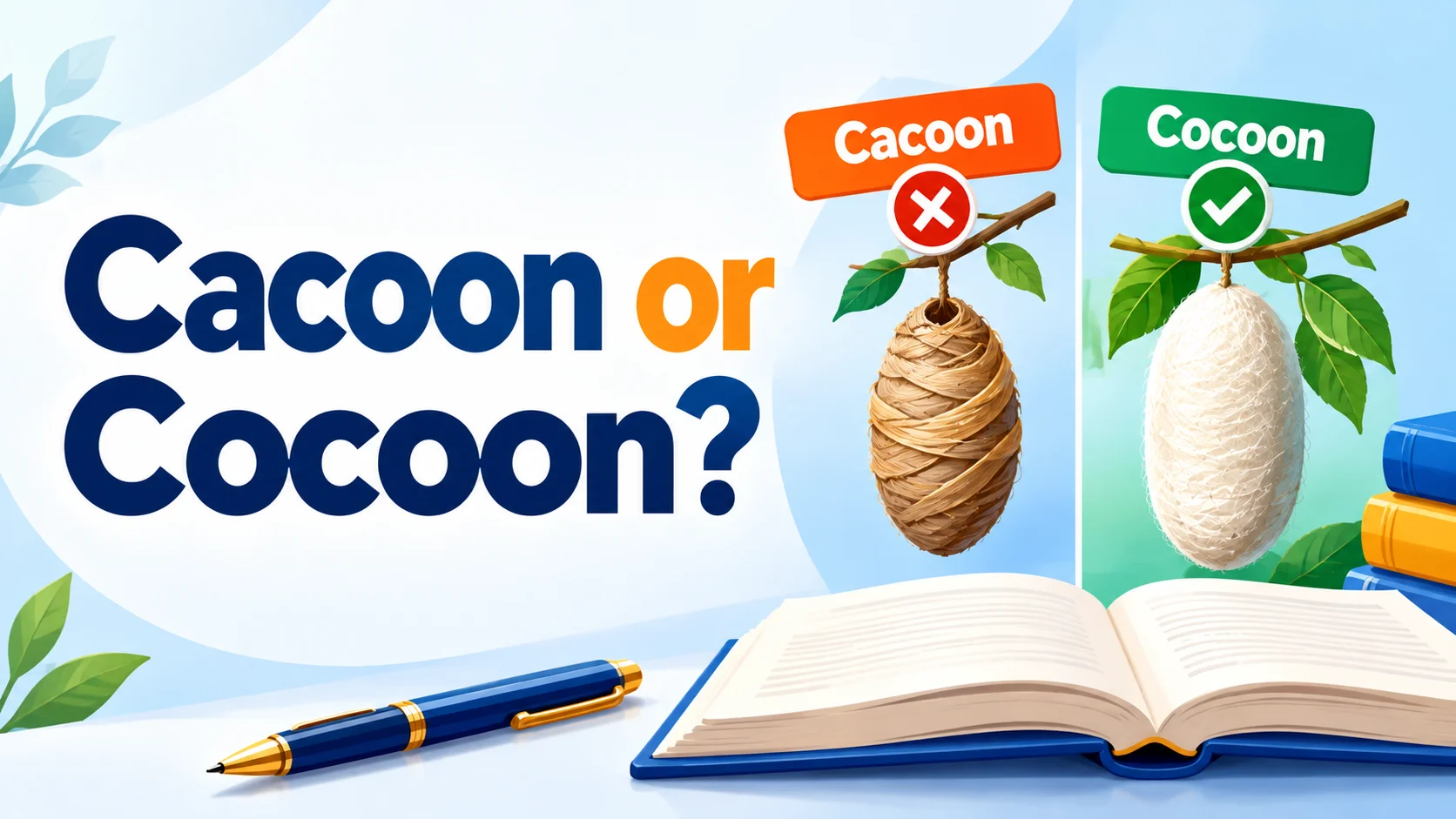
Cacoon or cocoon is a surprisingly easy spelling question to get wrong because the two forms look almost identical, yet they do not normally refer to the same thing. If you are writing about an insect’s protective covering, the standard English spelling is cocoon. The spelling cacoon is not simply a British or American alternative; it can exist as a separate, uncommon botanical term. That distinction matters because replacing one word with the other can change the meaning of a sentence. In this guide, you’ll learn which spelling to use, why the confusion happens, how cocoon is used as a noun and verb, and when cocoon can actually be a legitimate word.
The confusion becomes more interesting when biology enters the picture. A cocoon, pupa, and chrysalis are related but not interchangeable terms, and the familiar image of a butterfly emerging from a “cocoon” is not always scientifically precise. Some insects make silk cocoons around their pupae, while many butterflies form exposed chrysalises instead. The distinction is useful for students, writers, teachers, and anyone trying to describe insect development accurately. It also explains why dictionaries define cocoon in a more specific way than simply “the stage before an insect becomes an adult.”
There is also a practical language question: Why does “cacoon” look so believable? Part of the answer is that English spelling cannot always be predicted from pronunciation, and the unusual spelling resembles the genuine word cocoon closely enough to survive as a recurring mistake. At the same time, cocoons do appear in dictionaries for a completely different object—a large seed or bean associated with a tropical climbing plant. So the safest approach is not to declare cocoon “never a word,” but to understand which word belongs in which context.
Cocoon vs. Cacoon: The Correct Spelling at a Glance
If you mean the protective covering associated with an insect’s pupal development, use cocoon.
| Word | Main meaning | Use for an insect covering? | Example |
| cocoon | Protective covering made by certain insects | Yes | The moth formed a cocoon. |
| cacoon | A separate botanical/common-name term | No, not in this sense | The word may refer to a tropical seed or plant. |
| chrysalis | A butterfly or moth pupa, especially the exposed pupal form | Related, but different | The butterfly remained inside its chrysalis. |
| pupa | The developmental stage between larva and adult in complete metamorphosis | Broader biological term | The insect is now in the pupal stage. |
Cambridge defines cocoon as a covering made from threads that surrounds and protects particular insects during the pupal stage. It also records figurative and verbal meanings.
The simple rule
If you are talking about the familiar insect covering, spell it “cocoon,” not “cacoon.”
The exception is when you deliberately mean the unrelated botanical term cacoon. That is a specialized usage rather than an alternative spelling of cocoon.
What Does “Cocoon” Mean?
Cocoon as a Noun
In its literal biological sense, a cocoon is a protective covering produced by certain insects, often from silk or other material, around the pupal stage.
For example:
- The moth larva spun a cocoon before pupating.
- The silkworm remained inside its cocoon.
- Researchers collected several cocoons from the study area.
The plural is straightforward: cocoons.
One important detail is that not every insect that undergoes metamorphosis makes a cocoon. A cocoon is a protective structure, whereas the pupa is the insect’s developmental stage.
Cocoon as a Verb
Cocoon can also function as a verb. Cambridge records the verb in the sense of protecting someone or something from unpleasant experiences or conditions.
For example:
The thick material cocooned the fragile equipment.
It can also appear in passive constructions:
The child was cocooned from the noise outside.
The verb developed from the noun, first referring to insects forming cocoons and later gaining figurative applications.
Figurative Meaning of Cocoon
English speakers also use cocoon metaphorically for a protected, secluded, or comfortable environment.
Examples include:
- She created a quiet cocoon of books and blankets.
- The small room became a cocoon away from the busy city.
- He spent the weekend cocooned at home.
This figurative meaning is well established rather than being an informal misuse. Cambridge lists cocoon as a noun meaning a safe, quiet place and as a verb meaning to protect someone or something from pain or an unpleasant situation.
Why Is “Cacoon” Often Confused With “Cocoon”?
The mistake is understandable. The two spellings differ by only one vowel, and both produce a word that looks plausible at a glance.
The Visual Confusion
When someone remembers the word primarily from reading rather than writing, cocoon can be misremembered as cacoon. The repeated co pattern is unusual enough that a writer may mentally reconstruct it incorrectly.
This is especially common when someone knows the meaning but has not had much experience writing the word.
Pronunciation Does Not Give You the Whole Spelling
Both English dictionary entries and pronunciation guides show cocoon with the stress on the second syllable: /kəˈkuːn/ in Cambridge’s British and American entries.
That pronunciation does not transparently tell a learner whether the first vowel should be represented by o or a. English contains many words whose spelling cannot be reliably reconstructed from sound alone.
That is why relying exclusively on pronunciation can produce spelling errors.
Familiarity Can Make a Misspelling Look Correct
There is another psychological trap: a frequently encountered incorrect spelling can begin to look normal.
If you repeatedly see cocoons in informal writing, your brain may stop flagging it as unusual. A quick visual check is therefore not enough. When spelling matters, especially in school, professional writing, or published content, use a reliable dictionary rather than trusting what “looks right.”
Is “Cacoon” Ever a Correct Word?
Yes—but this is where the answer needs more nuance.
Calling a cocoon simply “wrong” is incomplete. Cocoon is an established but uncommon word with a separate meaning.
Collins Dictionary defines cocoon as the large bean of a tropical climber, Entada scandens, traditionally used for making various objects.
Other references associate cacoon with the cacoon vine, including Entada rheedii.
Why This Does Not Make “Cacoon” an Alternative Spelling
Suppose someone writes:
The caterpillar disappeared inside its cocoon.
In ordinary English, that is a spelling error because the intended word is cocoon.
But if a botanical text says:
The seeds of the cocoon vine were used traditionally.
the writer may be using cocoon as the name of a plant or its seed.
The key is meaning, not just spelling.
| If you mean… | Use |
| An insect’s protective covering | cocoon |
| A figurative protected environment | cocoon |
| The verb meaning to surround/protect | cocoon |
| A specific tropical plant/seed term | cocoon may be appropriate |
This distinction is particularly important in spelling articles because a rare legitimate word should not be incorrectly labeled a universal misspelling.
Cocoon, Chrysalis, and Pupa Are Not the Same Thing
These three words frequently get mixed together, particularly in descriptions of butterflies and moths.
What Is a Pupa?
A pupa is a developmental stage in insects that undergo complete metamorphosis.
The broad sequence is:
egg → larva → pupa → adult
The pupal stage is when the insect undergoes major transformation before becoming an adult.
What Is a Chrysalis?
A chrysalis is the pupal form of a butterfly and is also used for certain moth pupae. It is not simply another spelling of cocoon.
Smithsonian Gardens describes a chrysalis as the hard-shelled pupa of a moth or butterfly.
A butterfly’s chrysalis is generally an exposed structure rather than a separate silk case wrapped around the pupa.
What Is a Cocoon?
A cocoon is a covering or protective case, often made from silk, that surrounds the developing insect.
Smithsonian material illustrates the distinction clearly: butterflies commonly have chrysalises, while many moth caterpillars spin silk cocoons around their pupae.
Expert distinction: A pupa describes the insect’s developmental stage. A cocoon describes a protective structure surrounding that stage.
That single distinction prevents many inaccurate sentences.
How a Cocoon Fits Into an Insect’s Life Cycle
For insects that undergo complete metamorphosis, development generally follows four major stages:
1. Egg
The insect begins life as an egg.
2. Larva
The larval stage is focused largely on growth and feeding. In butterflies and moths, the larva is commonly called a caterpillar.
3. Pupa
The insect enters the pupal stage, during which major physical changes occur.
4. Adult
The mature insect emerges with its adult body structure and begins the activities associated with adulthood, such as feeding, dispersal, and reproduction.
A cocoon, when the species makes one, is associated with the pupal stage. It is not itself a fifth stage of the life cycle.
Smithsonian sources describe butterfly development as progressing from larva to chrysalis/pupa and then to adult.
How Do Insects Make a Cocoon?
A cocoon is not merely an empty shell that appears around an insect.
In many silk-producing insects, the mature larva produces silk using specialized structures and arranges the fibers into a protective covering. Smithsonian’s entomology resources describe mature caterpillars activating silk-producing glands and ejecting silk through a spinneret.
The resulting structure can:
- Shield the pupa from physical disturbance
- Provide a degree of environmental protection
- Create a controlled space around the developing insect
- Help conceal the vulnerable pupal stage
The exact construction differs among species. Some insects create elaborate silk structures, while others use leaves, debris, soil, or existing materials as part of their pupation environment.
That variation is another reason not to define every pupa as being “inside a cocoon.”
Why Do Insects Form Cocoons?
The central advantage is protection during a vulnerable developmental period.
An insect in the pupal stage is undergoing substantial transformation and may be less capable of responding to threats than an active larva or adult. A protective covering can provide physical shielding and, depending on the species, help conceal the developing insect.
However, there is no single universal cocoon design.
Some species rely heavily on silk. Others construct shelters using surrounding materials. Some pupae are relatively exposed and do not have a conventional cocoon at all.
The practical lesson
Do not write:
All insects become adults inside cocoons.
A more accurate statement is:
Some insects form protective cocoons around their pupae as they undergo development.
That wording respects biological variation.
Silkworm Cocoons and the Silk Industry
The silkworm provides one of the best-known examples of a cocoon because its silk is commercially valuable.
A silkworm produces a silk cocoon around itself during its transformation. The long silk filament can then be processed into textile fiber.
Cambridge’s corpus examples specifically describe silk being produced by unwinding filaments from several cocoons and reeling them together.
This gives cocoons a second familiar association: silk production.
It is also a useful example for understanding the difference between the biological structure and its human use. The cocoon exists because of the insect’s life cycle; the silk industry makes use of the material afterward.
How to Use “Cocoon” Correctly in a Sentence
1. Examples From Nature
- The moth built a cocoon beneath a leaf.
- The silkworm spun a silk cocoon.
- Several empty cocoons were found on the branch.
- The larva entered the pupal stage inside its protective cocoon.
2. Examples With the Verb “Cocoon”
- The silk fibers cocooned the developing insect.
- Thick layers of material cocooned the fragile object.
- The quiet room cocooned her from the noise outside.
3. Examples of the Figurative Meaning
- The cabin became a warm cocoon during winter.
- He created a comfortable cocoon for studying.
- She spent the evening cocooned in the quiet of her room.
4. Examples of “Cacoon”
Use cocoon only when the intended meaning is the specialized botanical term.
For example:
- The book describes the cocoon vine as a tropical climber.
- The traditional use of the cacoon seed is discussed in the botanical record.
If you are talking about an insect’s covering, replace the cocoon with a cocoon.
Common Mistakes Involving “Cocoon”
Writing “Cacoon” When You Mean “Cocoon”
Incorrect in ordinary insect-related usage:
The butterfly emerged from its cocoon.
Correct:
The moth emerged from its cocoon.
Assuming “Cacoon” Is a British or American Variant
It isn’t a British-versus-American spelling difference.
Cambridge lists cocoon in both its UK and US English entries with the same spelling.
So changing your language setting from US English to UK English will not turn cocoon into cocoon.
Calling Every Butterfly Pupa a Cocoon
This is a biological terminology mistake rather than a spelling mistake.
Many butterflies form a chrysalis rather than a silk cocoon. Smithsonian explains that a chrysalis is the pupal stage, while a cocoon is a silk case formed around the pupa.
Treating Cocoon, Chrysalis, and Pupa as Exact Synonyms
They overlap in everyday conversation, but technical writing benefits from keeping their meanings separate.
Pupa = developmental stage
Chrysalis = a type of exposed pupal form
Cocoon = protective covering
The distinctions can become more complicated across insect groups, so scientific writing should follow the terminology appropriate to the species being discussed.
Is “Cocoon” Spelled Differently in British and American English?
No.
Both British and American English use cocoons.
Cambridge gives the same spelling and essentially the same pronunciation for UK and US English.
This makes cocoon different from genuine regional spelling pairs such as:
- colour / color
- centre / center
- organise / organize
You should therefore not treat cocoon as a regional variant.
Quick language-setting check
| Question | Answer |
| British English spelling | cocoon |
| American English spelling | cocoon |
| Standard spelling for an insect covering | cocoon |
| British variant “cacoon”? | No |
| American variant “cacoon”? | No |
| Separate botanical word “cacoon”? | Yes, in specialized usage |
Where Does the Word “Cocoon” Come From?
The history of the word helps explain why the spelling is cocoon, although etymology is not a spelling rule.
The word entered English in the late seventeenth century. The Online Etymology Dictionary traces cocoon to French cocoon and ultimately connects it with words meaning a shell, including French coque. It records the insect-related English noun from the 1690s.
The figurative sense developed much later. Etymonline dates the modern idea of a person’s “interior comfort place” to the twentieth century, while the verb developed earlier from the biological noun.
So the word’s history contains three useful stages:
- Biological noun: an insect’s protective covering
- Verb: to form or surround with a cocoon
- Figurative noun/verb: a protected or secluded environment
The spelling remained cocoon throughout these related uses.
Cocoon Synonyms and Related Words
Choosing a synonym depends heavily on what you are trying to say.
| Word | What it emphasizes | Exact substitute for “cocoon”? |
| Cocoon | Protective covering | Yes |
| Pupa | Developmental stage | No |
| Chrysalis | Pupal form, especially butterflies | No |
| Case | General outer covering | Sometimes, depending on context |
| Sheath | Protective outer layer | Usually metaphorical/general |
| Covering | Broad protective layer | General substitute |
| Shelter | Protection from surroundings | Usually figurative or broad |
A common writing mistake is replacing cocoon with chrysalis simply because both are associated with metamorphosis. They describe different aspects of the process.
How to Remember the Correct Spelling of Cocoon
The easiest memory trick is to focus on the repeated co pattern:
CO + COON → COCOON
You can also break it visually into:
C O C O O N
That gives you two c’s, three o’s, and one n.
If you are unsure while writing a sentence, ask yourself:
“Am I describing the insect’s protective covering?”
If the answer is yes, cocoon is the spelling you want.
A better proofreading habit
Do not rely only on a red spell-check underline. If your software accepts a specialized or uncommon word, that does not automatically mean it is the word you intended.
Instead:
- Identify the meaning.
- Check the spelling.
- Check whether the word fits the context.
- For technical writing, verify the biological terminology as well.
That four-step habit catches both spelling errors and terminology errors.
Cocoon vs. Cacoon: Quick Comparison
| Feature | Cocoon | Cacoon |
| Standard English word | Yes | Yes, but specialized/uncommon |
| Insect protective covering | Correct | Incorrect for this meaning |
| Figurative protected place | Correct | Incorrect |
| Verb meaning “to protect/surround” | Correct | Not the standard verb |
| British spelling | Cocoon | Not a variant |
| American spelling | Cocoon | Not a variant |
| Botanical usage | No | Yes, in specialized contexts |
| Most likely word in everyday writing | Cocoon | Rare |
The important point is that the two words should not be treated as interchangeable spellings.
A Practical Decision Guide for Writers
When you’re unsure which word to use, follow this quick decision process:
If you’re writing about an insect
Use cocoon when you mean a protective covering.
If you’re writing about a butterfly’s exposed pupal stage
Chrysalis may be more precise.
If you’re discussing the developmental stage itself
Use pupa.
If you’re writing about a tropical plant or seed
Check whether cocoon is the specialized term intended by your source.
If you’re writing casually
Cocoon is almost certainly the word you need when discussing the familiar insect structure.
Conclusion
Cocoon is the correct spelling when you mean the protective covering produced by certain insects during their pupal development. Cacoon is not a British or American variant of the word, although it does have a legitimate, specialized botanical use for a tropical seed or plant term. Keeping those meanings separate prevents both spelling mistakes and misleading explanations. It is equally important to distinguish a cocoon from a pupa and a chrysalis: the pupa is a developmental stage, while a cocoon is a protective covering. One final actionable tip: when writing about an insect’s covering, pause and check that your sentence needs cocoon, not cacoon. A common mistake to avoid is assuming that every butterfly pupa is a cocoon. Once you connect the spelling with the meaning, the distinction becomes much easier to remember. In ordinary English, when the insect is wrapped in its familiar protective covering, cocoon is the word to choose.
Frequently Asked Questions
Q1. Is “cacoon” a misspelling of “cocoon”?
When you mean an insect’s protective covering, cocoon is a misspelling and cocoon is the standard spelling. However, cocoon also exists as a rare botanical/common-name term for a tropical plant or seed. Context therefore matters, even though cocoon is not an alternative spelling of cocoon.
Q2. Is “cacoon” an accepted English word?
Yes, but it has a different and specialized meaning. Collins records cocoons for the large beans of a tropical climbing plant. It should not be used as a substitute for cocoon when discussing moths, silkworms, or insect development.
Q3. Do butterflies make cocoons?
Many butterflies form a chrysalis rather than a silk cocoon. The chrysalis is the butterfly’s pupal stage and is generally exposed. Some moths, by contrast, spin silk cocoons around their pupae. The exact structure varies among species, so “butterfly cocoon” is not always biologically precise.
Q4. What is the difference between a cocoon and a pupa?
A pupa is a developmental stage, while a cocoon is a protective covering that can surround the pupa. Not every pupa is enclosed in a cocoon. This distinction is especially useful in science writing because it prevents the covering and the insect’s developmental stage from being treated as the same thing.
Q5. Is “cocoon” spelled differently in British and American English?
No. Cocoon is spelled the same way in British and American English. Cambridge gives the same spelling and pronunciation for both varieties. Therefore, cocoon should not be explained as a British or American spelling variant.