
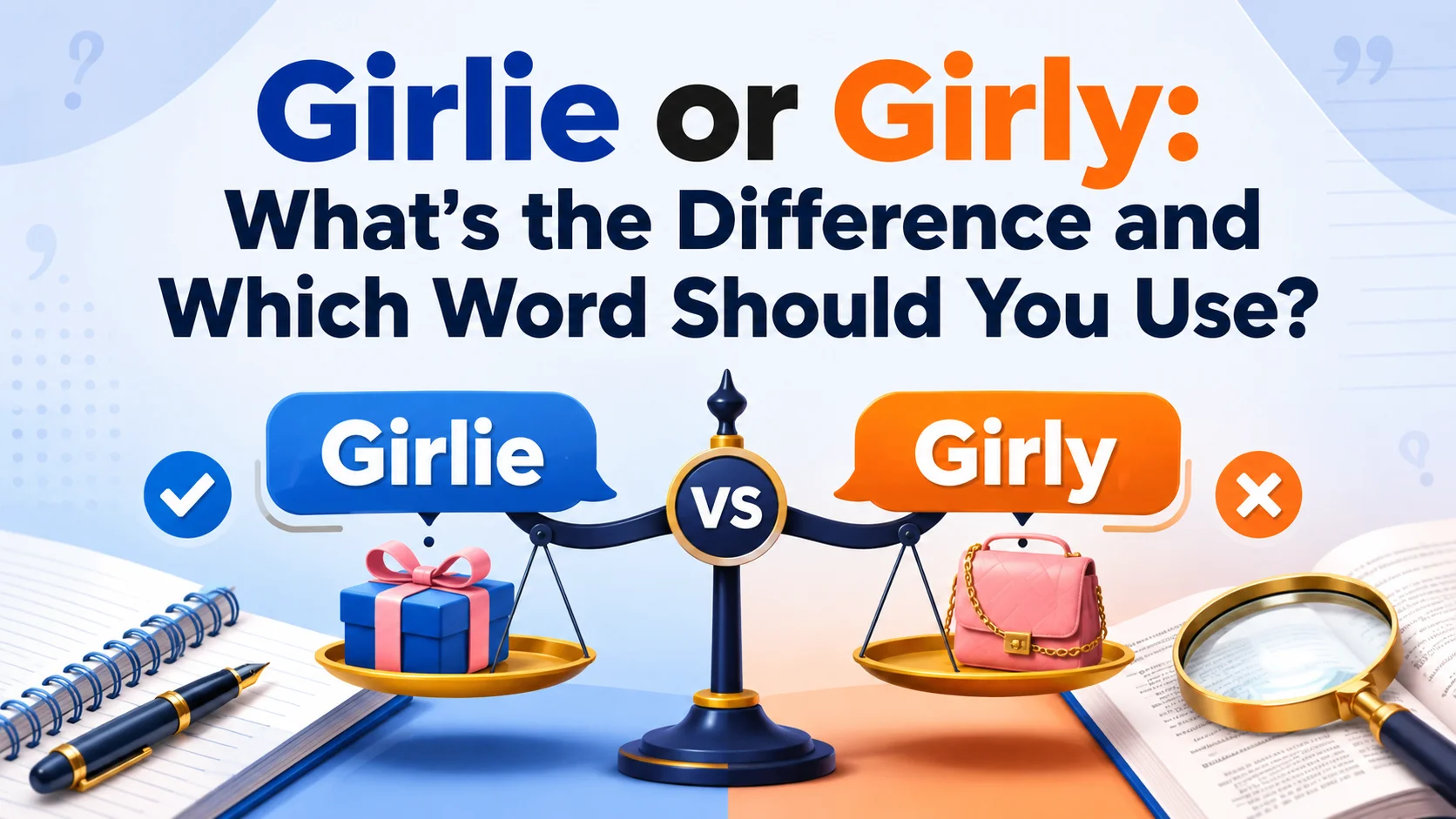
Have you ever paused while writing and wondered whether girlie or girly is the better choice? Although these two words look almost identical, they don’t always serve the same purpose. One is commonly used as a descriptive adjective, while the other has become a friendly, informal term that gained popularity through social media and everyday conversations. Understanding the difference helps you write more naturally, avoid awkward wording, and choose the expression that best matches your audience and tone.
Language changes constantly, and words that once felt unusual can quickly become part of everyday English. That’s exactly what has happened with girlie. Platforms like TikTok, Instagram, and X have transformed it into a playful way of addressing friends or describing a lifestyle, while girly continues to be the standard adjective found in dictionaries and formal writing. Knowing when each word sounds appropriate can make your communication clearer and more authentic.
This guide goes beyond a simple definition. You’ll learn the meaning, grammar, tone, real-world usage, and cultural differences between girlie and girly. You’ll also discover common mistakes, practical examples, comparison tables, and simple memory tricks that make choosing the right word effortless. Whether you’re writing an essay, posting on social media, or texting a friend, you’ll leave with the confidence to use both words correctly.
Quick Answer: Girlie vs Girly
If you only need the short answer, here’s the key distinction:
- Girly is the standard English adjective used to describe something that has traditionally feminine qualities, style, appearance, or interests.
- Girlie is an informal noun or term of address often used affectionately, playfully, or casually, especially in online conversations and social media.
Although the words are closely related, they are not always interchangeable because they differ in grammar, tone, and context.
The Short Answer
| Word | Primary Function | Best Used For |
| Girly | Adjective | Describing style, personality, fashion, hobbies, or appearance |
| Girlie | Informal noun or nickname | Referring to someone in a friendly or playful way |
At a Glance Comparison Table
| Feature | Girly | Girlie |
| Part of speech | Mostly adjective | Mostly noun or nickname |
| Formality | Neutral to moderately informal | Very informal |
| Dictionary recognition | Standard English | Informal English |
| Common on social media | Yes | Very common |
| Suitable for academic writing | Yes, when appropriate | Usually no |
Quick Tip: If you’re describing something, choose girly. If you’re talking to someone or referring to a person casually, girlie is often the better fit.
Why People Confuse Girlie and Girly
The confusion is understandable. Both words come from girl, they look nearly identical, and many people encounter them in the same online spaces. Because they sound similar, it’s easy to assume they mean exactly the same thing.
In reality, each word developed a slightly different role. Girly has been part of English for decades as an adjective describing feminine characteristics. Girlie, however, evolved into a conversational expression that feels more personal and affectionate.
Similar Spelling, Different Purpose
The only visible difference is the ending:
- Girl + y = Girly
- Girl + ie = Girlie
That tiny spelling change creates a noticeable shift in tone.
For example:
- “She has a girly fashion style.”
- “Thanks for checking in, girlie!”
The first sentence describes a style, while the second directly addresses a person.
How Social Media Changed Everyday Usage
Over the past few years, creators on TikTok, Instagram, and lifestyle blogs have popularized expressions such as:
- “Hot girlie walk”
- “That girlie routine”
- “Corporate girlie”
- “Pilates girlie”
- “Clean girlie aesthetic”
These phrases helped transform girlie from a relatively uncommon informal word into one of today’s most recognizable internet expressions.
As a result, younger speakers often encounter girlie more frequently than previous generations did.
Why Context Matters More Than the Dictionary
If you open a dictionary, you’ll usually find girly presented as the standard descriptive word. However, dictionaries cannot fully capture how language evolves online.
Modern English depends heavily on context.
For example:
“She prefers girly colors.”
Here, girly describes the colors.
Now compare it with:
“You’re doing amazing, girlie!”
In this sentence, girlie functions as a warm, friendly way of addressing someone.
The surrounding context—not just the dictionary definition—determines which word sounds natural.
What Does Girly Mean?
Girly is an adjective that describes something traditionally associated with girls or femininity. Depending on the situation, it can refer to clothing, hobbies, decorations, personality traits, interests, colors, or styles.
Importantly, girly does not automatically imply weakness, immaturity, or stereotypes. In modern English, many people proudly use the word to describe their preferences without attaching negative meaning.
Dictionary Meaning of Girly
Most dictionaries define girly as:
Having qualities, characteristics, or interests traditionally associated with girls or women.
While this definition provides a useful starting point, everyday usage is often broader and more flexible.
Girly as an Adjective
You’ll usually find girly modifying a noun.
Examples include:
- Girly clothes
- Girly bedroom
- Girly handwriting
- Girly accessories
- Girly aesthetic
- Girly hobbies
Because it’s an adjective, it answers the question:
“What kind?”
For example:
- She bought a girly dress.
- The room has a girly design.
- Her notebook has a girly floral pattern.
Can Girly Be Used as a Noun?
Occasionally, people say things like:
“She’s such a girly girl.”
Here, girly is still functioning as a descriptive adjective rather than replacing the noun completely.
Unlike girlie, girly is rarely used by itself to refer directly to a person.
Common Characteristics Associated With “Girly”
Depending on the context, girly may describe:
- Fashion
- Makeup
- Jewelry
- Floral patterns
- Soft colors
- Beauty routines
- Romantic themes
- Feminine décor
- Certain hobbies or lifestyles
These are cultural associations rather than fixed rules. Someone can enjoy traditionally masculine and traditionally feminine interests at the same time.
Real-Life Examples of Girly in Sentences
- She loves wearing girly outfits with pastel colors.
- The wedding decorations had a soft, girly theme.
- Her journal has a very girly design.
- They chose a girly color palette for the birthday party.
- Although she’s athletic, she also enjoys girly fashion trends.
In every example, girly describes a thing, style, or characteristic—not a person being addressed.
What Does Girlie Mean?
Unlike girly, which mainly functions as an adjective, girlie is most often an informal noun or a friendly way of addressing someone. It has become especially popular on social media, where people use it to refer to themselves, friends, or groups in a warm, playful, and supportive tone.
Although girlie appears in some dictionaries, its modern popularity comes largely from online culture rather than traditional grammar books. Today, it often reflects a sense of community, humor, or shared identity instead of simply referring to a girl.
Dictionary Meaning of Girlie
In standard English, girlie traditionally means:
A girl or young woman, usually in an informal, affectionate, or playful way.
Modern usage has expanded beyond this definition. Online, people often use girlie regardless of age to create a friendly and relatable tone.
Girlie as an Informal Noun
Unlike girly, girlie can stand alone as a noun.
For example:
- “That girlie always knows the best coffee shops.”
- “The fitness girlies are sharing their morning routines.”
- “Every book girlie should read this novel.”
In these examples, girlie refers directly to a person or group rather than describing something.
Girlie as a Friendly Form of Address
One reason girlie became so popular is that it works like other casual expressions such as:
- Bestie
- Sis
- Babe
- Queen
- Friend
Examples:
“You’ve got this, girlie!”
“Morning, girlie! Ready for work?”
“Don’t worry, girlie, everything will be okay.”
The word often creates an encouraging, conversational tone that feels more personal than simply saying “girl.”
Why “Girlie” Feels More Personal Than “Girly”
The difference isn’t just grammar—it’s emotional tone.
Compare these two sentences:
- “She has a girly wardrobe.”
- “You’re doing great, girlie.”
The first describes clothing. The second speaks directly to someone in a friendly way.
Because of this emotional quality, girlie often sounds:
- Encouraging
- Affectionate
- Casual
- Playful
- Trendy
- Community-oriented
Examples of Girlie in Everyday Conversations
- “Come on, girlie, let’s grab coffee.”
- “The skincare girlies will love this product.”
- “Every travel girlie needs this backpack.”
- “You’re absolutely glowing today, girlie!”
- “The reading girlies are obsessed with this novel.”
These examples show why girlie has become part of everyday online vocabulary.
Girlie vs Girly: Side-by-Side Comparison
Although the words share the same root, they perform different jobs in a sentence.
| Feature | Girly | Girlie |
| Main role | Adjective | Informal noun |
| Purpose | Describes something | Refers to or addresses someone |
| Tone | Neutral or descriptive | Friendly, playful, affectionate |
| Formal writing | Appropriate | Usually inappropriate |
| Social media | Common | Extremely common |
| Professional settings | Sometimes | Rarely |
Meaning
Girly describes feminine qualities or characteristics.
Girlie usually refers to a person in a casual or affectionate way.
Part of Speech
Understanding grammar makes the difference much easier.
Girly
- Primarily an adjective
- Describes nouns
- Cannot usually replace a person’s name
Girlie
- Primarily a noun
- Refers directly to people
- Often works as a nickname or form of address
Tone
The emotional feeling changes noticeably.
Girly sounds:
- Descriptive
- Neutral
- Straightforward
Girlie sounds:
- Warm
- Friendly
- Supportive
- Internet-savvy
Formality
If you’re writing:
- An essay
- A report
- Professional emails
- Academic papers
Girly is usually the better choice.
If you’re:
- Texting friends
- Posting on TikTok
- Writing Instagram captions
- Commenting online
Girlie often feels more natural.
Best Situations to Use Each Word
| Situation | Better Choice |
| Describing clothing | Girly |
| Talking about room décor | Girly |
| Writing a school assignment | Girly |
| Greeting a friend | Girlie |
| TikTok caption | Girlie |
| Lifestyle content | Girlie |
| Casual text message | Girlie |
Grammar Rules: Is Girlie or Girly Grammatically Correct?
One of the biggest misconceptions is that one word is “correct” while the other is “wrong.” In reality, both are grammatically correct, but they serve different grammatical functions.
When Girly Functions as an Adjective
An adjective modifies a noun.
Examples:
- A girly backpack
- A girly hairstyle
- A girly bedroom
- A girly personality
Notice that girly always describes something.
When Girlie Functions as a Noun
A noun names a person.
Examples:
- “Hi, girlie!”
- “That girlie always arrives early.”
- “The gym girlies meet every Saturday.”
Here, girlie replaces the person’s name.
Can Either Word Replace the Other?
Usually, no.
Incorrect:
“She has a girlie dress.”
Correct:
“She has a girly dress.”
Incorrect:
“Hi, girly. Thanks for coming.”
Although some people casually say this, girlie generally sounds more natural as a direct form of address.
Correct:
“Hi, girlie! Thanks for coming.”
Choosing the right word depends more on grammar than spelling.
Common Grammar Errors to Avoid
Avoid these mistakes:
❌ Using girlie as an adjective.
✔ “A girly outfit.”
❌ Using girly as a friendly nickname in professional writing.
✔ Reserve girlie for informal conversations.
❌ Assuming social media usage changes grammar rules.
Even though trends evolve, girly still functions primarily as an adjective, while girlie continues to function mainly as an informal noun.
Tone and Context: The Biggest Difference
If grammar explains how the words work, tone explains why people choose one over the other.
Imagine reading these sentences:
“She likes girly perfumes.”
This simply describes her preference.
Now compare:
“You’re doing amazing, girlie.”
The second sentence creates warmth and encouragement.
The emotional effect is completely different.
Friendly and Affectionate Tone
Many creators intentionally choose girlie because it feels:
- Inclusive
- Supportive
- Friendly
- Relatable
That’s why phrases like these became viral:
- “Hot girlie walk”
- “Book girlie”
- “Coffee girlie”
- “Corporate girlie”
The goal isn’t grammar alone—it’s creating a sense of belonging.
Descriptive and Neutral Tone
Meanwhile, girly stays focused on description.
Examples:
- Girly handwriting
- Girly fashion
- Girly accessories
- Girly bedroom
- Girly colors
When to Use Girly vs Girlie
After understanding the meanings, tone, and grammar behind both words, the next step is knowing which one fits a particular situation. Although they often refer to similar ideas, context, audience, and purpose determine the better choice. Selecting the appropriate word makes your writing sound more natural and avoids sending the wrong message.
Use Girly When You Want a Standard English Adjective
Girly is the preferred choice whenever you need a descriptive adjective in standard English. It works well in everyday conversation, journalism, academic writing, marketing, and professional communication.
Use girly when describing:
- Clothing or fashion
- Makeup and beauty products
- Room décor
- Colors and accessories
- Personality traits
- Activities or hobbies
- Writing with a neutral tone
Examples:
- She prefers a girly style with floral dresses and pastel colors.
- The bedroom has a girly theme featuring pink curtains and white furniture.
- Some people think ballet is girly, but that stereotype is outdated.
- The advertisement promotes a girly fragrance collection.
- Her handwriting has a slightly girly appearance.
Because girly is recognized by dictionaries and style guides, it’s usually the safest option when you want your writing to appear polished and universally understood.
Tip: If you could replace the word with feminine, cute, or traditionally feminine, girly is probably the right choice.
Use Girlie When Speaking Directly to Someone
Unlike girly, girlie usually functions as a noun or nickname rather than a descriptive adjective. It’s commonly used to refer to a person in an affectionate, playful, or trendy way.
You’ll often see it in:
- Text messages
- TikTok captions
- Instagram comments
- Group chats
- Friendly conversations
- Lifestyle content aimed at young audiences
Examples:
- You got this, girlie!
- Morning, girlie! Ready for brunch?
- Every skincare girlie needs sunscreen.
- My coffee girlies are meeting later today.
- She’s a travel girlie who visits a new country every year.
In these situations, girlie creates a warm, informal tone that feels conversational rather than descriptive.
Situations Where Either Word Can Appear
Sometimes both words can appear in the same conversation, but they serve different grammatical roles.
| Sentence | Correct Word | Why |
| She’s very girly. | Girly | Describes her style or personality. |
| Hey, girlie, how are you? | Girlie | Used as a nickname. |
| The outfit looks girly. | Girly | Describes the outfit. |
| Our skincare girlies love this product. | Girlies | Refers to a group of people. |
| That’s such a girly handbag. | Girly | Adjective modifying a noun. |
Notice that girly describes things, while girlie usually refers to people.
When Not to Use Girly or Girlie
Knowing when not to use these words is just as important as knowing when to use them.
Avoid Girly When Neutral Language Is Better
Although girly isn’t offensive by itself, it can sometimes reinforce stereotypes if used carelessly.
For example:
❌ Engineering isn’t for girly girls.
A better alternative would be:
✔ Engineering is for anyone interested in solving problems.
Similarly, avoid using girly to criticize someone for enjoying traditionally feminine interests.
Avoid Girlie in Professional or Academic Writing
Because girlie has a casual, social-media tone, it rarely belongs in formal communication.
Instead of writing:
❌ This product targets modern girlies.
Write:
✔ This product is designed for young women.
Or:
✔ This product appeals to beauty enthusiasts.
Professional reports, business emails, academic essays, news articles, and official documents generally favor standard vocabulary over internet slang.
Common Mistakes People Make
Many writers misuse these terms because they assume they are perfect substitutes. Here are the mistakes experts see most often.
Treating Them as Exact Synonyms
Although closely related, they perform different jobs.
Incorrect:
- She has a girlie bedroom.
Correct:
- She has a girly bedroom.
Using Girlie in Formal Documents
A resume, university application, or business proposal isn’t the place for slang-inspired language.
Professional readers expect clear, standard English, making girly or another neutral adjective a much safer choice when appropriate.
Assuming Girly Is Always Negative
Years ago, calling something girly sometimes implied weakness or lack of seriousness. Today, many people proudly embrace feminine interests, and the word often carries a positive or neutral meaning.
The tone depends more on how the speaker intends it than on the word itself.
Thinking Girlie Is a New Dictionary Word
While dictionaries include girlie, its popularity comes largely from social media culture, where communities create affectionate labels for themselves.
That doesn’t necessarily mean it’s appropriate in every setting.
Expert Tips to Remember the Difference
If you still hesitate between the two words, these simple memory tricks can help.
✅ Girly describes things.
A girly outfit
A girly bedroom
A girly handwriting style
✅ Girlie refers to people.
Hi, girlie!
Beauty girlies
Pilates girlies
Quick Memory Formula
| If you’re talking about… | Use |
| Style, appearance, personality | Girly |
| A person or friendly nickname | Girlie |
| Professional writing | Girly (or another neutral adjective) |
| TikTok, Instagram, or texting | Usually Girlie |
Conclusion
Choosing between girlie and girly becomes much easier once you understand that the difference is about grammar, tone, and context, not correctness. Girly is the traditional adjective used to describe something with feminine qualities, style, or appearance, making it the better choice for formal writing, school assignments, business communication, and most everyday situations. Girlie, on the other hand, is an informal noun or affectionate nickname that has gained popularity through social media, texting, and online communities. It’s perfect for friendly conversations but usually out of place in professional contexts. Before using either word, think about who you’re talking to and where your writing will appear. One final actionable tip: if you’re describing an object, outfit, personality, or aesthetic, choose girly; if you’re warmly addressing a person or referring to a community, girlie is often the natural fit. A common mistake to avoid is treating the two words as completely interchangeable. Matching the word to the situation will make your English sound more natural, accurate, and confident.
FAQs
Q1. Is “girlie” a real word or just internet slang?
Girlie is a real English word, but its popularity has grown significantly because of TikTok, Instagram, and other social media platforms. While dictionaries recognize it, today’s usage is largely informal and often serves as an affectionate nickname or community label rather than a formal descriptive word.
Q2. Which is more appropriate in professional writing: “girly” or “girlie”?
For professional, academic, or business writing, girly is generally the better option because it functions as a standard adjective. Girlie has a casual, conversational tone that may sound too informal in reports, emails, articles, or official documents unless you’re intentionally targeting a youthful audience.
Q3. Can “girly” and “girlie” have negative meanings?
Yes, both words can carry positive, neutral, or negative meanings depending on context. Used respectfully, they often express affection or describe a feminine style. However, when used to stereotype, mock, or belittle someone, either term can sound dismissive or offensive.
Q4. Why has “girlie” become so popular on social media?
The rise of online communities and influencer culture helped popularize girlie as a friendly identity label. Expressions like “book girlie,” “clean girlie,” or “fitness girlie” create a sense of belonging, making the term feel warm, relatable, and community-driven rather than simply descriptive.
Q5. How can I remember the difference between “girly” and “girlie”?
A simple trick is to remember that girly usually describes things, while girlie usually refers to people. If you’re describing an outfit, room, style, or personality, choose girly. If you’re greeting someone or referring to a group of friends online, girlie is usually the more natural choice.