

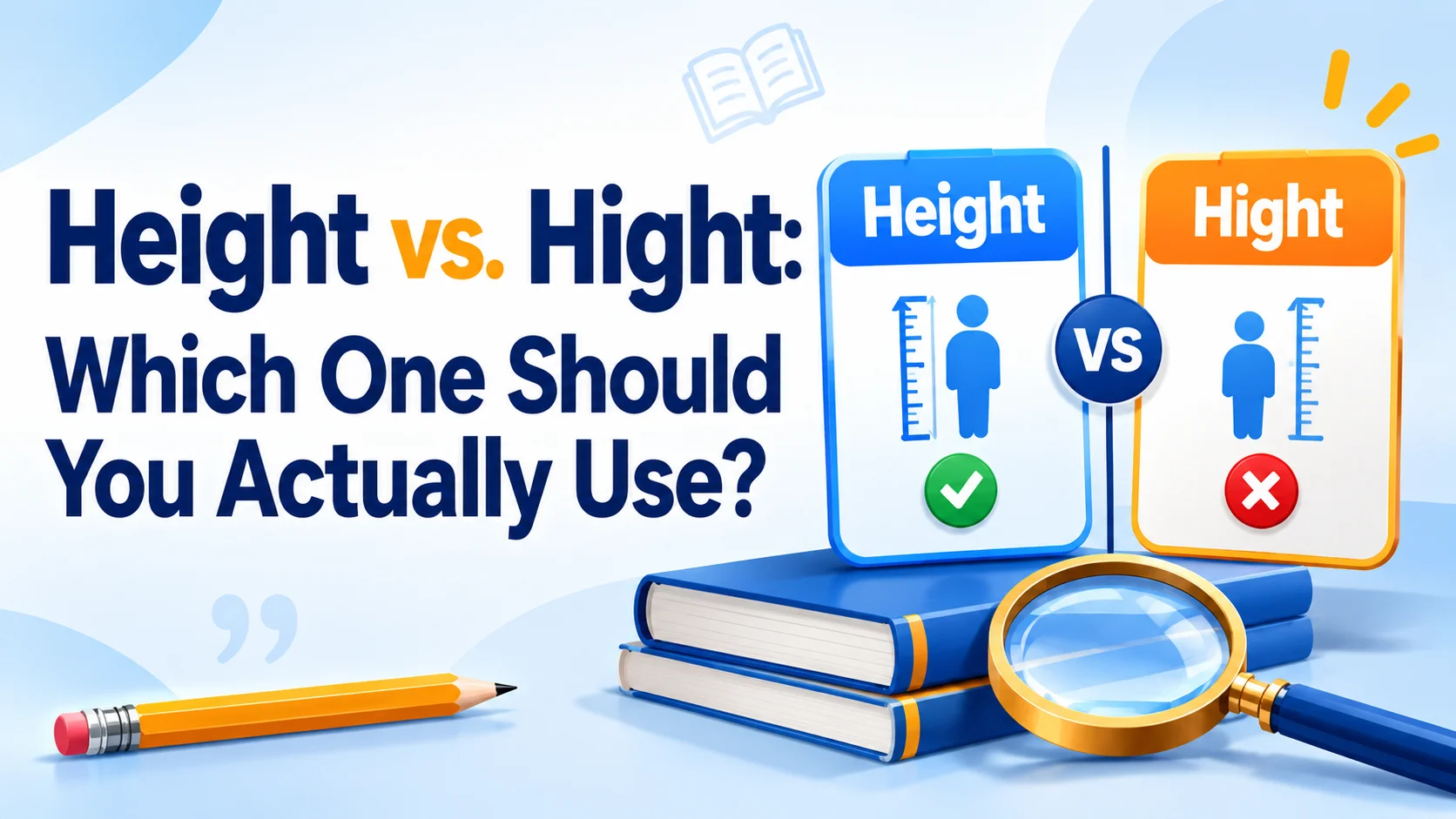
Height vs. hight is an easy spelling question to answer, but the reason behind the correct choice is more interesting than it first appears. If you are describing how tall a person is, measuring a building, or talking about the vertical distance of an object, height is the standard modern English spelling. Hight, although it may look like a logical alternative, does not serve as the modern noun for vertical measurement. Understanding that distinction can prevent a surprisingly common writing mistake.
The confusion usually comes from pronunciation. Height is pronounced /haɪt/, which sounds exactly like a word ending in “-ight.” English contains many familiar spellings such as light, night, right, and sight, so writing hight can feel natural. The connection with high can make matters even less obvious. This guide explains why height has its unusual spelling, what hight actually means in historical English, and how to choose the right word in everyday, academic, and professional writing.
There is also more to the question than simply memorizing one spelling. Height, high, tall, length, depth, width, altitude, and elevation describe related but different ideas. Choosing the right term depends on what you are measuring and how you are describing it. By the end of this guide, you will know the correct spelling, understand the historical exception, recognize common usage mistakes, and have practical rules for using height naturally and accurately.
The Quick Answer: Height Is the Correct Modern Spelling
If you mean the distance from the bottom to the top of something, the correct modern spelling is height.
Examples:
- “What is your height?”
- “The height of the wall is three meters.”
- “We need to measure the height of the door.”
- “The aircraft reached a height of 10,000 meters.”
- “The building has an impressive height.”
Major English dictionaries define height as a noun referring to vertical distance, the quality of being tall, or a particular level above a surface. Cambridge also uses height for figurative ideas such as the peak of a career or the busiest point of a season.
By contrast, hight is not the modern spelling of this measurement noun.
Simple rule: If you are talking about how tall or high something is, write height, not hight.
There is one historical wrinkle, however: height is a real English word, but it has a different history and meaning. That distinction matters when reading older literature or historical texts.
What Does “Height” Actually Mean?
The core definition of height
Height is primarily a noun. It describes vertical measurement—the distance from the bottom to the top of something—or the condition of being tall or elevated.
For example:
“The height of the table is 75 centimeters.”
Here, height identifies the vertical measurement of the table.
Cambridge gives several closely related senses, including the distance from top to bottom, the distance above a surface, high places, and a high level of achievement.
Height as a physical measurement
When you measure an object vertically, height is the appropriate noun.
Consider a rectangular box:
- Length describes one horizontal dimension.
- Width describes the other horizontal dimension.
- Height describes the vertical dimension.
That distinction becomes especially important in technical writing, product specifications, construction documents, diagrams, and mathematics.
For example:
“The cabinet is 180 cm in height.”
That sentence tells the reader exactly which dimension is being discussed.
Height when describing a person
For people, height describes how tall someone is.
Examples:
- “Her height is 165 centimeters.”
- “The form asks for your height.”
- “The two players are similar in height.”
- “He is above average height.”
In ordinary conversation, however, English often uses tall instead of the noun height:
“She is 165 centimeters tall.”
Both constructions are correct, but they serve different grammatical roles. Height is a noun; tall is an adjective.
Height of buildings, structures, and objects
The word works naturally for almost anything whose vertical dimension can be measured.
You might talk about:
- the height of a tree
- the height of a tower
- the height of a ceiling
- the height of a fence
- the height of a mountain
- the height of a wave
- the height of a shelf
For example:
“The height of the tower makes it visible from several kilometers away.”
Height in figurative language
Height is not limited to physical measurement.
English also uses it to describe a peak, extreme point, or period of maximum activity or achievement.
Examples include:
- “She was at the height of her career.”
- “August is the height of the tourist season.”
- “The company reached new heights.”
- “Fashion was at its height in the 1990s.”
Cambridge specifically records these figurative meanings, including the height of a situation or event and the expression at the height of.
Height vs. Hight: The Difference at a Glance
| Word | Modern measurement word? | Meaning | Example |
| height | Yes | Vertical distance; tallness; high point | “The height of the building is 40 meters.” |
| hight | No, not in this sense | Historical/archaic word meaning “called” or “named” | It may appear in older English texts. |
The important point is that hight is not simply an alternative spelling of height.
Merriam-Webster lists hight as an archaic adjective meaning “being called” or “named,” with roots in Middle English and Old English.
So if you write:
“What is your height?”
when asking someone about their physical measurement, you have used the wrong word.
The correct sentence is:
“What is your height?”
Why Is “Height” Spelled With an “E”?
This is where English spelling becomes more interesting.
The modern word height comes from older forms of English. Merriam-Webster traces it through Middle English heighthe to Old English hīehthu, with a relationship to Old English hēah, meaning “high.”
Meanwhile, high itself comes from Old English hēah.
That history helps explain why height and high are related words even though their modern spellings do not look as straightforward as a learner might expect.
The connection between “high” and “height”
Think of the relationship this way:
- high → adjective
- height → noun
Compare:
“The wall is high.”
with:
“The wall has considerable height.”
The words are related, but English does not simply create the noun by adding a predictable ending to the adjective.
Why pronunciation does not solve the spelling
Both height and the hypothetical spelling hight would naturally suggest the same pronunciation: /haɪt/.
That means listening alone cannot tell you which spelling is standard.
This is a broader lesson about English spelling: sound and spelling do not always correspond perfectly. A word can have a pronunciation that makes several spellings seem plausible while only one is standard.
That is exactly what happens with height.
Is “Hight” a Real Word?
Yes—but this is where context matters.
Hight is a genuine historical English word, according to Merriam-Webster. Its meaning is not “height” or “the measurement of something from bottom to top.” Instead, the archaic adjective means “being called” or “named.” Its recorded history goes back to Middle English.
“Hight” in historical English
You may encounter hight when reading older literature, historical documents, or texts deliberately written in an archaic style.
In that context, seeing hight does not necessarily mean the writer made a spelling mistake.
This is an important distinction:
A word can be historically legitimate without being appropriate for modern everyday writing.
That is why telling readers simply “hight is not a word” would be technically incomplete.
Should modern writers use “hight”?
For normal modern English, no.
If you are writing:
- a school assignment
- an email
- a blog post
- a report
- an application
- product specifications
- technical documentation
- everyday communication
use height when referring to vertical measurement.
The historical word hight belongs to a very different linguistic context.
Why Do People Confuse Height and Hight?
1. Pronunciation creates the problem
Height is pronounced /haɪt/. The final sound resembles familiar words such as light, night, right, and sight.
Someone spelling the word from sound may naturally produce:
h-i-g-h-t
That spelling looks reasonable even though it is incorrect for the modern measurement noun.
2. “High” influences the spelling
The word height is closely associated with high, but the relationship is not visually obvious.
A learner may think:
high → hight
That would make sense if English spelling worked completely predictably. It does not.
The correct noun is:
high → height
3. English has many “-ight” words
Words such as night, right, light, fight, and sight reinforce the pattern.
As a result, hight can look more familiar than height even though height is the standard modern spelling.
4. Fast typing encourages sound-based spelling
When people type quickly, they sometimes write the first spelling that matches the sound in their head. This is particularly common with words whose pronunciation does not clearly reveal their spelling.
5. English learners face an additional challenge
Learners often expect related words to follow consistent spelling patterns. High and height can therefore be frustrating because their connection is historical rather than completely transparent in modern spelling.
The best solution is not to invent a pronunciation rule. Treat “height” as a word whose spelling needs to be learned as a unit.
How to Use “Height” Correctly in a Sentence
Talking about a person’s height
Use height when the noun itself is required:
“His height is six feet.”
“The application asks for your height.”
“There was a noticeable difference in height between the two people.”
If you want an adjective instead, use tall:
“He is six feet tall.”
Both forms are grammatical.
Describing an object’s height
“The height of the desk is adjustable.”
“Measure the height before buying the cabinet.”
Giving a measurement
The construction “a height of + measurement” is especially useful in formal or technical writing:
“The aircraft was flying at a height of 8,000 meters.”
Cambridge gives this same type of construction in its examples and notes that height can refer to how far something is above a surface.
Using “height of” naturally
The structure is:
the height of + noun
Examples:
- the height of the building
- the height of the tree
- the height of the mountain
- the height of the ceiling
- the height of the wave
Avoid replacing height with hight simply because the latter appears shorter.
Height, High, Tall, Length, Depth, Width, Altitude, and Elevation
These terms overlap, but they are not interchangeable.
| Word | Part of speech | What it normally describes | Example |
| height | Noun | Vertical measurement or level | “The height is 2 meters.” |
| high | Adjective/adverb/noun | Position, distance upward, or level | “The wall is high.” |
| tall | Adjective | Greater vertical stature, especially people/objects | “The building is tall.” |
| length | Noun | Distance along the longer dimension | “The table is 2 meters in length.” |
| width | Noun | Side-to-side measurement | “The width is 80 cm.” |
| depth | Noun | Distance from front to back or downward | “The depth is 40 cm.” |
| altitude | Noun | Vertical distance above a reference level, especially Earth/sea level | “The aircraft reached a high altitude.” |
| elevation | Noun | Height of land or a location above a reference level | “The city has a high elevation.” |
Cambridge specifically groups length, width, depth, and height as nouns used for dimensions, while long, wide, deep, and high function as corresponding adjectives.
Height vs. high
Compare:
“The building has a height of 100 meters.”
“The building is 100 meters high.”
The first sentence uses the noun height. The second uses the adjective high.
Height vs. tall
Tall commonly describes people and upright objects:
“She is tall.”
“They built a tall tower.”
Height names the measurement or quality:
“The tower has considerable height.”
Cambridge defines tall as having more than average height or a particular height and provides examples such as “six feet tall.”
Height vs. length
The distinction depends on orientation and context.
For a standing cabinet:
- vertical dimension → height
- horizontal dimension → length/width
For something lying horizontally, what counts as length may change depending on how the object is conventionally described.
Height vs. altitude
Altitude is more specialized. It commonly refers to vertical distance above a reference level, particularly in aviation or geography.
For example:
“The aircraft reached an altitude of 10,000 meters.”
You would normally not replace altitude with height in every technical context, even though the concepts overlap.
Height vs. elevation
Elevation is frequently used for the height of land or a location relative to a reference level, such as sea level.
“The town has an elevation of 1,500 meters above sea level.”
That is more precise than simply saying:
“The town has a height of 1,500 meters.”
Common Grammar and Usage Questions About “Height”
Is it “how high” or “how height”?
Use “how high” when asking for a measurement with high functioning as an adjective.
“How high is the wall?”
Use “what is the height” when asking for the noun.
“What is the height of the wall?”
Do not say:
“How height is the wall?”
Is “height” singular or plural?
Height is singular.
The plural is heights.
Examples:
“The height of the two towers is different.”
“The heights of the two towers are different.”
The singular refers to one measurement or concept; the plural can refer to multiple measurements or high places.
“At a height of” vs. “with a height of”
Both can be correct, but they often appear in different contexts.
At a height of is especially natural when describing position above a surface:
“The plane was flying at a height of 5,000 meters.”
With a height of describes an object’s measured dimension:
“The tower, with a height of 80 meters, dominates the skyline.”
“In height” vs. “in the height”
Be careful with these constructions.
“The tree is ten meters in height.”
is grammatical but relatively formal.
In everyday English, this is often more natural:
“The tree is ten meters tall.”
Meanwhile, “at the height of” has a different meaning when referring to a peak or period:
“She was at the height of her career.”
Common Mistakes With Height
| Mistake | Incorrect | Better choice | Why |
| Spelling | “What is your height?” | “What is your height?” | Height is the modern measurement noun. |
| Adjective/noun confusion | “What height is the wall?” | “How high is the wall?” | High works naturally as the adjective here. |
| Measurement term | “The width is 3 meters tall.” | “The height is 3 meters.” | Tall describes vertical extent, not width. |
| Dimension confusion | “The height of the table from side to side…” | “The width of the table…” | Side-to-side measurement is generally width. |
| Technical vocabulary | “The plane reached a height above sea level…” | “The plane reached an altitude…” | Altitude is often more precise in aviation. |
| Historical assumption | “Hight is just an old spelling of height.” | Treat them as separate words. | Historical hight has its own meaning and origin. |
Mistake 1: Writing “hight”
This is the most direct spelling error.
Incorrect:
“The hight of the building is 20 meters.”
Correct:
“The height of the building is 20 meters.”
Mistake 2: Confusing height with high
Remember the grammatical difference:
height = noun
high = adjective
So:
“The wall is high.”
but:
“The wall has considerable height.”
Mistake 3: Using tall everywhere
Tall is useful, but it cannot replace height in every grammatical structure.
You can say:
“He is tall.”
You cannot naturally turn that into:
“He is six feet tall.”
You need the noun:
“His height is six feet.”
Mistake 4: Confusing measurement directions
When describing a product, furniture, building, or diagram, identify the dimension first.
Ask:
Am I measuring upward, across, or from front to back?
That simple question often tells you whether you need height, width, length, or depth.
Mistake 5: Assuming spelling should follow sound
English contains many words whose spelling cannot be predicted perfectly from pronunciation.
If you hear /haɪt/, do not automatically write hight. The standard spelling is height.
Why Getting the Spelling Right Matters
A single spelling error usually does not make a sentence impossible to understand. Most readers will infer what hight means from context.
Still, accuracy matters.
In a school assignment, an incorrect spelling can affect the impression your writing makes, In professional communication, repeated errors can make otherwise useful information appear less carefully edited. In technical writing, precision matters even more because the wrong word can create ambiguity.
The goal is not to obsess over tiny mistakes. It is to recognize high-value corrections that are easy to learn and easy to apply.
For height, the rule is especially simple:
Use height when you mean vertical measurement or a high point.
How to Remember the Spelling of Height
Memory trick: connect “height” with “eight”
One useful spelling aid is to notice that height contains “eight”:
h + eight → height
The pronunciation is different, but the letter sequence can serve as a visual reminder.
Memory trick: connect “high” and “height”
Think of this pair:
high → height
Not:
high → hight
This helps reinforce the relationship between the adjective and noun.
Spell it as a complete word
Instead of trying to reconstruct the spelling every time, memorize:
H-E-I-G-H-T
That is more reliable than trying to derive it from pronunciation.
Use a spelling checkpoint
When proofreading, ask:
“Am I talking about how tall or high something is?”
If yes, check whether you have written height.
That one-second check can prevent the mistake.
When “Hight” May Actually Appear
If you are reading an old text and encounter hight, do not immediately assume the author misspelled height.
Merriam-Webster records hight as an archaic word meaning “being called” or “named,” tracing it to Middle English and ultimately to Old English.
This creates an important distinction between modern writing and historical reading.
In modern writing
Use:
“The height of the tower is 50 meters.”
In historical literature
You may encounter:
hight
as part of an older linguistic form.
If you are quoting a historical source, preserving the original spelling may be appropriate. If you are writing your own modern prose, however, height is the correct choice for physical measurement.
Expert tip: Never judge a historical spelling solely by modern English rules. First determine what the word meant in the original period.
Height in Different Types of Writing
Everyday conversation
Natural:
“How tall are you?”
“What is the height of that shelf?”
The first is more conversational; the second sounds more measurement-focused.
Academic writing
Academic prose may favor the noun:
“The study recorded the height of each structure.”
This is useful when height is one of several measured variables.
Technical writing
Technical documents need consistent terminology.
If a specification lists:
- length
- width
- height
- weight
then changing terminology halfway through the document can confuse readers.
Use the same measurement labels consistently throughout a specification.
Business writing
In a product description, for example:
“The unit has a height of 120 cm and a width of 60 cm.”
That is clearer than repeatedly using vague descriptions such as big, small, high, or tall.
Creative writing
The word can be literal:
“They stood beneath the enormous height of the cliffs.”
Or figurative:
“At the height of her career, she received international recognition.”
The figurative sense adds another reason not to think of height merely as a ruler measurement.
A Practical Decision Guide: Which Word Should You Choose?
| If you want to describe… | Best word | Example |
| A person’s vertical measurement | height | “His height is 180 cm.” |
| Whether someone is tall | tall | “He is tall.” |
| Whether something is far above the ground | high | “The shelf is high.” |
| A building’s vertical dimension | height | “The building’s height is 60 m.” |
| A horizontal dimension | length/width | “The table is 2 m long.” |
| Front-to-back dimension | depth | “The cabinet has a depth of 40 cm.” |
| Aircraft distance above a reference level | altitude | “The aircraft reached an altitude of 10,000 m.” |
| Land’s height above sea level | elevation | “The town has an elevation of 900 m.” |
| A peak period of success/activity | height | “At the height of her career…” |
| Historical “called/named” usage | hight | An archaic literary usage |
Examples: Height vs. Hight in Real Sentences
Correct modern examples
- “The height of the door is two meters.”
- “What is the height of the mountain?”
- “The shelf can be adjusted to different heights.”
- “The aircraft reached a height of 9,000 meters.”
- “She is average height.”
- “The height of the ceiling makes the room feel spacious.”
- “He was at the height of his career.”
Incorrect modern examples
- “What is your height?”
- “The hight of the wall is three meters.”
- “Measure the hight before installing the cabinet.”
In each case, replace hight with height.
A useful editing exercise
If you are proofreading a document, search for:
hight
Then check every occurrence individually.
In modern writing about physical dimensions, it will almost certainly need to become height. The exception is when the word deliberately refers to its historical meaning or occurs in an original historical quotation.
A Short Case Study: Choosing the Right Word in a Product Description
Imagine a furniture seller writing:
“This cabinet is 180 cm tall, 80 cm wide, and 40 cm deep.”
That sentence is already clear.
Now imagine a formal specification sheet:
“Height: 180 cm
Width: 80 cm
Depth: 40 cm”
Here, height is the ideal noun because it is functioning as a standardized measurement label.
Now suppose the seller writes:
“Hight: 180 cm”
The intended meaning remains understandable, but the spelling looks unprofessional and may make the specification appear poorly edited.
The lesson is broader than one typo: good technical writing uses precise terminology consistently.
Common Misconceptions About Height and Hight
Myth 1: “Hight” is simply the informal version of “height.”
No. Modern English does not treat hight as a casual alternative spelling of height.
Myth 2: “Hight” is completely fake.
Also no. Hight is historically attested, but its recorded meaning is different from modern height.
Myth 3: “Height” should be spelled “hight” because it sounds that way.
English spelling is not always phonetic. The standard spelling is determined by established usage and word history, not simply by pronunciation.
Myth 4: “High” and “height” should have identical spelling patterns.
They are historically related, but modern English does not require related words to look identical.
Myth 5: Height is only used for people.
No. It can describe the vertical dimension of people, buildings, objects, natural features, and many other things. It also has figurative meanings involving peaks or extremes.
Conclusion:
The answer to height vs. hight is straightforward: when you mean vertical measurement, tallness, or a high point, height is the correct modern spelling. Hight deserves a small footnote rather than a place in ordinary measurement vocabulary because it survives mainly as an archaic word meaning “called” or “named.” The more useful lesson is knowing how related words work together. Height is a noun, while high and tall serve different grammatical roles. Length, width, depth, altitude, and elevation can also be more precise depending on what you are describing. One final actionable tip: whenever you hesitate, ask whether you mean the vertical measurement. If you do, choose height. A common mistake to avoid is spelling from pronunciation and automatically writing hight. English may not always make its spelling predictable, but this particular choice can be made with confidence: height is the word you want in modern English.
FAQs
Q1. Is it height or hight?
For modern English, the correct spelling is height when you mean vertical measurement, tallness, or a high point. Height is a separate archaic word meaning “called” or “named.” Therefore, write “the height of the building,” not “the height of the building.”
Q2. Why is height spelled differently from high?
Height and high are historically related, but English spelling developed over centuries rather than following a perfectly regular pattern. Height comes through Middle English from Old English hīehthu, while high comes from Old English hēah. Their modern forms preserve different spelling histories.
Q3. Can I use “hight” in an English essay?
If your essay is written in modern English, do not use height to mean height. The correct noun is height. You may encounter height in historical literature, where it has an archaic meaning, but that specialized usage should not be substituted for the modern measurement word.
Q4. What is the difference between height and tall?
Height is a noun, while tall is an adjective. You can say, “His height is 180 centimeters,” or “He is 180 centimeters tall.” You cannot use tall where a noun is grammatically required. The choice depends on the sentence structure rather than a difference in measurement.
Q5. Is “height” used only for physical measurements?
No. Height has both literal and figurative meanings. It can describe vertical distance, a high position, or a peak in achievement or activity. Expressions such as “at the height of her career” and “the height of the season” use the word figuratively rather than as a simple physical measurement.