

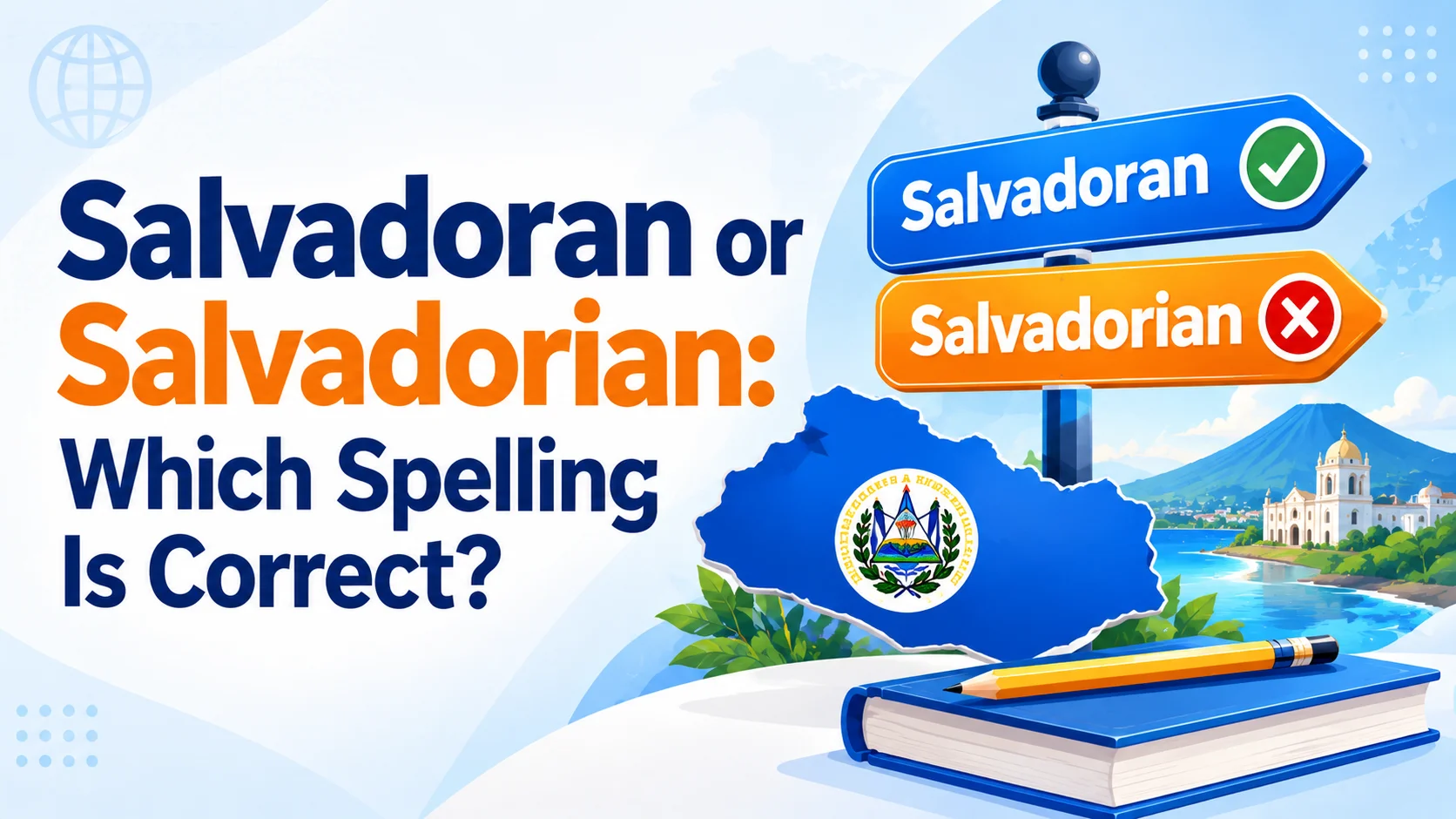
Salvadoran or Salvadorian can both be found in English, but they are not equally common. If you are writing about a person from El Salvador, its culture, food, history, or anything associated with the country, Salvadoran is the safest and most widely established choice. Cambridge, for example, defines Salvadoran as both the noun for someone from El Salvador and the adjective meaning “coming from or relating to El Salvador.”
The confusion is understandable. English has no single rule for forming demonyms, so a writer may naturally expect Salvadorian to work because many nationality words end in -ian. It is not simply a made-up spelling, either: dictionaries and terminology resources recognize Salvadorian as an alternative form. The Canadian government’s TERMIUM Plus, for instance, lists Salvadoran, Salvadorean, and Salvadorian as correct English inhabitant names.
So which one should you actually choose? In most modern English writing, Salvadoran is the better default. This article explains what each form means, why Salvadoran is more widely preferred, when Salvadorian may appear, how to use the word as a noun or adjective, and which mistakes to avoid in essays, articles, business writing, and everyday conversation.
Salvadoran or Salvadorian: The Short Answer
If you need one practical rule, use this:
Use “Salvadoran” when referring to a person, people, culture, or anything connected with El Salvador.
Examples:
- She is Salvadoran.
- He is a Salvadoran.
- We tried Salvadoran food.
- The museum is hosting a Salvadoran art exhibition.
- They are studying Salvadoran history.
Salvadorian is also an established English form. Collins lists it as an alternative to Salvadoran, and other English-language reference resources recognize it as a variant.
That means calling Salvadorian an outright “wrong spelling” oversimplifies the issue. The more useful distinction is preferred form versus less common alternative.
Quick decision table
| If you are writing… | Recommended form |
| A school essay | Salvadoran |
| A professional document | Salvadoran |
| A news article | Salvadoran |
| A website or blog | Salvadoran |
| About a person from El Salvador | Salvadoran |
| About food or culture | Salvadoran |
| A quotation containing “Salvadorian” | Preserve the original wording when appropriate |
| A publication with a house style | Follow its stated style |
The important point is that “Salvadoran” is the safest general-purpose choice, not that every occurrence of Salvadorian is automatically an error.
What Does “Salvadoran” Mean?
Salvadoran is used as both a noun and an adjective.
Cambridge defines the noun as someone from El Salvador and the adjective as something coming from or relating to El Salvador.
Salvadoran as a Noun
As a noun, Salvadoran identifies a person from El Salvador.
Examples:
- A Salvadoran joined the discussion.
- Several Salvadorans attended the event.
- She is Salvadoran.
- The organization supports Salvadorans living abroad.
The plural is Salvadorans, not Salvadoranes or Salvadorian.
Salvadoran as an Adjective
As an adjective, Salvadoran describes something associated with El Salvador.
For example:
- Salvadoran culture
- Salvadoran history
- Salvadoran literature
- Salvadoran music
- Salvadoran cuisine
- Salvadoran artists
- Salvadoran communities
- Salvadoran traditions
This adjective function is particularly useful in informational writing because it lets you describe an object, subject, institution, or idea without repeatedly writing “from El Salvador.”
Why “Salvadoran” Is Usually the Best Choice
The strongest reason is not that Salvadorian is impossible. It is that Salvadoran is the established default in major English references and ordinary contemporary usage.
Cambridge uses Salvadoran as its English term, while Collins gives Salvadorian as an alternative. Dictionary.com likewise identifies Salvadoran as the main entry and gives Salvadorian and Salvadorean as alternatives.
That makes Salvadoran the sensible choice when you have no special reason to use another form.
What Does “Salvadorian” Mean?
Salvadorian generally means the same thing as Salvadoran: a person from El Salvador or something connected with the country.
The important nuance is that it is less common, rather than meaningless.
Wiktionary treats Salvadorian as an alternative form of Salvadoran, and Collins also lists it as an alternative.
Is “Salvadorian” a Real Word?
Yes. It occurs in English dictionaries and real-world usage.
The Canadian government’s TERMIUM Plus terminology database is particularly useful here because it lists Salvadoran, Salvadorean, and Salvadorian as correct English inhabitant names.
So a sentence such as:
He is Salvadorian.
may be understandable and recognized as English usage.
However, if you are deciding which form to use from scratch, Salvadoran is generally the more conventional choice.
Why Do People Write “Salvadorian”?
There is a straightforward linguistic reason: -ian is a familiar ending in English nationality words.
Writers see forms such as:
- Canadian
- Brazilian
- Armenian
- Australian
- Indian
and may naturally form Salvadorian by analogy.
That reasoning is understandable, but English demonyms are not generated by one universal formula. Some use -an, some -ian, some -ese, some -ish, and others have forms that cannot be predicted reliably from the country’s name.
The practical lesson is simple: check the established demonym instead of inventing one from a familiar suffix pattern.
Salvadoran vs. Salvadorian: What Is the Actual Difference?
In ordinary English, the two forms have essentially the same basic reference.
| Feature | Salvadoran | Salvadorian |
| Refers to El Salvador | Yes | Yes |
| Can refer to a person | Yes | Yes |
| Can function as an adjective | Yes | Yes |
| Recognized in English reference sources | Yes | Yes |
| General frequency | More common | Less common |
| Best default for new writing | Yes | Usually no |
| Automatically an error? | No | No |
The distinction is therefore mainly one of usage, frequency, and preference.
This matters because language advice can become misleading when it labels every less-common variant “incorrect.” A professional editor should distinguish between:
- a spelling that is genuinely wrong,
- a recognized alternative that is uncommon,
- and the standard form that should normally be preferred.
Salvadorians belong much closer to the second category.
Salvadoran, El Salvador, and Salvador: Three Terms to Keep Separate
One of the easiest ways to make a nationality-related mistake is to confuse the country name, demonym, and a related proper name.
El Salvador
El Salvador is the name of the Central American country.
Example:
My friend traveled to El Salvador last summer.
Salvadoran
Salvadoran identifies someone or something from El Salvador.
Example:
My friend enjoyed Salvadoran cuisine.
Notice the grammatical difference:
- She traveled to El Salvador.
- She ate Salvadoran food.
Salvador
Salvador can refer to different things depending on context. Dictionary.com, for example, lists it as another name for El Salvador while also recognizing other uses, including a personal name and the Brazilian city Salvador.
For that reason, simply replacing El Salvador with Salvador can create ambiguity.
Best practice: when you mean the Central American country in ordinary English, write El Salvador.
How the Word “Salvadoran” Is Formed
The spelling may look unusual if you are expecting a more familiar -ian ending.
A useful way to think about Salvadoran is that it is an established English demonym derived from Salvador + -an. Wiktionary gives this formation explicitly.
That does not mean English demonyms always behave this way. It simply explains why the standard form ends in -an.
Demonyms Do Not Follow One Universal Rule
English learners sometimes try to create nationality words mechanically:
Country name + familiar suffix = demonym.
That approach works occasionally, but it is unreliable.
Consider how different established demonyms can be:
- Canada → Canadian
- Japan → Japanese
- Spain → Spanish
- Germany → German
- France → French
- El Salvador → Salvadoran
There is no single suffix that can safely be applied to every country.
Expert tip: If a demonym feels uncertain, do not rely on what “sounds right.” Check an authoritative dictionary or terminology source.
Salvadoran vs. Salvadorian in American and British English
The difference between American and British English is sometimes exaggerated in discussions of this word.
American English
Salvadoran is the safest choice for American English. It is well established in US dictionaries and current American usage. Dictionary.com, for example, gives Salvadoran as its main entry.
British English
British English does not require writers to switch automatically to Salvadorian. The standard form Salvadoran remains widely recognizable and established.
So there is no simple rule such as:
American = Salvadoran
British = Salvadorian
That would be misleading.
International English
For international audiences, Salvadoran is usually the clearest default because it is widely recognized and is the form used by major English-language reference sources.
If you are editing material for a particular publication, however, its house style takes priority.
Editorial rule: When an organization, journal, publisher, or institution has a stated terminology policy, follow that policy consistently.
How to Use “Salvadoran” Correctly in a Sentence
Knowing which word to choose is only half the job. You also need to place it naturally.
Talking About a Person
Maria is Salvadoran.
Here, Salvadoran functions as a subject complement describing Maria’s nationality.
You can also use it as a noun:
Maria is a Salvadoran.
Both structures are natural.
Talking About a Community
The city has a large Salvadoran community.
Here, Salvadoran modifies the community.
Talking About Culture
The exhibition explores Salvadoran culture.
This is the standard adjective construction.
Talking About Food
The restaurant serves traditional Salvadoran food.
This is preferable to repeatedly writing “food from El Salvador.”
Talking About Art or Literature
The course includes several works by Salvadoran writers.
Again, the adjective describes the noun that follows it.
Salvadoran or Salvadorian in Formal and Professional Writing
The choice becomes more important when the writing is intended for publication.
Academic Writing
For an essay, thesis, research paper, or university assignment, Salvadoran is generally the strongest default.
Why?
- It is widely recognized.
- It is concise.
- It matches major English dictionary usage.
- It avoids distracting readers with an uncommon variant.
If a source you are quoting uses Salvadorian, you do not necessarily need to “correct” the quotation. Quoted material should normally preserve the source’s wording.
News Writing
Journalistic writing benefits from familiar, established terminology.
Current English-language examples also overwhelmingly demonstrate the usefulness of Salvadoran. Dictionary.com currently provides examples from major publications including the BBC, Los Angeles Times, Wall Street Journal, and Barron’s using the form.
Business Writing
In a report, email, website, or customer-facing document, consistency matters more than showing off an unusual variant.
Prefer:
We are partnering with a Salvadoran organization.
rather than switching between Salvadoran and Salvadorian throughout the document.
School Assignments
If a student asks, “Which one should I write in my essay?” The practical answer is Salvadoran.
There is little benefit in choosing the less common form unless the assignment specifically requires reproducing a source’s terminology.
Common Mistakes With Salvadoran and Salvadorian
Mistake 1: Assuming “-ian” Must Be Correct
A writer may think Salvadorian looks more natural because of other words ending in -ian.
Better approach: learn the established demonym rather than constructing one from a suffix rule.
Mistake 2: Calling “Salvadorian” Completely Wrong
This is too absolute.
Multiple reference sources recognize Salvadorian as an alternative.
A better editorial statement is:
Salvadoran is the preferred general form; Salvadorian is a recognized but less common alternative.
Mistake 3: Using “Salvador” for Everything
These sentences do not mean exactly the same thing:
- He lives in El Salvador.
- He is Salvadoran.
- He speaks about Salvadoran culture.
Replacing all three with Salvador removes important grammatical distinctions.
Mistake 4: Mixing Forms Without a Reason
Suppose an article begins with Salvadoran culture and later switches to Salvadorian culture without explanation.
Even though readers can understand both, the inconsistency looks careless.
Choose one form and maintain it throughout your own prose.
Mistake 5: Assuming Search Results Prove Correctness
Search engines show what people write, not necessarily what editors recommend.
A large number of results can reflect:
- older usage,
- copied content,
- regional preferences,
- machine-generated text,
- informal writing,
- or legitimate variants.
Use dictionary and terminology evidence to determine standard usage, then use search results to understand real-world patterns.
Mistake 6: Forgetting Capitalization
When referring to nationality or people, capitalize Salvadoran.
Correct:
Salvadoran culture has a rich culinary tradition.
Correct:
She is Salvadoran.
Incorrect:
She is Salvadoran.
The capitalization follows the standard English treatment of nationality terms.
Salvadoran vs. Salvadorian: Real-World Examples
| Context | Preferred example | Why |
| Nationality | She is Salvadoran. | Standard demonym |
| Person as noun | He is a Salvadoran. | Natural noun usage |
| Culture | They study Salvadoran culture. | Standard adjective |
| Food | We ordered Salvadoran food. | Standard adjective |
| History | The class covers Salvadoran history. | Clear and conventional |
| Community | A Salvadoran community lives nearby. | Natural modifier |
| Academic writing | The paper examines Salvadoran literature. | Formal and widely recognized |
| Less-common variant | The source uses Salvadorian. | Preserve source terminology when appropriate |
The final example illustrates an important editorial principle: not every variation needs to be silently changed.
When Might “Salvadorian” Be Appropriate?
There are a few situations where retaining Salvadorian makes sense.
When Quoting a Source
If a historical document, interview, or published source uses Salvadorian, changing the quoted wording would alter the source.
When Following an Established House Style
A publication may have its own terminology preferences. If its style guide consistently uses Salvadorian, writers working within that system should follow the house style.
When Discussing the Word Itself
If your article is specifically about the difference between Salvadoran and Salvadorian, the word Salvadorian obviously needs to appear.
When Preserving Someone’s Original Wording
In some editorial contexts, preserving a person’s exact wording matters more than replacing it with the editor’s preferred form.
Outside such contexts, Salvadoran remains the practical default.
A Better Way to Decide: The Three-Step Rule
When you encounter the two spellings, use this quick process.
Step 1: Ask What You Mean
Are you referring to:
- the country?
- a person?
- nationality?
- culture?
- food?
- history?
- something else connected with El Salvador?
If you mean the country itself, write El Salvador.
If you mean the people or something associated with the country, Salvadoran is usually the answer.
Step 2: Check Whether You Are Following a Source
If you are writing original content, choose the standard form.
If you are quoting or following a publication’s style, preserve its terminology where appropriate.
Step 3: Be Consistent
Once you select Salvadoran, do not randomly switch to Salvadorian halfway through the article.
This three-step method solves most real-world usage problems without requiring a long grammar lesson.
Is “Salvadorean” Another Spelling?
Yes. Salvadorean is another variant that readers may encounter.
It is worth mentioning because someone researching this question may see three forms:
- Salvadoran
- Salvadorian
- Salvadorean
Reference sources recognize these variants, although Salvadoran is the strongest general-purpose choice. Collins lists Salvadorian and Salvadorean as alternatives to Salvadoran, while TERMIUM Plus lists all three as correct English inhabitant names.
This is another reason not to treat every spelling difference as a simple right-versus-wrong problem.
For modern general writing, choosing Salvadoran keeps the terminology straightforward.
Salvadoran vs. Salvadorian: What Dictionaries Tell Us
Dictionary evidence is especially useful because it separates actual English usage from assumptions about how a word should be formed.
| Reference source | What it shows |
| Cambridge | Uses Salvadoran for the noun and adjective |
| Collins | Defines Salvadoran and lists Salvadorian/Salvadorean as alternatives |
| Dictionary.com | Uses Salvadoran as the main entry and recognizes alternatives |
| TERMIUM Plus | Lists Salvadoran, Salvadorian, and Salvadorean as correct inhabitant names |
| Wiktionary | Treats Salvadorian as an alternative form and notes Salvadoran as the most common |
The evidence leads to a more accurate conclusion than “one is correct and the other is wrong”:
Salvadoran is the established preferred form for general English, while Salvadorian is a recognized alternative.
Conclusion
Salvadoran is the form to reach for when you are writing about people, culture, food, history, or anything connected with El Salvador. It is the standard choice presented by Cambridge and the main form used by major English reference sources, while Salvadorian is a recognized but less common alternative. The most useful lesson is not simply memorizing one spelling. It is understanding the difference between a preferred form and a legitimate variant. Salvadorian should not automatically be labeled a spelling error, but there is usually little reason to choose it when writing fresh content for a broad English-speaking audience. One final actionable tip: if you hesitate, use Salvadoran and keep that form consistent throughout your document. A common mistake to avoid: do not confuse El Salvador, the country, with Salvadoran, the demonym and adjective. Once that distinction is clear, this spelling question becomes much easier. A useful distinction is between linguistic correctness and editorial preference. If a dictionary recognizes a form, it can be misleading to call that form nonexistent. But when a writer asks which word to use in a new article, essay, or professional document, they usually want the form that is most conventional and least likely to distract the reader. That is why Salvadoran wins the practical choice even though Salvadorian has legitimate usage.
Frequently Asked Questions
Q1. Is “Salvadorian” grammatically wrong?
No. Salvadorian is a recognized English variant and appears in reference sources. The more important distinction is frequency: Salvadoran is the more established general form. For new writing, especially formal or academic work, Salvadoran is usually the better choice.
Q2. What do you call someone from El Salvador?
The standard English demonym is Salvadoran. It works as both a noun and adjective: “She is a Salvadoran” and “She is Salvadoran.” The plural noun is Salvadorans. Cambridge specifically defines Salvadoran as someone from El Salvador.
Q3. Should I write “Salvadoran food” or “Salvadorian food”?
For ordinary English writing, choose Salvadoran food. It uses the more widely established English adjective and will be immediately familiar to most readers. Salvadorian food is understandable and attested, but there is usually no practical advantage to choosing the less common variant.
Q4. Is “Salvadoran” used as both a noun and an adjective?
Yes. As a noun, it identifies a person from El Salvador: “The Salvadoran spoke with the reporter.” As an adjective, it describes something associated with the country: “The restaurant serves Salvadoran cuisine.” This dual use is standard English.
Q5. Which spelling should I use in an academic paper?
Use Salvadoran unless your required style guide or source uses another form for a specific reason. It is the clearest standard choice in academic prose. If you quote a source that says Salvadorian, preserve the original wording rather than silently changing the quotation.