

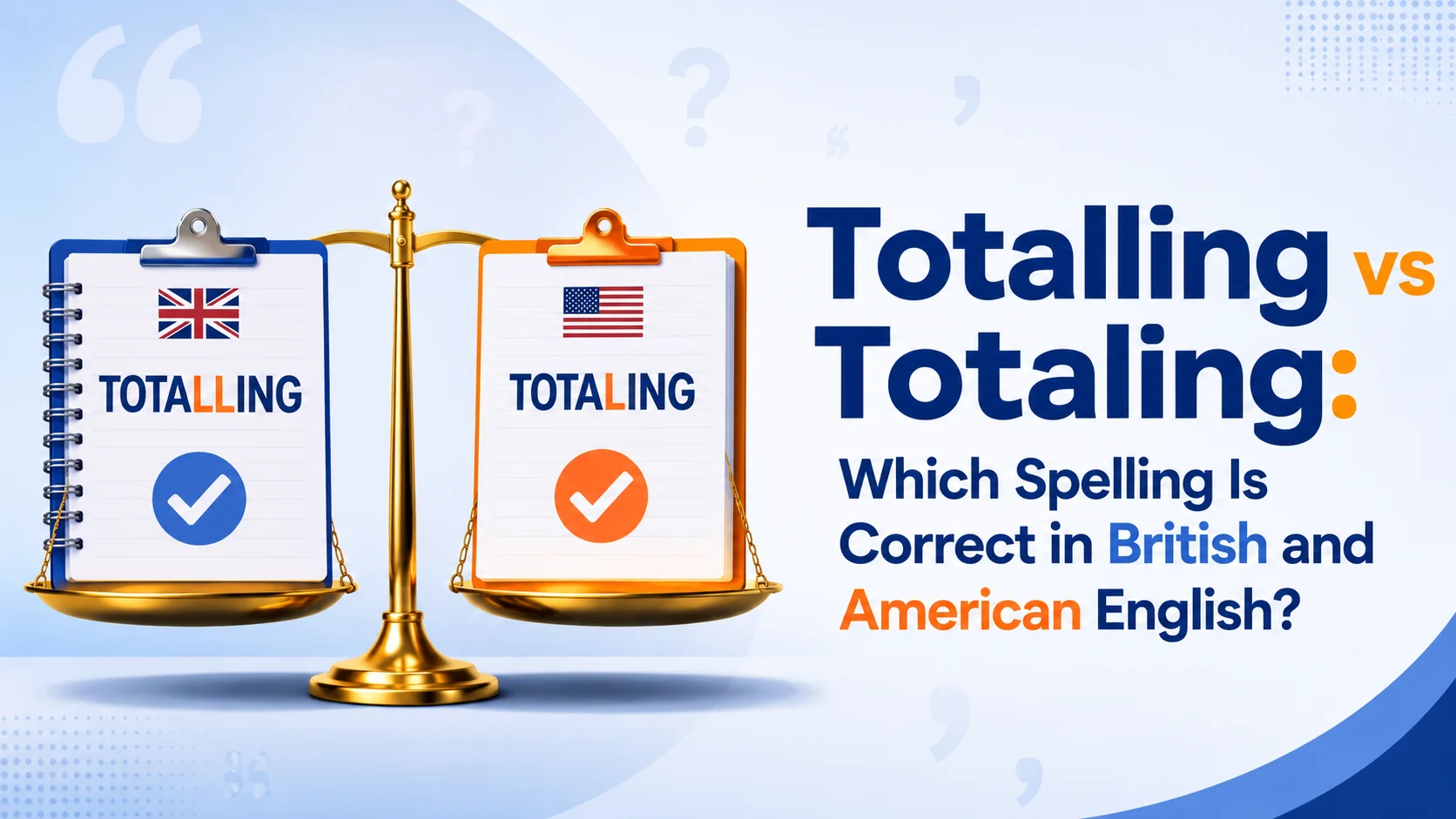
Many writers stop when they reach totalling or totaling, wondering whether they’ve made a spelling mistake. The truth is that both spellings are correct, but each belongs to a different variety of English. If you’ve ever switched between American English and British English, edited an international document, or relied on spellcheck only to receive conflicting suggestions, you’re not alone. Understanding the difference isn’t just about spelling—it’s about writing with consistency, meeting your audience’s expectations, and communicating professionally.
Whether you’re preparing a business report, an academic paper, an insurance claim, or a simple email, choosing the right spelling helps build credibility. Many people mistakenly believe one version is “wrong,” but the real answer depends on the regional spelling rules you follow. This article explains why the spellings differ, how the consonant-doubling rule works, when each form should be used, and how major style guides treat these variations. You’ll also discover practical examples, memory tricks, comparison tables, and proofreading tips that make the rule easy to remember.
By the end, you’ll know exactly when to write totalling and when to write totaling, without second-guessing yourself. Along the way, you’ll learn how similar spelling patterns apply to words like travelling/traveling, labelled/labeled, and cancelled/canceled, helping you improve your overall writing—not just this one word. Whether you’re a student, editor, content writer, business professional, or English learner, you’ll leave with a clear understanding of one of the most commonly misunderstood spelling differences in modern English.
Quick Answer
| Audience or Style | Correct Spelling |
| American English | Totaling |
| British English | Totalling |
| Australian English | Totalling |
| Canadian English | Usually Totalling (though some organizations prefer Totaling) |
| International writing | Follow one style consistently throughout the document |
Key takeaway: Neither spelling is universally “more correct.” The right choice depends on the regional variety of English you’re writing in.
What Do “Totalling” and “Totaling” Mean?
Both totalling and totaling are present participle (or gerund) forms of the verb total. Regardless of spelling, they carry exactly the same meaning.
Depending on the sentence, the word can mean:
- Adding numbers together
- Calculating a final amount
- Reaching an overall sum
- Completely destroying something, especially a vehicle in insurance contexts
Example meanings
| Sentence | Meaning |
| She is totaling the monthly expenses. | Adding figures together |
| The accountant is totalling the invoices. | Calculating a total |
| The crash ended up totaling the car. | Damaging the vehicle beyond economical repair |
Notice that the meaning never changes—only the spelling changes depending on the English standard being used.
Totalling vs Totaling: The Core Difference Explained
The distinction between totalling and totaling is surprisingly simple.
- Totalling is the preferred spelling in British English.
- Totaling is the preferred spelling in American English.
This difference isn’t unique to the word total. It’s part of a broader spelling pattern involving verbs that end in -l before adding suffixes like -ing or -ed.
British English
British spelling typically doubles the final “l” before adding -ing or -ed, even when the last syllable isn’t stressed.
Examples include:
- travel → travelling
- cancel → cancelling
- label → labelling
- total → totalling
American English
American spelling usually keeps a single “l” unless the stress falls on the final syllable.
Examples include:
- travel → traveling
- cancel → canceling
- label → labeling
- total → totaling
The pronunciation remains exactly the same in both versions.
British vs American English Spelling Rules
The spelling difference comes from how each variety of English applies the consonant-doubling rule.
British English Pattern
British English generally doubles a final l before adding a suffix.
| Base Word | British Form |
| travel | travelling |
| signal | signalling |
| fuel | fuelling |
| total | totalling |
This rule creates visual consistency across many commonly used verbs.
American English Pattern
American English simplifies many of these spellings by keeping a single l.
| Base Word | American Form |
| travel | traveling |
| signal | signaling |
| fuel | fueling |
| total | totaling |
This simplification became widely accepted through American dictionaries and style guides over time.
Why Do the Spellings Differ?
Many people assume one spelling evolved from a mistake, but that’s not what happened.
The difference developed because British and American English gradually adopted different editorial conventions during the 18th and 19th centuries. British publishers generally retained traditional doubling patterns, while American lexicographers—most notably Noah Webster—favored simpler, more standardized spellings where possible.
As a result:
- British English kept totalling.
- American English standardized totaling.
Neither version is newer or more “official.” They simply reflect different publishing traditions that continue today.
Comparison at a Glance
| Feature | Totalling | Totaling |
| Meaning | Same | Same |
| Pronunciation | Same | Same |
| British English | ✔ Preferred | Rare |
| American English | Rare | ✔ Preferred |
| Grammatically Correct | ✔ Yes | ✔ Yes |
| Use in International Writing | Depends on style guide | Depends on style guide |
How to Choose the Correct Spelling Every Time
One of the most common questions writers ask is, “Which spelling should I use?” The answer is straightforward once you know who your audience is and which style guide you follow. Instead of switching between totalling and totaling, choose one version and use it consistently throughout your document.
Writing for an American Audience
If your readers are primarily in the United States, use totaling. This spelling appears in major American dictionaries and is preferred by widely used style guides such as the Associated Press (AP) Stylebook and The Chicago Manual of Style.
You’ll commonly see totaling in:
- Business reports
- Corporate emails
- Financial documents
- Academic papers written in American English
- Government publications
- Online articles targeting U.S. readers
Example
The accountant is totaling the quarterly sales figures before submitting the report.
This looks natural to American readers and matches their spelling expectations.
Writing for a British Audience
If you’re writing for readers in the United Kingdom—or in countries that generally follow British spelling, such as Australia, New Zealand, and often Canada—totalling is the standard choice.
You’ll often find totalling in:
- Newspapers published in the UK
- University assignments following British English
- Legal documents
- Business communications in Britain
- Government publications
Example
The finance team is totalling all project expenses before final approval.
British readers will immediately recognize this as the standard spelling.
What If Your Audience Is International?
Many businesses, universities, and websites have readers from multiple countries. In these situations, the most important rule is consistency.
Choose one variety of English before you begin writing.
For example:
| If You Choose… | Then Also Use… |
| American English | totaling, traveling, labeling, canceled |
| British English | totalling, travelling, labelling, cancelled |
Mixing styles can make otherwise polished writing appear unprofessional.
Why Consistency Matters More Than the Spelling Itself
Editors rarely reject a document because you chose totalling instead of totaling. What they do notice is inconsistency.
Imagine reading this paragraph:
We are totaling the invoices before totalling the annual expenses.
Although both spellings are technically correct in different varieties of English, using both together distracts readers and suggests the document wasn’t carefully proofread.
Professional writers usually decide on one style before writing begins.
Real-Life Examples of Totalling and Totaling
Seeing both spellings in context makes the difference much easier to remember.
American English Examples
| Sentence | Why It’s Correct |
| She’s totaling today’s receipts. | American spelling |
| We’re totaling all customer refunds this afternoon. | American business writing |
| The insurance company declared the accident totaling the vehicle. | Standard U.S. usage |
British English Examples
| Sentence | Why It’s Correct |
| He’s totalling the department’s monthly expenses. | British spelling |
| They spent the afternoon totalling the invoices. | Standard UK usage |
| The collision ended up totalling the car. | Common British form |
Notice that the meaning stays identical. Only the spelling changes.
Totalling vs Totaling in Professional Writing
Professional writing values clarity, accuracy, and consistency. Whether you’re writing an annual report or publishing an article, your chosen spelling should match the publication’s editorial standards.
Where Consistency Matters Most
- Academic research papers
- Financial statements
- Legal documents
- Corporate reports
- Insurance claims
- Government publications
- Technical documentation
- Books and magazines
Large organizations often publish internal style guides specifically to prevent inconsistent spelling across teams.
Example Scenario
Imagine you’re preparing an annual financial report for a U.S. company.
Correct:
We are totaling all operating costs before calculating annual profit.
Incorrect:
We are totalling all operating costs before calculating annual profit.
Now imagine you’re preparing the same report for a London-based company.
Correct:
We are totalling all operating costs before calculating annual profit.
Using the preferred regional spelling helps your writing feel natural to your audience.
Related Word Patterns That Follow the Same Rule
The totalling vs totaling difference isn’t an isolated case. Once you understand the pattern, many other spelling differences become much easier.
| American English | British English |
| traveling | travelling |
| labeling | labelling |
| canceled | cancelled |
| modeling | modelling |
| signaling | signalling |
| fueling | fuelling |
| totaling | totalling |
Instead of memorizing every individual word, learn the overall regional spelling pattern.
A Simple Memory Trick
If you struggle to remember which spelling belongs to which variety of English, try this shortcut.
British English usually likes an extra “L.” American English usually simplifies it.
Think of these pairs:
- travelling → traveling
- labelling → labeling
- fuelling → fueling
- totalling → totaling
You don’t have to memorize dozens of exceptions. Just remember the broader pattern.
Quick Proofreading Checklist
Before submitting any document, ask yourself:
- ✅ Am I writing for American or British readers?
- ✅ Does my spellcheck match that language setting?
- ✅ Have I used the same spelling throughout the document?
- ✅ Do similar words (traveling/travelling, labeling/labelling) follow the same style?
- ✅ Would my audience naturally expect this spelling?
Common Mistakes People Make with Totalling and Totaling
Even experienced writers occasionally hesitate when deciding between totalling and totaling. The confusion usually doesn’t come from the meaning of the word—it comes from switching between British English and American English without realizing it. Fortunately, most mistakes are easy to spot and even easier to fix once you know what to look for.
Mistake #1: Mixing Both Spellings in One Document
The most frequent mistake is using both spellings in the same piece of writing.
Incorrect Example
The finance team is totaling today’s sales before totalling the monthly revenue.
This immediately signals inconsistent editing. Readers may not consciously notice the spelling difference, but the document feels less polished.
Correct (American English)
The finance team is totaling today’s sales before totaling the monthly revenue.
Correct (British English)
The finance team is totalling today’s sales before totalling the monthly revenue.
Expert Tip
Before publishing, use your word processor’s Find feature to search for both spellings. This quick check helps ensure your document stays consistent.
Mistake #2: Assuming One Spelling Is Always Wrong
Many people believe totaling is incorrect because they learned totalling in school—or vice versa.
The reality is much simpler:
| Statement | Correct? |
| Totalling is correct. | ✔ Yes (British English) |
| Totaling is correct. | ✔ Yes (American English) |
| Only one spelling is acceptable worldwide. | ✘ No |
Neither spelling is “better.” The correct choice depends entirely on the variety of English you’re using.
Mistake #3: Letting Spellcheck Decide Everything
Spellcheck is helpful, but it isn’t perfect.
If your software is set to American English, it may automatically change totalling to totaling.
If it’s set to British English, it may suggest the opposite.
Always check your document’s language settings before accepting corrections.
Mistake #4: Forgetting Similar Words
Some writers correctly use totaling but accidentally write travelling later in the same article.
For example:
The company is totaling expenses while travelling across Europe.
This mixes American and British spelling conventions.
Instead, keep the entire document consistent.
American Style
- totaling
- traveling
- labeling
- canceled
British Style
- totalling
- travelling
- labelling
- cancelled
Why Writers Get Confused
Several factors contribute to the confusion.
Global English
Many websites serve international readers. Writers often read both American and British publications without realizing they’re switching spelling systems.
Multiple Style Guides
Different employers, universities, and publishers follow different editorial standards.
For example:
- A British university expects totalling.
- A U.S. marketing agency expects totaling.
Neither is incorrect—they simply follow different conventions.
Search Engines Display Both
Online searches often return pages using both spellings, making it easy to think one page contains an error when it’s actually following a different regional standard.
Case Study: Editing an International Business Report
Imagine a content writer preparing a financial report for an international company.
The first draft contains these sentences:
We are totaling projected expenses for the next quarter.
Later:
The accounting department is totalling supplier invoices.
The editor notices the inconsistency.
Option 1: American Version
Every occurrence becomes:
- totaling
- traveling
- labeling
- canceled
Option 2: British Version
Every occurrence becomes:
- totalling
- travelling
- labelling
- cancelled
The final document reads smoothly because readers aren’t distracted by inconsistent spelling.
Best Practices for Different Types of Writers
Students
Before submitting assignments, check whether your school or instructor requires British or American English.
Many universities specify this in their writing guidelines.
Business Professionals
Companies often maintain internal style guides.
If your organization follows American English, use totaling consistently in:
- Reports
- Presentations
- Emails
- Financial summaries
If your organization follows British English, use totalling throughout.
Content Writers
Writers creating online content should consider their target audience.
For example:
| Target Audience | Recommended Spelling |
| United States | totaling |
| United Kingdom | totalling |
| Australia | totalling |
| International website | Choose one style and remain consistent |
Consistency also strengthens your site’s editorial professionalism.
Expert Recommendations
Professional editors generally follow a simple workflow.
Before Writing
- Identify your audience.
- Choose your English variety.
- Set your spellchecker accordingly.
While Writing
- Avoid switching styles.
- Use the same spelling pattern for related words.
- Check examples from reliable dictionaries if unsure.
Before Publishing
Complete this final review:
- ✔ The language setting is correct.
- ✔ Spelling is consistent.
- ✔ Similar words follow the same convention.
- ✔ Headings and body text match.
- ✔ No accidental regional mixing.
These habits require very little time but significantly improve writing quality.
Quick Decision Guide
If you’re still unsure, use this simple decision process:
- Who will read your work?
- American readers → totaling
- British readers → totalling
- Are you following a company or university style guide?
- Follow its preferred spelling.
- Writing for an international audience?
- Pick one style and stick with it from beginning to end.
Totalling vs Totaling: Quick Reference Guide
If you only need a fast answer before writing, this section summarizes everything discussed so far. Keep it handy whenever you’re unsure which spelling to choose.
| Situation | Use Totaling | Use Totalling |
| American English | ✅ | ❌ |
| British English | ❌ | ✅ |
| U.S. business writing | ✅ | ❌ |
| UK academic writing | ❌ | ✅ |
| International audience | Choose one style and stay consistent | Choose one style and stay consistent |
Use Totaling If:
- You’re writing in American English.
- Your organization follows U.S. style guides.
- Your audience is primarily in the United States.
- Your spellchecker is set to American English.
Use Totalling If:
- You’re writing in British English.
- Your readers are in the United Kingdom or other regions that use British spelling.
- Your publisher, employer, or university follows British conventions.
Always Remember
- Both spellings are correct.
- The meaning never changes.
- Only the regional spelling convention changes.
- Consistency is more important than choosing one spelling over the other.
Quick Tip: If you’re ever in doubt, check your document’s language settings before proofreading. That single step prevents most spelling inconsistencies.
Conclusion
Choosing between totalling and totaling is much easier once you understand that the difference comes from British English and American English, not from meaning or grammar. Both spellings are accepted within their respective language standards, so your goal should be to match your audience and remain consistent throughout your writing. Whether you’re preparing a business report, academic assignment, blog post, or financial document, following one style makes your work look polished and professional. One final actionable tip: decide which variety of English you’ll use before you begin writing. A common mistake to avoid: mixing both spellings in the same document, as it creates inconsistency and distracts readers.
Frequently Asked Questions
Q1. Is “totalling” or “totaling” more correct?
Neither spelling is universally more correct. Totaling is the standard in American English, while totalling is preferred in British English. The best choice depends on your audience and the writing style you’re following.
Q2. Why does British English use “totalling” with two Ls?
British spelling often doubles the final consonant before adding endings like -ing when the word follows specific spelling patterns. That’s why you’ll also see travelling, labelling, and modelling alongside totalling.
Q3. Should I change my spelling for international readers?
If you’re writing for a global audience, you don’t need to switch between spellings. Choose either American English or British English and use it consistently throughout the article, report, or document.
Q4. Does Microsoft Word automatically choose the correct spelling?
Only if the language settings match your intended writing style. If Word is set to American English, it will usually recommend totaling. If it’s set to British English, it will suggest totalling.
Q5. Can using the wrong regional spelling affect professionalism?
Using totalling instead of totaling (or vice versa) isn’t a major grammar error, but mixing both spellings in one document can make your writing appear inconsistent. Professional editors value consistency as much as correct spelling.