

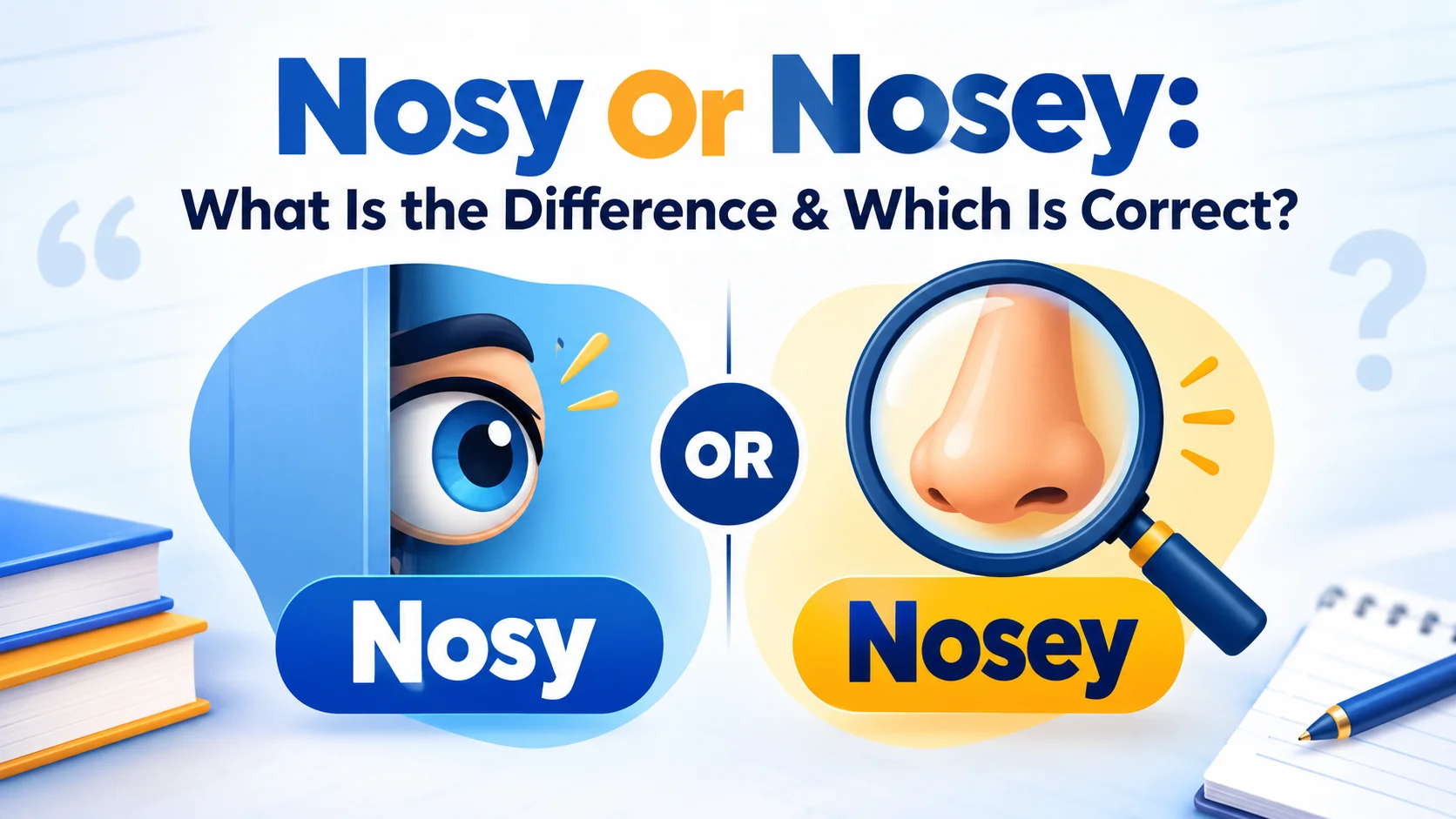
If you have ever paused while writing nosy or nosey, you are not alone. Both spellings appear in English, and both describe someone who takes too much interest in other people’s private affairs. However, nosy is the more conventional spelling and the safest choice for most everyday and professional writing. The alternative, nosey, is also used and generally carries the same meaning. The difference is not about grammar, pronunciation, or attitude; it is mainly a matter of spelling preference. Knowing which form to choose can help you write more confidently, avoid unnecessary corrections, and keep your wording consistent.
The word itself has a slightly negative edge. Calling someone nosy suggests that their curiosity has crossed a boundary. A person who asks how a machine works may simply be curious, while someone who repeatedly questions a coworker about their salary may be described as nosy. That distinction matters because word choice affects tone as much as spelling does. Whether you are writing a school assignment, a blog post, a text message, or a professional email, you need to understand not only which spelling is preferred but also when the word sounds appropriate.
In this guide, you will learn the meaning of nosy and nosey, how the spellings compare, where the word comes from, and how to use it naturally in sentences. You will also see practical examples, common expressions, and the difference between nosy, curious, and inquisitive. By the end, you will know which version to use, why the alternative exists, and how to describe intrusive curiosity without sounding unnecessarily harsh. The goal is simple: help you make the right choice for your audience and context.
What Does Nosy or Nosey Mean?
Nosy is an adjective that describes someone who is excessively interested in other people’s personal business. A nosy person might ask questions that feel intrusive, listen in on private conversations, or try to discover information that others have chosen not to share.
Nosey is an alternative spelling with essentially the same meaning. In ordinary use, the two forms do not describe different personality traits or levels of curiosity. The main distinction is which spelling a writer chooses.
Consider these examples:
- “Our nosy neighbor keeps asking when we will move.”
- “My cousin is always nosey about my relationships.”
- “Please stop asking nosy questions about her finances.”
- “I’m not trying to be nosy, but did you get the job?”
In each sentence, the word suggests interest that may be unwelcome. The tone can range from playful teasing to genuine criticism.
What Does It Mean to Be a Nosy Person?
A nosy person wants to know details that may not concern them. The behavior can be obvious, such as asking personal questions, or subtle, such as reading someone else’s messages without permission.
For example, a friend who asks whether you enjoyed your holiday is showing ordinary interest. A friend who demands to know how much the trip cost, who paid for it, and why you traveled with a particular person may be crossing a boundary.
The important distinction is not how many questions someone asks, but whether those questions disregard another person’s privacy.
People sometimes use nosy affectionately among close friends or family members. Someone might laugh and say, “You’re so nosy!” after a harmless question. In a tense conversation, however, the same words can sound like an accusation.
Is Nosy Always an Insult?
No. Although nosy usually has a negative or disapproving connotation, its force depends on context, delivery, and the relationship between the people speaking.
- Playful: “You’re nosy! I wanted the surprise to stay secret.”
- Critical: “The manager was nosy about employees’ personal lives.”
- Self-deprecating: “Sorry, I’m being nosy. You don’t have to answer.”
- Boundary-setting: “I don’t want to be nosy, so I’ll let you bring it up if you want.”
If you want to sound respectful, avoid using the word to label someone’s character when you can describe the behavior instead. Saying “That question feels personal” may work better than saying “You’re nosy.”
Nosy vs. Nosey: What Is the Main Difference?
The central difference between nosy and nosey is spelling preference. Both are used as adjectives, both refer to intrusive curiosity, and both are generally pronounced alike.
In most modern writing, nosy is the preferred default. It is the form you should normally choose when you are unsure, especially in edited content, schoolwork, workplace communication, and general publications. Nosey remains a recognized variant, so it is too absolute to say that it is never correct.
Nosy Is the Preferred Everyday Spelling
If you are writing a sentence from scratch, choose nosy unless a particular publication or style guide directs you otherwise.
For example:
- “He has a nosy habit of checking what everyone is doing.”
- “I wish my neighbors were less nosy.”
- “The reporter was accused of asking nosy questions.”
This spelling is a practical choice because it is widely familiar and conventional. Writers and editors generally prefer the form their readers are most likely to expect, especially when an alternative spelling offers no change in meaning.
Nosey Is a Recognized Alternative
The spelling nosey is used by English speakers and appears in informal writing and published material. Its extra e may make the connection with the noun nose seem more obvious, but it does not create a separate definition.
For instance:
- “My brother can be nosey about my plans.”
- “She gave me a nosey look when I mentioned the surprise.”
- “I felt nosey asking about their private conversation.”
These examples illustrate the variant spelling. If you are editing an existing text, you do not necessarily need to change every instance of nosey to nosy without considering the document’s style and purpose.
Do Nosy and Nosey Have Different Pronunciations?
No meaningful pronunciation difference is normally intended. Both spellings are pronounced the same way in standard English usage.
The word has two syllables, with the stress on the first. The final -y sounds like the long ee sound heard at the end of happy.
Adding an e to the spelling does not ordinarily change how the word is spoken. If you hear someone say the word, you generally cannot tell which spelling they would use in writing.
Does One Spelling Sound More Rude Than the Other?
No. The spelling does not determine how harsh the word sounds.
Compare these sentences:
- “You’re being nosy!” said with a laugh.
- “You’re being nosey!” said angrily.
The emotional difference comes from the situation and delivery, not from the extra letter. Both versions can sound teasing, critical, or mildly disapproving.
If politeness is your concern, focus on the sentence itself. “Would you mind if I asked something personal?” is more considerate than an abrupt question, regardless of whether you later describe the question as nosy or nosey.
Nosy vs. Nosey: Comparison Table
The following table gives you a quick way to decide which spelling fits your writing.
| Feature | Nosy | Nosey |
| Meaning | Excessively interested in others’ private affairs | Same general meaning |
| Part of speech | Adjective | Adjective |
| Spelling status | Preferred conventional form | Recognized alternative |
| Pronunciation | Usually identical to nosey | Usually identical to nosy |
| General writing | Recommended default | Acceptable when appropriate to the context |
| Formal or edited content | Usually the safer choice | Check the relevant style preference |
| Tone | Usually disapproving, sometimes playful | Same range of tones |
| Example | “That was a nosy question.” | “That was a nosey question.” |
Which Spelling Should You Choose?
Use this decision guide when you are unsure:
| Your situation | Recommended choice | Reason |
| Writing a school assignment | Nosy | Conventional and widely recognized |
| Writing a blog post or article | Nosy | A reliable default for general readers |
| Writing a professional email | Nosy, if needed at all | Familiar spelling; consider whether the word is too personal or judgmental |
| Quoting someone directly | Preserve the original spelling | Quotations should represent the source accurately |
| Editing a document that consistently uses nosey | Follow the document’s style unless correction is required | Consistency matters |
| Unsure which form to use | Nosy | The simplest, safest default |
The practical rule is straightforward: write nosy in most cases, recognize nosey as a variant, and remain consistent.
Where Does the Word Nosy Come From?
The word nosy is connected to nose, the part of the face used figuratively in expressions about intrusion and interference. English has long used the image of putting one’s nose into something to describe becoming involved in matters that do not concern you.
The familiar expression “stick your nose into someone else’s business” captures this idea. A person is not literally using their nose to discover information; the image suggests getting too close to another person’s affairs.
The adjective nosy developed from this association with intrusive interest. The spelling nosey reflects the same underlying word and idea, but the extra e does not indicate a separate origin or meaning in everyday use.
Why Is Nosey Spelled With an Extra E?
English spelling is not always perfectly consistent. Some words have alternative forms that preserve a visible connection to a base word, while other forms become more conventional through repeated use.
In nosey, the e makes the connection to nose visually apparent. However, a spelling that looks more directly related to a root word is not automatically the preferred form. Usage conventions matter, which is why nosy is generally the better default.
Do not confuse this explanation with a rule that every word ending in -y should omit an e. English spelling patterns vary, and the best approach is to learn the conventional form of the particular word.
How to Use Nosy and Nosey in Sentences
Both spellings work in similar grammatical positions because both function as adjectives. They can describe people, questions, behavior, neighbors, or habits.
Examples of Nosy in Everyday English
- Nosy neighbor: “Our nosy neighbor always wants to know who visits our house.”
- Nosy question: “Asking someone how much money they earn can seem like a nosy question.”
- Nosy coworker: “I changed the subject when my nosy coworker asked about my family situation.”
- Nosy relative: “At family gatherings, my nosy aunt asks everyone about their relationships.”
- Nosy behavior: “Reading another person’s messages without permission is nosy behavior.”
- Self-aware comment: “I don’t mean to be nosy, but how did the interview go?”
- Playful remark: “You’re getting nosy—you’ll find out about the party tomorrow.”
- Boundary-setting: “I know you mean well, but those questions feel a little nosy.”
Notice that the word can describe a person or the person’s actions. It can also modify a noun directly, as in nosy question or nosy neighbor.
Examples of Nosey in Everyday English
The alternative spelling can appear in equivalent sentences:
- “My sister is nosey about everyone’s plans.”
- “That was a nosey question to ask at dinner.”
- “The nosey neighbor watched everyone coming and going.”
- “I felt nosey asking why he had left the meeting.”
- “Stop being nosey and let her explain when she is ready.”
The meaning remains the same. If you are producing new content for a broad audience, however, using nosy consistently will usually be the more straightforward editorial choice.
Common Expressions With Nosy
Some phrases appear frequently in everyday conversations. Understanding their tone can help you use the word naturally.
“I Don’t Mean to Be Nosy, But…”
This phrase signals that the speaker knows a question may be personal. It can make a question sound more considerate, but it does not automatically make the question appropriate.
For example:
“I don’t mean to be nosy, but are you and Alex still together?”
That may be acceptable between close friends. Asked by a new coworker, it could feel intrusive. A polite introduction does not replace someone’s right to keep personal information private.
“Stop Being Nosy”
This expression is direct and can sound annoyed or confrontational.
For example:
“Stop being nosy. I’ll tell you if I decide to share.”
Use it when you need a clear boundary, but remember that a gentler version may work better when the other person has not realized they are asking too much.
Alternatives include:
- “I’d rather not get into that.”
- “That’s something I’m keeping private.”
- “I’ll share more if I feel comfortable doing so.”
“Nosy Neighbor”
A nosy neighbor is someone who shows excessive interest in the lives or activities of people living nearby. The expression often appears in humorous stories, but it can also describe genuinely intrusive behavior.
For example: “Our nosy neighbor asked who had stayed overnight and why we came home so late.”
The phrase describes a behavior pattern, not proof that someone is a bad person. It is more useful to identify the specific action than to assume someone’s motives.
“Nosy Questions”
A nosy question asks for information that feels too personal for the situation.
Examples include asking a new acquaintance about their medical history, pressing a colleague about their salary, or demanding details about a couple’s private disagreement.
However, the same subject can be appropriate in one relationship and intrusive in another. A doctor may need to ask health questions as part of treatment, for example. The setting, purpose, and consent of the person answering all matter.
Nosy vs. Curious vs. Inquisitive
These three words relate to wanting information, but they carry different implications. Choosing the right one helps you communicate the intended tone.
Nosy: Curiosity That Crosses a Boundary
Nosy usually implies excessive or unwelcome interest in another person’s private affairs.
Example: “He was nosy about his colleague’s salary.”
The word signals disapproval because the interest appears intrusive or unnecessary.
Curious: Wanting to Learn or Understand
Curious is generally more neutral. It can describe a healthy desire to learn, investigate, or understand something.
Example: “She was curious about how the new software worked.”
Curiosity can become intrusive in some circumstances, but the word itself does not automatically suggest a lack of respect for privacy.
Inquisitive: Eager to Ask Questions
Inquisitive often describes someone who actively seeks knowledge by asking questions. It can suggest intelligence, engagement, or a willingness to investigate, though context can make it sound excessive.
Example: “The inquisitive student asked how the experiment worked.”
Comparison Table: Which Word Fits Best?
| Word | Usual implication | Example | Best used when |
| Nosy | Intrusive or unwelcome curiosity | “She was nosy about their finances.” | You want to criticize an invasion of privacy |
| Curious | Desire to know or understand | “He was curious about the result.” | The interest is neutral or positive |
| Inquisitive | Eager to ask and investigate | “The inquisitive child asked thoughtful questions.” | You want to emphasize active questioning |
| Interested | Attention or concern | “They were interested in the project.” | You want a broad, neutral description |
Expert tip: If you want to praise someone’s interest, curious or inquisitive will usually work better than nosy. If you want to explain why a question felt inappropriate, nosy may communicate the problem more clearly.
Common Mistakes to Avoid With Nosy and Nosey
Assuming Nosey Is Always Wrong
It is too rigid to treat nosey as automatically incorrect in every context. It is a recognized spelling variant, although nosy is the more conventional choice for general writing.
If you are correcting an assignment or editing a publication, follow the relevant dictionary or house style rather than relying on personal preference alone.
Believing the Two Spellings Have Different Meanings
The extra e does not normally change the meaning. You should not use nosy for a more serious intrusion and nosey for a harmless question. Both can describe the same behavior.
Confusing Nosy With Being Friendly
Asking questions can show care, but repeated questions about private matters may make someone uncomfortable. A person’s good intentions do not guarantee that their questions will be welcome.
Before asking, consider whether the information is necessary, whether the person has invited the conversation, and whether they can decline without feeling pressured.
Using Nosy When You Mean Curious
Calling a person nosy can sound like a criticism of their manners. If you simply mean that someone wants to learn, choose a neutral word instead.
For example:
- Less neutral: “Maya is nosy about astronomy.”
- More natural: “Maya is curious about astronomy.”
The second sentence describes interest without suggesting that Maya has crossed a boundary.
Switching Spellings Without a Reason
Using nosy in one paragraph and nosey in the next may look careless, even though both forms exist. Pick one spelling for the document and apply it consistently. When editing someone else’s writing, preserve the original form if a quotation or house style requires it.
How to Respond When Someone Is Being Nosy
Sometimes the word matters less than the situation behind it. If someone asks a question that feels too personal, you can protect your privacy without turning the conversation into an argument.
Polite Responses
Use these when you want to keep the interaction friendly:
- “I’d rather keep that private, if you don’t mind.”
- “I haven’t decided whether I want to talk about it.”
- “Thanks for asking, but I’d prefer not to discuss that.”
- “I’ll let you know if there’s anything I want to share.”
Friendly or Humorous Responses
If the relationship is relaxed, a light response may be enough:
- “You’ll have to wait for the official announcement.”
- “That’s classified information for now.”
- “You’re curious today! I’ll tell you when I’m ready.”
Humor is useful when the other person is likely to respect the hint. It is less effective if they repeatedly ignore your boundaries.
When a Direct Boundary Is Necessary
If someone continues asking after you have declined, be clear rather than offering increasingly detailed explanations.
For example: “I’ve said I don’t want to discuss this. Please stop asking.”
You do not need to prove that your reason for keeping something private is good enough. A respectful conversation allows people to choose what they share.
Conclusion
When deciding between nosy or nosey, choose nosy for most everyday, academic, and professional writing. It is the more conventional spelling, while nosey remains a recognized alternative with essentially the same meaning and pronunciation. You do not need to assign the two spellings different levels of rudeness or different definitions; context determines the tone. If you are editing a quotation or following a publication’s established style, preserve the form that the situation requires. Otherwise, keep your choice simple and consistent. One final actionable tip: when writing from scratch, use nosy unless you have a clear reason to choose the variant. A common mistake to avoid is confusing the spelling question with the meaning of the word. The best writing choice is the one that is conventional, clear, and appropriate for your reader.
Frequently Asked Questions
Q1. Is Nosy or Nosey Correct?
Both nosy and nosey are used in English and generally have the same meaning. However, nosy is the more conventional spelling and the safest choice for most schoolwork, articles, and professional writing. Use nosey when it fits an established style or an existing text.
Q2. Is Nosey a Real Word?
Yes. Nosey is a recognized spelling variant of nosy, not simply a made-up word. It describes someone who is overly interested in other people’s private affairs. Although it appears in real usage, nosy remains the recommended default when you want the more conventional spelling.
Q3. Is Nosy American or British English?
Nosy is widely used in American English and in general English writing. Nosey also appears in British English and other varieties. The distinction is not an exclusive American-versus-British rule, so writers should avoid assuming that one spelling belongs only to one country.
Q4. What Is the Correct Spelling of Nosy Neighbor?
Nosy neighbor is the conventional spelling in general writing. You may also encounter nosey neighbor, which uses the recognized alternative form. If you are writing an article, school assignment, or formal document and have no style guide to follow, choose a nosy neighbor for consistency and familiarity.
Q5. Is Being Nosy the Same as Being Curious?
Not exactly. Curious usually means wanting to learn or understand something and can be positive or neutral. Nosy suggests that someone’s interest is excessive or intrusive, especially when it concerns another person’s private life. The difference is often whether curiosity respects personal boundaries.