

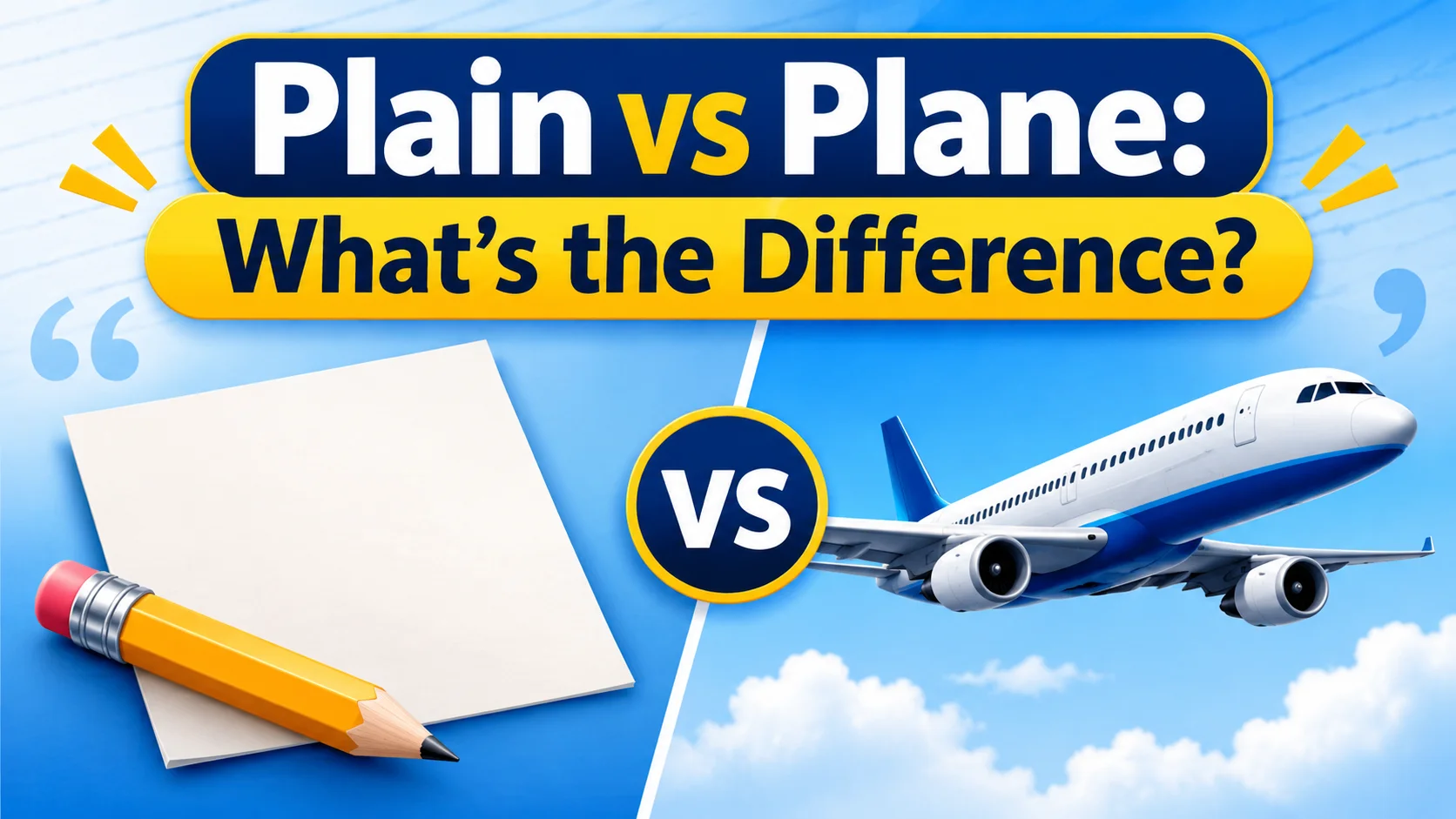
Plain vs. plane is a classic English word pair that can cause mistakes because the two words sound exactly alike in most standard varieties of English. Despite that shared pronunciation, they have different spellings, meanings, and grammatical uses. Plain can describe something simple, ordinary, obvious, or a broad area of flat land, while plane can refer to an aircraft, a flat surface, a geometric concept, or a woodworking tool. Choosing the right spelling therefore depends entirely on what you mean, not on how the word sounds.
The confusion becomes especially noticeable in everyday phrases such as plain English, plain clothes, and plain to see, where plain is correct, compared with passenger plane, plane ticket, and plane surface, where plane belongs. There are also less familiar uses: a plain can be a geographical landform, while a plane can describe a mathematical surface or an instrument used to smooth wood. Understanding these distinctions makes the spelling much easier to remember.
In this guide, you will learn exactly when to use plain and plane, how their meanings differ, how they function grammatically, and why they are pronounced alike. You will also see practical examples, common mistakes, memory tricks, comparisons with related words, and a quick decision guide. By the end, you should be able to identify the correct word from context rather than relying on pronunciation or guesswork.
Plain vs. Plane: What’s the Difference?
The simplest distinction is this:
- Plain usually means simple, ordinary, clear, or without decoration. It can also mean a broad area of relatively flat land.
- Plane usually means an aircraft, but it can also mean a flat surface, geometric surface, or woodworking tool.
The two words are homophones: they share the same pronunciation but have different spellings and meanings.
| Word | Main meaning | Common examples | Part of speech |
| plain | Simple, ordinary, or unadorned | plain clothes, plain food | Adjective |
| plain | Clear or obvious | plain to see | Adjective/adverb |
| plain | Flat area of land | a coastal plain | Noun |
| plane | Aircraft | passenger plane | Noun |
| plane | Flat surface or level | horizontal plane | Noun |
| plane | Tool for smoothing wood | wood plane | Noun |
| plane | To smooth or level a surface | plane the board | Verb |
A useful rule is:
If you mean “simple” or “clear,” think plain. If you mean “aircraft” or “flat surface,” think plane.
There are exceptions to any memory rule because both words have several meanings, but this distinction handles the majority of everyday cases.
What Does “Plain” Mean?
Plain has several meanings, and its grammatical role can change depending on the sentence. Most everyday uses fall into the ideas of simplicity, lack of decoration, obviousness, or flat land.
Plain as an Adjective
As an adjective, plain commonly describes something that is simple, ordinary, undecorated, or easy to understand.
Consider these examples:
- She wore a plain white shirt.
- We ordered plain rice.
- He gave me a plain explanation.
- The instructions were written in plain language.
- It was a plain wooden table.
In each case, plain tells us something about the noun. The shirt is not decorated, the rice has no elaborate preparation or strong added flavor, the explanation is straightforward, and the language is easy to understand.
Plain Can Mean “Without Decoration”
When plain describes clothing, furniture, food, or objects, it often means simple or lacking decorative features.
For example:
She chose a plain black dress.
This does not necessarily mean the dress is unattractive. It simply emphasizes that the design is simple rather than elaborate.
That distinction matters because plain can sometimes carry a negative judgment when it describes a person’s appearance. In phrases such as “plain-looking,” the word may suggest that someone is not especially striking or attractive. The intended meaning therefore depends heavily on context and tone.
Plain Can Mean “Clear” or “Obvious”
Another important meaning is clear, unmistakable, or obvious.
Examples include:
- The evidence was plain to see.
- It became plain that something was wrong.
- The mistake was plain for everyone to notice.
- She made her feelings plain.
The expression plain to see is particularly useful because it demonstrates that plain does not always mean “simple.” Here, it means something is clearly apparent.
Plain Can Mean “Straightforward”
Plain can also describe language or communication that is direct and easy to understand.
For example:
Please explain the policy in plain English.
Here, plain English means language that communicates information clearly, without unnecessary technical terminology, complicated wording, or obscure expressions.
This is why writing plane English is incorrect when you mean clear, accessible English.
Plain as a Noun
As a noun, plain refers to a large area of land that is relatively flat.
Examples:
- The river flows across a wide plain.
- Farmers cultivate crops on the fertile plain.
- The region contains extensive grassland plains.
- The flood covered much of the plain.
Geographical plains can vary considerably in size, vegetation, climate, and elevation. The key idea is the relatively flat or gently rolling terrain.
Common geographical expressions include:
- coastal plain
- floodplain
- grassland plain
- river plain
- alluvial plain
A floodplain, for instance, is an area of land near a river that can be affected by flooding.
Plain as an Adverb
Less commonly, plain functions as an adverb. In this use, it can mean clearly, completely, or simply.
For example:
The plan is plain wrong.
Here, plain intensifies wrong, meaning completely or obviously wrong.
Another example is:
She was plain exhausted.
The word emphasizes the extent of the condition.
This use is less likely to cause spelling confusion once you recognize the meaning. If the word means clearly, simply, or completely, plain is the correct spelling.
What Does “Plane” Mean?
Plane has a surprisingly broad range of meanings. The word most people recognize is the noun referring to an aircraft, but English also uses plane for flat surfaces, mathematical geometry, woodworking, and related verbs.
Plane as an Aircraft
The most familiar meaning of plane is an aircraft that flies.
Examples:
- Our plane leaves at six.
- I booked a seat on the morning plane.
- The plane landed safely.
- They boarded the plane at the airport.
- Her plane ticket was expensive.
In ordinary conversation, plane is commonly used as a shortened form of airplane or aeroplane.
This is the easiest meaning to associate with the spelling:
A plane flies.
If you are talking about an aircraft, the correct word is always plane, not plain.
Plane as a Flat Surface
Plane also has a technical meaning: a flat, two-dimensional surface or level.
For example:
The object moves along a horizontal plane.
This meaning appears in science, engineering, mathematics, architecture, and technical writing.
The concept is different from simply saying that something is “flat.” A plane can describe a particular level, orientation, or theoretical flat surface.
Plane in Mathematics and Geometry
In geometry, a plane is an ideal flat surface extending indefinitely in two dimensions.
You can think of it as a perfectly flat mathematical space. Unlike a physical sheet of paper, a mathematical plane has no thickness and extends without a boundary.
A basic geometric relationship might involve:
- a point located on a plane,
- a line lying within a plane,
- two or more planes intersecting,
- objects positioned relative to a plane.
You do not need advanced mathematics to understand the spelling distinction. The important point is that this technical meaning uses plane, not plain.
Plane as a Woodworking Tool
A plane is also a hand tool used to smooth, flatten, or shape wood.
For example:
The carpenter used a plane to smooth the board.
This meaning may be unfamiliar to readers who mainly associate plane with aircraft.
The tool typically has a sharp blade that removes thin layers of wood as it moves across a surface.
Plane as a Verb
Plane can also function as a verb.
To plane wood means to use a plane to smooth or level it.
Examples:
- The carpenter planed the board.
- She planed the rough edge until it was smooth.
- The craftsman carefully planed the surface.
This is completely unrelated to flying.
The context makes the intended meaning clear:
The plane landed.
Here, plane is an aircraft.
He planed the board.
Here, planed is the past tense of the woodworking verb.
Plain and Plane Are Homophones
The relationship between these words is easiest to understand through the term homophone.
A homophone is a word that has the same pronunciation as another word but a different meaning and spelling.
Examples include:
- plain / plane
- right / write
- pair / pear
- sea / see
- flour / flower
Because plain and plane sound alike, listening alone may not tell you which spelling belongs in a sentence.
Suppose someone says:
“I need to catch a plane.”
You hear the sound, but the context tells you that the speaker means an aircraft.
Likewise:
“The instructions are plain.”
The surrounding meaning tells you that the word means clear or straightforward.
This is why homophones are primarily a spelling and context problem, not a pronunciation problem.
Expert tip: When two words sound identical, do not try to hear the spelling. Identify the meaning first, then choose the spelling associated with that meaning.
How to Pronounce Plain and Plane
In standard English, plain and plane are pronounced the same.
They contain the same core vowel sound and end with the same consonant sound. Their different spellings do not normally create a difference in pronunciation.
For learners of English, this is an important point: you cannot reliably distinguish these words by sound alone.
The difference appears in writing:
- plain → simple, clear, ordinary, flat land
- plane → aircraft, flat surface, geometry, woodworking
Regional accents can produce small differences in how the vowel sounds are realized, but speakers generally do not use pronunciation to distinguish these two words.
When Should You Use “Plain”?
- Use plain when the intended meaning relates to simplicity, clarity, lack of decoration, or a geographical area of flat land.
1. Use “plain” for something simple or undecorated
- plain clothing
- plain walls
- plain food
- a plain design
- plain furniture
2. Use “plain” when something is obvious
- plain to see
- plain truth
- plain fact
- plain evidence
3. Use “plain” for straightforward language
- plain English
- plain language
- a plain explanation
4. Use “plain” for flat land
- a broad plain
- a coastal plain
- fertile plains
- an open plain
A quick test is to replace plain with simple, clear, or flat land. If one of those meanings works, plain is probably correct.
When Should You Use “Plane”?
- Use plane when you mean an aircraft, a flat mathematical or physical surface, or a woodworking tool/action.
1. Use “plane” for an aircraft
- plane ticket
- passenger plane
- private plane
- commercial plane
- catch a plane
- board a plane
2. Use “plane” for a flat surface or level
- horizontal plane
- vertical plane
- cutting plane
- plane surface
3. Use “plane” in geometry
- geometric plane
- coordinate plane
- plane of symmetry
4. Use “plane” for woodworking
- hand plane
- wood plane
- plane a board
- plane the surface
If you could replace the word with aircraft, plane is clearly the answer. If you are discussing a mathematical surface or woodworking tool, plane is also correct.
Plain vs. Plane: Examples in Real Sentences
Seeing the words in different contexts is one of the fastest ways to make the distinction automatic.
Examples With Plain
- She prefers plain clothes for everyday wear.
- The teacher gave us a plain explanation of the rule.
- The difference was plain to see.
- He ordered plain rice with his meal.
- The room had plain white walls.
- Please use plain English in the report.
- The farmers settled on the fertile plain.
- The mistake was plain enough to everyone.
- Her instructions were plain and direct.
- A broad plain stretched toward the mountains.
Notice how the meanings change while the spelling remains the same.
Examples With Plane
- Our plane landed ahead of schedule.
- I left my passport on the plane.
- They were waiting to board the plane.
- The engineer examined the object in a horizontal plane.
- A line can lie entirely within a geometric plane.
- The carpenter used a plane to smooth the wood.
- He carefully planed the rough board.
- The aircraft disappeared above the cloud layer.
- The diagram shows a vertical plane.
- She bought a new woodworking plane.
The key is not the spelling pattern by itself. It is the meaning and grammatical context.
Plain vs. Plane: Common Mistakes to Avoid
Homophones cause predictable spelling errors, especially when writing quickly.
Mistake 1: “Plane English”
Incorrect:
Please explain it in plane English.
Correct:
Please explain it in plain English.
Why? Plain English means clear, straightforward language.
Mistake 2: “I Missed My Plain”
Incorrect:
I missed my plain.
Correct:
I missed my plane.
Here, the writer means an aircraft.
Mistake 3: “Plain Ticket”
Incorrect:
I bought a plain ticket to London.
Correct:
I bought a plane ticket to London.
A plane ticket is a ticket for an aircraft. A plain ticket would technically suggest a ticket that is simple or undecorated, which is not the intended meaning.
Mistake 4: “Plane to See”
Incorrect:
The problem was plane to see.
Correct:
The problem was plain to see.
The intended meaning is that the problem was obvious.
Mistake 5: “Geometric Plain”
Incorrect:
The line lies on a geometric plain.
Correct:
The line lies on a geometric plane.
Geometry uses plane for a flat mathematical surface.
A Simple Decision Guide: Plain or Plane?
When you are unsure, follow this sequence.
| What do you mean? | Correct word | Example |
| Simple or undecorated | plain | plain shirt |
| Clear or obvious | plain | plain to see |
| Straightforward language | plain | plain English |
| Flat area of land | plain | coastal plain |
| Aircraft | plane | passenger plane |
| Flat mathematical surface | plane | coordinate plane |
| Level or orientation | plane | horizontal plane |
| Woodworking tool | plane | hand plane |
| Smooth wood with a tool | plane | plane the board |
The 10-Second Test
Ask yourself:
1. Am I talking about an aircraft?
→ Plane
2. Am I talking about simplicity or clarity?
→ Plain
3. Am I talking about flat land?
→ Plain
4. Am I talking about geometry or a flat technical surface?
→ Plane
5. Am I talking about woodworking?
→ Plane
This approach is more reliable than trying to remember isolated spellings.
Plain vs. Simple: Are They Always the Same?
Not quite.
Plain and simple overlap when describing something uncomplicated, but they are not interchangeable in every sentence.
Compare:
She wore a plain dress.
This emphasizes that the dress has little decoration.
She wore a simple dress.
This can mean the dress has an uncomplicated design, but it may also suggest elegance, practicality, or lack of complexity.
Similarly:
Use plain English.
This is a well-established expression for clear, accessible communication.
Replacing it with “simple English” may change the emphasis. Simple English can suggest language with reduced complexity or vocabulary, while plain English focuses more broadly on clear communication for the intended reader.
The best word therefore depends on what you are trying to emphasize.
Plain vs. Obvious: Understanding “Plain to See”
One subtle meaning of plain appears in expressions such as plain to see.
In this context, plain means clearly visible or obvious.
Compare:
The answer was obvious.
and:
The answer was plain to see.
Both communicate a similar idea, but the constructions are different.
You can also see this meaning in expressions such as:
- plain truth
- plain fact
- make something plain
- plainly evident
- plainly wrong
This is useful because a learner who only remembers plain = simple may incorrectly think that the word cannot mean obvious.
Plain vs. Plane vs. Airplane vs. Aeroplane
When plane means an aircraft, you may also encounter airplane and aeroplane.
| Term | Meaning | Typical usage |
| plane | Aircraft | Common everyday term |
| airplane | Aircraft | Especially common in American English |
| aeroplane | Aircraft | Common in British English and some other varieties |
All three refer to an aircraft, although regional preferences differ.
The important spelling point remains unchanged:
Aircraft = plane, not plain.
Plain vs. Plane: Commonly Confused Phrases
Some expressions are particularly useful for memorizing the distinction.
Phrases With Plain
- plain English
- plain language
- plain clothes
- plain food
- plain text
- plain truth
- plain fact
- plain to see
- plain and simple
- open plain
- coastal plain
- floodplain
Phrases With Plane
- plane ticket
- passenger plane
- private plane
- commercial plane
- plane crash
- board a plane
- catch a plane
- coordinate plane
- horizontal plane
- vertical plane
- plane surface
- wood plane
Learning these phrases as complete expressions can be more effective than memorizing the individual words in isolation.
Common Misconceptions About Plain and Plane
“They sound the same, so either spelling is acceptable.”
No. Homophones are not interchangeable spellings.
English spelling depends on meaning and grammatical function. Writing plane English instead of plain English creates a genuine spelling error even though the reader can probably infer your meaning.
“Plane only means an aircraft.”
Not necessarily.
Although aircraft is the most familiar everyday meaning, plane also appears in geometry, mathematics, engineering, woodworking, and technical descriptions of surfaces.
“Plain only means simple.”
Again, no.
Plain can mean obvious, undecorated, straightforward, or a flat area of land. It can also function as an adverb in expressions where it means clearly or completely.
“Plain and simple always mean exactly the same thing.”
They overlap, but their connotations and typical collocations differ. Plain English, for example, is a specific and widely established expression for clear communication.
Memory Tricks for Plain vs. Plane
A good memory device should connect spelling with meaning.
Plain = Plain and Simple
The phrase plain and simple gives you a direct association:
plain → simple
If you mean uncomplicated, straightforward, or undecorated, think plain.
Plane = A Plane Flies
Associate plane with an aircraft:
plane → flies
The spelling with -ane is the one you want for an aircraft.
Plane = Flat Plane
You can extend the same association to geometry:
plane → flat surface
A geometric plane is flat, and a woodworking plane works on a flat surface.
Use Meaning, Not Sound
The strongest long-term strategy is not memorizing dozens of examples. Instead, train yourself to ask:
What does this word mean here?
If the answer is “simple,” “clear,” or “flat land,” choose plain.
If the answer is “aircraft,” “geometric surface,” or “woodworking tool,” choose plane.
Quick Reference: Plain vs. Plane
| Question | Plain | Plane |
| Can it describe something simple? | ✓ | — |
| Can it mean obvious? | ✓ | — |
| Can it refer to flat land? | ✓ | — |
| Can it mean an aircraft? | — | ✓ |
| Can it refer to geometry? | — | ✓ |
| Can it mean a woodworking tool? | — | ✓ |
| Can it be a verb? | Rare/limited | ✓ |
| Is it a homophone of the other word? | ✓ | ✓ |
| Does pronunciation normally distinguish them? | No | No |
Conclusion
Plain and plane sound alike, but their meanings are distinctly different. Use plain for something simple, clear, ordinary, undecorated, or a broad area of flat land. Use plane for an aircraft, flat mathematical surface, level, or woodworking tool. The most dependable way to choose between them is to identify the meaning before thinking about the spelling. One final actionable tip: when proofreading, mentally replace the word with its intended meaning—“simple,” “flat land,” “aircraft,” or “flat surface.” A common mistake to avoid is choosing a spelling because it sounds right; homophones cannot be solved by pronunciation alone. Once you connect each spelling to its core meanings, the distinction becomes easy to apply.
Frequently Asked Questions
Q1. Are “plain” and “plane” pronounced exactly the same?
Yes. Plain and plane are normally pronounced alike in standard English and are therefore homophones. Regional accents may produce small phonetic differences, but speakers generally do not use pronunciation to distinguish the two words. Context and spelling determine which word is intended.
Q2. Is it “plain English” or “plane English”?
The correct expression is plain English. It refers to language that is clear, direct, and easy for the intended audience to understand. Plane English is incorrect when you mean straightforward communication. Remember the association: plain = clear and simple.
Q3. Is a flat area of land called a plain or a plane?
It is called a plain. In geography, a plain is a broad area of relatively level or gently rolling land. A plane, by contrast, can describe a theoretical flat surface in mathematics or geometry. The two concepts may sound similar but belong to different vocabulary categories.
Q4. Can “plane” be used as a verb?
Yes. As a verb, plane means to smooth, flatten, or shape a surface, particularly wood, using a plane. For example, “The carpenter planed the board.” The past tense is planed, which is unrelated to the aircraft meaning despite having the same spelling.
Q5. What is the easiest way to remember plain vs. plane?
Connect plain with “plain and simple” and plane with an aircraft that flies. Then remember that plane also describes a flat mathematical surface. If the sentence concerns simplicity, clarity, or flat land, choose plain; if it concerns aircraft, geometry, or woodworking, choose plane.