

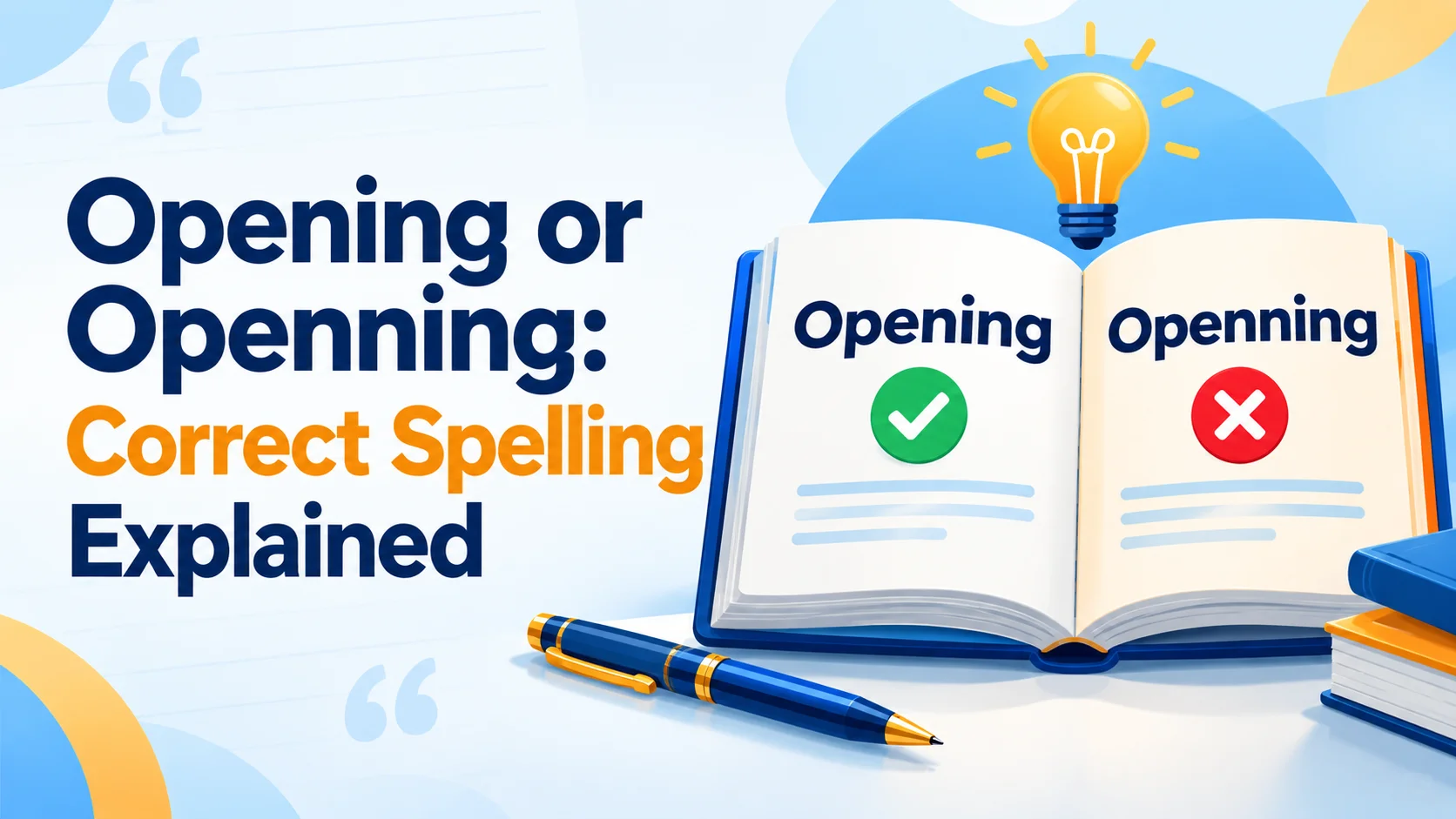
Opening or openning? The correct spelling is opening, with only one n. The form openning is a common spelling mistake, usually caused by applying the consonant-doubling rule too broadly. The correct word comes from the verb open, and its -ing form is simply open + ing = opening. This matters because “opening” is used in many everyday contexts, from opening a door to describing a job opening, opening ceremony, or the beginning of a speech. Once you understand how the spelling rule works, the difference becomes much easier to remember.
The confusion is understandable. English really does double final consonants in words such as run → running, sit → sitting, and stop → stopping. So it is tempting to assume that open should behave in exactly the same way. It does not. The key is where the stress falls in the word. Cambridge’s grammar guidance specifically lists open among verbs whose final consonant is not doubled before -ing because the final syllable is not stressed.
This guide explains more than simply choosing the right spelling. You will learn what opening means, why openning is incorrect, how the -ing spelling rule works, how opening functions as a noun, verb form, and adjective, and how to use it naturally in everyday and professional writing. You will also see practical comparisons, related forms of open, common mistakes, and examples that make the pattern easier to apply to other English words.
Opening vs. Openning: Which Spelling Is Correct?
The answer is straightforward:
Correct: opening
Incorrect: openning
Opening is the standard English spelling in both British and American English. There is no legitimate regional spelling in which openning becomes correct. Major English dictionaries list opening, while grammar references use open → opening as the standard formation.
| Form | Correct? | Explanation | Example |
| opening | ✅ Yes | Standard spelling | The store is opening tomorrow. |
| openning | ❌ No | Extra n is unnecessary | Avoid The store is openning tomorrow. |
| opened | ✅ Yes | Past tense/past participle | The store opened yesterday. |
| opens | ✅ Yes | Third-person singular present | The store opens at nine. |
| open | ✅ Yes | Base form | Please open the door. |
The quickest rule
If you are forming the -ing word from open, keep the spelling simple:
open + ing → opening
Do not insert another n.
What Does “Opening” Mean?
Opening has several meanings, and its grammatical role changes according to context. That is one reason the word appears so frequently in everyday English.
Opening as a noun
As a noun, opening can refer to the beginning of something, a physical gap, a ceremony, an available position, or an opportunity.
For example:
- The opening of the film was dramatic.
- We found an opening in the fence.
- The company has a job opening.
- The official opening is scheduled for Friday.
Cambridge identifies several noun meanings, including a beginning, a hole or space, a ceremony, and an available job or opportunity.
Opening as a verb form
Opening is also the present participle and -ing form of open.
Examples:
- She is opening the package.
- They are opening a new branch.
- I am opening the document now.
In a present continuous construction, the -ing form follows am, is, or are:
She is opening the window.
The important point is that opening here describes an action in progress.
Opening as an adjective
The same spelling can describe something that occurs at the beginning of an event or activity:
- opening remarks
- opening ceremony
- opening scene
- opening paragraph
- opening night
For instance:
The speaker delivered the opening remarks.
Here, opening is not describing someone physically opening something. It means coming at the beginning. Cambridge lists this adjective use for things that happen at the beginning of an event or activity.
Why Is “Opening” Correct and “Openning” Wrong?
The easiest way to understand the spelling is to start with the base verb:
OPEN
Then add the normal -ing ending:
OPEN + ING = OPENING
Nothing else needs to happen.
The confusion begins when writers remember that some verbs double their final consonant before adding -ing. That rule is real, but it is not universal.
Why the final “n” is not doubled
In words with more than one syllable, English commonly doubles the final consonant before a suffix such as -ing when the final syllable is stressed.
Compare:
- begin → beginning
- prefer → preferring
- admit → admitting
- occur → occurring
But:
- open → opening
- happen → happening
- visit → visiting
- enter → entering
The difference is not arbitrary. Open has two syllables, but the stress falls on the first syllable, not the final one. Therefore, its final n is not doubled before -ing. Cambridge explicitly gives open → opening as an example of a verb whose final consonant is not doubled because the final syllable is unstressed.
Why “running” does not justify “openning”
Consider:
run → running
This is a one-syllable verb ending in a vowel plus a single consonant. Doubling occurs before -ing.
Now compare:
open → opening
Although open ends with n, it is a two-syllable word with stress on the first syllable. The same doubling pattern does not apply.
So the useful lesson is not:
“Never double a final consonant.”
Instead, remember:
Double the final consonant only when the spelling and stress pattern call for it.
When Does English Double the Final Consonant Before -ing?
This is the broader spelling principle behind the confusion.
For many verbs, a final consonant is doubled when the base ends in a vowel + single consonant and the relevant final syllable is stressed.
| Base verb | -ing form | What happens? |
| run | running | n doubles |
| sit | sitting | t doubles |
| stop | stopping | p doubles |
| begin | beginning | n doubles |
| prefer | preferring | r doubles |
| open | opening | No doubling |
| happen | happening | No doubling |
| visit | visiting | No doubling |
| enter | entering | No doubling |
The important distinction is stress, not merely the presence of a final consonant. Cambridge’s spelling guidance notes that the consonant is generally doubled in multisyllabic words when the last syllable is stressed, while forms such as open do not double it when that syllable is unstressed.
Practical tip: If you are unsure about an unfamiliar verb, do not invent a doubled consonant just because another -ing word has one. Check the base word and its spelling pattern first.
A useful three-way comparison
begin → beginning
The final syllable is stressed, so the n doubles.
open → opening
The final syllable is not stressed, so the n stays single.
run → running
It is a one-syllable verb with the relevant short-vowel/consonant pattern, so the n doubles.
That contrast explains the spelling much better than memorizing the opening in isolation.
Is “Openning” Ever Correct?
No. Openning is not the standard spelling of the English word.
It is best treated as a typo or spelling error, not as a second acceptable form.
Why “openning” looks plausible
The mistake usually comes from a reasonable but incomplete assumption:
“If a verb ends in a consonant and I add -ing, I should double that consonant.”
English spelling does not work that mechanically.
A learner who knows:
- run → running
- stop → stopping
- begin → beginning
may naturally produce openning. The problem is that those examples involve spelling patterns that open does not share.
Why online examples can be misleading
A misspelling can appear repeatedly on websites, social media posts, comments, or user-generated content. Frequency on the internet does not automatically make a spelling standard.
For formal writing, academic work, applications, business communication, and published content, use opening.
Opening in British and American English
There is no British-versus-American spelling dispute here.
| Variety | Correct spelling | Incorrect spelling |
| British English | opening | openning |
| American English | opening | openning |
| International English | opening | openning |
British and American English do have genuine spelling differences in words such as colour/color, centre/center, and travelling/traveling. But opening is not one of those cases. Cambridge’s grammar guidance distinguishes real British-American differences, while its verb spelling guidance gives open → opening as the standard formation.
So changing your English variety will not change the answer.
How to Use “Opening” Correctly in a Sentence
Understanding the spelling is only half the job. The word also appears in several grammatical roles.
Opening as a verb
Use opening to describe an action that is happening or developing.
Examples:
- Ali is opening the door.
- The manager is opening the meeting.
- They are opening a new restaurant.
- She was opening the box when the phone rang.
The structure is often:
subject + be + opening + object
For example:
The staff are opening the store.
The present continuous uses a form of be followed by the -ing form.
Opening as a noun
Here, opening names a thing, position, space, beginning, or opportunity.
Examples:
- There is an opening in the wall.
- The company advertised a job opening.
- The opening of the book is memorable.
- We are waiting for the official opening.
Opening as an adjective
In phrases such as opening statement or opening ceremony, opening modifies another noun.
Examples:
- The lawyer gave an opening statement.
- The principal delivered the opening speech.
- We watched the opening ceremony.
- The team scored during the opening minutes.
A subtle point: “opening” does not always mean physically opening something
This is an easy distinction to miss.
Compare:
She is opening the door.
Here, the opening describes an action.
She gave the opening speech.
Here, opening means first or at the beginning.
There is an opening for a designer.
Here, opening means available position or opportunity.
The spelling never changes; the context determines the meaning.
Common Phrases and Expressions with “Opening”
Because opening has several meanings, it appears in many fixed or familiar combinations.
Opening ceremony
An opening ceremony is an event marking the formal beginning of something.
The school held an opening ceremony for its new science building.
Opening statement
An opening statement introduces a presentation, discussion, debate, or legal case.
The speaker began with a brief opening statement.
Job opening
A job opening is an available position.
The company has a job opening for a junior editor.
This is one of the most important meanings for professional and employment-related writing. Cambridge specifically defines opening as an available job or opportunity.
Grand opening
A grand opening is a formal or celebratory launch of a new business, store, facility, or similar venture.
The café announced its grand opening for Saturday.
Opening hours
Opening hours refers to the period when a business or service is available to customers.
Please check the library’s opening hours before you visit.
Opening remarks
Opening remarks are introductory comments made at the beginning of a meeting, event, speech, or presentation.
The chairperson gave a few opening remarks before the discussion began.
Opening up
Opening up is a phrasal verb with several meanings. Depending on context, it can mean physically opening something, making something more available, or becoming more willing to talk about personal thoughts and feelings.
For example:
The new policy is opening up opportunities for small businesses.
That meaning is different from simply saying:
She is opening the door.
Common Spelling Mistakes Involving “Opening”
Mistake 1: Writing “Openning”
This is the central error.
❌ The shop is openning at 9 a.m.
✅ The shop is opening at 9 a.m.
The extra n has no grammatical or spelling purpose.
Mistake 2: Assuming every final consonant doubles
This is perhaps the most useful lesson beyond this individual word.
Not every verb follows the pattern:
consonant → doubled consonant + -ing
Compare:
- stop → stopping
- run → running
- open → opening
- happen → happening
Learning the rules behind the examples is more reliable than memorizing isolated words.
Mistake 3: Confusing “opening” with “beginning”
Both can refer to the start of something, but their spellings are different.
- opening → open + ing
- beginning → begin + ning
The second word doubles the final n because begin has stress on its final syllable. Cambridge specifically contrasts verbs such as begin and open in its spelling guidance.
Mistake 4: Assuming pronunciation determines spelling
English spelling and pronunciation do not always correspond one-to-one. A word can sound a certain way without giving you enough information to reconstruct its spelling.
That is why it is better to understand the morphological relationship:
open → opening
rather than trying to spell the word only from its sound.
Opening vs. Other Related Forms of “Open”
Knowing the complete word family can prevent mistakes.
| Word | Form | Example |
| open | Base verb | Please open the file. |
| opens | Third-person singular | The bank opens at 9. |
| opened | Past/past participle | They opened the store yesterday. |
| opening | -ing form | They are opening the store now. |
| openly | Adverb | She spoke openly about the issue. |
| openness | Noun | His openness made the discussion easier. |
Cambridge identifies opened as the past form of open and distinguishes the adjective open from the verb open.
A particularly useful comparison: opened vs. opening
These two are easy to confuse because both describe forms of the same verb.
Opened normally refers to a completed past action or functions as a past participle:
She opened the door.
Opening refers to an action in progress or can function as a noun/adjective:
She is opening the door.
The difference is grammatical, not simply spelling-related.
A Practical Decision Table for “Opening”
When you encounter a sentence, use the table below to identify the correct form.
| If you mean… | Use | Example |
| The basic action | open | Please open the door. |
| A repeated action by he/she/it | opens | The shop opens at 8. |
| A completed past action | opened | The shop opened yesterday. |
| An action happening now | opening | The shop is opening now. |
| The beginning of something | opening | The opening was impressive. |
| An available position | opening | There is a job opening. |
| A beginning-related description | opening | Her opening remarks were clear. |
This approach is more useful than memorizing a single spelling because it helps you select the right grammatical form and meaning at the same time.
Examples of “Opening” in Different Types of Writing
Everyday communication
I am opening the window because the room is warm.
The store is opening later today.
School and academic writing
The opening paragraph introduces the main argument.
The author creates tension in the opening chapter.
Here, opening helps describe the beginning of a written work.
Workplace communication
We have an opening for a customer support assistant.
Please prepare the opening remarks for tomorrow’s meeting.
Business writing
The new branch is opening next month.
The official opening will take place on Monday.
Digital communication
The app is opening slowly on my laptop.
I can’t find the file-opening option in the menu.
The context changes, but the spelling remains opening.
Why Correct Spelling Matters
A single extra letter may seem insignificant, especially in casual messaging, but accurate spelling becomes more important when your writing represents you professionally.
A misspelling such as openning can:
- Make schoolwork look less polished.
- Reduce confidence in professional communication.
- Create unnecessary editing work.
- Look careless in applications or formal documents.
- Reinforce incorrect spelling habits.
This does not mean every typo is serious. People make mistakes. The practical goal is to recognize recurring errors and correct the pattern behind them.
In this case, learning the consonant-doubling rule is more valuable than simply memorizing that opening has one n.
Expert Tip: Learn the Rule, Not Just the Word
If you remember only one thing from this article, make it this:
Open + ing = opening.
But if you want a spelling skill that transfers to other words, learn the reason behind it. English often doubles a final consonant when the relevant stress and spelling pattern require it, but open does not meet that condition. Cambridge’s grammar references specifically classify open → opening with verbs such as happen where the consonant is not doubled.
That distinction will help you avoid similar errors with other verbs.
Quick Checklist: Is Your Spelling Correct?
Before submitting an assignment, email, article, or application, run through this short check:
- Did I write opening, not openning?
- Am I using the correct grammatical form?
- Does the sentence mean an action, beginning, opportunity, or description?
- If I used opened, am I talking about a completed action?
- If I used the opening, does the surrounding grammar support the -ing form?
- Am I accidentally applying a doubling rule from another word?
For a simple spelling check, the first question is usually enough. For polished writing, the remaining questions help catch grammar and usage errors, too.
Conclusion
Opening is the correct spelling, while opening is a misspelling. The important lesson is not simply to memorize one word; it is to understand why English sometimes doubles a final consonant and sometimes does not. Because open has an unstressed final syllable, its -ing form remains opening, not openning. The word itself is versatile: it can describe an action, a beginning, an opportunity, a physical gap, or something associated with the start of an event. One final actionable tip: when you hesitate, return to the base verb and build the form carefully: open + ing = opening. A common mistake to avoid is copying the spelling pattern of running or beginning without checking whether the same rule actually applies. Good spelling becomes much easier when you learn the pattern behind it.
Frequently Asked Questions
Q1. Is “openning” ever an acceptable spelling?
No. Openning is not a standard British or American English spelling. The correct form is opening. The extra n comes from incorrectly applying consonant-doubling rules. Standard grammar references give open → opening, not open → openning.
Q2. Why is “beginning” spelled with two n’s but “opening” with one?
The words follow different stress patterns. Beginning has stress on its final syllable, so the final consonant is doubled before -ing. Open has stress on its first syllable, so its final n remains single: opening.
Q3. Is “opening” the same in British and American English?
Yes. Both major varieties use opening. Unlike genuine differences such as colour/color or travelling/traveling, this word does not have a British-American spelling variation. You can safely use opening in either variety.
Q4. Can “opening” be a noun and a verb?
Yes. As a verb form, opening describes an action, as in “They are opening the store.” As a noun, it can mean a beginning, gap, ceremony, job, or opportunity. It can also function as an adjective in phrases such as opening remarks.
Q5. What is the easiest way to remember “opening”?
Use the word’s base form: open + ing = opening. Then remember that the final n is not doubled because open has an unstressed final syllable. If you compare it with begin → beginning, the reason for the difference becomes easier to remember.