

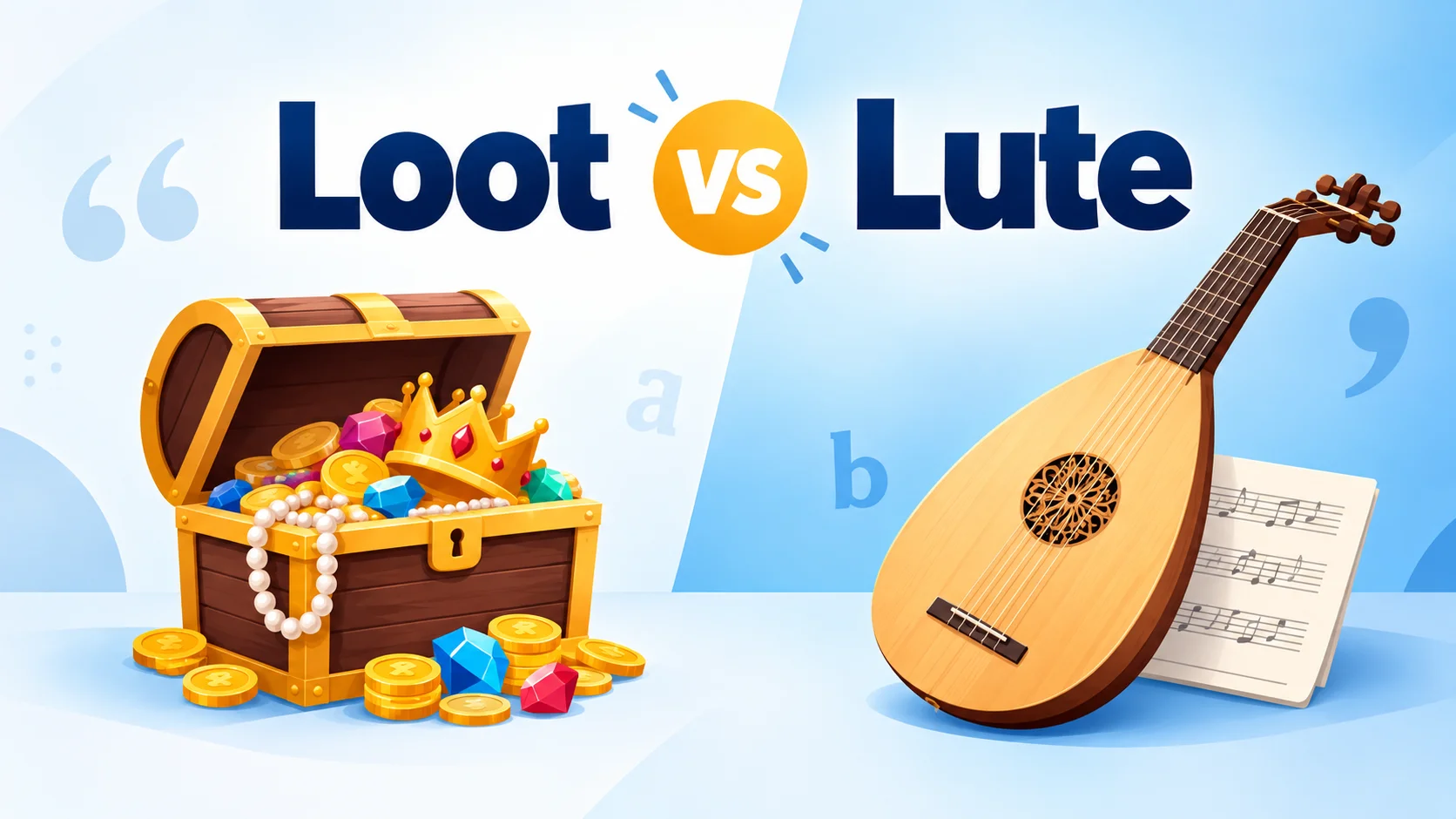
Loot vs lute is a common spelling confusion because both words sound exactly alike in standard English, yet they describe completely different things. Loot refers to stolen goods, plunder, or valuable items collected as rewards in video games. Lute, on the other hand, is a traditional stringed musical instrument associated with historical music and modern early-music performances. Choosing the right word depends on what you want to communicate, not how the word sounds. Understanding this distinction helps you avoid confusing sentences, improve your spelling accuracy, and recognize each word when reading, writing, or listening to English.
The confusion becomes easier to understand when you consider how people encounter these words. Gamers regularly talk about collecting loot, while musicians and history enthusiasts may discuss playing a lute. Someone who has heard either word but has rarely seen it written might choose the wrong spelling. Both are legitimate English words, so a spell-checker may not identify the mistake. The surrounding sentence becomes the most reliable clue. In this guide, you will learn their meanings, grammatical uses, pronunciation, origins, and differences, with practical examples that show how to choose the correct word in everyday, professional, historical, and gaming contexts.
Although loot and lute share the same pronunciation, they have separate histories and serve different purposes in English. One describes valuables or the act of taking them, while the other names an instrument used to make music. These distinctions matter in everything from school assignments and news reports to gaming discussions and historical writing. You will also discover how their meanings change with context, which related words are useful substitutes, and why certain substitutions sound unnatural. By the end, you should be able to identify the correct spelling quickly and explain the difference without relying on guesswork.
Loot vs Lute: The Quick Answer
The simplest way to distinguish these words is to connect each one with its central meaning:
- Loot means stolen goods, plunder, or items collected as rewards, especially in video games. It can also be a verb meaning to steal goods or plunder a place.
- Lute is a plucked stringed musical instrument with a rounded body and a fretted neck.
Consider these sentences:
- The adventurers divided the loot after defeating the enemy.
- The musician played a lute during the historical performance.
Both sentences are grammatically correct, but replacing one word with the other changes the meaning. In the first, the characters divide valuable items. In the second, a musician performs on an instrument.
Loot vs Lute comparison table
| Feature | Loot | Lute |
| Main meaning | Stolen goods, plunder, or collected rewards | A traditional stringed musical instrument |
| Part of speech | Noun and verb | Primarily a noun |
| Pronunciation | /luːt/ | /luːt/ |
| Common contexts | Theft, war, gaming, informal conversation | Music, history, performance |
| Example | The players found rare loot. | She tuned her lute. |
| Related terms | Plunder, spoils, valuables | Oud, theorbo, archlute |
| Memory clue | Loot is something you collect | Lute is something you play |
Remember: Both spellings are correct English words. Neither is an alternative spelling of the other.
What Does Loot Mean?
The word loot has two main grammatical uses. It can refer to goods that have been stolen or taken by force, and it can describe the act of stealing or plundering those goods. Its meaning also extends into informal speech and video games, where it often refers to valuable items collected during an activity.
Understanding the difference between the noun and verb is useful because the same word can describe either the objects involved or the action performed.
Loot as a noun
As a noun, loot refers to valuables taken unlawfully, particularly during a robbery, riot, war, or similar situation. It may include money, jewelry, equipment, artwork, or other possessions.
Examples:
- Police recovered the loot from an abandoned vehicle.
- The thieves escaped with a bag of jewelry and other loot.
- The invading army carried away valuable loot from the captured city.
- The museum strengthened its security to protect its collection from theft and looting.
The word often carries a negative association because it suggests that possessions have been taken without permission. However, the precise implication depends on the context.
For example, loot in a crime report usually refers to stolen property. In a fantasy novel, it might refer to treasure recovered after a battle. In a video game, it commonly means rewards obtained through gameplay.
Loot as a verb
As a verb, loot means to steal goods or plunder a place. It often describes widespread theft during disorder, conflict, or a breakdown of normal public order.
Examples:
- The attackers attempted to loot several shops.
- Investigators believe the group planned to loot the warehouse.
- Security officers prevented the crowd from looting the store.
- The abandoned building was looted before authorities arrived.
Notice how the grammatical form changes:
| Form | Example | Function |
| Loot | They found the loot. | Noun |
| Loot | The gang tried to loot the shop. | Verb |
| Looted | The building was looted. | Past tense or past participle |
| Looting | Officials investigated the looting. | Gerund or present participle |
Practical tip: If you can replace the word with steal or plunder and the sentence still makes sense, you probably need the verb loot. If it names the stolen goods themselves, the noun is more likely.
What does loot mean in video games?
In gaming, loot usually refers to items a player obtains while playing. These may include weapons, armor, coins, crafting materials, consumables, equipment upgrades, or rare collectibles.
For example:
- The boss dropped legendary loot.
- We explored the dungeon to find better loot.
- Players can earn additional loot by completing difficult missions.
- She collected enough materials from the loot to upgrade her equipment.
This usage is different from the traditional meaning associated with theft. A player can earn loot by completing a quest or defeating an opponent; the items are not necessarily stolen in the real-world sense.
Several related gaming terms are worth knowing:
- Loot drop: An item or group of items awarded or released by an enemy, event, or activity.
- Loot pool: The collection of items that may be available from a particular source.
- Loot farming: Repeatedly completing activities to obtain desirable items.
- Loot box: A virtual container that provides randomized in-game items, sometimes through paid or earned systems.
The exact mechanics depend on the game. For instance, some games allow players to collect items from defeated enemies, while others reward equipment for completing quests or opening chests.
Loot in informal English
In casual conversation, loot can also mean purchases, prizes, money, or desirable possessions without necessarily suggesting criminal activity.
Examples:
- She showed her friends the loot she bought at the market.
- The team celebrated its victory and admired its loot.
- He returned from the convention with a bag full of gaming loot.
This informal sense is common in some social and hobby-related settings. Nevertheless, it may sound inappropriate in formal reports, legal writing, or serious news coverage. When precision matters, use a more specific word such as purchases, prizes, rewards, or valuables.
What Does Lute Mean?
A lute is a traditional plucked stringed instrument with a rounded body, a neck, and strings that run along the instrument. It is particularly associated with medieval and Renaissance European music, although its history connects to a broader family of instruments found across different musical traditions.
Unlike loot, which can describe an action or a collection of goods, lute primarily names a physical musical instrument.
What does a lute look like?
A traditional European lute generally has:
- A rounded or pear-shaped body that helps produce its resonant sound.
- A fretted neck along which the player places their fingers to change notes.
- Strings stretched across the body and neck.
- A distinctive headstock, often angled backward on historical instruments.
<PRIVATE_PERSON>For someone unfamiliar with early music, a lute may look somewhat like a small, rounded guitar. However, it is a distinct instrument with its own construction, playing techniques, repertoire, and historical development.</PRIVATE_PERSON>
A useful example is:
The museum displayed a beautifully decorated lute beside several other historical instruments.
Here, lute identifies the instrument itself, not something stolen or collected as a reward.
How is a lute played?
A lute is generally played by plucking its strings with the fingers. Depending on the instrument, musical tradition, and historical period, players may use different techniques and string arrangements.
The instrument can be used for solo melodies, musical accompaniment, dances, and small ensemble performances. Its sound is often described as warm and resonant, making it suitable for intimate performances.
Examples:
- The musician carefully tuned the lute before the concert.
- She played a delicate melody on a Renaissance lute.
- The ensemble combined the lute with other early instruments.
If a sentence refers to strings, tuning, frets, melodies, or a musician playing an instrument, lute is likely the correct choice.
The lute in history and modern music
The lute became particularly prominent in European musical life during the Renaissance. It was used in courtly settings, private music-making, and instrumental performances. Musicians played solo pieces and accompanied singers, and composers developed substantial repertoires for the instrument.
Its historical significance does not mean it has disappeared from modern music. Today, lutes are played by early-music specialists, performers interested in historical techniques, and musicians exploring older repertoires.
The lute also appears in historical dramas, fantasy stories, and video games. A fictional bard carrying a lute, for example, draws on the instrument’s association with traditional storytelling and historical performance.
However, not every stringed instrument shown in a medieval-inspired scene is technically a lute. A guitar, oud, mandolin, and lute have different characteristics, even when they look similar to an unfamiliar viewer.
Why Are Loot and Lute So Easy to Confuse?
The main reason is straightforward: loot and lute are homophones. They sound alike but have different spellings and meanings.
When people learn a word through conversation rather than reading, they may know exactly what it means without knowing which letters represent it. The problem becomes more noticeable when both possible spellings are legitimate words.
Loot and lute are homophones
A homophone is a word that has the same pronunciation as another word but a different meaning and often a different spelling.
Common examples include:
- Pair and pear
- Right and write
- Flour and flower
- Loot and lute
Because the two words sound the same, pronunciation alone cannot tell you which spelling to use. You must consider the intended meaning.
For example:
- The players collected the loot after the battle.
- The players collected the lute after the battle.
Both sentences are grammatically possible. The first describes collecting rewards or valuables; the second suggests that the players gathered a musical instrument. The surrounding situation determines whether either sentence makes sense.
Why do OO and U sound the same?
English spelling does not follow a perfectly consistent relationship between letters and sounds. In loot, the letters oo represent the long vowel sound /uː/. In lute, the letter u, together with the final silent e, represents the same vowel sound.
The spellings differ, but the pronunciation does not.
This is why trying to choose between the words by sound alone is ineffective. Instead, associate each spelling with its meaning:
- Loot: stolen goods, plunder, or game rewards.
- Lute: a musical instrument.
A reader who remembers the meaning has a more reliable strategy than someone who tries to infer the spelling from the sound.
Loot vs Lute Pronunciation
Both words are generally pronounced /luːt/ in standard English. They begin with the /l/ sound, contain the long /uː/ vowel, and end with /t/.
The difference is written rather than spoken.
| Pronunciation feature | Loot | Lute |
| IPA | /luːt/ | /luːt/ |
| First sound | /l/ | /l/ |
| Main vowel | /uː/ | /uː/ |
| Final sound | /t/ | /t/ |
| Standard pronunciation distinction | None | None |
British and American accents may differ in their overall vowel quality, but these words are normally homophones in both varieties.
For English learners, the important lesson is that correct pronunciation does not guarantee correct spelling. If you hear either word in a conversation, use the context to identify the meaning before writing it down.
Loot vs Lute: Origins and Word History
Although these words sound alike, their histories are different. Understanding their origins explains why they refer to unrelated concepts.
Where does the word loot come from?
The English word loot entered the language from Hindi lūṭ, meaning plunder or the act of robbing. Its adoption is associated with British contact with the Indian subcontinent.
Over time, the word became established in English and developed a broad range of uses. It came to describe stolen goods and the act of taking valuables, particularly in circumstances involving conflict or disorder.
Its later use in gaming builds on the idea of acquiring valuable items. Although gaming loot does not necessarily involve real theft, the word provides a convenient label for objects a player obtains during play.
Where does the word lute come from?
The English word lute passed through European languages, including Old French forms such as lut, and ultimately traces back to Arabic al-ʿūd, the name of a related stringed instrument.
The word’s history reflects the movement of musical instruments and musical knowledge between cultures. The European lute belongs to a broader historical family of instruments rather than representing the only tradition of rounded-bodied, plucked string instruments.
The Arabic oud remains an important instrument in Middle Eastern music and is related to the lute, but the two should not automatically be treated as interchangeable names. They have distinct constructional and musical traditions.
Do loot and lute have the same origin?
No. Loot is connected to a word for plunder, while lute is connected to the history of stringed musical instruments.
Their matching pronunciation is coincidental from the perspective of their meanings. They are not alternate spellings of a single word, nor should their shared sound be taken as evidence that one developed from the other.
How to Use Loot and Lute Correctly in Sentences
The most dependable way to choose between the words is to identify the subject of the sentence. Is it about valuables or stealing, or is it about a musical instrument?
Examples using loot
| Sentence | Meaning |
| The police recovered the stolen loot. | Stolen property |
| The attackers attempted to loot the shop. | The act of stealing goods |
| Players searched the dungeon for rare loot. | Gaming rewards |
| The team celebrated its victory and divided the loot. | Valuable items or rewards |
| She showed us the loot from her shopping trip. | Informal purchases |
These examples demonstrate why it is important to understand the word’s grammatical role. In the first, third, fourth, and fifth examples, loot is a noun. In the second, it is a verb.
Examples using lute
| Sentence | Meaning |
| The musician played a lute at the concert. | A musical instrument |
| She replaced the worn strings on her lute. | An instrument with strings |
| The painting showed a musician holding a lute. | An instrument in an artwork |
| Students studied lute music from the Renaissance. | A musical tradition |
| The performer tuned the lute before beginning. | An instrument being prepared for performance |
In each case, words such as musician, strings, music, and tuned help establish the intended meaning.
A practical decision table
| If the sentence mentions… | Choose | Example |
| Stolen property | Loot | The stolen loot was recovered. |
| Stealing or plundering | Loot | The thieves tried to loot the store. |
| Video game rewards | Loot | The boss dropped rare loot. |
| Strings or tuning | Lute | She tuned her lute. |
| Historical music | Lute | The composer wrote music for the lute. |
| A musical performance | Lute | He played the lute for the audience. |
Editing recommendation: When proofreading, do not rely exclusively on automated spelling tools. Since both words are valid, a spell-checker may accept the wrong one. Read the complete sentence and verify that the selected word expresses the intended meaning.
Loot vs Lute in Gaming, Music, and Formal Writing
Context can make the distinction obvious, but certain settings deserve special attention because both words may appear in the same story or discussion.
In video games
Loot is the expected term for items collected during gameplay. A sentence such as “The players divided the loot after the raid” is natural when describing rewards.
Using lute instead would normally confuse the reader:
- Correct: The players collected rare loot after defeating the boss.
- Incorrect for the intended meaning: The players collected rare lute after defeating the boss.
The second sentence could be meaningful if the players literally collected a musical instrument, but it would not express the normal gaming-reward meaning.
In music and historical writing
Use lute when writing about instruments, musicians, historical performances, or early music.
- Correct: The performer accompanied the singer on a lute.
- Incorrect for the intended meaning: The performer accompanied the singer on loot.
The distinction is especially important in educational content, museum descriptions, music reviews, and historical research, where accurate terminology helps readers understand the subject.
In news reporting
In news reports, loot may describe stolen goods or the act of taking property during a period of disorder.
For example:
Authorities are working to recover the loot stolen from local businesses.
Here, loot refers to the stolen property. If the article were about a historical musical instrument recovered from an antique collection, lute might be appropriate instead.
Professional writers should also distinguish between the neutral description of recovered property and language that implies theft. If the ownership or circumstances are uncertain, a more precise phrase such as recovered valuables may be preferable.
In fiction and fantasy
A single fantasy setting can feature both words naturally:
- The adventurers divided their loot beside the campfire.
- A traveling bard played a lute beside the campfire.
The shared setting does not make the words interchangeable. One refers to valuable objects, while the other names the instrument used by the bard.
This is also a useful proofreading lesson: when two similar-sounding words are both plausible within a broad topic, check what the sentence actually describes.
Synonyms and Related Words for Loot and Lute
Knowing related vocabulary can improve precision, but not every related word is a perfect substitute.
Synonyms for loot
Depending on the sentence, alternatives for loot include:
- Plunder: goods taken by force, or the act of taking them.
- Spoils: goods or benefits gained through conflict or competition.
- Stolen goods: a direct and clear term for property taken unlawfully.
- Valuables: items worth a significant amount, whether stolen or legally owned.
- Treasure: valuable objects, often associated with wealth or discovery.
- Pillage: a verb describing the violent or destructive taking of goods.
These words carry different implications. For instance, treasure does not necessarily imply theft, while stolen goods explicitly identifies property obtained unlawfully.
In gaming, terms such as rewards, drops, equipment, and items may be more suitable than plunder, depending on the game’s terminology.
Related words for lute
The lute belongs to a broader family of plucked stringed instruments. Related or comparable instruments include:
- Oud: a plucked stringed instrument central to several Middle Eastern musical traditions and historically related to the European lute.
- Theorbo: a large bass-register member of the lute family with an extended neck.
- Archlute: a historical lute-family instrument developed for particular musical and bass functions.
- Mandolin: a separate plucked stringed instrument, generally with a different body and string arrangement.
- Guitar: another plucked stringed instrument with its own construction and repertoire.
These names are not exact synonyms. A music article should identify the instrument as accurately as possible instead of using lute as a generic name for every stringed instrument.
Are loot and lute synonyms?
No. They are homophones, not synonyms.
Synonyms have similar or related meanings, such as plunder and loot in appropriate contexts. Homophones simply share a pronunciation. The relationship between loot and lute is based on sound, not meaning.
Common Mistakes When Using Loot vs Lute
Using lute when you mean stolen goods or rewards
Incorrect: The players collected rare lute after the battle.
Correct: The players collected rare loot after the battle.
The intended meaning concerns items collected during gameplay, so loot is required.
Using loot when you mean a musical instrument
Incorrect: The musician tuned her loot before the concert.
Correct: The musician tuned her lute before the concert.
The references to a musician and tuning indicate that the sentence concerns an instrument.
Assuming one spelling is wrong
Neither word is inherently incorrect. A writer should not replace lute with loot simply because the latter is more familiar, or vice versa. The correct spelling follows the meaning.
Ignoring the part of speech
Remember that loot can function as a noun or verb:
- The police recovered the loot. (noun)
- The attackers tried to loot the shop. (verb)
Lute, by contrast, primarily functions as a noun:
- The musician played the lute.
Recognizing the grammatical role helps, although context remains essential.
Easy Ways to Remember Loot vs Lute
Two short memory cues can make the distinction easier to retain.
Remember loot
Think: Loot is what you collect.
The word can describe stolen valuables, plunder, or items obtained as gaming rewards. The mnemonic is not a complete definition, but it links the spelling with the idea of acquiring goods.
Remember lute
Think: Lute is what you play.
Picture a musician plucking the strings of a traditional instrument. Connecting the word with music makes it easier to distinguish from loot.
Use a quick context check
Before writing either word, ask yourself:
- Am I talking about valuables, stolen goods, or gaming rewards? Use loot.
- Am I talking about an instrument, strings, tuning, or music? Use lute.
- Could both words make grammatical sense? Check which meaning the sentence is intended to convey.
This method works better than memorizing spelling alone because it connects the word to its actual use.
Conclusion
Understanding loot vs lute comes down to recognizing what each word describes. Loot refers to stolen goods, plunder, or valuable items collected as rewards, and it can also function as a verb meaning to steal or plunder. Lute names a traditional plucked stringed instrument associated with historical and contemporary music. Although the two words share the same standard pronunciation, their spellings and meanings are distinct. When writing, pay attention to context, grammatical role, and nearby clues rather than relying on sound alone. One final actionable tip: connect loot with collected valuables and lute with music whenever you proofread. A common mistake to avoid is assuming a spell-checker will catch the wrong word simply because it fits the sentence grammatically. The best spelling choice is always the one that communicates your intended meaning accurately.
Frequently Asked Questions
Q1. Can loot and lute ever be used interchangeably?
No. Loot and lute have different meanings, so substituting one for the other changes the sentence. Loot refers to stolen goods, plunder, or collected rewards, while a lute is a musical instrument. They are interchangeable only in sound, not in meaning or spelling.
Q2. Is loot countable or uncountable?
Loot is generally an uncountable noun when it refers to stolen goods or a collection of valuables. You would normally say “some loot” or “a lot of loot,” rather than “three loots.” In gaming, specific items can be counted individually, even when the general term remains uncountable.
Q3. What is the plural form of lute?
The plural of lute is lutes. For example, “The museum’s collection includes several historical lutes.” The plural is useful when comparing different instruments or discussing a collection. The word loot, by contrast, is generally used as a mass noun when referring to valuables collectively.
Q4. Is loot always associated with stealing?
No. Although loot traditionally refers to stolen goods or plunder, modern informal English and video games use it for purchases, prizes, equipment, and rewards. In gaming, loot can be earned legitimately through quests or battles, so the word does not necessarily imply real-world criminal activity.
Q5. Is a lute the same as an oud or a guitar?
No. The lute, oud, and guitar are distinct instruments, although they share features as plucked stringed instruments. The oud is closely related historically to the European lute, while the guitar has a different design and musical history. Their names should not be treated as interchangeable technical terms.