

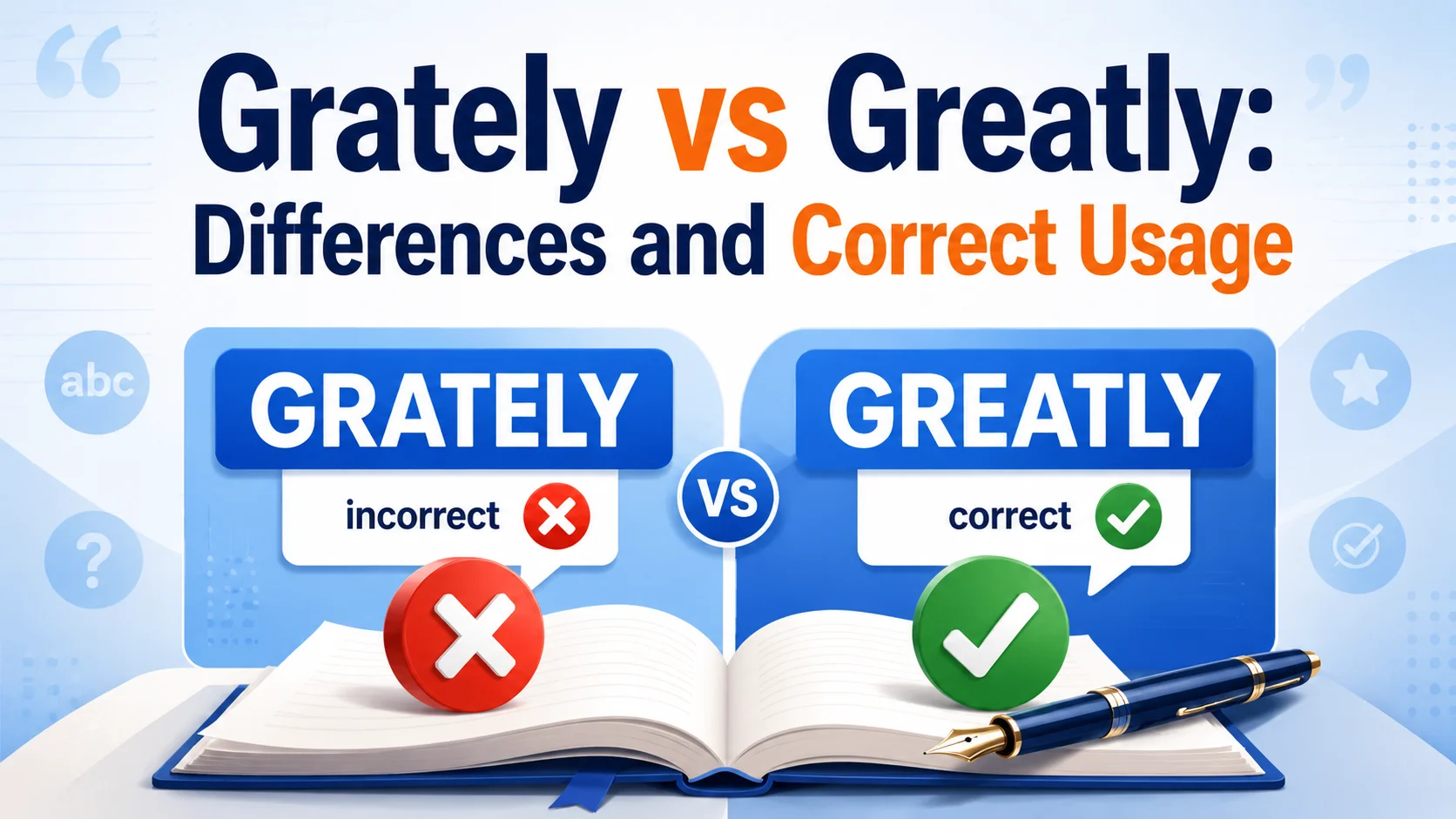
Grately vs greatly is a common spelling confusion because both forms look plausible and are usually intended to represent the same word. However, there’s an important distinction: greatly is the standard English spelling, while grately is generally a misspelling when someone means “to a great extent” or “very much.” If you’ve ever hesitated before writing “greatly appreciated,” “greatly affected,” or “greatly improved,” you’re dealing with exactly this kind of spelling trap. The good news is that the correct choice becomes easy once you understand how greatly is formed and how it functions in a sentence.
The confusion often comes from the way English forms adverbs. Writers may assume that adding -ly to great requires removing the final e, especially because some English words do change their spelling when suffixes are added. That assumption doesn’t apply here. The base adjective great remains intact, producing greatly. Understanding that small spelling pattern is more useful than simply memorizing one word because it gives you a reliable way to recognize and correct the error when it appears in your writing.
This guide explains grately vs greatly from both a spelling and usage perspective. You’ll learn what greatly means, why grately causes confusion, how to use greatly naturally, which expressions commonly occur with it, and when another adverb may be a better stylistic choice. You’ll also see practical examples, comparisons, common mistakes, and quick exercises. By the end, you should be able to distinguish the two forms instantly and use greatly with confidence in casual, professional, academic, and formal writing.
Grately vs Greatly: Which Spelling Is Correct?
The short answer is simple:
Greatly is correct. Grately is generally incorrect when you mean the adverb formed from “great.”
Greatly is an established English adverb. It means to a great degree, to a considerable extent, or very much, depending on the sentence.
For example:
- “I greatly appreciate your assistance.”
- “The new system greatly improved efficiency.”
- “She was greatly affected by the experience.”
- “The decision greatly reduced unnecessary costs.”
In each sentence, greatly tells the reader that the effect, feeling, or degree is substantial.
By contrast, writing grately in these sentences would be a spelling error:
- ❌ “I grately appreciate your help.”
- ❌ “The change grately improved performance.”
- ❌ “He was grately concerned about the situation.”
The correct versions are:
- ✅ “I greatly appreciate your help.”
- ✅ “The change greatly improved performance.”
- ✅ “He was greatly concerned about the situation.”
At a Glance: Greatly vs Grately
| Feature | Greatly | Grately |
| Standard English spelling | Yes | No |
| Part of speech | Adverb | Usually a misspelling |
| Related word | Great | Intended to be “great” |
| Meaning | To a great extent; very much | No standard meaning in this context |
| Example | “I greatly appreciate it.” | “I grately appreciate it.” ❌ |
| Appropriate in formal writing | Yes | No |
| Appropriate in casual writing | Yes | No |
The important point is that you generally aren’t choosing between two legitimate words. You’re choosing between the correct spelling and a common error.
What Does “Greatly” Mean?
Greatly is an adverb used to express a high degree or substantial extent.
Depending on the context, it can mean:
- very much
- to a great extent
- considerably
- significantly
- strongly, in certain contexts
Consider these examples:
“I greatly appreciate your patience.”
Here, greatly means very much.
“The renovation greatly improved the building.”
Here, it means to a considerable extent.
“The incident greatly affected her.”
Here, it communicates that the effect was strong or substantial.
So, the exact shade of meaning comes from the verb or expression that greatly modifies.
Greatly Definition and Meaning
The adjective great can describe something large, important, impressive, intense, or significant. When -ly is added, greatly becomes an adverb that expresses a high degree.
A useful way to think about it is:
great → greatly
The adverb doesn’t describe a physical object. Instead, it tells you how strongly, how significantly, or to what extent something happens.
For example:
- “The policy greatly influenced the industry.”
- “Your support is greatly valued.”
- “The treatment greatly reduced the symptoms.”
- “We were greatly surprised by the outcome.”
The word is particularly useful when you want to emphasize that something had a substantial effect.
How “Greatly” Works as an Adverb
An adverb can modify a verb, adjective, another adverb, or an entire clause. In everyday use, greatly most often modifies a verb or participial expression.
Compare:
- “The project changed.”
- “The project greatly changed.”
The second sentence tells you that the change was substantial.
Similarly:
- “The experience affected him.”
- “The experience greatly affected him.”
The addition of greatly increases the degree of the effect.
Common combinations include:
- greatly appreciate
- greatly admire
- greatly improve
- greatly increase
- greatly decrease
- greatly affect
- greatly influence
- greatly benefit
- greatly reduce
- greatly concern
- greatly value
- greatly disappoint
These combinations are useful because they show how greatly naturally fits into English sentence structure.
Greatly Does Not Simply Mean “Very”
Although greatly and very can both add emphasis, they aren’t interchangeable everywhere.
You can say:
“I greatly appreciate your help.”
But you normally wouldn’t replace greatly with very:
❌ “I very appreciate your help.”
Instead, natural English would use:
“I very much appreciate your help.”
Likewise:
- greatly improved ✅
- very improved ❌
But:
- very useful ✅
- greatly useful ⚠️ unusual in ordinary modern English
This demonstrates an important writing principle: an adverb must fit the word it modifies. Choosing a synonym based only on dictionary meaning can produce an unnatural sentence.
Is “Grately” a Word?
For ordinary modern English writing, grately should not be used as an alternative spelling of greatly.
If you intend to express the meaning “to a great extent” or “very much,” write greatly.
Why “Grately” Is Usually Incorrect
The problem is straightforward: the spelling grately removes the final e from great before adding -ly. That might look reasonable at first glance, but English spelling doesn’t require that change here.
The standard form preserves the base word:
great + ly = greatly
Therefore:
- ❌ grately
- ✅ greatly
This is especially important in formal writing because spelling errors can distract readers from your actual message.
Why “Grately” Looks Like It Should Be Correct
English has many suffix patterns, and some of them involve spelling changes.
For example, certain words lose letters or alter their endings when suffixes are added. Because writers encounter these patterns regularly, they may unconsciously apply the wrong pattern to great + -ly.
There is also a visual issue. The sequence greatly can look slightly unusual because the t and l occur next to each other:
GREATLY
Someone writing quickly may instinctively simplify it to:
GRATELY
But visual simplicity isn’t a reliable spelling rule.
Can “Grately” Appear Anywhere?
You may encounter grately in informal online writing, comments, messages, or user-generated content. Its appearance, however, doesn’t automatically make it a standard English spelling.
The same principle applies to many common typos: frequency of error isn’t the same thing as correctness.
If you see “grately” in an email, essay, article, or document, the intended word is almost certainly greatly.
Why Do People Confuse Grately and Greatly?
The error isn’t random. Several factors make grately look believable.
The “Great + -ly” Spelling Trap
The biggest source of confusion is the assumption that adding -ly means dropping the final e.
A writer may reason:
great → grate → grately
But that’s not how the word is formed.
The correct relationship is:
great → greatly
The word isn’t based on grate. It comes directly from great.
This distinction gives you an easy mental correction: don’t insert an imaginary “grate” step.
Pronunciation Makes the Difference Easy to Miss
When you hear someone say greatly, pronunciation doesn’t clearly announce every letter in the spelling.
That’s why relying on sound can be risky. English contains many words whose pronunciation doesn’t provide a perfect guide to spelling.
If you’ve heard:
“I greatly appreciate it.”
you might reproduce the sound correctly while still writing the spelling incorrectly.
For this particular word, visual recognition is more reliable than phonetic guessing.
Autocorrect and Fast Typing Can Reinforce the Error
Typing quickly creates another problem. If you already suspect that grately might be correct, your fingers can reinforce the mistake before you consciously check it.
Autocorrect can help, but it shouldn’t be your only safeguard. Spell-checking systems don’t always catch every error, particularly when a mistaken form resembles a possible word or isn’t flagged in a particular software environment.
For important writing, a quick manual review is still worthwhile.
Greatly vs Grately: The Key Difference
The difference can be reduced to three questions: spelling, meaning, and usage.
Correct Spelling
The correct spelling is:
greatly
Not:
grately
Meaning
Greatly has a recognized meaning: it expresses a large degree, substantial effect, or strong intensity.
Grately doesn’t normally provide a separate meaning in standard English. It is usually simply an incorrectly spelled version of greatly.
Usage
Use greatly when it naturally modifies a verb or related expression:
- “I greatly admire her work.”
- “The decision greatly affected the company.”
- “The update greatly improved the software.”
- “We greatly appreciate your cooperation.”
If you encounter grately in a sentence where this meaning is intended, correct it to greatly.
How to Use “Greatly” Correctly in a Sentence
Knowing the spelling is only half the job. You also need to know when greatly sounds natural.
Greatly With Verbs
Greatly commonly appears before verbs that describe change, influence, appreciation, or emotional response.
Examples:
- “The new training program greatly improved employee performance.”
- “I greatly appreciate your honesty.”
- “The decision greatly influenced future negotiations.”
- “The discovery greatly expanded our understanding of the subject.”
- “The discount greatly reduced the overall cost.”
Notice that greatly communicates more than the simple fact that something happened. It emphasizes degree.
Greatly With Participles and Adjectival Expressions
You may also see greatly before words such as:
- appreciated
- concerned
- disappointed
- affected
- surprised
- reduced
- improved
- valued
Examples:
- “Your contribution is greatly appreciated.”
- “The community was greatly affected by the closure.”
- “She was greatly disappointed with the result.”
- “The risk was greatly reduced after the changes.”
These constructions are especially common in formal and professional writing.
Greatly in Formal and Professional Writing
Greatly fits naturally into professional communication when you want to express strong appreciation or substantial impact without sounding excessively emotional.
For example:
“We greatly appreciate your cooperation during the transition.”
This sounds polished and professional.
Another example:
“The revised procedure greatly improved response times.”
Here, greatly emphasizes the size of the improvement.
However, professional writing shouldn’t rely on greatly simply because it sounds formal. Precision matters more than formality. If you have a specific measurable figure, giving the figure may be stronger.
Instead of:
“The change greatly reduced costs.”
you might write:
“The change reduced costs by 18%.”
The second version communicates the actual magnitude rather than asking the reader to interpret “greatly.”
Greatly in Everyday English
Greatly isn’t restricted to formal documents. It can appear in everyday English, although alternatives may sound more conversational.
For example:
“I greatly appreciate it.”
is perfectly natural, but in casual conversation you might also hear:
“I really appreciate it.”
or:
“I appreciate it a lot.”
The choice depends on your desired tone and register.
Common Phrases and Collocations With “Greatly”
One of the best ways to become comfortable with greatly is to learn the combinations in which it naturally appears.
“Greatly Appreciate”
This is probably one of the most recognizable expressions:
“I greatly appreciate your help.”
It expresses strong gratitude.
You’ll often see it in:
- professional emails
- thank-you messages
- customer communication
- formal requests
- acknowledgments
“Greatly Improve” and “Greatly Increase”
These combinations emphasize substantial change.
Examples:
“The redesign greatly improved usability.”
“Demand greatly increased after the product launch.”
The word doesn’t necessarily indicate a specific numerical amount. It simply signals that the change was large or important enough to emphasize.
“Greatly Concerned,” “Greatly Affected,” and Similar Expressions
The word also works with emotional or impact-related expressions:
- greatly concerned
- greatly disappointed
- greatly surprised
- greatly affected
- greatly influenced
- greatly valued
For example:
“Parents were greatly concerned about the proposed changes.”
The phrase communicates a strong level of concern without specifying an exact measurement.
Why Collocations Help You Recognize Correct Usage
A collocation is a word combination that commonly occurs in natural language.
When you repeatedly see:
- greatly appreciate
- greatly improve
- greatly affected
your brain begins to recognize greatly as a complete word rather than trying to reconstruct its spelling each time.
That makes common collocations useful as spelling anchors.
Greatly vs Similar Words: When Is Each One Better?
Knowing alternatives prevents you from overusing one word.
Greatly vs Very Much
These can overlap, especially when expressing appreciation.
- “I greatly appreciate your help.”
- “I very much appreciate your help.”
Both are correct.
Greatly often sounds somewhat more polished or formal, while very much can feel more conversational depending on the sentence.
Greatly vs Considerably
Considerably usually emphasizes a substantial amount or degree.
“The price has considerably decreased.”
Greatly can also work:
“The price has greatly decreased.”
But considerably may sound more precise in analytical writing because it directly emphasizes degree.
Greatly vs Significantly
These words overlap but aren’t identical in every context.
Significantly can mean “to an important or notable degree,” and in academic or statistical contexts it may carry a more technical implication.
For example:
“The treatment significantly improved recovery time.”
If you’re discussing statistical analysis, significantly may be preferable because it can communicate a specific methodological meaning.
Greatly is broader and more general.
Greatly vs Extremely
These words serve different grammatical purposes.
You can say:
“The change greatly affected the outcome.”
But you wouldn’t normally say:
❌ “The change extremely affected the outcome.”
Instead, extremely commonly modifies adjectives and adverbs:
“The result was extremely important.”
This is another reminder that synonyms aren’t automatically interchangeable.
“Greatly Appreciated” vs Other Common Expressions
The phrase greatly appreciated deserves special attention because it’s a frequent place where spelling mistakes occur.
Is “Greatly Appreciated” Correct?
Yes.
“Your assistance is greatly appreciated.”
This is grammatically correct and widely used.
The phrase means that someone’s help or contribution is strongly valued.
“Greatly Appreciated” vs “Much Appreciated”
Both expressions can communicate gratitude:
“Your help is greatly appreciated.”
“Your help is much appreciated.”
Greatly appreciated often sounds more formal and deliberate.
Much appreciated is shorter and can feel more conversational, particularly in brief messages.
Neither requires grately.
“Greatly Appreciate” vs “Greatly Appreciated”
These forms differ grammatically.
Greatly appreciate is active:
“I greatly appreciate your help.”
The subject I performs the appreciating.
Greatly appreciated is passive:
“Your help is greatly appreciated.”
The help is the thing being valued.
Both are correct, but they serve different sentence structures.
Examples in Emails
Professional communication often uses these constructions:
“I greatly appreciate your time and consideration.”
“Your prompt response is greatly appreciated.”
“We greatly appreciate your continued support.”
These are appropriate when you want to express gratitude respectfully without sounding overly casual.
Common Mistakes With “Greatly”
Writing “Grately” Instead of “Greatly”
This is the central error.
Incorrect:
“I grately appreciate your assistance.”
Correct:
“I greatly appreciate your assistance.”
A simple visual check catches it immediately.
Assuming Every “Great” Adverb Drops the E
This is a dangerous generalization.
English spelling shouldn’t be learned through one universal rule such as “remove the final e before adding -ly.” Different words behave differently.
For this particular word, simply remember:
great → greatly
The safest approach is to learn the actual spelling pattern rather than inventing a broader rule from it.
Using “Greatly” Where a Different Adverb Sounds More Natural
A sentence can be grammatically correct but stylistically awkward.
For example:
“The beautiful scenery greatly impressed me.”
This is possible, but depending on the context, you might prefer:
“The beautiful scenery deeply impressed me.”
or:
“The beautiful scenery really impressed me.”
The best choice depends on what you want to emphasize.
Overusing “Greatly” in Formal Writing
Formal writing isn’t improved merely by adding stronger-sounding adverbs.
Compare:
“The policy greatly improved outcomes.”
with:
“The policy increased completion rates from 71% to 86%.”
The second sentence provides concrete information.
Expert writing doesn’t confuse intensity with precision. Use greatly when the degree matters but doesn’t need exact measurement.
A Simple Way to Remember “Greatly”
You don’t need a complicated mnemonic.
Keep “Great” Intact
The easiest memory rule is:
GREAT + LY = GREATLY
The word great remains visible inside greatly.
Think:
great → greatly
not:
great → grate → grately
Use the “Greatly Appreciated” Test
If you’re writing:
“Your help is ______ appreciated.”
the correct answer is:
greatly
The familiar phrase can act as a spelling checkpoint.
Quick Spelling Check
| Incorrect | Correct |
| grately | greatly |
| gratefully? | Different word |
| greately | greatly |
| greatfully | gratefully |
| greatly | Correct |
Be careful with gratefully, too. It is a completely different word.
- greatly = to a great extent
- gratefully = with gratitude
For example:
“I greatly appreciate your help.”
“I gratefully accept your offer.”
These words can occur in similar contexts but have different meanings.
Greatly in Different Types of Writing
Professional and Business Writing
Greatly is especially useful when communicating:
- appreciation
- impact
- improvement
- concern
- value
- change
Example:
“We greatly value your continued partnership.”
It communicates respect without requiring an overly emotional tone.
Academic and Research Writing
Academic writers should use greatly carefully.
For broad descriptions, it can work:
“The discovery greatly expanded researchers’ understanding of the process.”
But when evidence is available, specific measurements and carefully defined terms are usually stronger.
Instead of:
“The intervention greatly reduced errors.”
a research paper might say:
“The intervention reduced reported errors by 24%.”
If statistical significance is relevant, significantly may also be more appropriate than greatly, depending on what the evidence actually demonstrates.
Casual Messages and Everyday Communication
In casual communication, greatly is grammatically fine but may sometimes sound more formal than necessary.
Compare:
“I greatly appreciate it.”
with:
“I really appreciate it.”
The second version is often more relaxed.
Neither is universally better. The right choice depends on your relationship with the reader and the situation.
Creative Writing
Creative writers have more flexibility.
A character’s voice, personality, background, and emotional state can influence whether greatly feels appropriate.
For example:
“She greatly feared what would happen next.”
This sounds somewhat literary.
A more conversational character might say:
“She was really scared about what would happen next.”
The grammar isn’t the only consideration. Voice matters.
Quick Decision Guide: Should You Use “Greatly”?
When choosing an adverb, ask what you actually want to communicate.
| Intended meaning | Strong choice | Example |
| Strong appreciation | greatly | “I greatly appreciate your help.” |
| Large change | greatly | “The update greatly improved performance.” |
| Considerable degree | considerably | “The cost was considerably lower.” |
| Important measurable effect | significantly | “The treatment significantly reduced errors.” |
| Casual emphasis | really | “I really appreciate it.” |
| Strong emotional intensity | deeply | “She was deeply affected.” |
| Casual gratitude | very much | “I very much appreciate your help.” |
The point isn’t to replace greatly whenever another word exists. Instead, choose the adverb that best communicates your intended degree, tone, and context.
Practice: Can You Spot the Correct Spelling?
A little practice makes this distinction automatic.
Choose “Greatly” or “Grately”
- I ______ appreciate your assistance.
- The changes ______ improved the process.
- She was ______ affected by the news.
- Your patience is ______ appreciated.
- The new design ______ reduced production time.
Answers:
- greatly
- greatly
- greatly
- greatly
- greatly
Correct the Spelling
- Correct these sentences:
- “We grately appreciate your feedback.”
- “The new method grately improved accuracy.”
- “He was grately concerned about the result.”
- Correct versions:
- “We greatly appreciate your feedback.”
- “The new method greatly improved accuracy.”
- “He was greatly concerned about the result.”
Improve the Sentence
Sometimes the challenge isn’t spelling but word choice.
Consider:
“The change greatly increased sales.”
This is perfectly acceptable if you simply want to emphasize a large increase.
But if you know the number, a more informative version could be:
“The change increased sales by 27%.”
Similarly:
“The program greatly improved attendance.”
could become:
“The program increased attendance from 64% to 82%.”
The lesson is simple: use greatly when broad emphasis is useful; use specific evidence when precision matters more.
Conclusion
The grately vs greatly question has a straightforward answer: when you mean “to a great extent,” “considerably,” or “very much,” the correct spelling is greatly. Grately is generally a misspelling, not a competing form with its own standard meaning. The easiest way to remember the distinction is to keep the base word visible: great + ly = greatly. From there, focus on usage. Greatly works naturally with expressions such as greatly appreciate, greatly improve, greatly affect, and greatly appreciated, although alternatives like significantly, considerably, really, or very much may be better in particular contexts. One final actionable tip: before submitting important writing, look for the base word great and check that you haven’t accidentally changed it to grate. A common mistake to avoid: don’t assume that a spelling that looks logical or appears online is automatically standard English. When in doubt, choose greatly.
Frequently Asked Questions
Q1. What is the difference between grately and greatly?
Greatly is the standard English adverb meaning to a great extent, considerably, or very much. Grately is generally a spelling error when someone intends to write greatly. They aren’t normally two alternative words with different meanings, so use greatly in standard writing.
Q2. Is “grately” a real word?
Grately isn’t the standard spelling of the adverb derived from great. You may encounter it in informal online writing or as a typo, but that doesn’t make it an accepted alternative. When you mean “to a great extent” or “very much,” the standard form is greatly.
Q3. How do you spell “grately” correctly?
If you’re using grately to mean “to a great extent,” spell it greatly. The easiest way to remember this is to keep the base word great intact: great + ly = greatly. Don’t change great into grate before adding the suffix.
Q4. Why is “greatly” spelled with an E?
Greatly keeps the spelling of its base adjective, great, when -ly is added. Think of the formation as great + ly, not grate + ly. Because the base spelling remains recognizable, the correct form contains the sequence greatly, including the e.
Q5. Is “greatly appreciated” grammatically correct?
Yes. “Greatly appreciated” is a standard and grammatically correct expression used to emphasize that something is strongly valued. For example, “Your assistance is greatly appreciated.” In casual communication, “much appreciated” or “really appreciated” may sound more conversational, depending on the context.