
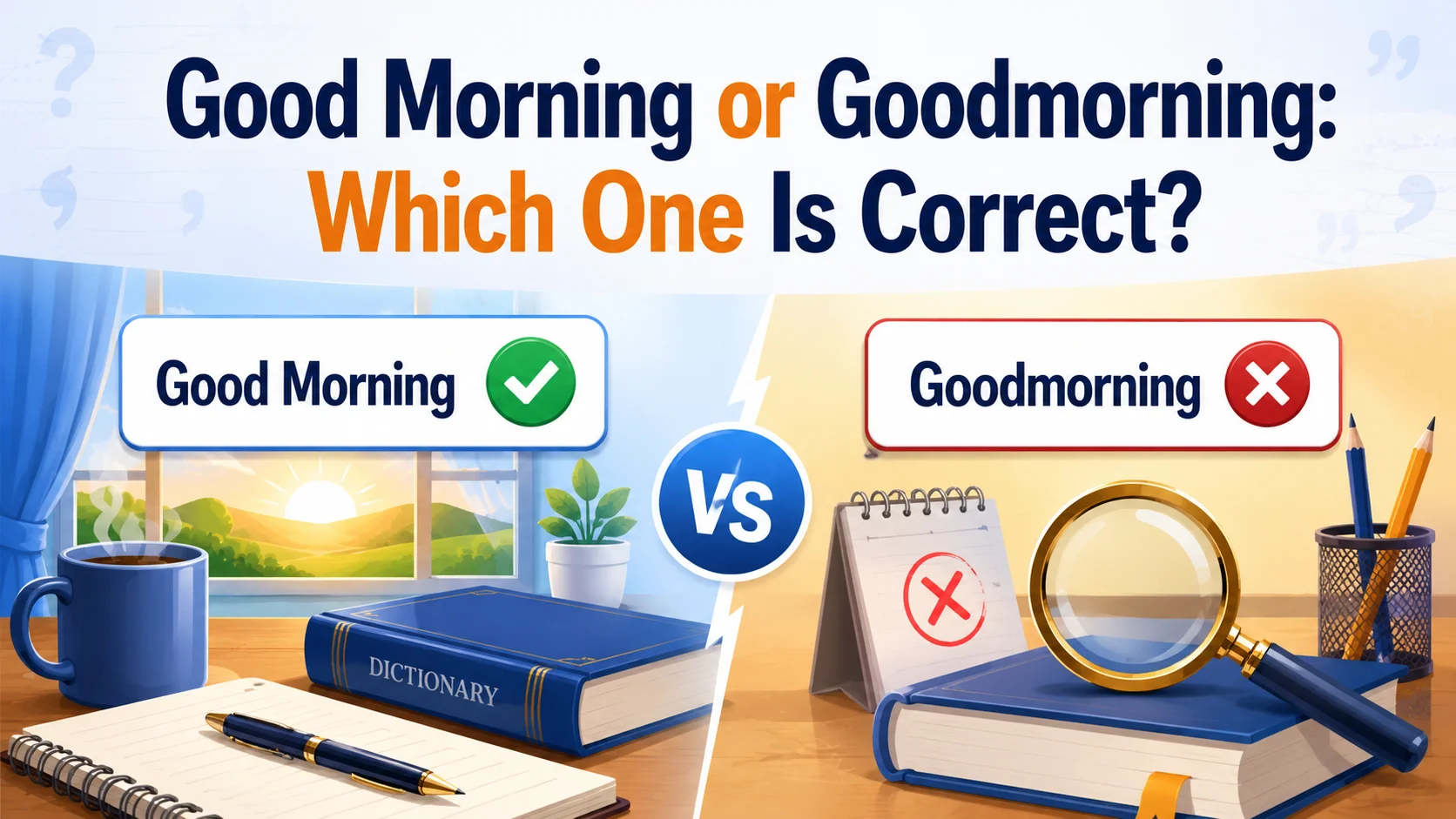
Good Morning or Goodmorning is a common spelling question, especially when you’re writing emails, texts, school assignments, social media posts, or workplace messages. The correct standard-English form is “good morning,” written as two separate words. “Goodmorning” may appear online, in usernames, or as a casual typing error, but it isn’t the standard spelling of the greeting. Major dictionaries such as Cambridge and Merriam-Webster list good morning as a greeting or interjection used when meeting someone in the morning.
The confusion makes sense because English contains many familiar compounds and closed words, including goodnight, while phrases such as good afternoon and good evening remain open. That can make it tempting to treat “good morning” the same way. The difference becomes much easier to understand once you separate spelling, grammar, capitalization, and punctuation. In this guide, you’ll learn not only which form is correct, but also why it is correct, when to capitalize it, where commas belong, and how the greeting works in professional and casual communication.
You’ll also see how context changes the best way to write the greeting. “Good morning!”, “Good morning, Sarah,” and “She wished me a good morning” are all legitimate constructions, but they don’t follow exactly the same capitalization or punctuation pattern. We’ll look at those differences, compare good morning with goodnight, good afternoon, hello, hi, and morning, examine common mistakes, and finish with practical examples you can use immediately. The goal is simple: by the end, you should be able to choose the right form without having to second-guess every morning greeting.
Good Morning or Goodmorning: The Quick Answer
If you only need the answer, here it is:
Correct: Good morning
Incorrect in standard English: Goodmorning
Good morning is normally written as two words. Cambridge Dictionary defines it as something said to greet someone politely when you meet them in the morning, and its examples consistently use the two-word form. Merriam-Webster likewise lists good morning as an interjection used to say hello to someone in the morning.
Is “Good Morning” One Word or Two?
It is two words:
- Good — adjective
- Morning — noun
Together, they form the familiar greeting good morning.
For example:
- Good morning!
- Good morning, everyone.
- Good morning, Dr. Patel.
- I wished my neighbor a good morning.
Is “Goodmorning” Ever Correct in Standard English?
No. Goodmorning is not the standard spelling of the English greeting.
You may encounter it in a username, hashtag, brand name, deliberately compressed social-media wording, or an informal message. Those contexts can explain why someone writes it that way, but they don’t establish it as the standard spelling.
If you’re writing for school, work, publication, customer communication, or any other setting where standard English matters, choose good morning.
Quick Examples of the Correct Usage
| Situation | Correct example |
| Simple greeting | Good morning! |
| Greeting one person | Good morning, Emma. |
| Greeting a group | Good morning, everyone. |
| Email opening | Good morning, Mr. Davis. |
| Reported speech | She said good morning to her teacher. |
| Describing the morning | It was a good morning for a walk. |
The Simple Rule to Remember
If you mean the standard English morning greeting, keep “good” and “morning” separate.
A useful mental comparison is:
- Good morning
- Good afternoon
- Good evening
All three are normally written as separate words.
What Does “Good Morning” Mean?
At its simplest, good morning is a greeting used during the morning. It is a polite way of acknowledging another person and beginning an interaction.
Cambridge classifies the expression as an exclamation and defines it as something used to greet someone politely when you meet them in the morning.
The Literal Meaning of “Good Morning”
The phrase combines:
- good — expressing a positive quality or wish
- morning — the part of the day between night and afternoon
Historically and grammatically, the expression is more than a literal description of the morning. In everyday English, it functions as a conventional greeting.
When you say:
Good morning!
you usually aren’t making a factual claim that the morning is objectively good. You’re performing a social function: greeting the other person politely.
“Good Morning” as a Greeting
The phrase can be used when you first encounter someone during the morning.
For example:
Good morning, Alex. How are you?
Or:
Good morning, everyone. Thanks for joining the meeting.
The greeting can sound warm, neutral, formal, cheerful, or professional depending on your voice and the surrounding words.
How the Meaning Changes With Context and Tone
Compare these:
Good morning!
This sounds straightforward and friendly.
Good morning, Professor.
This is respectful and appropriate in an academic setting.
Good morning, everyone. Let’s get started.
This works well when addressing a group.
Well, good morning!
Depending on tone, this could sound genuinely cheerful, surprised, playful, or even sarcastic.
The words remain the same, but context and delivery influence the social meaning.
Is “Good Morning” a Phrase, Greeting, or Sentence?
It can be described in different grammatical ways depending on how it is being used.
As a greeting, good morning functions as an interjection or greeting expression. Dictionaries such as Merriam-Webster and Cambridge treat it as a greeting expression rather than simply as an ordinary descriptive noun phrase.
You can also encounter the words in an ordinary noun phrase:
It was a good morning.
Here, the phrase is not a greeting at all. It describes a morning.
That distinction matters because context can affect capitalization and punctuation.
Why Is “Good Morning” Written as Two Words?
The spelling isn’t arbitrary. Good morning remains an open phrase rather than a standard closed compound word.
The Grammatical Structure of “Good Morning”
In its ordinary literal structure, good is an adjective and morning is a noun.
Consider:
It was a good morning.
Here, good describes morning.
The same word combination became established as a conventional greeting:
Good morning!
The fact that the phrase functions as a greeting doesn’t automatically turn its two words into one word.
What Role Does “Good” Play?
Good modifies the noun morning.
You see the same basic pattern in expressions such as:
- good day
- good evening
- good afternoon
- good luck
- good health
- good news
The presence of an adjective before a noun doesn’t mean the two words should be joined.
What Role Does “Morning” Play?
Morning identifies the time of day associated with the greeting.
It also appears independently in countless expressions:
- this morning
- tomorrow morning
- Monday morning
- early morning
- morning meeting
- morning routine
There is no spelling reason to turn good + morning into goodmorning.
Why These Words Don’t Form a Standard Compound Word
English does create compounds in several ways:
- toothbrush
- sunlight
- bedroom
- notebook
But compounds aren’t created simply because two words frequently appear together.
Some remain open:
- high school
- coffee table
- post office
- ice cream
Others become hyphenated or closed depending on established usage.
Good morning belongs to the open-word category in standard English.
Why “Goodmorning” Doesn’t Follow Normal English Spelling Patterns
There is no standard rule saying that a frequently used greeting should be compressed into one word.
So even if you see goodmorning repeatedly online, frequency in informal digital writing doesn’t make it the accepted standard form.
Why Do People Write “Goodmorning” as One Word?
The existence of goodmorning online is easy to explain without treating it as correct spelling.
Fast Typing and Texting Habits
When people type quickly, spaces are among the easiest things to miss.
Someone might write:
Goodmorning! How are you?
The intended meaning is obvious, but the spelling is still nonstandard.
A single missing space is a small error, not a new grammatical rule.
Influence of Compound Words Such as “Goodnight”
This is probably one of the most understandable sources of confusion.
English uses:
Goodnight.
But it generally uses:
Good morning.
And:
Good afternoon.
And:
Good evening.
You can’t reliably predict English spelling by looking at one similar expression and applying its pattern to another.
Informal Social Media Usage
Online writing often bends conventional spelling for:
- usernames
- hashtags
- captions
- branding
- stylistic effect
- speed
For example, a person might intentionally create a username such as @goodmorningworld.
That’s a naming choice, not evidence that goodmorning is the standard dictionary spelling of the greeting.
Autocorrect, Predictive Text, and Typing Mistakes
Phones can make unusual forms feel normal. If you repeatedly encounter a compressed spelling, you may eventually type it yourself without noticing.
The safest approach is simple: proofread important messages rather than trusting visual familiarity.
Why Seeing “Goodmorning” Online Doesn’t Make It Standard English
Internet usage and standard usage serve different purposes.
A social platform may tolerate:
goodmorning everyone ☀️
But a formal document, school paper, business email, or edited article should follow standard spelling.
Informal visibility is not the same thing as grammatical correctness.
Good Morning vs Goodmorning: Side-by-Side Comparison
| Feature | Good Morning / good morning | Goodmorning |
| Standard spelling | Yes | No |
| Number of words | Two | One |
| Used as a greeting | Yes | Intended meaning, but nonstandard spelling |
| Suitable for formal writing | Yes | No |
| Suitable for professional email | Yes | No |
| May appear online | Yes | Yes |
| Dictionary-standard form | Yes | No |
| Recommended for school writing | Yes | No |
Which Form Should You Use in Everyday Writing?
Use good morning.
It works in virtually every ordinary context:
- Good morning!
- Good morning, Sarah.
- Good morning, team.
- I said good morning before leaving.
Which Form Should You Avoid in Professional Writing?
Avoid goodmorning in:
- business emails
- resumes
- academic assignments
- reports
- customer service messages
- professional websites
- formal letters
- published content
Even though the mistake is minor, correct spacing makes your writing look careful and polished.
How to Use “Good Morning” Correctly in a Sentence
The phrase is flexible. Your punctuation and capitalization depend on how you’re using it.
“Good Morning” as a Standalone Greeting
When it begins a sentence or stands alone as a greeting:
Good morning!
Good morning.
The first word is capitalized because it begins the sentence or greeting.
“Good Morning” at the Beginning of a Sentence
If the greeting begins a sentence, capitalize Good:
Good morning, everyone. The presentation will begin shortly.
Notice that morning remains lowercase in ordinary sentence capitalization when it follows Good.
“Good Morning” Before Someone’s Name
When directly addressing someone, use a comma:
- Good morning, Maria.
- Good morning, Mr. Wilson.
- Good morning, everyone.
The name or group is a direct address, so the comma separates it from the greeting.
“Good Morning” Followed by a Question or Statement
You can continue naturally after the greeting:
Good morning, Daniel. How was your trip?
Good morning, everyone. Today we’ll discuss the new schedule.
Examples With Correct Punctuation
- Good morning!
- Good morning, Lisa.
- Good morning, team.
- Good morning. Is everyone ready?
- She smiled and said, “Good morning.”
Capitalization: “Good Morning” vs “good morning”
Capitalization causes almost as much confusion as the missing space.
The key is to distinguish sentence capitalization from title-style capitalization and email-salutation conventions.
When to Write “Good Morning” With Capital Letters
Capitalize Good when it starts a sentence:
Good morning, everyone.
If you’re using title case for a heading, you may see:
Good Morning or Goodmorning: Which One Is Correct?
That’s title formatting, not ordinary sentence capitalization.
Email and letter salutations can also follow a particular style guide or house style. There is some variation in professional conventions, so don’t assume every organization treats standalone salutations identically.
When to Write “good morning” in Lowercase
Use lowercase when the phrase appears in the middle of a sentence:
She wished me good morning before she left.
We exchanged good morning greetings.
He said good morning and walked into the office.
You don’t capitalize Good simply because the words form a familiar greeting.
Do You Capitalize Both Words in “Good Morning”?
In normal sentence-style writing:
Good morning, Sarah. ✅
not:
Good Morning, Sarah. ⚠️
The second version may appear as a stylistic choice, particularly in headings or certain email-salutation styles, but it isn’t the normal sentence-capitalization pattern.
Capitalization in Sentences
Compare:
Good morning, John.
She said good morning to John.
The first begins a sentence. The second occurs in the middle of one.
Capitalization in Emails and Messages
A practical professional approach is:
Good morning, Ms. Carter,
or:
Good morning, Ms. Carter.
The exact punctuation after a salutation can vary with organizational and style conventions. What matters most for the spelling question is that good morning remains two words.
Punctuation Rules for “Good Morning”
Spacing and capitalization aren’t the only details worth getting right.
Should You Add a Comma After “Good Morning”?
When good morning directly addresses someone, use a comma:
Good morning, James.
Good morning, everyone.
This is an instance of direct address. The comma separates the greeting from the person or group being addressed.
“Good Morning, Sarah” vs “Good Morning Sarah”
The standard punctuated form is:
Good morning, Sarah.
The comma clearly marks Sarah as the person being addressed.
This principle also applies to other greetings:
Hello, Sarah.
Hi, Sarah.
Good afternoon, Sarah.
When a Comma Is Needed After the Person’s Name
If the sentence continues after the person’s name, punctuation depends on the larger sentence:
Good morning, Sarah. How are you?
Good morning, Sarah, and welcome to the team.
The second comma can close the direct-address element when the sentence continues.
Examples of Natural Punctuation in Greetings
Standalone:
Good morning!
With a person:
Good morning, Alex.
With a group:
Good morning, everyone.
Greeting followed by another sentence:
Good morning, team. Let’s begin.
Common Punctuation Mistakes to Avoid
Avoid:
Good morning Sarah.
Prefer:
Good morning, Sarah.
Also avoid adding commas where the phrase is simply part of an ordinary noun phrase:
It was a good morning.
not:
It was a good morning,.
Punctuation follows grammatical function, not the fact that the words happen to resemble a greeting.
“Good Morning” in Emails and Professional Writing
A morning greeting can work very well in professional communication, but the best choice depends on your relationship with the recipient and the purpose of the message.
Is “Good Morning” a Professional Email Greeting?
Yes.
Good morning is polite, neutral, and widely understood. It can be especially useful when you’re contacting someone early in their working day.
For example:
- Good morning, Professor Adams.
- Good morning, team.
- Good morning, Ms. Chen. I’m writing to follow up on yesterday’s meeting.
When “Good Morning” Works Well in a Formal Email
Use it when:
- you know the recipient’s time zone
- you’re sending the message in the morning
- you want a courteous opening
- the communication isn’t extremely formal or ceremonial
For a first contact, you might choose:
Good morning, Dr. Williams.
For an internal workplace message:
Good morning, everyone.
When “Hi” or “Hello” May Be Better
A greeting isn’t automatically better just because it sounds formal.
If you’re emailing someone at 4:30 p.m., Good morning is obviously inappropriate. A time-neutral greeting such as Hello can be safer.
Similarly, if you’re communicating across several time zones, you may not know whether it’s morning for the recipient.
Examples of Professional Email Openings
Warm and professional:
Good morning, Jennifer.
I’m following up on the proposal we discussed yesterday.
Neutral:
Hello, Mr. Carter.
Thank you for your message.
Internal team message:
Good morning, everyone.
Here are the materials for today’s meeting.
Examples of Less Effective Email Openings
Goodmorning Mr. Carter
Problems:
- missing space
- missing comma
- visually rushed
Better:
Good morning, Mr. Carter.
Should You Write “Good Morning” in an Email Subject Line?
Usually, no special capitalization is required simply because it appears in a subject line. The subject line should follow your organization’s chosen style.
For example:
Good morning — meeting confirmation
or:
Good morning: Project update
If it’s functioning as a title, title-case conventions may capitalize more words. That’s a formatting decision, not a spelling change.
“Good Morning” in Texts, Chats, and Social Media
Digital communication is where goodmorning appears most often.
Is “Good Morning” Correct in Text Messages?
Absolutely.
Good morning! ☀️
Good morning, how are you?
Good morning 😊 Hope you slept well!
There’s no need to abandon standard spelling just because the message is casual.
Casual vs Standard Digital Writing
Casual communication gives you more freedom with:
- emojis
- abbreviations
- lowercase writing
- repeated punctuation
- playful spellings
But if you want standard English, the spelling remains:
good morning
Even this casual message is perfectly normal:
good morninggg ☀️
The extended g changes the tone, but the two-word structure remains recognizable.
Can “Goodmorning” Be Used Intentionally Online?
Yes, but context matters.
A username, hashtag, campaign name, or stylized brand might intentionally use:
#Goodmorning
or:
@goodmorningworld
That doesn’t make goodmorning the standard English spelling.
Think of it like a brand choosing YouTube rather than ordinary grammatical capitalization. Names and branding can follow their own conventions.
Why Informal Usage Doesn’t Change the Standard Spelling
Digital language evolves quickly. People shorten, merge, abbreviate, and stylize words constantly.
That’s useful for understanding internet culture, but when you’re answering “Which spelling is correct?”, the relevant standard remains good morning.
Natural Examples for Friends, Family, and Social Media
Good morning! How did you sleep?
Good morning, everyone! Hope you have a great day.
Morning! Coffee first, questions later.
The third example demonstrates another useful option: morning can work as an informal standalone greeting.
Good Morning in Different Contexts
The phrase is versatile, but tone should match the situation.
At School or University
Appropriate:
Good morning, Professor.
Good morning, everyone.
For an assignment, don’t write goodmorning simply because classmates use it in chat.
At Work
Appropriate:
Good morning, team.
Good morning, Mr. Lee.
A workplace greeting should be courteous without sounding unnecessarily elaborate.
In Customer Service
A customer-facing message might begin:
Good morning, Ms. Brown. How may I help you?
This sounds more polished than a compressed or careless spelling.
In Personal Conversations
You can keep things simple:
Good morning!
Or:
Morning!
The choice depends on personality and relationship.
In Social Media Posts and Comments
Standard spelling works well:
Good morning, friends!
If you’re creating a branded hashtag, however, capitalization and spacing can be governed by the platform or brand’s style.
In Formal Letters and Official Communication
A formal salutation may use:
Good morning, Dr. Anderson.
But if the situation calls for a more traditional formal opening, another salutation may be more appropriate.
The important point is that formality affects the choice of greeting, not whether “good morning” is spelled as one word.
Good Morning vs Goodnight: Why Are They Different?
This is one of the biggest reasons people wonder whether goodmorning might be legitimate.
Why “Good Morning” Is Two Words
Good morning has an established open form in standard English. Dictionaries list it that way.
Why “Goodnight” Is Commonly Written as One Word
Goodnight has developed its own conventional spelling and usage, especially as a farewell.
For example:
Goodnight! See you tomorrow.
English spelling isn’t a mathematical formula. Similar-looking expressions can have different conventional forms.
How Historical Usage Influenced the Difference
Word formation changes over time. Some frequently used combinations become compounds; others remain separate.
That means you shouldn’t reason:
Good + night = goodnight
Good + morning = therefore goodmorning
Instead, learn the established form of each expression.
Other Greeting Expressions That Follow Different Patterns
Compare:
- good morning
- good afternoon
- good evening
- goodnight
- hello
- good day
- goodbye
English has a mixture of open phrases, compounds, and single words.
Why You Shouldn’t Use “Goodnight” as a Spelling Model for “Good Morning”
The fact that one expression is closed doesn’t force another expression to behave the same way.
Dictionary-established usage beats guesswork.
Good Morning vs Similar Greetings
| Greeting | Typical use | Standard form | Tone |
| Good morning | Morning greeting | Two words | Polite, neutral, friendly |
| Morning! | Casual morning greeting | One word | Informal |
| Good afternoon | Afternoon greeting | Two words | Polite, neutral |
| Good evening | Evening greeting | Two words | Polite, neutral |
| Hello | General greeting | One word | Neutral, versatile |
| Hi | General greeting | One word | Casual, friendly |
| Goodnight | Usually a farewell | One word | Friendly, often used at bedtime |
Good Morning vs Good Afternoon
Both are standard two-word expressions:
Good morning, everyone.
Good afternoon, everyone.
This is useful because it gives you a simple spelling pattern to remember.
Good Morning vs Good Evening
Again:
Good evening, Dr. Smith.
The phrase remains two words.
Good Morning vs Hello
Hello works throughout the day, while good morning specifically identifies the morning context.
If you’re unsure of the recipient’s local time, hello is often safer.
Good Morning vs Hi
Hi is more casual.
Compare:
Good morning, Professor.
with:
Hi, Professor.
The first generally sounds more formal or courteous, although the best choice depends on the relationship and setting.
Good Morning vs Morning
Morning! is a shortened informal greeting.
It can sound natural between friends or colleagues:
Morning! Ready for the meeting?
In a formal email, however, Good morning is usually the safer choice.
Common Mistakes With “Good Morning”
Mistake 1: Writing “Goodmorning”
❌ Goodmorning, everyone.
✅ Good morning, everyone.
The missing space is the main spelling error.
Mistake 2: Overcapitalizing the Phrase
❌ Good Morning, Sarah.
✅ Good morning, Sarah.
In ordinary sentence-style writing, only Good needs capitalization because it starts the sentence.
However, a particular organization may use title case or a house style for standalone email salutations. Follow the applicable style guide consistently.
Mistake 3: Omitting the Comma Before a Person’s Name
❌ Good morning Sarah.
✅ Good morning, Sarah.
The comma identifies Sarah as the person being addressed.
Mistake 4: Adding Unnecessary Punctuation
❌ Good morning,!
❌ Good morning,, Sarah.
✅ Good morning, Sarah!
Keep punctuation proportional to the message.
Mistake 5: Using an Informal Texting Style in Formal Writing
Something like:
goodmorninggggg ☀️
may be perfectly understandable between friends.
It isn’t the style you want in a formal business letter.
Mistake 6: Assuming “Goodmorning” Is Correct Because It Appears Online
This is a broader digital-writing lesson: common doesn’t always mean standard.
Online language includes intentional misspellings, abbreviations, slang, branding, and simple mistakes.
Is “Goodmorning” Ever Acceptable?
There is an important distinction between acceptable as a creative form and correct as standard English.
Standard English vs Informal Internet Usage
If your goal is standard English, use:
good morning
If you’re quoting someone’s exact message, discussing online slang, or reproducing a username, you may preserve the original spelling.
Usernames, Hashtags, and Creative Branding
Names aren’t always governed by ordinary sentence spelling.
For example:
@GoodMorningDaily
could be a perfectly legitimate account name.
Likewise, a company could intentionally call a campaign:
#GoodMorningWorld
These are proper-name or branding choices, not evidence that goodmorning has become the standard word.
Why Informal Exceptions Don’t Make It a Standard Spelling
A spelling can be understandable, searchable, and intentional without being standard.
That’s why the safest rule remains:
Use “good morning” in standard writing.
What to Use in School, Work, and Professional Content
Choose good morning for anything where correctness matters.
That includes:
- academic work
- workplace communication
- professional websites
- published articles
- customer emails
- formal correspondence
- applications
- reports
Good Morning Examples: Correct and Incorrect
Correct Examples in Everyday Conversation
Good morning! How are you?
- Good morning, Dad.
- Good morning, everyone.
- Good morning. Did you sleep well?
Correct Examples in Professional Writing
Good morning, Ms. Taylor. I’m following up regarding the meeting.
Good morning, team. Please review the attached schedule.
Good morning, Professor Adams. Thank you for your feedback.
Correct Examples in Text Messages
Good morning! Hope you have a great day.
Good morning 😊 Are you awake yet?
Morning! Want to grab coffee?
Incorrect Examples Using “Goodmorning”
❌ Goodmorning, everyone!
❌ Goodmorning! How are you?
❌ I sent him a goodmorning message.
The standard versions are:
✅ Good morning, everyone!
✅ Good morning! How are you?
✅ I sent him a good morning message.
Correcting Common Real-World Sentences
Incorrect:
Goodmorning Sarah, hope you’re well.
Correct:
Good morning, Sarah. I hope you’re well.
Incorrect:
Good Morning everyone!
Correct:
Good morning, everyone!
Incorrect:
She said Good Morning to me.
Correct:
She said good morning to me.
The last example is especially useful because the phrase appears inside a sentence rather than at the beginning.
How to Remember “Good Morning” Is Two Words
The Simple Two-Word Memory Trick
Think of the phrase as:
Good + morning
You’re wishing someone a good morning, just as you can wish them:
good afternoon
and:
good evening
Keeping that structure in mind makes goodmorning look unusual.
Connect It With “Good Afternoon”
If you remember good afternoon is two words, use the same pattern for good morning.
good morning
good afternoon
good evening
This is more reliable than trying to memorize an isolated spelling.
Think of “Good” as Describing “Morning”
Imagine the ordinary phrase:
It was a good morning.
The two words clearly perform separate grammatical jobs.
The greeting simply uses the same established word combination in a conventional way.
A Quick Proofreading Test
Before sending a professional message, ask:
“Can I visually see a space between good and morning?”
If not, fix it:
❌ Goodmorning
✅ Good morning
It takes less than a second.
When “Morning” Can Be Used Without “Good”
Not every morning greeting needs the word good.
“Morning!” as a Casual Greeting
Morning! is a natural informal greeting:
Morning! How’s it going?
It’s especially common among friends, family members, and coworkers who already know each other.
“This Morning” in a Sentence
Here, morning isn’t a greeting:
I went for a walk this morning.
“Tomorrow Morning” and Similar Expressions
Again, these are ordinary time expressions:
I’ll call you tomorrow morning.
The meeting starts Monday morning.
She works the morning shift.
Why These Examples Reinforce the Two-Word Pattern
They show that morning is an independent noun that combines with many other words without becoming attached to them.
That makes the standard spelling of good morning easier to recognize.
Good Morning: Formal vs Casual Usage
| Situation | Recommended form | Example |
| Formal email | Good morning | Good morning, Dr. Lee. |
| Workplace chat | Good morning | Good morning, everyone. |
| Text to a friend | Good morning or Morning! | Morning! How are you? |
| School writing | Good morning | Good morning, Professor. |
| Social media | Good morning | Good morning, friends! |
| Informal typo | Goodmorning | Avoid in standard writing |
| Username/brand | Depends on chosen name | @GoodMorningDaily |
The main lesson is that tone can change the greeting, but it doesn’t change the standard spelling.
A Practical Decision Guide: Which Greeting Should You Choose?
When you’re unsure, use this quick decision process.
Step 1: Are You Greeting Someone in the Morning?
If yes, good morning is appropriate.
Step 2: Is the Communication Professional?
If yes, Good morning is a safe, courteous choice.
Step 3: Are You Writing to Someone Casually?
You can use:
- Good morning!
- Morning!
- Morning 😊
Step 4: Are You Addressing Someone by Name?
Use a comma:
Good morning, David.
Step 5: Are You Writing Across Time Zones?
If you don’t know whether it is morning for the recipient, consider:
Hello, David.
Step 6: Are You Writing Standard English?
Keep the words separate:
Good morning
not:
Goodmorning
This six-step approach handles most real-world situations without requiring you to memorize complicated rules.
Expert Tips for Using “Good Morning” Naturally
Tip 1: Match the Greeting to the Relationship
A professor, client, close friend, and sibling don’t necessarily need the same level of formality.
Tip 2: Consider the Recipient’s Time Zone
This matters particularly in remote work. A message sent at 9 a.m. in New York may arrive much later elsewhere.
Tip 3: Don’t Overthink a Simple Greeting
Good morning is already polite. You don’t need to decorate it with excessive punctuation or formal language.
Tip 4: Proofread the First Line of Professional Emails
The opening line creates an immediate impression. A tiny spacing error is easy to prevent.
Tip 5: Separate Spelling From Style
You can choose:
Good morning!
or:
Morning!
Those are style choices.
But if you choose the standard full greeting, the spelling is:
good morning
Conclusion
When you’re deciding between good morning or goodmorning, the standard choice is clear: good morning is the correct two-word form. The phrase works as a conventional morning greeting, while goodmorning is generally a typing error, informal construction, or deliberate digital styling. The same distinction applies whether you’re writing an email, school assignment, text message, workplace announcement, or published content. Remember that capitalization depends on position and style, while a comma normally separates the greeting from a person’s name: Good morning, Sarah. Don’t let the existence of compounds such as goodnight mislead you; English spelling isn’t always predictable from similar expressions. One final actionable tip: before sending an important message, look at the opening line and check the space, capitalization, and comma. A common mistake to avoid is assuming that a form you frequently see online must be standard English. When in doubt, choose the simple, established form: Good morning.
Frequently Asked Questions
Q1. Is “Good Morning” One Word or Two?
Good morning is two words in standard English. The form goodmorning is not the standard spelling of the greeting. You should use good morning in schoolwork, professional communication, emails, articles, and other formal or edited writing.
Q2. Is “Goodmorning” Correct in English?
No, goodmorning is not the standard form. People may use it in informal texts, usernames, hashtags, or branding, but those contexts don’t change conventional English spelling. For normal writing, always separate the words: good morning.
Q3. Should I Capitalize Both Words in “Good Morning”?
Usually, write Good morning when it begins a normal sentence. If the phrase appears in the middle of a sentence, use good morning. Headings, titles, and standalone salutations may follow different capitalization styles, so follow the relevant style guide consistently.
Q4. Do You Need a Comma After “Good Morning”?
Use a comma when directly addressing someone or a group: “Good morning, Sarah.” and “Good morning, everyone.” If the greeting stands alone, no comma is needed: “Good morning!” The punctuation depends on the grammatical structure of the sentence.
Q5. Is “Good Morning” Appropriate for a Professional Email?
Yes. Good morning is a polite, professional greeting, particularly when you know it is morning for the recipient. If you’re communicating across time zones or at an unknown time, Hello can be more flexible. Always keep the standard spelling as two words.