

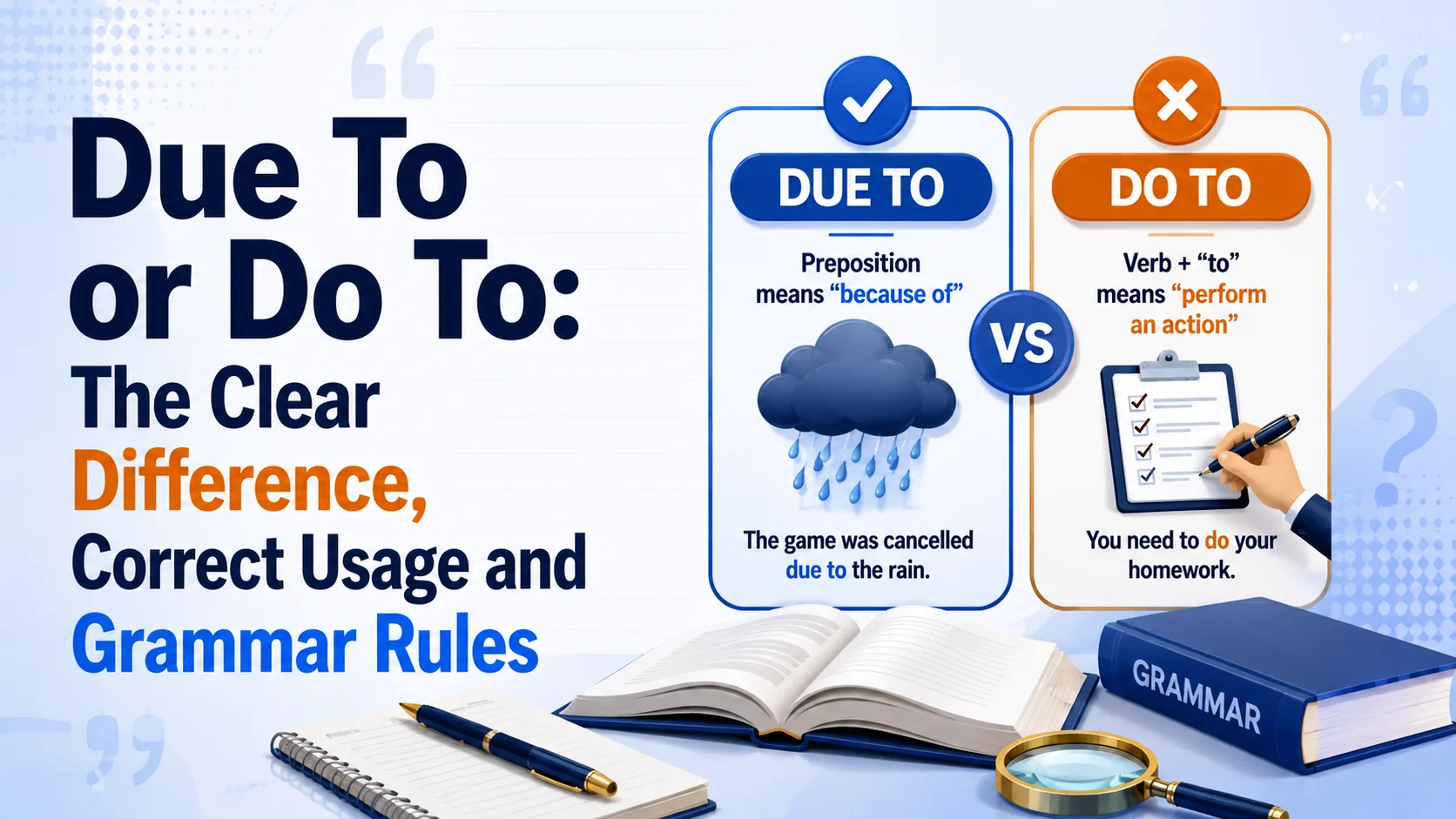
Due To or Do To: The Clear Difference, Correct Usage and Grammar Rules helps students avoid confusion in writing and improves grammar clarity.In my experience with writing, English grammar, and communication, I have often seen students, workers, and even professionals feel confused, facing paused mid-sentence wondering moments when dealing with due to, do to, grammar rules, clear difference, correct usage, and second-guessing their phrases. These words may look similar, sound similar, but carry completely different meanings, and using them incorrectly can feel awkward, incorrect, or plain wrong in everyday English, text writing, and academic writing.
From a practical approach, I often break down the meanings, give examples, and use memory tricks, tables, and even a mini quiz style to reduce confusion, improve writing skills, and strengthen English grammar. This helps with error correction, avoids grammar mistakes, and improves usage rules, language clarity, correctness, and better interpretation and understanding of sentence structure, phrase usage, and sentence usage in both formal writing and informal writing.
When looking deeper at difference explanation, verb, preposition, and structure, you understand how due to connect with caused by, while do to relates to perform action, someone, or something. This distinction improves writing accuracy, supports communication skills, and avoids common mistakes in written communication, text analysis, and sentence formation. It also strengthens linguistic rules, syntax, and semantics, which are essential for English usage, language learning, and overall writing improvement.
Quick Answer: Due To vs. Do To
Let’s start with the simplest explanation possible.
| Phrase | Meaning | Example |
| Due to | Because of | The game was canceled due to rain. |
| Do to | Perform an action toward something | What did you do to the car? |
That’s the core difference.
- Due to explain a reason or cause.
- Do to describe an action performed on someone or something.
One phrase deals with explanation. The other deals with action.
Simple. Yet surprisingly easy to mix up.
What Does “Due To” Mean?
The phrase “due to” means:
- Because of
- Caused by
- Resulting from
Writers use it to explain why something happened.
For example:
“The concert was canceled due to weather.”
In that sentence, weather caused the cancellation.
Think of “due to” as a bridge connecting an event to its cause.
Common Examples of “Due To”
| Sentence | Cause |
| School closed due to snow. | Snow |
| Flights changed due to storms. | Storms |
| Sales increased due to social media. | Social media |
| The delay happened due to traffic. | Traffic |
Notice the pattern?
Something happens. Then “due to” explains why.
What Does “Do To” Mean?
“Do to” works completely differently.
The word “do” acts as a verb. It describes an action. The word “to” connects that action to a person or object.
For example:
“What did you do to my laptop?”
That sentence asks about an action performed on the laptop.
Common Examples of “Do To”
| Sentence | Action |
| What did you do to the TV? | Someone affected the TV |
| Don’t do that to yourself. | Harmful action |
| Why would you do this to me? | Emotional action |
| What did the dog do to the couch? | Physical damage |
Unlike “due to,” this phrase has nothing to do with causes or explanations.
It’s all about actions.
The Main Difference Between Due To and Do To
Here’s the easiest way to remember it:
| Phrase | Purpose |
| Due to | Explains why something happened |
| Do to | Describes an action |
Think of it this way:
- Due to = reason
- Do to = action
That single missing letter changes the entire meaning of the sentence.
It’s like confusing “dessert” and “desert.” One gives you cake. The other gives you sand and regret.
Why People Constantly Confuse Due To and Do To
Several things cause this grammar mistake.
Similar Pronunciation
When people speak quickly, “due to” and “do to” sound almost identical.
That creates confusion during writing.
Autocorrect Problems
Spellcheck often ignores the mistake because both phrases exist.
For example:
❌ “The meeting was canceled do to weather.”
Technically, “do” is a real word. Your device may not flag it.
Fast Typing Habits
Modern communication rewards speed. People type quickly on phones, skim messages, and hit send before proofreading.
Grammar becomes collateral damage.
Weak Grammar Foundations
Many people never learned the grammatical difference clearly in school.
They rely on sound instead of sentence structure.
That’s where mistakes multiply.
What “Due To” Really Means in Grammar
Traditional grammar experts classify “due to” as an adjective phrase.
That sounds intimidating. However, the concept is simpler than it appears.
Historically, “due” meant:
- Owed
- Attributed
- Caused by
So when you say:
“The cancellation was due to rain.”
You’re essentially saying:
“The cancellation was caused by rain.”
That’s why many grammar experts recommend using the “caused by” test.
The “Caused By” Test
This trick works beautifully.
Replace “due to” with “caused by.”
If the sentence still makes sense, your usage is probably correct.
Example
✅ “The delay was due to traffic.”
Becomes:
✅ “The delay was caused by traffic.”
Still works perfectly.
Now look at this:
❌ “What did you due to the project?”
Becomes:
❌ “What did you caused by the project?”
Clearly wrong.
That quick substitution catches mistakes instantly.
When to Use “Due To” Correctly
Use “Due To” After Forms of “To Be”
Traditional grammar rules prefer “due to” after:
- Is
- Are
- Was
- Were
- Be
- Been
Examples:
| Correct Sentence | Why It Works |
| The issue was due to poor planning. | Follows “was” |
| The delay is due to weather. | Follows “is” |
| The cancellation was due to rain. | Proper structure |
This structure sounds natural and polished.
Use “Due To” to Explain Causes
This is the most common usage today.
Examples:
- Due to heavy traffic, we arrived late.
- The store closed early due to staffing shortages.
- Flights changed due to storms.
- The website crashed due to high demand.
In each sentence, “due to” introduces the reason something happened.
Use “Due To” in Professional Writing
Businesses love “due to.”
Why?
Because it sounds formal without sounding stiff.
You’ll see it constantly in:
- Workplace emails
- News reports
- Academic papers
- Customer support notices
- Corporate announcements
Common Workplace Examples
| Situation | Example |
| Business email | Meeting postponed due to illness |
| Airline notice | Delays due to weather |
| Customer service | Shipping delays due to demand |
| School announcement | Campus closed due to snow |
Professional environments prefer clarity. “Due to” delivers that clarity efficiently.
When “Due To” Sounds Awkward
Even correct grammar can sound clunky if overused.
That’s where good writing style matters.
Overusing “Due To”
Repeating the phrase constantly makes writing feel robotic.
Example:
“The event was canceled due to rain. Due to flooding, roads closed. Due to poor visibility, flights stopped.”
That repetition sounds stiff.
Instead, vary your wording.
Better Alternatives
| Instead of | Try |
| Due to the fact that | Because |
| Due to rain | Because of rain |
| Due to being late | Since they were late |
| Due to bad weather | Owing to bad weather |
Strong writing mixes sentence structures naturally.
Due To vs. Because Of
This comparison confuses many writers.
The truth? They often mean nearly the same thing.
Side-by-Side Examples
| Due To | Because Of |
| The game ended due to rain. | The game ended because of rain. |
| Flights changed due to storms. | Flights changed because of storms. |
| Sales grew due to social media. | Sales grew because of social media. |
Both versions work.
However, tone changes slightly.
Which Sounds More Natural?
Generally:
| Phrase | Tone |
| Due to | Formal |
| Because of | Conversational |
For example:
Formal
“The meeting was postponed due to technical issues.”
Casual
“The meeting got postponed because of tech problems.”
Neither is wrong. The context determines the better choice.
When “Do To” Is Correct
“Do to” appears less frequently than “due to,” yet it remains perfectly valid.
You simply use it when discussing actions.
Examples of Correct “Do To” Usage
| Sentence | Meaning |
| What did you do to my phone? | Action affected phone |
| Don’t do that to yourself. | Harmful action |
| What did the storm do to the house? | Damage caused |
| Why would you do this to me? | Emotional effect |
In every example, someone or something performs an action.
That’s the key.
Why “Do To” Appears Less Often
Most people encounter “due to” more frequently because explanations appear constantly in writing.
Meanwhile, “do to” usually appears in conversation.
That imbalance creates confusion.
Search engines also contribute to the problem. Millions of users accidentally search:
- “Do to meaning”
- “Do to grammar”
- “Do to vs due to”
Grammar confusion spreads quickly online.
Common Grammar Mistakes With Due To and Do To
Let’s examine the mistakes people make most often.
Mistake: Using “Do To” Instead of “Due To”
❌ Incorrect:
“School closed do to snow.”
✅ Correct:
“School closed due to snow.”
Why?
Because snow caused the closure.
Mistake: Using “Due To” Instead of “Do To”
❌ Incorrect:
“What did you due to the computer?”
✅ Correct:
“What did you do to the computer?”
Why?
Because someone performed an action.
Real Examples of Grammar Errors Online
You’ll spot these mistakes everywhere.
Social Media Examples
❌ “Late do to traffic.”
❌ “Cancelled do to rain.”
❌ “What did you due to your hair?”
These errors spread because users prioritize speed over proofreading.
Unfortunately, grammar mistakes can make otherwise smart writing look careless.
Why This Grammar Mistake Matters
Some people dismiss grammar entirely.
That’s a mistake.
Grammar affects perception.
Readers often judge professionalism based on writing quality within seconds.
Poor Grammar Can Hurt:
- Job applications
- Academic papers
- Business communication
- Marketing copy
- Social media credibility
Tiny errors create surprisingly large impressions.
Imagine showing up to a business meeting wearing mismatched shoes. The mistake may seem small, yet people notice instantly.
Grammar works similarly.
Easy Trick to Remember the Difference
Here’s the fastest memory hack.
“Due” = Reason
Think:
“Due to = caused by.”
If the sentence explains a cause, use “due.”
“Do” = Action
Think:
“Do to = perform an action.”
If someone does something, use “do.”
Memory Chart
| Phrase | Memory Trick |
| Due to | Due = reason |
| Do to | Do = action |
Simple memory devices often work better than complicated grammar rules.
Your brain likes shortcuts.
Real-Life Examples of Due To and Do To
Workplace Examples
| Sentence | Correct Phrase |
| The project stalled ___ budget cuts. | Due to |
| What did you ___ the presentation file? | Do to |
School Examples
| Sentence | Correct Phrase |
| School closed ___ snow. | Due to |
| Don’t ___ that ___ your grades. | Do to |
Relationship Examples
| Sentence | Correct Phrase |
| The breakup happened ___ communication problems. | Due to |
| Why would you ___ that ___ your partner? | Do to |
Funny Examples
Humor helps memory stick.
Compare these:
| Sentence | Meaning |
| My diet failed due to pizza. | Pizza caused failure |
| What did you do for the pizza? | Someone harmed the pizza |
Completely different meanings. Same pronunciation.
English loves chaos sometimes.
Why Native Speakers Still Make This Mistake
Even fluent English speakers confuse these phrases regularly.
Why?
Because spoken English blurs sounds together.
When someone says:
“Due to weather…”
It often sounds like:
“Doo tah weather…”
That pronunciation overlap causes spelling errors naturally.
Language isn’t always logical. If it were, silent letters would’ve disappeared centuries ago.
Looking at you, “knife.
How Professional Writers Avoid This Mistake
Professional editors rely on systems instead of memory alone.
Here’s Their Process
- Read sentences aloud
- Check whether the phrase explains a reason
- Replace “due to” with “caused by”
- Look for action verbs
Those tiny proofreading habits prevent embarrassing mistakes.
The Difference Between Formal and Informal Usage
Formal Writing
Professional writing often prefers:
- Due to
- Owing to
- As a result of
Example:
“The event was canceled due to severe weather.”
Informal Writing
Casual conversation often prefers:
- Because of
- Since
- Thanks to
Example:
“The event got canceled because of the storm.”
Both styles work. Context matters.
Case Study: How One Grammar Mistake Changed Perception
Imagine two job candidates sending emails.
Candidate One
“The delay happened do to traffic.”
Candidate Two
“The delay happened due to traffic.”
The second sentence instantly appears more polished.
Same meaning. Different perceptions.
That tiny detail subtly affects credibility.
Employers notice those things more than people realize.
Why “Due To” Dominates Search Engines
Search engines contain millions of searches for:
- Due to vs do to
- Difference between due to and do to
- Due to meaning
- Correct usage of due to
Why?
Because mistakes happen constantly.
Many users hear the phrase long before they learn its spelling.
The internet amplified that confusion dramatically.
The Evolution of “Due To” in Modern English
Grammar purists once argued that “due to” should appear only after forms of “to be.”
For example:
✅ “The delay was due to rain.”
They disliked constructions like:
“Due to rain, the game ended early.”
However, modern English evolved.
Today, both forms appear widely in:
- Journalism
- Business writing
- Academic work
- Everyday communication
Language changes over time. Strict grammar rules eventually soften when enough people use language differently.
That’s how English evolves. Slowly. Messily. Like a garage drawer full of tangled phone chargers.
Conclusion
Understanding the difference between due to and do to is essential for clear English grammar, stronger writing skills, and accurate communication. Many learners, including students, workers, and professionals, get confused because the phrases look and sound similar, but their meaning and usage rules are completely different. Once you learn the clear difference, use examples, and practice grammar rules, your sentence structure, clarity, and writing accuracy improve naturally. Over time, avoiding this common grammar mistake becomes automatic, helping you write with more confidence in both formal writing and informal writing.
FAQs
Q1. What is the difference between due to and do to?
Due to means caused by, while do to refers to performing an action on someone or something in English grammar.
Q2. Why do people get confused between due to and do to?
People get confused because both phrases look and sound similar, but they have completely different meanings and usage rules.
Q3. How can I remember the correct usage of due to?
A simple memory trick is: use due to causes and situations showing reason in sentence structure.
Q4. Is using do to a common grammar mistake?
Yes, using do to incorrectly is a frequent error in writing, especially in quick messages and informal communication.
Q5. How does learning this improve writing skills?
It improves clarity, correctness, and communication skills, helping you avoid confusion and write more accurately in everyday English