

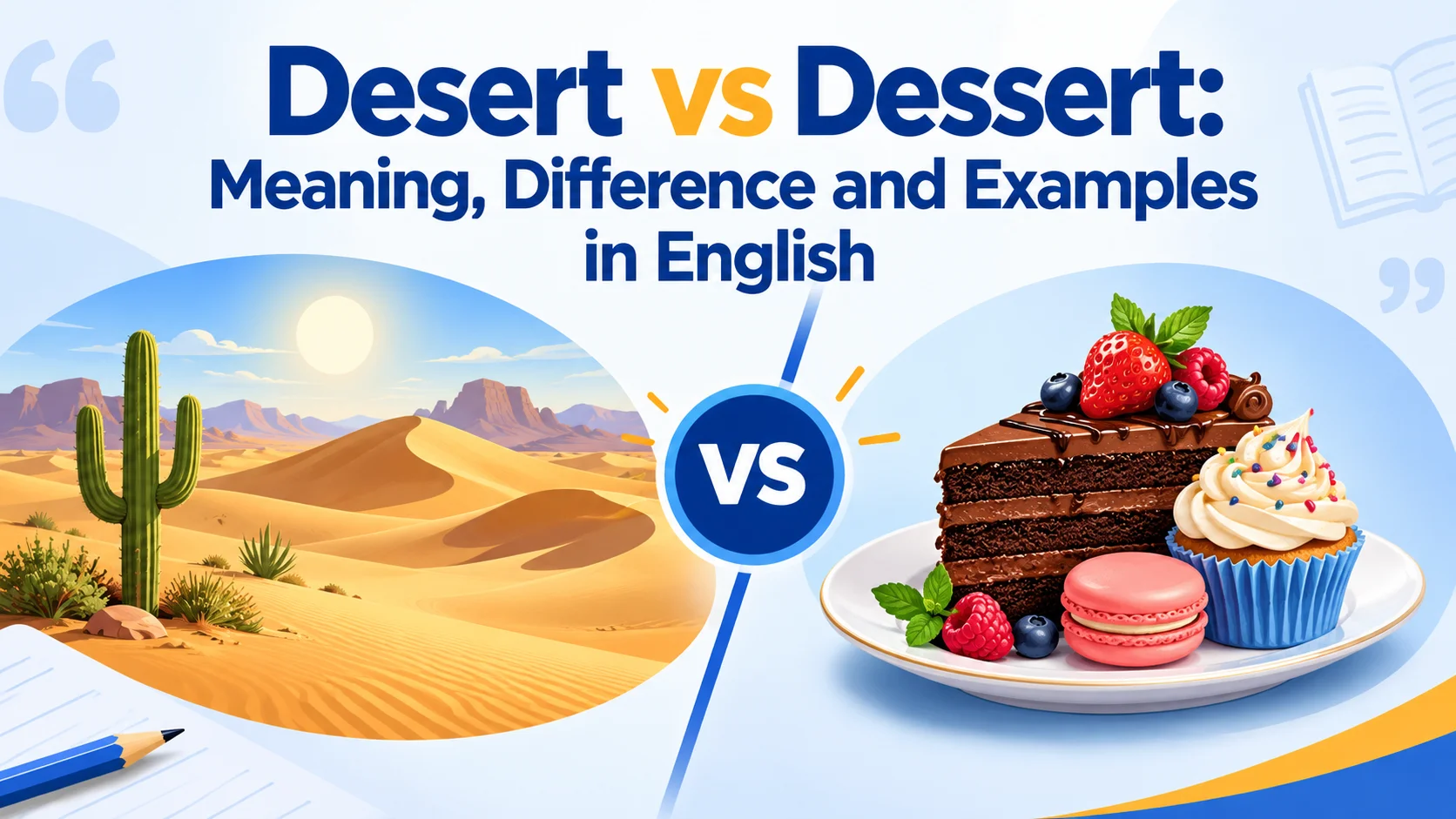
The desert vs dessert difference comes down to meaning, spelling, and pronunciation. A desert is usually a dry region with little precipitation, while a dessert is a sweet course served after a meal. However, there’s another meaning worth knowing: desert can also be a verb meaning to abandon someone or something. These words look almost identical, yet using the wrong one can change the meaning of your sentence completely.
The confusion is understandable. Both words contain similar letters, and their pronunciations overlap in certain contexts. If you’re writing an essay, preparing a restaurant menu, sending a message, or learning English vocabulary, knowing which spelling to choose will help you communicate more accurately. One extra S can make a surprising difference, especially when you’re writing about food or geography.
In this guide, you’ll discover the meaning of desert and dessert, their grammatical differences, pronunciation and stress patterns, and practical examples showing how each word works. You’ll also learn a simple spelling trick, understand expressions such as just deserts and food desert, and test your knowledge with a short quiz. By the end, you’ll have a reliable way to choose the correct word without second-guessing yourself.
Desert vs Dessert: What’s the Difference?
The main difference is that desert can refer to a dry geographical region or the act of abandoning someone or something, whereas dessert refers to sweet food typically served at the end of a meal.
Compare these sentences:
- We traveled across the desert during our vacation.
- We ate chocolate cake for dessert after dinner.
- A loyal friend would never desert you in a difficult situation.
The first sentence refers to a landscape, the second to food, and the third to abandoning someone.
Desert vs Dessert at a Glance
| Feature | Desert | Dessert |
| Main meaning | A dry geographical region | Sweet food served after a meal |
| Other meaning | To abandon someone or something | No common equivalent verb meaning |
| Part of speech | Noun or verb | Noun |
| Number of S’s | One | Two |
| Pronunciation | Depends on whether it’s a noun or verb | Stress on the second syllable |
| Example | The desert is beautiful at sunset. | We ordered dessert after dinner. |
| Memory clue | One S for a dry landscape | Two S’s because you may want seconds |
Quick rule: If you’re talking about a meal’s sweet course, write dessert. If you’re talking about a dry landscape or abandoning someone, write desert.
What Does Desert Mean?
The word desert has more than one meaning in English. It can describe a geographical environment, or it can describe the act of leaving a person, responsibility, or place behind.
Understanding the sentence’s context helps you identify which meaning applies.
Desert as a Noun: A Dry Region
A desert is a region that receives very little precipitation compared with the amount of water that could evaporate from it. Deserts can be hot or cold, and they don’t always consist of endless sand dunes.
For example, the Sahara is a famous hot desert, while Antarctica is classified as a polar desert because of its extremely low precipitation.
Here are some natural examples:
- The travelers crossed the desert before reaching the next town.
- Many desert plants have adaptations that help them conserve water.
- Temperatures can change dramatically in some desert environments.
- The Gobi is a cold desert in Asia.
Notice that the word refers to the environment, not simply to heat or sand. A dry, rocky landscape can be a desert even if it doesn’t look like the sandy scenes shown in movies.
Desert as a Verb: To Abandon
Desert can also be a verb meaning to abandon someone, leave a place, or give up a responsibility or cause.
This meaning often carries a negative tone because it suggests leaving when someone or something still depends on you.
Examples include:
- He refused to desert his friends when they needed help.
- The soldiers were warned not to desert their posts.
- She felt that her colleagues had deserted her during the difficult project.
- The village was gradually deserted as residents moved elsewhere.
In these sentences, desert has nothing to do with geography or food.
Pay attention to the grammar, too. The verb changes according to tense:
- Present: desert
- Third-person singular: deserts
- Past tense: deserted
- Present participle: deserting
For example, “He deserted his team last year” describes an action in the past, while “He is deserting his responsibilities” describes an ongoing action.
What Does “Just Deserts” Mean?
The expression just deserts means the consequences, treatment, or rewards that someone deserves.
For example:
- After years of dishonest behavior, he finally got his just deserts.
- The judge believed the punishment was the defendant’s just deserts.
- She received her just deserts after her hard work was recognized.
The spelling often surprises people because the phrase sounds as though it should refer to sweet treats. However, just deserts uses the noun related to what someone deserves, not the geographical meaning of desert and not the food meaning of dessert.
This is an established English expression, so it’s best to learn it as a complete phrase.
What Does Dessert Mean?
Dessert is a noun for the sweet course commonly served at the end of a meal. It can include cakes, pastries, ice cream, puddings, fruit-based dishes, and many traditional sweets.
For example:
- We had strawberry cheesecake for dessert.
- Would you like to see the dessert menu?
- My grandmother makes a delicious rice pudding for dessert.
- Fresh fruit was served as a light dessert after lunch.
Dessert doesn’t have to be elaborate or particularly sugary. A simple bowl of fruit can serve as dessert, depending on the meal and the person’s preferences.
Common Types of Dessert
Desserts vary across cultures, so the word covers a broad range of foods.
- Cakes and pastries: Cheesecake, chocolate cake, apple pie, and croissants served as part of a sweet course.
- Frozen desserts: Ice cream, sorbet, and other frozen treats.
- Puddings and custards: Rice pudding, crème brûlée, and similar dishes.
- Fruit-based desserts: Fruit salad, baked apples, and berry tarts.
- Traditional sweets: Gulab jamun, kheer, baklava, and many other regional specialties.
The common feature is their role as a sweet course or dish, not a particular ingredient or cooking method.
Common Expressions With Dessert
You’ll often see dessert used in phrases related to food, dining, and recipes.
| Expression | Meaning | Example |
| Dessert menu | A list of available desserts | The waiter brought us the dessert menu. |
| Dessert recipe | Instructions for preparing a sweet dish | I found a simple dessert recipe online. |
| Dessert spoon | A spoon designed for eating dessert | She set a dessert spoon beside each plate. |
| Chocolate dessert | A sweet dish featuring chocolate | He prepared a chocolate dessert for the guests. |
| Serve dessert | Present the sweet course | We’ll serve dessert after the main course. |
In standard English, dessert is generally a noun. You can use it in singular or plural form, depending on what you mean.
- Singular: We ordered one dessert.
- Plural: We ordered three desserts.
- General course: We had dessert after dinner.
Why Are Desert and Dessert So Often Confused?
These words are easy to mix up because their spelling differs by only one letter, and their meanings aren’t related in the way their appearance might suggest.
There are three main reasons for the confusion.
The Words Look Almost Identical
Compare the spellings:
- D E S E R T — desert
- D E S S E R T — dessert
The difference is the extra S in dessert. When you’re typing quickly, it’s easy to leave out the second S or add one where it doesn’t belong.
Autocorrect may catch some mistakes, but it won’t always identify a wrong word when both spellings are valid. For example, “We ate desert after dinner” is grammatically recognizable, but it communicates the wrong word.
Their Pronunciations Depend on Stress
The geographical noun desert and the verb desert have different stress patterns. Meanwhile, dessert shares its second-syllable stress with the verb.
This means you can’t reliably identify every form by looking at the letters alone. You need to understand the word’s meaning and how it’s used.
Their Meanings Require Different Contexts
The surrounding words usually provide a useful clue.
- Words such as sand, dunes, rainfall, and climate may point to the geographical noun.
- Words such as abandon, responsibility, friend, and post may point to the verb.
- Words such as cake, ice cream, menu, and dinner may point to dessert.
The most reliable approach is to connect the spelling with the meaning rather than memorizing the letters in isolation.
Desert vs Dessert Pronunciation: How to Say Each Word
Pronunciation makes the difference between these words particularly interesting. English uses word stress to distinguish certain words that have identical or similar spellings.
How to Pronounce Desert as a Noun
When desert means a dry region, the stress falls on the first syllable.
Pronunciation guide: DEZ-ert
Example:
“The DEZ-ert stretches for miles.”
The first syllable receives the emphasis, while the second is shorter and less prominent.
How to Pronounce Desert as a Verb
When desert means to abandon, the stress shifts to the second syllable.
Pronunciation guide: de-ZERT
Example:
“They must not de-ZERT their responsibilities.”
This change in stress is an important feature of English word pronunciation. The noun and verb have the same spelling but different spoken forms.
How to Pronounce Dessert
The word dessert also stresses the second syllable.
Pronunciation guide: de-ZERT
Example:
“We ordered de-ZERT after dinner.”
The verb desert and the food word dessert are therefore pronounced alike in standard English, even though their meanings differ.
Pronunciation Comparison Table
| Word | Meaning | Stress pattern | Approximate pronunciation |
| Desert (noun) | Dry region | First syllable | DEZ-ert |
| Desert (verb) | To abandon | Second syllable | de-ZERT |
| Dessert (noun) | Sweet course | Second syllable | de-ZERT |
Regional accents can affect vowel sounds, but the stress distinction between the geographical noun and the other two forms remains a useful general guide.
Desert vs Dessert in Sentences: Examples You Can Learn From
Examples help you see how the words work in real sentences. The following examples cover everyday writing, schoolwork, conversations, and more formal contexts.
Examples Using Desert as a Noun
- The desert became cooler after sunset.
- We studied the plants and animals that survive in the desert.
- The explorers carried extra water during their journey through the desert.
- A sudden rainstorm changed the appearance of the desert landscape.
- The film featured a dramatic chase across a rocky desert.
In every example, desert names a geographical environment.
Examples Using Desert as a Verb
- I would never desert a friend who needed my help.
- The captain refused to desert the ship.
- Several families deserted the area after the flood.
- He was accused of deserting his responsibilities.
- She worried that everyone would desert her when the project became difficult.
Here, desert describes leaving, abandoning, or withdrawing from someone or something.
Examples Using Dessert
- We shared a slice of chocolate cake for dessert.
- The restaurant offers a separate dessert menu.
- My favorite dessert is mango ice cream.
- She brought two desserts to the family gathering.
- Would you prefer fruit or cake for dessert?
Each sentence refers to sweet food or a sweet course.
Desert vs Dessert: Side-by-Side Sentence Contrasts
| Sentence | Correct word | Why it is correct |
| We explored the ___ during our trip. | Desert | It refers to a geographical region. |
| We ate ice cream for ___. | Dessert | It refers to sweet food. |
| He would never ___ his family. | Desert | It means abandon. |
| The restaurant serves three different ___. | Desserts | It refers to multiple sweet dishes. |
| She received her just ___. | Deserts | It is part of the established expression. |
| The ___ climate is extremely dry. | Desert | It describes a geographical environment. |
Notice how the meaning of the complete sentence determines the spelling. You don’t need to rely on the sentence’s length or complexity.
When to Use Desert or Dessert: A Simple Decision Guide
If you’re unsure which spelling to choose, identify what you’re trying to communicate before writing the word.
Use Desert When You’re Talking About a Landscape
Choose desert when the sentence refers to a dry geographical region.
Clues include:
- Sand or dunes
- Dry climate or low rainfall
- Desert animals and plants
- A journey across a region
- A particular desert’s location or environment
Example: “The researchers measured rainfall in the desert.”
Use Desert When You’re Talking About Abandonment
Choose desert when someone leaves a person, responsibility, post, or cause behind.
Clues include:
- Leaving a friend without support
- Abandoning a duty
- Leaving a military post without authorization
- Withdrawing from a commitment
Example: “She refused to desert her teammates.”
Use Dessert When You’re Talking About Food
Choose dessert when you’re referring to a sweet dish or the final course of a meal.
Clues include:
- Cake, pudding, or ice cream
- Restaurant menus
- Dessert recipes
- Serving sweets after a meal
- Choosing between sweet dishes
Example: “We saved room for dessert.”
A Three-Question Spelling Check
Ask yourself these questions before choosing the word:
- Am I describing a dry region? Use desert.
- Am I describing someone abandoning a person, place, or responsibility? Use desert.
- Am I referring to a sweet dish or course? Use dessert.
If none of these meanings fits, reread the sentence and check whether you’re using a fixed expression, such as just deserts.
Desert vs Dessert in Grammar
The two spellings also differ in their grammatical roles. Understanding these roles can help you catch mistakes when proofreading.
Parts of Speech
Desert can function as a noun or a verb.
- Noun: “The desert was quiet.”
- Verb: “They chose to desert the project.”
Dessert is generally used as a noun.
– Noun: “The dessert was delicious.”
You can use a noun as a subject or object, while a verb expresses an action or state. Identifying the role a word plays in a sentence can help you select the correct form.
Singular and Plural Forms
Both words can take a regular plural ending when used as countable nouns.
| Singular | Plural | Example |
| Desert | Deserts | The country has several different deserts. |
| Dessert | Desserts | We prepared two desserts for the party. |
The verb desert follows regular conjugation patterns: deserts, deserted, and deserting.
Remember that the plural deserts can also appear in the expression just deserts. Its meaning depends on the context, not just the spelling.
Is Dessert Countable or Uncountable?
Dessert can be used as a countable noun when you mean individual dishes or varieties.
- “We ordered two desserts.”
- “The café offers several desserts.”
It can also refer more generally to the sweet course.
- “Dessert will be served shortly.”
- “We had dessert after dinner.”
In the second set, the word refers to the course as a whole rather than a count of separate dishes.
Common Expressions and Tricky Cases
Some phrases are especially useful to learn because they don’t follow the meaning you might expect from the individual words.
“Just Deserts” or “Just Desserts”: Which Is Correct?
The established expression is just deserts.
It means receiving what you deserve, whether the outcome is a reward or a punishment.
Correct: “After years of cheating customers, he finally got his just deserts.”
Incorrect in the established expression: “He finally got his just desserts.”
The second version is a common spelling error caused by the familiar food-related word dessert. When using the idiom, remember that deserts is the correct form.
What Does “Food Desert” Mean?
A food desert is an area where residents face limited access to affordable, nutritious food. The term is associated with food availability and access, not with sweet dishes.
For example:
“The community organization is working to improve access to fresh produce in the local food desert.”
The phrase uses desert because it describes an area characterized by a shortage of accessible food options. It doesn’t mean an area where people lack desserts.
The term’s exact definition can vary across research and policy contexts, particularly in how access and affordability are measured.
Can Desert and Dessert Ever Be Interchanged?
In standard English, the two spellings are not interchangeable when you want to preserve their intended meanings.
Consider these examples:
- Incorrect: “We ordered chocolate desert.”
- Correct: “We ordered chocolate dessert.”
- Incorrect: “The travelers crossed the dessert.”
- Correct: “The travelers crossed the desert.”
- Incorrect: “He would never dessert his friends.”
- Correct: “He would never desert his friends.”
A spelling checker may catch these mistakes, but context-aware proofreading is more reliable because both words are legitimate English words.
Common Mistakes to Avoid
Using Desert When You Mean Dessert
This mistake often occurs in restaurant reviews, invitations, recipes, and informal messages.
Incorrect: “My favorite desert is cheesecake.”
Correct: “My favorite dessert is cheesecake.”
Remember: Two S’s for seconds.
Using Dessert When You Mean a Dry Region
Incorrect: “The camels traveled through the dessert.”
Correct: “The camels traveled through the desert.”
The presence of geographical clues, such as camels, dunes, or dry conditions, makes the intended word clear.
Pronouncing Every Form of Desert the Same Way
The noun desert and the verb desert have different stress patterns. If you’re learning spoken English, practice them in complete sentences rather than memorizing isolated spellings.
- “The DEZ-ert is vast.”
- “They must not de-ZERT their post.”
- “We ordered de-ZERT.”
The final example uses dessert, which shares its stress pattern with the verb.
Misspelling “Just Deserts”
Because dessert is much more familiar in everyday food-related contexts, writers sometimes substitute it into the idiom.
Incorrect: “She got her just desserts.”
Correct: “She got her just deserts.”
The easiest solution is to learn just deserts as a fixed expression.
Desert vs Dessert: Practice Quiz
Choose the correct word to complete each sentence. Pay attention to meaning and grammar.
- We ordered cheesecake for ______.
- The Sahara is a famous ______.
- A good friend won’t ______ you when you need support.
- The restaurant offers several homemade ______.
- The travelers prepared for a cold night in the ______.
- He finally got his just ______.
- The soldiers were ordered not to ______ their posts.
- Would you like to see the ______ menu?
Answers and Explanations
- Dessert — Cheesecake is a sweet dish.
- Desert — The Sahara is a geographical region.
- Desert — The verb means to abandon someone.
- Desserts — The plural refers to multiple sweet dishes.
- Desert — The sentence describes a landscape.
- Deserts — The correct expression is just deserts.
- Desert — The verb refers to abandoning a post.
- Dessert — A dessert menu lists sweet dishes.
If you answered all eight correctly, you’ve understood the main distinctions. If you missed a question, focus on what the sentence means before deciding which spelling looks right.
Conclusion
The difference between desert vs dessert becomes straightforward once you connect each spelling to its meaning. A desert is a dry geographical region or, as a verb, the act of abandoning someone or something. A dessert is the sweet course you enjoy after a meal. Their pronunciation also differs in an important way: the geographical noun stresses the first syllable, while the verb and food-related noun stress the second. One final actionable tip: When proofreading, identify what your sentence describes before checking the spelling. If it concerns cake, ice cream, or another sweet dish, use dessert. If it concerns a dry landscape or abandonment, use desert. A common mistake to avoid is writing just desserts instead of just deserts. Remember the meanings, practice with complete sentences, and these similar-looking words will become much easier to use correctly.
Frequently Asked Questions
Q1. What is the main difference between desert and dessert?
Desert refers to a dry geographical region or the act of abandoning someone or something. Dessert means a sweet dish or course typically served after a meal. The extra S in dessert is a helpful spelling clue when writing about food.
Q2. Why does dessert have two S’s?
The spelling contains two S’s, but the popular memory trick “dessert has two S’s because you may want seconds” is simply a learning aid. It isn’t the historical origin of the word. Use the trick to remember the spelling when writing menus, recipes, and everyday messages.
Q3. Is it “just deserts” or “just desserts”?
The established expression is just deserts. It means receiving the consequences or rewards one deserves. Although desserts is the familiar spelling for sweet dishes, it isn’t the correct spelling in this idiom. Learning the complete phrase helps prevent this common mistake.
Q4. Are desert and dessert pronounced the same way?
The noun desert, meaning a dry region, stresses the first syllable. The verb desert, meaning to abandon, stresses the second syllable. Dessert also stresses the second syllable, so the verb and food-related noun sound alike in standard English.
Q5. What is the plural of desert and dessert?
The plural of desert is deserts, while the plural of dessert is desserts. For example, “The region contains several deserts” refers to landscapes, while “We ordered two desserts” refers to sweet dishes. Context helps distinguish the words when speaking.