

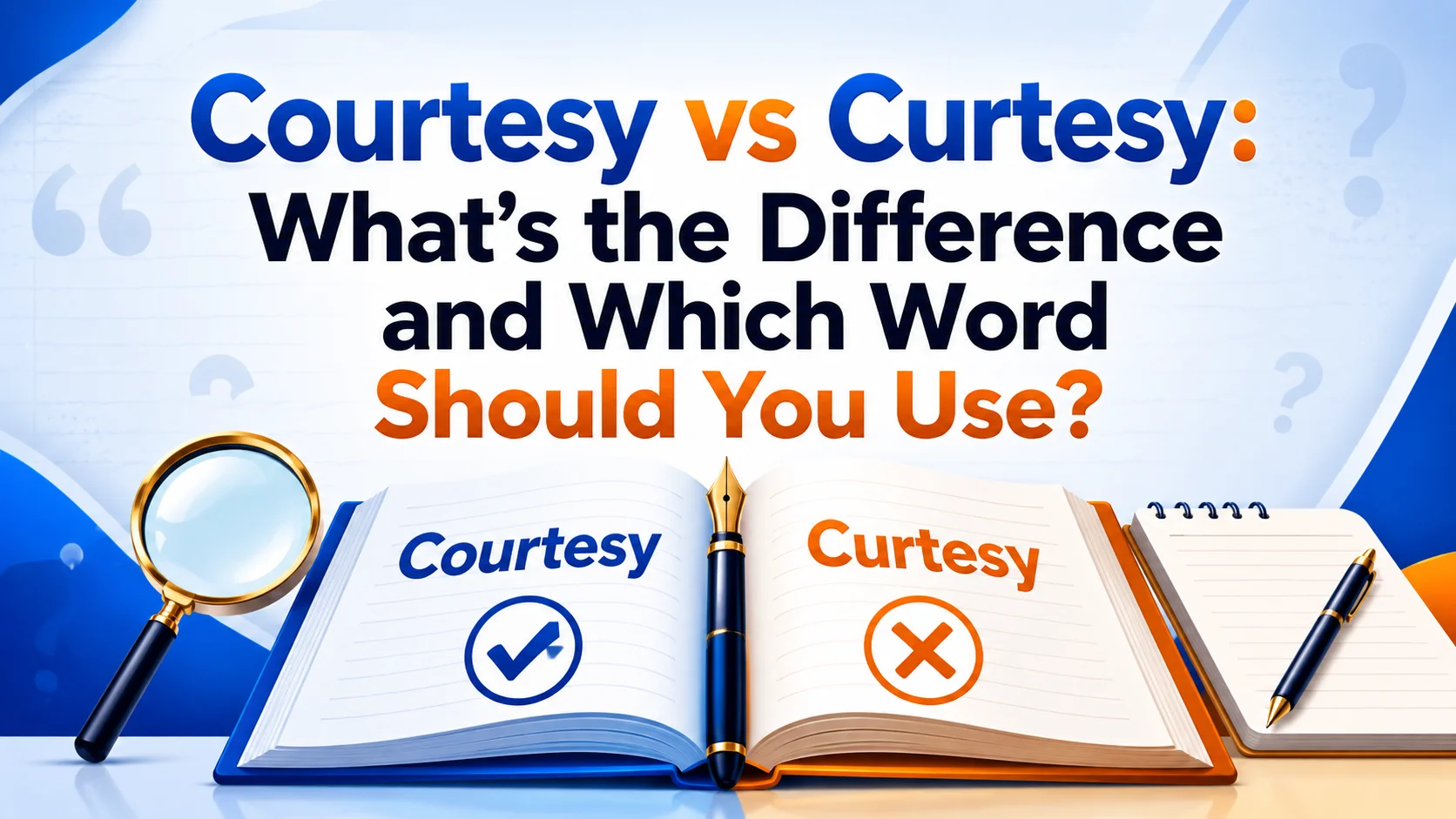
Courtesy vs Curtesy: What’s the Difference and Which Word Should You Use? Many people feel confused while typing these two words in emails, essays, and professional writing. I once spotted curtesy in a client email during proofreading, and even that small spelling mistake changed the tone of the message. In modern English, courtesy is the proper term connected with politeness, respect, consideration, social etiquette, and clear communication. Since both words have similar pronunciation and sound exactly the same, many students, beginners, and English learners struggle with spelling confusion and language confusion in everyday writing.
The word curtesy comes from old English law, legal terminology, and property rights related to a husband’s right over a deceased wife’s property. Today, this historical term is rarely used outside historical English or legal history discussions. In real-life communication context, using the wrong word may create misunderstandings, lead to embarrassing mistakes, and affect your professional appearance in formal messages, blog posts, or business communication. Strong communication skills, grammar learning, and writing skills help writers understand the difference between correct usage and incorrect usage.
To improve language understanding, focus on proper spelling, usage rules, semantic meaning, contextual meaning, and regular word comparison practice. I usually recommend reading practice, spelling practice, vocabulary building, and writing improvement because they build writing confidence, communication clarity, and language accuracy over time. Small acts of courtesy like saying please, thank-you, holding the door, and offering help also reflect respectful interaction, considerate behavior, and strong communication effectiveness in daily communication and social interaction.
Courtesy vs Curtesy: Quick Difference at a Glance
Before diving deeper, here’s the short answer.
| Word | Meaning | Modern Usage | Common Context |
| Courtesy | Politeness, respectful behavior, good manners | Very common | Everyday English |
| Curtesy | Historical inheritance right under common law | Extremely rare | Legal history |
The Simple Rule
If you’re talking about:
- manners
- professionalism
- kindness
- respectful behavior
- etiquette
…the correct word is courtesy.
What Does Courtesy Mean?
The word courtesy refers to polite behavior and respectful treatment toward others.
In simple terms, courtesy means:
treating people with consideration, respect, and good manners.
You use courtesy every day even if you don’t notice it.
Examples include:
- saying thank you
- holding a door open
- replying politely
- respecting someone’s time
- speaking professionally
Courtesy smooths social interaction like oil in an engine. Without it, communication gets rough fast.
The Origin of the Word Courtesy
The word comes from:
- Old French: courtoisie
- Latin roots connected to royal courts
Originally, courtesy described the refined behavior expected among nobles and royal court members. Over time, the meaning expanded into everyday politeness and social etiquette.
That historical background explains why the word still carries a slightly formal tone today.
Why Courtesy Still Matters Today
Some people treat politeness like an outdated custom. However, courtesy still shapes:
- first impressions
- customer relationships
- workplace communication
- leadership quality
- professional reputation
A courteous person often appears:
- more trustworthy
- more competent
- easier to work with
That matters in both personal and professional life.
Common Uses of Courtesy in Everyday English
You’ll encounter “courtesy” constantly in modern communication.
Courtesy in Daily Conversation
Examples include:
- “Thank you for your courtesy.”
- “He treated everyone with courtesy.”
- “Basic common courtesy still matters.”
These phrases sound natural because courtesy belongs in modern English.
Courtesy in Business Communication
Professional environments use the word frequently.
Common examples:
- courtesy reminder
- courtesy email
- courtesy notice
- courtesy call
Example
“This email serves as a courtesy reminder about tomorrow’s meeting.”
That sentence sounds professional without sounding stiff.
Courtesy in Hospitality and Customer Service
Hotels, airlines, and restaurants use courtesy-related services constantly.
Examples include:
- courtesy shuttle
- courtesy upgrade
- courtesy transportation
- courtesy breakfast
These gestures improve customer satisfaction and brand loyalty.
How to Use Courtesy Correctly in a Sentence
Understanding sentence structure helps eliminate confusion quickly.
Courtesy as a Noun
Most commonly, “courtesy” functions as a noun.
Correct Examples
- “She thanked him for his courtesy.”
- “Courtesy costs nothing.”
- “They handled the issue with professionalism and courtesy.”
Common Phrases With Courtesy
Several expressions appear regularly in English.
| Phrase | Meaning |
| Courtesy of | Giving credit or attribution |
| Common courtesy | Basic manners |
| Courtesy call | Polite follow-up communication |
| Courtesy copy | Additional email recipient |
Examples of Courtesy in Sentences
Casual Examples
- “Out of courtesy, she arrived early.”
- “He apologized as a courtesy.”
Professional Examples
- “Please accept this as a courtesy notification.”
- “The company issued a courtesy refund.”
Customer Service Examples
- “Guests receive a complimentary courtesy shuttle.”
- “The receptionist treated every visitor with courtesy.”
What Does Curtesy Mean?
Now things take a historical turn.
Unlike courtesy, curtesy is not a modern politeness word.
It’s a legal term from old English common law.
Definition of Curtesy
Curtesy refers to:
a historical legal right allowing a husband to inherit or use his deceased wife’s property under specific conditions.
Most modern readers never encounter this word outside legal history discussions.
Understanding Tenancy by the Curtesy
The most common historical phrase involving the word is:
tenancy by the curtesy
Under old common law:
- a husband could gain rights to his wife’s property after her death
- especially if the couple had children together
This legal system reflected older inheritance structures that modern laws eventually replaced.
Why Curtesy Is Rare Today
Modern inheritance laws made curtesy mostly obsolete.
Today, the word appears mainly in:
- legal archives
- historical writing
- academic research
- old property law discussions
That’s why most uses of “curtesy” online are spelling mistakes rather than intentional usage.
How to Use Curtesy Correctly in a Sentence
Because the word is rare, context matters enormously.
Correct Legal Examples
- “The estate passed through tenancy by the curtesy.”
- “Curtesy rights existed under old English law.”
- “The historian explained curtesy inheritance laws.”
Incorrect Everyday Examples
These examples are wrong:
- “Thank you for your curtesy.”
- “We appreciate your curtesy.”
- “Basic curtesy matters.”
In these cases, the correct word is “courtesy.”
Courtesy vs Curtesy: The Key Differences
Although the words sound similar, their meanings differ completely.
| Feature | Courtesy | Curtesy |
| Meaning | Politeness and respect | Historical inheritance right |
| Modern Usage | Extremely common | Extremely rare |
| Context | Everyday communication | Legal history |
| Professional Usage | Yes | Almost never |
| Common Confusion | Frequently misspelled | Often mistaken for courtesy |
Why People Confuse Courtesy and Curtesy
English spelling creates plenty of traps. This pair catches people constantly.
Similar Pronunciation
Both words sound almost identical in casual speech.
That phonetic similarity causes many people to spell the word incorrectly based on sound alone.
Typing and Autocorrect Mistakes
Fast typing causes letter swaps frequently.
Examples:
- definitely → definately
- separate → seperate
- courtesy → curtesy
Small spelling errors happen surprisingly often during quick typing.
Confusion With Similar Words
Several similar-looking words increase the confusion:
- courteous
- courtesy
- curtsey
- curtsy
- curtesy
English sometimes feels like it enjoys making things harder than necessary.
Courtesy vs Curtsey vs Curtsy
Things become even more confusing once “curtsey” enters the conversation.
What Is a Curtsey?
A curtsey is:
a formal bow traditionally performed by women or girls.
You’ll often see curtseys in:
- royal ceremonies
- historical dramas
- ballet performances
Curtsey vs Curtsy
Both spellings exist:
- curtsey
- curtsy
“Curtsy” appears more commonly in modern American English.
Quick Comparison Table
| Word | Meaning |
| Courtesy | Respectful behavior |
| Curtesy | Historical legal term |
| Curtsey/Curtsy | Formal bow gesture |
Common Mistakes Writers Make
Even experienced writers sometimes confuse these words.
Using Curtesy Instead of Courtesy
This mistake appears constantly online.
Unfortunately, spelling errors weaken credibility quickly in:
- resumes
- business emails
- blog posts
- professional communication
Assuming Curtesy Is a Modern Spelling Variant
It isn’t.
“Curtesy” is a separate legal term entirely.
That distinction matters.
Using Courtesy as a Verb
Incorrect
“She courtesied the guests.”
Correct
“She treated the guests with courtesy.”
“Courtesy” works naturally as a noun, not usually as a verb.
Confusing Courtesy With Respect
The meanings overlap slightly but differ in important ways.
| Word | Meaning |
| Courtesy | Polite behavior |
| Respect | Admiration or esteem |
You can show courtesy even when you don’t deeply respect someone personally.
Easy Tricks to Remember the Difference
Memory shortcuts make spelling easier.
Courtesy = Courteous
Both words share the same spelling root:
- courteous
- courtesy
That connection helps reinforce the correct spelling.
Curtesy = Court Law
Think:
- curtesy
- court
- legal systems
That association helps separate it from everyday politeness.
Curtsey = Curved Bow
Picture someone bending during a formal bow.
Visual memory works surprisingly well.
Real-World Examples of Courtesy in Different Contexts
Workplace Communication
- courtesy reminder
- courtesy notice
- courtesy follow-up
Professional environments rely heavily on polite communication.
Customer Service
Businesses often offer:
- courtesy refunds
- courtesy transportation
- courtesy upgrades
These gestures help maintain customer trust.
Academic and Historical Writing
This is where “curtesy” occasionally appears correctly.
Example:
“The article examined tenancy by the curtesy under English common law.”
Outside legal history, the word remains extremely rare.
Quick Grammar Checklist for Courtesy vs Curtesy
| Rule | Correct? |
| Use “courtesy” for politeness | ✅ |
| Use “curtesy” in customer emails | ❌ |
| Use “curtesy” in legal history | ✅ |
| Use “courtesy” as a noun | ✅ |
| Use “courtesy” as a verb | Usually ❌ |
Practice Exercises
Fill in the Blank
Example 1
“Thank you for your ______ during the meeting.”
Answer:
courtesy
Example 2
“The property transferred under tenancy by the ______.”
Answer:
curtesy
Example 3
“Basic ______ still matters in professional settings.”
Answer:
Courtesy
Conclusion
Choosing between courtesy and curtesy may look like a minor issue, but it can greatly affect clear communication and professional writing. In modern English, courtesy is the widely accepted and proper term connected with politeness, respect, consideration, and social etiquette. Meanwhile, curtesy belongs to historical English, legal terminology, and old English law, making it an outdated spelling that is rarely used today. Understanding the difference, improving spelling practice, and focusing on language accuracy can help you avoid embarrassing mistakes in emails, essays, blog posts, and formal messages. With regular reading practice, writing improvement, and better communication skills, using the right word becomes much easier and more natural.
FAQs
Q1. What is the main difference between courtesy and curtesy?
Courtesy is the correct and commonly used word in modern English that represents politeness, respect, and consideration. Curtesy is an outdated term connected to legal history and property rights from old English law.
Q2. Why do people confuse courtesy and curtesy?
Many people, students, and English learners face spelling confusion because both words have similar pronunciation and sound exactly the same in conversation and everyday writing.
Q3. Is curtesy still used in professional writing today?
No, curtesy is rarely used in professional communication, formal writing, or business emails today. Most writers use courtesy because it is the proper spelling in modern English.
Q4. How can I remember the correct spelling of courtesy?
You can improve writing confidence through spelling practice, reading practice, vocabulary building, and understanding the semantic meaning and contextual meaning of the word in real-life communication context.
Q5. Why is using the correct word important in communication?
Using the correct word improves communication clarity, supports professional appearance, and prevents misunderstandings or embarrassing mistakes in emails, essays, blog posts, and formal messages.